Within Flexible Compute
Can an AI Cluster Cut Power Without Going Offline?
A 256-GPU cluster cut power by about 25% for three hours while maintaining contracted computing performance.
On this page
- How the Phoenix trial controlled power use
- What the 25% reduction did and did not prove
- Why graceful slowdown differs from shutting down
Page outline Jump by section
Introduction
The Phoenix GPU trial is one of the first real-world demonstrations that a commercial AI data centre can behave like a demand-response resource without shutting down or installing large batteries. In the field test, a 256-GPU cluster at a hyperscale cloud facility in Phoenix, Arizona reduced its electricity consumption by around 25% for three hours during periods of grid stress while continuing to meet agreed computing performance targets. Rather than proving that AI data centres no longer need substantial electricity, the experiment showed something more specific: carefully managed software can make part of an AI facility’s demand temporarily flexible. That distinction matters because flexibility, not simply lower energy use, is what electricity grids need during short periods of exceptionally high demand.[nature.com]nature.comA I data centres as grid-interactive assets | Nature EnergyAI data centres as grid-interactive assets | Nature EnergyDecember 5, 2025…
Within the wider discussion of flexible data centres as grid-balancing tools, the Phoenix trial is important because it moves the idea from computer simulations into commercial operation. It provides evidence that at least some AI workloads can respond to grid conditions without interrupting customers or taking servers offline.[nature.com]nature.comA I data centres as grid-interactive assets | Nature EnergyAI data centres as grid-interactive assets | Nature EnergyDecember 5, 2025…
How the Phoenix trial controlled power use
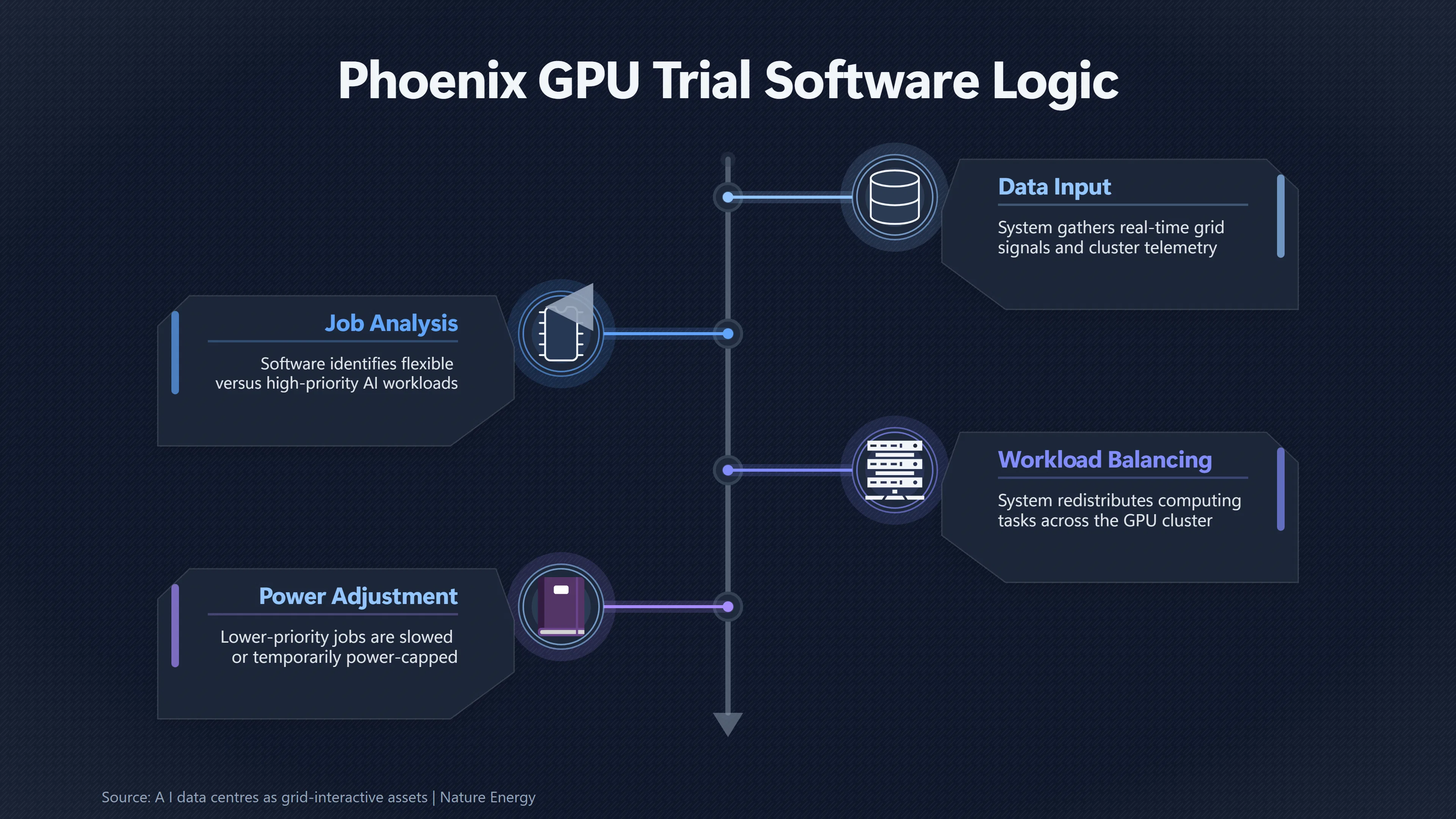
The central innovation was not new electrical hardware but workload orchestration software. The control platform continuously combined three kinds of information:
- real-time signals from the electricity grid indicating when demand reduction was valuable;
- telemetry showing the current power use and state of the GPU cluster; and
- information about individual AI jobs, including which workloads were flexible and which required uninterrupted performance.
Using these inputs, the software decided how to redistribute computing work across the cluster while respecting quality-of-service commitments. Some lower-priority jobs were slowed, delayed or temporarily power-capped. High-priority workloads continued to receive the resources they required.[nature.com]nature.comA I data centres as grid-interactive assets | Nature EnergyAI data centres as grid-interactive assets | Nature EnergyDecember 5, 2025…
Importantly, the trial did not rely on diesel generators, battery storage or switching off racks of servers. Instead, it adjusted how existing GPUs were used. This makes the approach potentially easier to deploy because it depends primarily on software and operational policies rather than expensive physical retrofits.[nature.com]nature.comA I data centres as grid-interactive assets | Nature EnergyAI data centres as grid-interactive assets | Nature EnergyDecember 5, 2025…
What the 25% reduction did—and did not—prove
The headline result was straightforward: the 256-GPU cluster sustained approximately a 25% reduction in electrical demand for three hours while maintaining contracted service quality for representative AI workloads. The reduction was achieved during genuine grid-demand events rather than under purely laboratory conditions.[nature.com]nature.comA I data centres as grid-interactive assets | Nature EnergyAI data centres as grid-interactive assets | Nature EnergyDecember 5, 2025…
That result demonstrates several things.
Large AI facilities are not necessarily fixed loads. Traditional grid planning often assumes a major data centre consumes nearly constant power once connected. The Phoenix demonstration showed that at least part of this demand can be adjusted when the electricity system needs relief.[nature.com]nature.comA I data centres as grid-interactive assets | Nature EnergyAI data centres as grid-interactive assets | Nature EnergyDecember 5, 2025…
Software can provide flexibility without reducing every service equally. Instead of applying uniform throttling, the system allocated reductions according to workload priorities, allowing more valuable or time-sensitive computing to continue with minimal disruption.[NVIDIA Blog]blogs.nvidia.comBlog How AI Factories Can Help Relieve Grid Stress | NVIDIA BlogNVIDIA BlogHow AI Factories Can Help Relieve Grid Stress | NVIDIA Blog…
Demand response can last longer than a brief emergency event. Many industrial demand-response programmes operate for relatively short intervals. Maintaining a meaningful reduction for around three hours is significant because evening demand peaks often persist for similar durations.[NVIDIA Blog]blogs.nvidia.comBlog How AI Factories Can Help Relieve Grid Stress | NVIDIA BlogNVIDIA BlogHow AI Factories Can Help Relieve Grid Stress | NVIDIA Blog…
However, the trial also has clear limits.
It did not prove that every AI workload is flexible. Interactive inference services with strict response-time requirements generally have much less scope for slowing than long-running model training or background processing.
It did not show that data centres can eliminate the need for new generating capacity or transmission infrastructure. Flexibility reduces peak demand, but total electricity consumption over longer periods may remain similar if postponed work is completed later.
Nor did it demonstrate that every commercial operator would accept the same trade-offs. The trial used workloads specifically chosen to explore flexibility while remaining within agreed performance guarantees. Different business models may allow more or less room for adjustment.[nature.com]nature.comA I data centres as grid-interactive assets | Nature EnergyAI data centres as grid-interactive assets | Nature EnergyDecember 5, 2025…

Why graceful slowdown differs from shutting down
One reason the Phoenix experiment attracted attention is that it redefined what demand response could mean for AI infrastructure.
Traditional industrial demand-response programmes often ask a factory to stop production temporarily or disconnect equipment altogether. That approach works for some processes but can be impractical where continuous service is expected.
The Phoenix system instead aimed for a graceful slowdown. Rather than switching off an entire computing facility, it selectively reduced activity where delays would have the smallest consequences. The result was a controlled reduction in electrical demand while the facility continued providing computing services.
This resembles how internet traffic is routinely managed: not every request receives identical priority, but the overall service continues operating. Applying the same principle to electricity consumption allows computing demand to become partially dispatchable without appearing “offline” to customers.[nature.com]nature.comA I data centres as grid-interactive assets | Nature EnergyAI data centres as grid-interactive assets | Nature EnergyDecember 5, 2025…
Why Phoenix matters beyond a single data centre
The trial’s broader importance lies less in the precise figure of 25% than in demonstrating a new operational model.
Electricity systems increasingly face periods when demand briefly exceeds available network capacity, even though sufficient generation exists over the course of a day. If a growing share of AI facilities can temporarily reduce demand during these periods, utilities may gain another tool alongside batteries, flexible generation and industrial demand-response programmes.
For rapidly growing regions such as Phoenix, where new AI data centres are placing pressure on electricity infrastructure, this could help operators accommodate additional computing capacity while transmission upgrades are still being built. The field demonstration was conducted in collaboration with utilities including Salt River Project and Arizona Public Service specifically to evaluate this possibility under realistic operating conditions.[nature.com]nature.comA I data centres as grid-interactive assets | Nature EnergyAI data centres as grid-interactive assets | Nature EnergyDecember 5, 2025…
Within the wider AI Bloom discussion, this is an example of software increasing the effective usefulness of existing physical infrastructure. Rather than creating more electricity, intelligent scheduling makes better use of the electricity already available during the most constrained hours. If similar approaches scale across many facilities, they could modestly reduce one practical bottleneck to expanding AI computing while helping grids remain more reliable. That is an incremental result rather than a transformative one, but it provides concrete evidence that AI infrastructure can sometimes become part of the solution to grid constraints instead of acting solely as a new source of demand.[nature.com]nature.comA I data centres as grid-interactive assets | Nature EnergyAI data centres as grid-interactive assets | Nature EnergyDecember 5, 2025…

Amazon book picks
Further Reading
Books and field guides related to Can an AI Cluster Cut Power Without Going Offline?. Use these as the next step if you want deeper reading beyond the article.
Designing Data-intensive Applications
Want to know how the best software engineers and architects structure their applications to make them scalable, reliable, and maintainabl...
The Datacenter as a Computer: Designing Warehouse-Scale Machines
This book describes warehouse-scale computers (WSCs), the computing platforms that power cloud computing and all the great web services w...
Computer Architecture: A Quantitative Approach
Computer Architecture: A Quantitative Approach, has been considered essential reading by instructors, students and practitioners of compu...
The Grid: The Fraying Wires Between Americans and Our Energy...
One of Bill Gates's Favorite Books of 2016 A revelatory look at our national power grid--how it developed, its current flaws, and how it...
eBay marketplace picks
Marketplace Samples
Live-tested eBay searches with available results related to this page.
Selected fromcomputer technology poster oneBay.co.uk.




Endnotes
1.
Source: nature.com
Title: A I data centres as grid-interactive assets | Nature Energy
Link:https://www.nature.com/articles/s41560-025-01927-1
Source snippet
AI data centres as grid-interactive assets | Nature EnergyDecember 5, 2025...
Published: December 5, 2025
2.
Source: blogs.nvidia.com
Title: Blog How AI Factories Can Help Relieve Grid Stress | NVIDIA Blog
Link:https://blogs.nvidia.com/blog/ai-factories-flexible-power-use/
Source snippet
NVIDIA BlogHow AI Factories Can Help Relieve Grid Stress | NVIDIA Blog...
3.
Source: arxiv.org
Link:https://arxiv.org/abs/2507.00909
4.
Source: nvidia.com
Title: How Emerald AI Makes AI Factories Power-Flexible | NVIDIA Success Story
Link:https://www.nvidia.com/en-us/case-studies/emerald-ai/
Source snippet
How Emerald AI Makes AI Factories Power-Flexible | NVIDIA Success Story...
5.
Source: arxiv.org
Title: arXiv Power-Flexible AI Data Centers: A New Paradigm for Grid-Responsive Compute
Link:https://arxiv.org/abs/2606.25098
6.
Source: nature.com
Link:https://www.nature.com/articles/s41467-026-72324-9
Source snippet
May 16, 2026 — Flexibility-aware framework for efficient planner-initiated siting of data center Download PDF Download PDF * Article * Op...
Published: May 16, 2026
7.
Source: nature.com
Link:https://www.nature.com/articles/s44287-025-00255-6
Source snippet
AI data centres step up as flexible grid assets | Nature Reviews Electrical EngineeringJanuary 2, 2026 — * Research Highlight *...
Published: January 2, 2026
8.
Source: nature.com
Title: A I data centres as grid-interactive assets | Nature Energy
Link:https://www.nature.com/articles/s41560-025-01927-1.pdf
9.
Source: nature.com
Title: Analog optical computer for AI inference and combinatorial optimization | Nature
Link:https://www.nature.com/articles/s41586-025-09430-z
10.
Source: nature.com
Link:https://www.nature.com/articles/s41598-025-16317-6
Additional References
11.
Source: youtube.com
Title: Leveraging data centers to keep the grid in balance
Link:https://www.youtube.com/watch?v=_pYdwM1hfSM
Source snippet
This video discusses Data Centers, AI, and the Grid: Can Load Flexibility Unlock New Capacity?, examining how data centers and AI stress...
12.
Source: researchgate.net
Title: (PDF) To Defer or To Shift?
Link:https://www.researchgate.net/publication/403605600_To_Defer_or_To_Shift_The_Role_of_AI_Data_Center_Flexibility_on_Grid_Interconnection/download
Source snippet
The Role of AI Data Center Flexibility on Grid InterconnectionApril 8, 2026 — CITATIONS (0) REFERENCES (27) ResearchGate has not been abl...
Published: April 8, 2026
13.
Source: youtube.com
Link:https://www.youtube.com/watch?v=LYzges6bhFQ
Source snippet
Leveraging data centers to keep the grid in balance...
14.
Source: youtube.com
Title: Data Centers, AI, and the Grid: Can Load Flexibility Unlock New Capacity?
Link:https://www.youtube.com/watch?v=F-xDuOy
Source snippet
Data centers continue to push Phoenix area's power grid to the limit...
15.
Source: youtube.com
Title: The GPU Gold Rush Behind AI Data Centers
Link:https://www.youtube.com/watch?v=H1yIgw_X4gI
Source snippet
How AI Is Driving Massive Power Demand in Data Centres | PDU & Energy Management Explained...
16.
Source: youtube.com
Title: Data centers continue to push Phoenix area’s power grid to the limit
Link:https://www.youtube.com/watch?v=QJUlRPxX8xo
Source snippet
The GPU Gold Rush Behind AI Data Centers...
17.
Source: researchgate.net
Link:https://www.researchgate.net/publication/393261449_Turning_AI_Data_Centers_into_Grid-Interactive_Assets_Results_from_a_Field_Demonstration_in_Phoenix_Arizona
18.
Source: emergentmind.com
Link:https://www.emergentmind.com/papers/2507.00909
19.
Source: completeaitraining.com
Link:https://completeaitraining.com/news/ai-data-centers-that-flex-with-the-grid-software/
20.
Source: econpapers.repec.org
Title: v 3a11 3ay 3a2026 3ai 3a2 3ad 3a10.1038 5fs41560 025 01927 1
Link:https://econpapers.repec.org/article/natnatene/v_3a11_3ay_3a2026_3ai_3a2_3ad_3a10.1038_5fs41560-025-01927-1.htm