Within Who Benefits
What Stays Expensive When Intelligence Becomes Cheap?
Abundant intelligence cannot make housing, energy or medicines cheap when land, power, factories and approvals remain bottlenecks.
On this page
- How complementary assets capture productivity gains
- Housing, energy and medicine as bottleneck cases
- When AI shifts scarcity instead of ending it
Page outline Jump by section
Introduction
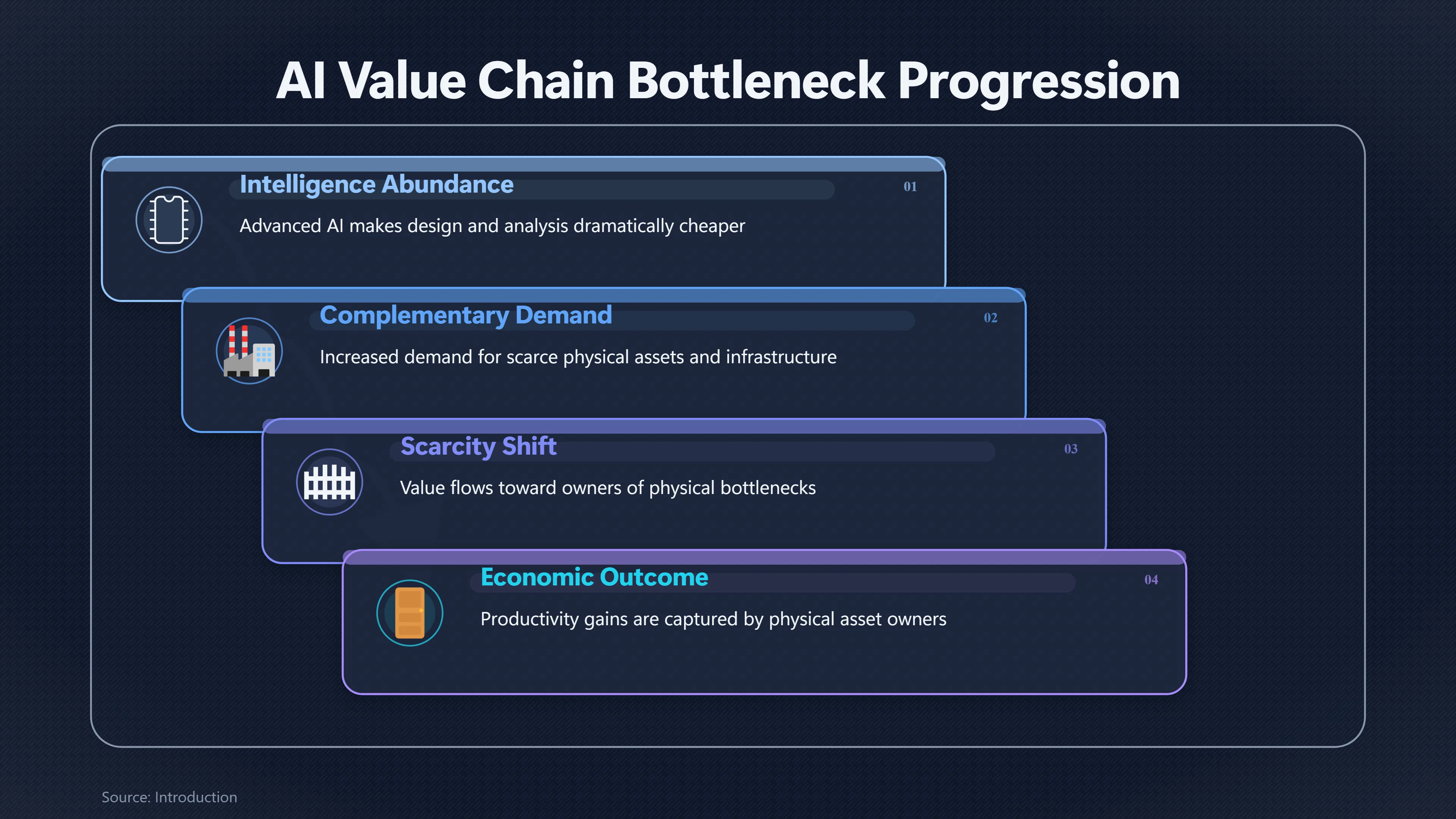
If advanced AI makes design, analysis, planning and many forms of expertise dramatically cheaper, it does not follow that the things people ultimately want—homes, electricity, medicines or transport—will become equally cheap. In many sectors, intelligence is only one ingredient in production. Land, energy, factories, skilled trades, supply chains, regulation and legal permissions remain limited. When one input becomes abundant but its complements remain scarce, the value created by higher productivity often flows towards whoever controls those bottlenecks rather than directly to consumers.
This mechanism is central to understanding who captures the gains from abundant AI services. The optimistic vision of AI-enabled human flourishing depends not only on making intelligence inexpensive, but also on expanding the supply of the physical and institutional assets that turn intelligence into real-world outcomes. Otherwise, AI changes where scarcity sits instead of eliminating it.
How complementary assets capture productivity gains
Economists have long observed that technologies rarely create value in isolation. A more productive design tool only matters if someone can manufacture the product. Better software only matters if businesses have the equipment, organisation and investment needed to use it effectively.
The OECD argues that digital technologies, including AI, depend heavily on “complementary factors”: physical infrastructure, organisational capability, skilled workers, financing, competitive markets and supportive regulation. Where these complementary assets are missing, economy-wide productivity gains are much smaller than the technology itself would suggest.[oecd.org]oecd.orgcomponent 4Digitalisation and productivity: A story of complementarities: OECD Economic Outlook, Volume 2019 Issue 1 | OECDMay 21, 2019…
This helps explain why AI may simultaneously:
- reduce the cost of producing ideas, plans and software;
- increase demand for scarce physical assets needed to implement those ideas; and
- raise the value of those scarce assets relative to the AI itself.
In economic terms, abundant intelligence increases the productivity of scarce complements. If thousands of AI systems can instantly design profitable housing developments, but planning permission remains limited, the main beneficiaries may be owners of developable land rather than users of AI.
This pattern is common in previous waves of technological change. Railways increased the value of strategically located land. The internet boosted the value of data centres, fibre networks and dominant digital platforms. AI may similarly raise the returns earned by owners of scarce complementary assets.
Housing shows why cheaper design does not guarantee cheaper homes
Housing provides perhaps the clearest illustration.
Generative AI can already assist with architectural design, structural analysis, planning documents, project scheduling and cost estimation. These improvements may reduce engineering costs and accelerate project preparation.
Yet design is only a small share of the total cost of housing.(#endnote-15 “Endnote 15”)[sciencedirect.com]sciencedirect.comThe housing cost diseaseThe housing cost disease
Construction depends on factors including:
- land in desirable locations;
- planning and zoning approvals;
- availability of construction workers;
- building materials;
- financing costs;
- transport and utility infrastructure.
Where these inputs remain constrained, AI mainly increases the value of obtaining permission to build rather than making homes dramatically cheaper.
This helps explain why economists often distinguish between reducing the cost of knowledge and increasing the supply of physical goods. If regulations or geography restrict the number of homes that can be built, lower design costs alone cannot create abundant housing.
Conversely, if planning systems become more efficient, modular construction expands and robotics lowers construction costs, AI’s cognitive gains could combine with greater physical supply to produce much larger reductions in housing costs. The interaction between these complementary changes matters more than AI alone.
Energy may become more valuable before it becomes cheaper
AI is often presented as a tool for making energy systems more efficient. It can optimise electricity grids, improve weather forecasting for renewable generation, accelerate materials discovery and help design better batteries.
However, advanced AI also consumes enormous computing resources, increasing demand for electricity and data-centre infrastructure.
If electricity generation expands slowly while AI demand rises rapidly, power itself becomes a bottleneck. In that situation, owners of generation capacity, transmission networks and suitable sites for new data centres may capture a disproportionate share of AI-driven economic gains.
The broader lesson is that abundant computation requires abundant energy. AI cannot make electricity effectively free if generation capacity, grid connections and permitting remain constrained.
The OECD therefore highlights investment in complementary capital—including cloud infrastructure, specialised hardware and supporting systems—as an essential condition for AI’s broader productivity gains.[oecd.org]oecd.orgFoundations for GrowthApril 16, 2026…
Over the longer term, if AI substantially accelerates energy innovation or speeds deployment of clean generation, today’s bottlenecks could ease. But that depends on expanding physical infrastructure as well as improving algorithms.
Medicine depends on laboratories, factories and approvals
Healthcare offers another example where intelligence is only one input.
AI may help identify promising drug candidates, analyse medical images, interpret clinical records and suggest treatment options more quickly than before.
Yet patients do not consume medical predictions—they consume approved medicines and delivered care.
Bringing a new drug to market still requires:
- laboratory experiments;
- clinical trials;
- manufacturing facilities;
- regulatory review;
- distribution systems;
- healthcare professionals who remain legally responsible for treatment.
Even if AI dramatically accelerates discovery, production capacity and regulatory processes can become the new bottlenecks.
The result is that pharmaceutical manufacturing, specialised laboratory facilities or scarce regulatory expertise may become more valuable precisely because AI increases the number of promising discoveries waiting to move through those systems.
In the optimistic AI bloom scenario, AI could eventually compress many stages of biomedical research and enable much faster scientific progress. But widespread benefits depend on expanding the capacity to manufacture therapies safely, conduct trials efficiently and approve effective treatments without compromising standards.
AI often shifts scarcity instead of eliminating it
One way to understand AI is as a technology that changes which resource is hardest to obtain.
Historically, expertise itself was scarce. Lawyers, engineers, translators and consultants spent years acquiring knowledge that relatively few people possessed.
As AI makes certain forms of expertise abundant, scarcity may move elsewhere.
Examples include:
- Attention. As AI generates vastly more content, trusted human attention becomes increasingly valuable.
- Trust. Verified identities, reliable institutions and accountable professionals become more important when information is cheap to produce.
- Physical capacity. Factories, robots, laboratories, ports and electricity networks become more valuable if AI increases demand for real-world production.
- Legal rights. Building permits, licences and intellectual property can become more valuable if they limit entry into expanding markets.
- Prime locations. Land in economically attractive regions may appreciate if AI increases productivity faster than housing supply.
Rather than creating a completely post-scarcity economy, AI may therefore produce a succession of shifting bottlenecks. Each wave of abundance exposes the next limiting factor.

The risk of a new productivity paradox
This mechanism also helps explain why rapid AI progress may not immediately translate into equally dramatic economic growth.
If productivity rises mainly in knowledge-intensive activities while labour, capital and demand remain tied to slower-moving sectors, aggregate gains can be muted. Economists sometimes describe related dynamics using Baumol’s cost disease, where sectors with limited productivity growth account for a growing share of spending over time. Recent OECD work notes that uneven sectoral productivity gains and adjustment frictions can reduce economy-wide benefits if resources cannot move efficiently towards more productive uses.[oecd.org]oecd.orgMiracle or Myth?April 20, 2026…
That does not mean AI lacks transformative potential. Rather, it suggests that physical investment, institutional reform and resource reallocation determine how much of AI’s technical progress becomes visible in everyday living standards.
What determines whether the gains become broadly shared?
Whether scarce assets absorb most AI productivity gains is not predetermined. Several factors influence the outcome.
Expanding supply. Building more housing, electricity generation, semiconductor fabrication, laboratories and transport infrastructure reduces bottlenecks that would otherwise capture the gains.
Competitive markets. If many firms can deploy AI and complementary assets, productivity improvements are more likely to reduce prices rather than increase profits.
Faster diffusion. Widespread access to AI tools allows smaller businesses and public institutions to benefit instead of concentrating gains among a few frontier firms.
Institutional reform. Planning systems, regulatory processes and infrastructure approvals can either amplify or constrain the translation of AI-enabled ideas into real-world improvements.
Investment in physical capital. AI works best when accompanied by robotics, manufacturing capacity, logistics and energy systems that convert digital intelligence into tangible goods and services.
These complementary investments have repeatedly been identified as crucial to turning AI into sustained economy-wide productivity growth rather than isolated efficiency gains.[oecd.org]oecd.orgcomponent 4Digitalisation and productivity: A story of complementarities: OECD Economic Outlook, Volume 2019 Issue 1 | OECDMay 21, 2019…
Why this matters for an AI bloom
The most optimistic vision of AI is not simply that software becomes astonishingly capable, but that abundant intelligence enables abundant health, energy, education and opportunity over generations.
The key obstacle is that intelligence alone cannot manufacture physical reality. Every major improvement still requires land, materials, energy, machinery, institutions and coordinated human effort.
If these complementary assets remain artificially scarce, much of AI’s productivity dividend may accrue to their owners through higher rents, prices or profits. If they expand alongside AI, however, abundant intelligence can reinforce abundant physical production, making broad human flourishing more plausible.
The distinction is therefore not between an AI-rich future and an AI-poor one. It is between a future where AI merely reallocates scarcity and one where successive bottlenecks are systematically removed, allowing the gains from increasingly abundant intelligence to spread through the wider economy.
Amazon book picks
Further Reading
Books and field guides related to What Stays Expensive When Intelligence Becomes Cheap?. Use these as the next step if you want deeper reading beyond the article.

Capitalism and freedom
Rating: 3.8/5 from 6 Google Books ratings
First published 1962. Subjects: Business, Capitalism, Economic policy, Liberty, Nonfiction.
The Undercover Economist
Who makes most money from the demand for cappuccinos early in the morning at Waterloo Station? Why is it impossible to get a foot on the...
The Price of Everything
Why is a life saved from a terrorist attack felt to be worth two saved from a natural disaster? Why are men more valuable than women? Why...
Capital in the Twenty-First Century
The main driver of inequality--returns on capital that exceed the rate of economic growth--is again threatening to generate extreme disco...
eBay marketplace picks
Marketplace Samples
Live-tested eBay searches with available results related to this page.
Selected fromsmart home model oneBay.co.uk.




Endnotes
1.
Source: oecd.org
Title: component 4
Link:https://www.oecd.org/en/publications/oecd-economic-outlook-volume-2019-issue-1_b2e897b0-en/full-report/component-4.html
Source snippet
Digitalisation and productivity: A story of complementarities: OECD Economic Outlook, Volume 2019 Issue 1 | OECDMay 21, 2019...
Published: May 21, 2019
2.
Source: oecd.org
Link:https://www.oecd.org/en/publications/the-impact-of-artificial-intelligence-on-productivity-distribution-and-growth_8d900037-en.html?wcmmode=disabled%27.html
3.
Source: oecd.org
Title: Foundations for Growth
Link:https://www.oecd.org/content/dam/oecd/en/publications/reports/2026/04/foundations-for-growth-and-competitiveness-2026_f68a156b/40a7532f-en.pdf
Source snippet
April 16, 2026...
Published: April 16, 2026
4.
Source: oecd.org
Title: Miracle or Myth?
Link:https://www.oecd.org/content/dam/oecd/en/publications/reports/2024/11/miracle-or-myth-assessing-the-macroeconomic-productivity-gains-from-artificial-intelligence_fde2a597/b524a072-en.pdf
Source snippet
April 20, 2026...
Published: April 20, 2026
5.
Source: oecd.org
Link:https://www.oecd.org/content/dam/oecd/en/publications/reports/2025/06/macroeconomic-productivity-gains-from-artificial-intelligence-in-g7-economies_dcf91c3e/a5319ab5-en.pdf
6.
Source: oecd.org
Link:https://www.oecd.org/en/publications/miracle-or-myth-assessing-the-macroeconomic-productivity-gains-from-artificial-intelligence_b524a072-en.html
7.
Source: oecd.org
Title: time for a regulatory reset 90ca6147
Link:https://www.oecd.org/en/publications/oecd-economic-outlook-volume-2025-issue-2_9f653ca1-en/full-report/time-for-a-regulatory-reset_90ca6147.html
Source snippet
Time for a Regulatory Reset?: OECD Economic Outlook, Volume 2025 Issue 2 | OECDDecember 2, 2025 — OECD ECONOMIC OUTLOOK, VOLUME 2025 ISSU...
Published: December 2, 2025
8.
Source: oecd.org
Link:https://www.oecd.org/en/publications/artificial-intelligence-and-competitive-dynamics-in-downstream-markets_ccf0624a-en/full-report/component-5.html
Source snippet
GenAI helps structure and guide less experienced users while complementing the expertise...
9.
Source: oecd.ai
Link:https://oecd.ai/en/ai-publications/miracle-or-myth-assessing-the-macroeconomic-productivity-gains-from-artificial-intelligence
10.
Source: oecd.org
Title: component 7
Link:https://www.oecd.org/en/publications/identifying-the-main-drivers-of-productivity-growth_00435b80-en/full-report/component-7.html
Additional References
11.
Source: oecd-ilibrary.org
Title: ai and the global productivity divide c315ea90 en
Link:https://www.oecd-ilibrary.org/en/publications/ai-and-the-global-productivity-divide_c315ea90-en.html
Source snippet
Working paper More info MORE INFO Close DOI [https://doi.org/10.1787/c315ea90-en](https://doi.org/10.1787/c315ea90-en) Authors Tania Chaar, Franc...
12.
Source: youtube.com
Link:https://www.youtube.com/watch?v=gYGyfHRwGTU
Source snippet
S01E10 - The AI Value Chain Explained || From Chips to Cloud to Applications...
13.
Source: youtube.com
Link:https://www.youtube.com/watch?v=kj6w7UKQB_Y
Source snippet
Dylan Patel — The single biggest bottleneck to scaling AI compute...
14.
Source: youtube.com
Title: Dylan Patel — The single biggest bottleneck to scaling AI compute
Link:https://www.youtube.com/watch?v=mDG_Hx3BSUE
Source snippet
The AI Productivity Paradox: Faster Code, Longer Weeks...
15.
Source: youtube.com
Title: The AI Productivity Paradox: Faster Code, Longer Weeks
Link:https://www.youtube.com/watch?v=MCl9B2-rUaM
Source snippet
Gold at $5,000 Is Just the Beginning | Jeroen Blokland...
16.
Source: nber.org
Link:https://www.nber.org/papers/w21154
17.
Source: oecd-ilibrary.org
Link:https://www.oecd-ilibrary.org/en/topics/technology-diffusion.html
18.
Source: youtube.com
Title: Gold at $5,000 Is Just the Beginning | Jeroen Blokland
Link:https://www.youtube.com/watch?v=ppv5JrBqJDk
19.
Source: sciencedirect.com
Title: The housing cost disease
Link:https://www.sciencedirect.com/science/article/pii/S016518891730249X
20.
Source: pubs.aeaweb.org
Link:https://pubs.aeaweb.org/doi/abs/10.1257/mac.20170388