Within Income Security
Could AI make the four day week normal?
Shorter working weeks could turn AI-driven productivity gains into more time for family, learning and community life, but only where work can be redesigned.
On this page
- Evidence from reduced working hour trials
- How productivity gains can become free time
- Limits across different industries
Page outline Jump by section
Introduction
Could AI make the four-day week normal? The evidence so far suggests it is possible in some workplaces, but it is not an automatic result of better technology. Four-day week trials show that companies can sometimes maintain output while giving workers more time, especially when they redesign meetings, processes and expectations. AI could strengthen this trend by reducing time spent on routine tasks, drafting, analysis and administration. But productivity gains do not naturally become extra leisure: without deliberate choices, they may instead become higher workloads, faster pace or greater profits for owners.[World Economic Forum]weforum.orgWorld Economic ForumUK four day work week trial: What are the pros and cons? | World Economic ForumMarch 10, 2023…
For an AI-enabled future with greater human flourishing, the important question is not simply whether machines make people more productive. It is whether societies convert those gains into better lives. A shorter working week is one possible way to share technological progress through time: allowing people to spend more hours with family, in education, caring roles, creativity, community life or simply rest.
Evidence from reduced working hour trials
The strongest evidence for shorter working weeks comes from trials where companies changed the way work was organised rather than simply removing a day from the calendar. The most influential model has been the “100-80-100” approach: workers receive 100% of their pay, work around 80% of their previous hours, and aim to maintain 100% of their output.
The UK four-day week pilot, involving more than 60 companies and around 3,000 workers, became one of the largest experiments of its kind. After the six-month trial, most participating organisations chose to continue with the arrangement. Researchers and organisers reported improvements in employee wellbeing, lower burnout and maintained business performance, although the companies were self-selecting and the results should not be treated as proof that every sector can make the same transition.[4 Day Week Global]4dayweek.comOpen source on 4dayweek.com.
Earlier experiments point in a similar direction. In 2019, Microsoft Japan tested a shorter working week by closing its offices on five Fridays while keeping salaries unchanged. The company reported a 40% increase in sales per employee during the trial period, alongside shorter meetings and reduced office resource use. The result was notable because it suggested that some lost time can be recovered through better organisation rather than simply asking people to work harder. However, it was a short corporate experiment rather than evidence that all industries could achieve the same gains.[The Guardian]theguardian.comThe GuardianMicrosoft Japan tested a four-day work week and productivity jumped by 40% | Microsoft | The GuardianNovember 4, 2019…
The broader research picture is therefore promising but cautious. Trials often find that shorter weeks can work where jobs are flexible, measurable and knowledge-based. They provide less evidence for occupations requiring continuous physical presence, such as healthcare, transport, hospitality, manufacturing operations or emergency services, where reducing hours may require more hiring, shift redesign or additional investment.
How AI productivity gains can become free time
AI changes the four-day week debate because it may increase the amount of useful work a person can complete in a given period. Generative AI tools can assist with writing, coding, customer support, research and administrative tasks. In a world where these gains are widely shared, the result could be fewer hours needed to produce the same level of economic output.
Research on workplace AI already shows measurable productivity improvements in specific settings. A study of more than 5,000 customer support workers found that access to a generative AI assistant increased productivity by around 15% on average, with larger benefits for less experienced workers. The researchers also found that AI could spread expertise by helping weaker performers approach the level of stronger colleagues.[arXiv]arxiv.orgarXiv Generative AI at WorkGenerative AI at WorkApril 24, 2023…
But the link between AI efficiency and free time is not guaranteed. Productivity improvements can be used in several ways:
- More output: companies may use AI to produce more goods and services.
- Higher profits: businesses may capture more of the value created.
- Higher expectations: workers may be asked to complete more tasks in the same hours.
- Shorter working time: productivity gains may be converted into fewer working hours.
The last option requires a social and organisational decision. Technology has historically reduced the amount of labour needed for many tasks, but societies have often chosen to increase consumption, production or expectations rather than expand leisure time. Recent research on AI and work has highlighted this tension, finding that AI exposure can sometimes be associated with longer working hours when productivity gains increase competition and workers have limited power to retain the benefits.[National Bureau of Economic Research]nber.orgNational Bureau of Economic ResearchAI and the Extended Workday: Productivity, Contracting Efficiency, and Distribution of Rents | NBERFe…
This makes the four-day week relevant to the wider question of income security when stable jobs decline. If AI creates more value with fewer human hours, societies will need mechanisms that allow ordinary people to benefit through income, services or time. A shorter working week is not a replacement for other forms of economic security, but it is a way of sharing abundance that does not depend only on cash transfers.

The workplace changes needed before four-day weeks spread
AI alone will not create shorter working weeks. Organisations usually need to redesign work before the benefits appear.
Successful trials often involve practical changes:
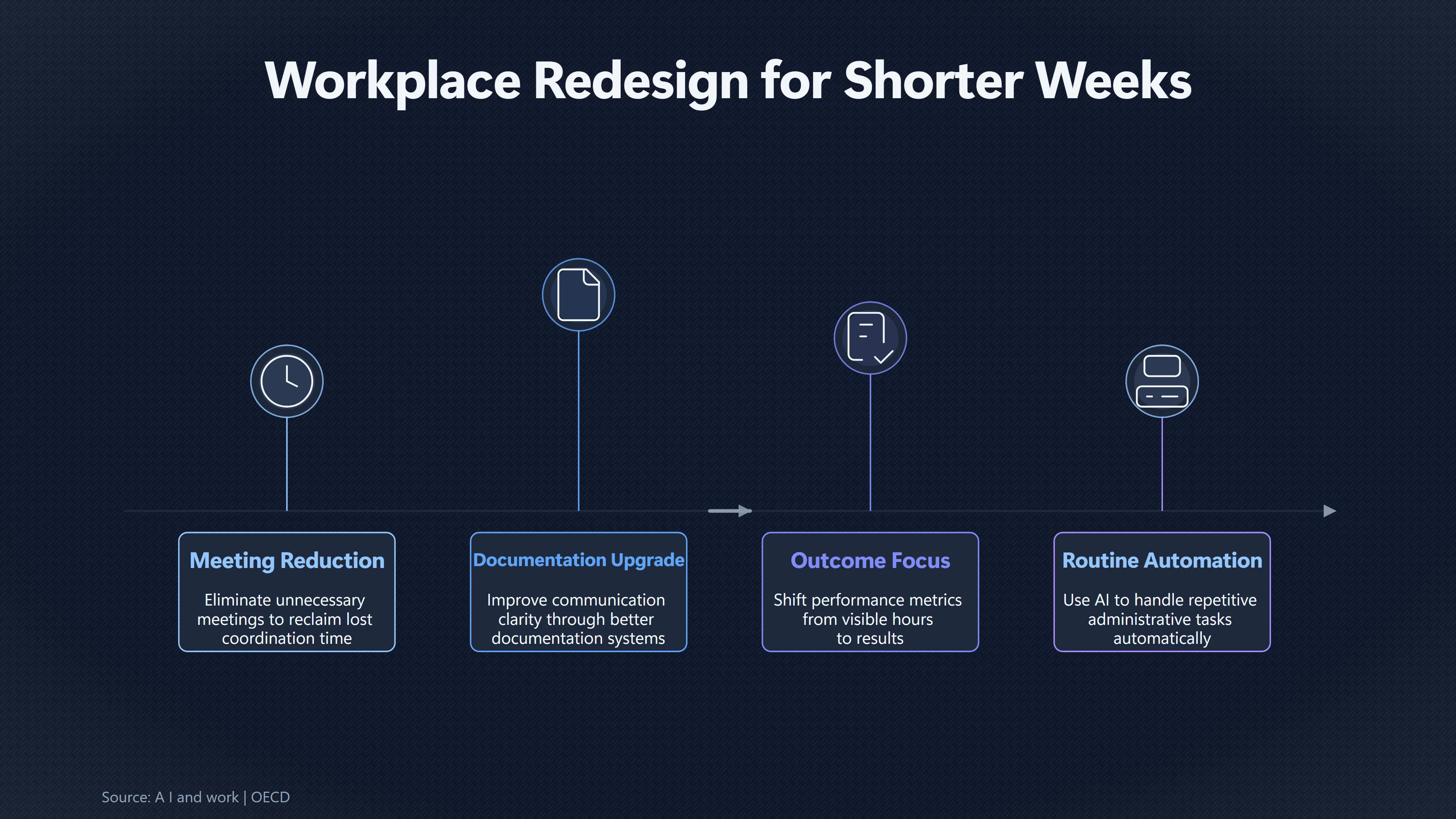
- reducing unnecessary meetings;
- improving documentation and communication;
- focusing on outcomes rather than visible hours;
- automating repetitive administrative work;
- giving employees more control over how tasks are completed.
These changes matter because many workplaces contain hidden inefficiencies. A five-day week may not always mean five days of high-value work; some time is absorbed by coordination problems, interruptions and outdated routines. AI may help remove some of this friction, but only if organisations change their systems rather than simply adding new tools on top of old processes.
The OECD has emphasised that AI can improve productivity and job quality, but that benefits depend on how workplaces adopt the technology and whether risks such as inequality and increased work intensity are addressed.[oecd.org]oecd.orgA I and work | OECDA I and work | OECD
Limits across different industries
The four-day week is sometimes presented as a universal future, but the evidence points towards a more uneven transition.
Office-based knowledge work may be among the easiest areas for AI-supported shorter weeks because output can often be measured through completed projects, decisions or services. AI assistants can reduce research time, automate routine paperwork and help workers complete tasks more efficiently.
Other sectors face different constraints. A hospital cannot simply ask nurses to work fewer days without replacing lost coverage. A factory may need continuous production. A restaurant still needs staff present when customers arrive. In these areas, shorter working weeks may still be possible, but they depend on broader changes such as automation, staffing levels, scheduling technology and improved productivity across the whole system.
There is also a distribution question. Wealthier firms and highly skilled workers may benefit first from AI-enabled reductions in working time, while lower-paid workers could face pressure to increase output without receiving more freedom. Ensuring that AI productivity becomes shared leisure rather than concentrated advantage will require labour policies, bargaining power and organisational choices.

A shorter week as a measure of AI progress
The four-day week offers a useful test of whether AI is improving human life in a deeper sense. A future where people work fewer hours while maintaining security would represent more than economic growth: it would show that technological progress is expanding human freedom.
However, the optimistic vision depends on choices made by companies, workers and governments. AI may create the technical possibility for shorter working lives, but institutions determine whether that possibility becomes reality. The central challenge is turning productivity into human time — one of the clearest measures of whether an AI-driven economy is helping people flourish rather than simply asking them to move faster.
Amazon book picks
Further Reading
Books and field guides related to Could AI make the four day week normal?. Use these as the next step if you want deeper reading beyond the article.
Bullshit Jobs
From bestselling writer David Graeber, a powerful argument against the rise of meaningless, unfulfilling jobs, and their consequences. Do...
Rest
LEARN HOW TO REST BETTER WITH THIS ESSENTIAL BOOK Do you regularly find yourself too tired after a long day to do anything other than bin...

Laziness Does Not Exist
Rating: 4.2/5 from 5 Google Books ratings
First published 2021. Subjects: Psychology, Laziness, Work-life balance, Stress management, Time management.

Shorter
First published 2020. Subjects: Work, Time management, Communication in management, Creative ability in business, Economics.
eBay marketplace picks
Marketplace Samples
Live-tested eBay searches with available results related to this page.
Selected fromrobot figure oneBay.co.uk.




Endnotes
1.
Source: oecd.org
Title: A I and work | OECD
Link:https://www.oecd.org/en/topics/ai-and-work.html
2.
Source: 4dayweek.com
Link:https://www.4dayweek.com/press-releases-posts/4-day-week-uk-results-dbaj7
3.
Source: arxiv.org
Title: arXiv Generative AI at Work
Link:https://arxiv.org/abs/2304.11771
Source snippet
Generative AI at WorkApril 24, 2023...
Published: April 24, 2023
4.
Source: oecd.org
Title: Using AI in the workplace | OECD
Link:https://www.oecd.org/en/publications/using-ai-in-the-workplace_73d417f9-en.html
5.
Source: oecd.org
Title: time use database
Link:https://www.oecd.org/en/data/datasets/time-use-database.html
6.
Source: oecd.org
Title: component 4
Link:https://www.oecd.org/en/publications/generative-ai-and-the-sme-workforce_2d08b99d-en/full-report/component-4.html
7.
Source: oecd.org
Title: artificial intelligence job quality and inclusiveness a713d0ad
Link:https://www.oecd.org/en/publications/oecd-employment-outlook-2023_08785bba-en/full-report/artificial-intelligence-job-quality-and-inclusiveness_a713d0ad.html
8.
Source: 4dayweek.com
Link:https://4dayweek.com/research
9.
Source: 4dayweek.com
Link:https://4dayweek.com/press-releases-posts/4-day-week-uk-results
11.
Source: 4dayweek.com
Link:https://4dayweek.com/uk-pilot-results
12.
Source: 4dayweek.com
Link:https://4dayweek.com/press-releases-posts/category/Press%2BRelease
13.
Source: 4dayweek.com
Link:https://4dayweek.com/press-releases-posts/uk-four-day-week-pilot-mid-results
14.
Source: 4dayweek.com
Title: uk 2023 participants
Link:https://www.4dayweek.com/uk-2023-participants
16.
Source: oecd.org
Link:https://www.oecd.org/en/topics/sub-issues/ai-and-work.html
17.
Source: oecd.org
Link:https://www.oecd.org/en/data/indicators/labour-productivity-and-utilisation.html
18.
Source: microsoft.com
Title: Shifting Work Patterns with Generative AI
Link:https://www.microsoft.com/en-us/research/publication/shifting-work-patterns-with-generative-ai/
19.
Source: oecd.ai
Title: OEC D Programme on AI in Work, Innovation, Productivity and Skills
Link:https://oecd.ai/en/wips
20.
Source: weforum.org
Link:https://www.weforum.org/stories/2023/03/four-day-work-week-uk-trial/
Source snippet
World Economic ForumUK four day work week trial: What are the pros and cons? | World Economic ForumMarch 10, 2023...
Published: March 10, 2023
21.
Source: theguardian.com
Link:https://www.theguardian.com/technology/2019/nov/04/microsoft-japan-four-day-work-week-productivity
Source snippet
The GuardianMicrosoft Japan tested a four-day work week and productivity jumped by 40% | Microsoft | The GuardianNovember 4, 2019...
Published: November 4, 2019
22.
Source: weforum.org
Link:https://www.weforum.org/stories/jobs-and-the-future-of-work/microsoft-4-day-work-week-productivity-increase/
23.
Source: nber.org
Link:https://www.nber.org/papers/w33536
Source snippet
National Bureau of Economic ResearchAI and the Extended Workday: Productivity, Contracting Efficiency, and Distribution of Rents | NBERFe...
24.
Source: theguardian.com
Link:https://www.theguardian.com/money/2024/feb/21/four-day-week-made-permanent-for-most-uk-firms-in-worlds-biggest-trial
25.
Source: weforum.org
Link:https://www.weforum.org/stories/2023/10/surprising-benefits-four-day-week/
26.
Source: theguardian.com
Link:https://www.theguardian.com/money/2023/feb/21/four-day-week-uk-trial-success-pattern
27.
Source: nber.org
Link:https://www.nber.org/papers/w33795
28.
Source: nber.org
Link:https://www.nber.org/papers/w34984
Additional References
29.
Source: ilo.org
Link:https://www.ilo.org/publications/impact-genai-jobs-productivity-and-work-organization-review-empirical
Source snippet
The impact of GenAI on jobs, productivity and work organization: a review of the empirical evidence | International Labour OrganizationJu...
30.
Source: eurofound.europa.eu
Link:https://www.eurofound.europa.eu/en/publications/all/working-time-reduction-and-its-impact-on-productivity-a-systematic-literature-review
Source snippet
4. Working time reduction and its impact on productivity: A systematic literature review Overview Image: working paper image Working pape...
31.
Source: youtube.com
Title: The Countries That Tried a 4-Day Work Week Never Went Back. Here’s Why
Link:https://www.youtube.com/watch?v=lvOIAGsPuRA
Source snippet
World's biggest four-day working week trial ends in success - BBC News...
32.
Source: youtube.com
Title: World’s biggest four-day working week trial ends in success
Link:https://www.youtube.com/watch?v=14qL_ol_zec
Source snippet
Are we working too much? The UK's four-day week trial...
33.
Source: youtube.com
Title: Are we working too much? The UK’s four-day week trial
Link:https://www.youtube.com/watch?v=yMrwopWq3Wo
Source snippet
Companies are experimenting with a 4-day week – and it's working...
34.
Source: youtube.com
Title: Companies are experimenting with a 4-day week – and it’s working
Link:https://www.youtube.com/watch?v=Aticp_ruvrI
Source snippet
Is AI the Answer to Achieving the 4-Day Week?...
35.
Source: techspot.com
Link:https://www.techspot.com/news/82609-4-day-workweek-microsoft-japan-boosted-employees-productivity.html
36.
Source: labourproviders.org.uk
Link:https://www.labourproviders.org.uk/the-results-are-in-the-uks-four-day-week-pilot/
37.
Source: 4dayweek.co.uk
Link:https://www.4dayweek.co.uk/case-studies
38.
Source: 4dayweek.co.uk
Link:https://www.4dayweek.co.uk/faqs