Within Housing Limits
Why Permission to Build Costs So Much
In expensive cities, the right to build often adds more to home prices than design or construction, limiting what cheaper AI can achieve.
On this page
- Construction cost versus land and permission value
- How supply restrictions raise site prices
- Why cheaper design may benefit landowners first
Page outline Jump by section
Introduction
Advanced AI could make it dramatically cheaper to produce building designs, optimise layouts and automate much of the paperwork involved in development. Yet in many of the world’s most expensive cities, those savings would barely dent the final price of housing if the legal right to build remains scarce. In places where planning permission is tightly rationed, a significant share of a property’s value comes not from the bricks, concrete or architectural drawings, but from the development rights attached to the land.

This distinction matters for the broader question of whether AI could help create genuine material abundance. Intelligence can reduce the cost of information, but it cannot by itself create additional legal permission to build. Where planning systems make those permissions scarce, the value created by cheaper design often flows first into higher land prices rather than substantially lower housing costs.
Construction Cost Versus Land and Permission Value
A common misconception is that expensive homes are mainly the result of expensive construction. In reality, economists often separate housing prices into three broad components:
- Construction costs: labour, materials, engineering and physical building work.
- Land value: the value of the location itself.
- Development rights: the legal ability to build a particular type, size or number of homes on that land.
In low-demand areas, construction costs often dominate. But in highly desirable cities such as London, San Francisco, New York or Sydney, the legal right to develop a site can become extraordinarily valuable because demand greatly exceeds the number of homes the planning system allows.
Edward Glaeser and Joseph Gyourko describe the gap between the market price of housing and the cost of producing it as an implicit “regulatory tax” where restrictions on new supply allow prices to remain well above physical construction costs. They argue that this gap is especially pronounced in tightly regulated, high-demand metropolitan areas.[AEA Publications]pubs.aeaweb.orgAEA Publications The Economic Implications of Housing SupplyAEA PublicationsThe Economic Implications of Housing Supply - American Economic Association…
The important point is that buyers are often paying not only for a building, but also for access to a scarce legal privilege.
How Supply Restrictions Raise Site Prices
Development rights behave like any other scarce economic asset.
If a city permits only a limited number of apartments in a neighbourhood where many people wish to live, competition shifts from construction firms to landowners. Developers bid against one another for the relatively small number of sites that can legally be intensified.
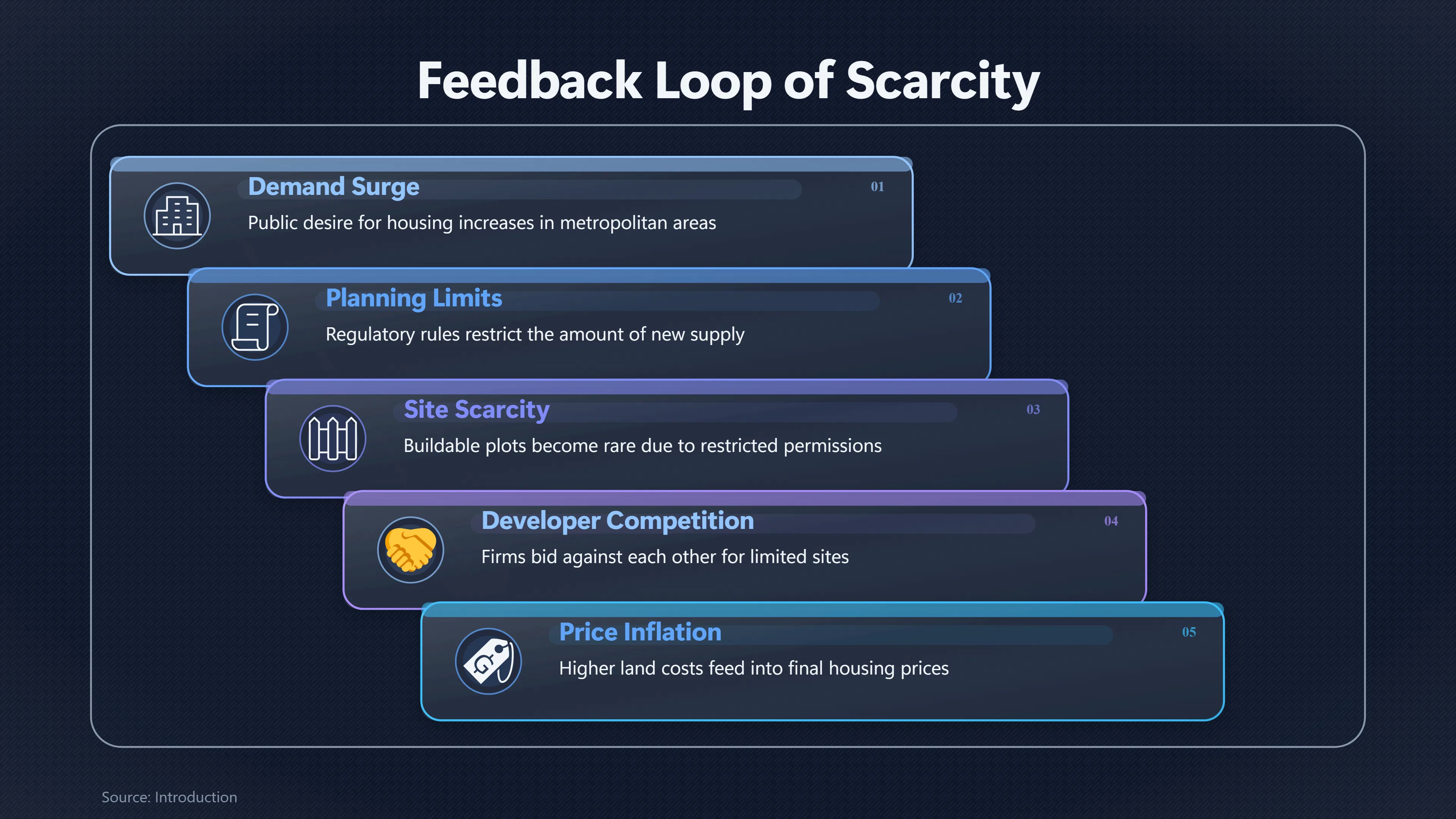
This creates a feedback loop:
- Demand for housing rises.
- Planning rules limit additional supply.
- Buildable sites become scarce.
- Developers compete for those sites.
- Land prices rise.
- Higher land costs feed into higher housing prices.
The physical land has not changed. What has become scarce is permission.
For this reason, developers frequently value urban land according to the number of homes planning rules allow them to build rather than simply by its size. A site that can legally accommodate 200 flats may be worth several times more than an otherwise identical site restricted to 20 homes.
Research estimating “zoning taxes” finds that restrictive land-use regulation can substantially increase the price of developable land, particularly in major coastal metropolitan areas where housing demand is strongest.[ScienceDirect]sciencedirect.comThe impact of local residential land use restrictions on land values across and within single family housing markets - Scien…
Development Rights Can Be Worth More Than the Building
One useful way to think about development rights is as an invisible asset attached to land.
A modest warehouse may have relatively little physical value. However, if planning authorities allow it to become a 30-storey residential tower, the market value of the site can increase dramatically overnight.
Most of that increase does not arise because the owner has improved the land.
Instead, it reflects a government decision to allow more valuable uses.
Economists describe this increase as a land value uplift or betterment. Much of urban planning policy concerns who should receive this newly created value:
- the existing landowner,
- the developer,
- the wider public through taxes or developer contributions,
- or some combination of these.
Studies of London’s planning system show that planning permissions and development rights generate substantial increases in land value, leading governments to capture part of that uplift through affordable housing obligations and developer contributions.[ScienceDirect]sciencedirect.comPolicy shifts, developer contributions and land value capture in London 2005–2017 - ScienceDirect…
Why Cheaper AI May Benefit Landowners First
This mechanism explains why advances in AI do not automatically translate into cheaper homes.
Imagine AI reduces architectural and engineering costs by 80%.
For an individual project, that is a genuine productivity improvement. However, if hundreds of developers are now able to produce viable schemes more cheaply, competition for the limited number of developable sites may intensify.
Rather than permanently reducing home prices, some of the savings may be capitalised into higher land values.
The sequence can look like this:
- AI lowers design and planning costs.
- More developers can profitably pursue projects.
- Competition for scarce permissions increases.
- Owners of buildable land gain greater bargaining power.
- Site prices rise.
- Buyers see only modest reductions in final housing costs.
Economists have long recognised that productivity improvements affecting scarce assets often become reflected in asset prices rather than consumer prices when supply cannot expand freely. Housing illustrates this particularly clearly because the number of legally developable sites is determined by planning systems rather than by technology alone.[AEA Publications]pubs.aeaweb.orgAEA Publications The Economic Implications of Housing SupplyAEA PublicationsThe Economic Implications of Housing Supply - American Economic Association…
Why This Matters for AI Abundance
Within the broader discussion of AI-enabled abundance, housing demonstrates that information is only one part of production.
Advanced AI can dramatically reduce:
- design costs,
- compliance checking,
- engineering analysis,
- planning documentation,
- project management,
- scheduling.
Yet if development rights remain artificially scarce, those gains encounter a political and legal bottleneck rather than a technological one.
This does not mean AI is irrelevant. AI could help planning authorities process applications faster, improve infrastructure modelling, detect unsuitable proposals more efficiently and support better land-use decisions. Faster, more predictable approval systems could reduce delays and uncertainty, lowering some development costs.
However, administrative efficiency is different from increasing the quantity of legal development rights. Unless governments choose to permit more housing where demand is highest, cheaper intelligence alone cannot eliminate the scarcity embedded in urban land markets.

The Wider Policy Debate
Not every planning restriction is unnecessary. Height limits, heritage protections, environmental safeguards, infrastructure capacity and neighbourhood design all reflect legitimate public objectives. The difficult policy question is whether the cumulative effect of these rules creates housing shortages whose costs exceed their benefits.
Many economists argue that in high-demand cities, restrictive land-use regulation has pushed housing prices significantly above construction costs and reduced affordability. Others caution that simply increasing development rights without parallel investment in transport, utilities, schools and public spaces may create new problems or distribute gains unevenly.[aeaweb.org]pubs.aeaweb.orgAEA Publications The Economic Implications of Housing SupplyAEA PublicationsThe Economic Implications of Housing Supply - American Economic Association…
For the AI abundance debate, the key lesson is narrower but important: when legal permission becomes the scarce resource, advances in intelligence primarily increase the value of that permission. AI can make designing homes much cheaper, but it cannot by itself make permission to build abundant. Until the supply of development rights expands alongside technological progress, a substantial share of AI’s productivity gains in housing may be captured through higher land values rather than dramatically lower housing prices.
Amazon book picks
Further Reading
Books and field guides related to Why Permission to Build Costs So Much. Use these as the next step if you want deeper reading beyond the article.
The Color of Law
New York Times Bestseller • Notable Book of the Year • Editors' Choice Selection One of Bill Gates’ “Amazing Books” of the Year One of Pu...
The Death and Life of Great American Cities
A direct and fundamentally optimistic indictment of the short-sightedness and intellectual arrogance that has characterized much of urban...
The Power Broker
Moses is pictured as idealist reformer and political manipulator as his rise to power and eventual domination of New York State politics...
Order without Design
An argument that operational urban planning can be improved by the application of the tools of urban economics to the design of regulatio...
eBay marketplace picks
Marketplace Samples
Live-tested eBay searches with available results related to this page.
Selected fromarchitecture model oneBay.co.uk.



Endnotes
1.
Source: sciencedirect.com
Link:https://www.sciencedirect.com/science/article/abs/pii/S0094119021000565
Source snippet
The impact of local residential land use restrictions on land values across and within single family housing markets - Scien...
2.
Source: sciencedirect.com
Link:https://www.sciencedirect.com/science/article/pii/S0264837717315624
Source snippet
Policy shifts, developer contributions and land value capture in London 2005–2017 - ScienceDirect...
3.
Source: sciencedirect.com
Title: ScienceDirect Housing productivity and the social cost of land-use restrictions
Link:https://www.sciencedirect.com/science/article/pii/S0094119018300329
Source snippet
Housing productivity and the social cost of land-use restrictions - ScienceDirect...
4.
Source: progress.org
Link:https://www.progress.org/wiki/gyourko-krimmel-zoning-tax/
Source snippet
July 11, 2026 — THE IMPACT OF LOCAL RESIDENTIAL LAND USE RESTRICTIONS ON LAND VALUES ACROSS AND WITHIN SINGLE FAMILY HOUSING MARKETS Gyou...
Published: July 11, 2026
5.
Source: pubs.aeaweb.org
Title: AEA Publications The Economic Implications of Housing Supply
Link:https://pubs.aeaweb.org/doi/10.1257/jep.32.1.3
Source snippet
AEA PublicationsThe Economic Implications of Housing Supply - American Economic Association...
Additional References
6.
Source: eprints.whiterose.ac.uk
Link:https://eprints.whiterose.ac.uk/id/eprint/204432/
Source snippet
White Rose Research OnlineJanuary 6, 2019 — CAPTURING DEVELOPMENT VALUE, PRINCIPLES AND PRACTICE: WHY IS IT SO DIFFICULT? Crook, A.D.H.T...
Published: January 6, 2019
7.
Source: hks.harvard.edu
Title: economic implications housing supply
Link:https://www.hks.harvard.edu/publications/economic-implications-housing-supply
Source snippet
32, Issue 1 Winter 2018 View on Publisher Site HKS AUTHORS See citation below for complete author information...
8.
Source: youtube.com
Title: Housing Affordability and Local Regulations with Dr. Edward Glaeser
Link:https://www.youtube.com/watch?v=FjOp5wDmagA
Source snippet
Harvard Professor Edward Glaeser on the U.S. Housing Crisis...
9.
Source: youtube.com
Title: Harvard Professor Edward Glaeser on the U.S. Housing Crisis
Link:https://www.youtube.com/watch?v=Ntq50ewPHo0
Source snippet
Zoning Rules! The Economics of Land Use Regulation...
10.
Source: papers.ssrn.com
Link:https://papers.ssrn.com/sol3/papers.cfm?abstract_id=3880226
Source snippet
Impact of Local Residential Land Use Restrictions on Land Values Across and Within Single Family Housing Markets by Joseph Gyourko, Jacob...
11.
Source: papers.ssrn.com
Link:https://papers.ssrn.com/sol3/papers.cfm?abstract_id=5118186
Source snippet
The Case of Community Infrastructure Levy in England by Anupam Nanda, Sotirios Thanos, Eero Valtonen:: SSRNMay 3, 2024 — DO DEVELOPER OB...
Published: May 3, 2024
12.
Source: escholarship.org
Link:https://escholarship.org/uc/item/90m9g90w
13.
Source: nber.org
Link:https://www.nber.org/papers/w28993
14.
Source: nber.org
Link:https://www.nber.org/papers/w8835
15.
Source: tandfonline.com
Link:https://www.tandfonline.com/doi/abs/10.1080/09599910500453863