Within A Lab
Why A Lab Was Not an Independent Scientist
A-Lab automated a narrow synthesis workflow, but humans still chose the goals, designed the platform and judged the wider significance.
On this page
- Which decisions remained human
- Why narrow autonomy is not open ended science
- How verification disputes limit stronger claims
Page outline Jump by section
Introduction
Berkeley’s A-Lab is often presented as evidence that AI and robotics can perform scientific discovery with minimal human intervention. That is broadly true within a carefully defined task: the system could plan, perform and refine many materials synthesis experiments without researchers manually directing every step. However, A-Lab was not an independent scientist. Human researchers still determined the scientific goals, designed the experimental framework, selected the domain in which the system would operate, interpreted its broader significance and evaluated whether its conclusions were actually correct.[nature.com]nature.comNovember 29, 2023…
This distinction matters for the wider debate about AI-enabled scientific acceleration and the possibility of an “AI bloom”. A-Lab demonstrates that important parts of the experimental cycle can be automated, potentially allowing scientists to test far more ideas than before. It does not show that current AI systems can independently identify the most important scientific questions, develop entirely new research programmes across disciplines, or replace human scientific judgement.
Which Decisions Remained Human?
Much of A-Lab’s autonomy operated inside boundaries established by people long before the robots began running experiments.
Researchers first designed the laboratory itself, integrating robotics, machine learning, scientific databases and analytical instruments into a single closed-loop system. They also defined which kinds of materials the laboratory would study, what equipment would be available, which precursor chemicals could be used safely, and which analytical techniques would determine success.[nature.com]nature.comNovember 29, 2023…
Even the experimental targets originated from human choices. The compounds investigated came from computational predictions and curated databases such as the Materials Project and DeepMind’s predicted stable materials, but scientists decided which candidates were appropriate for the laboratory’s capabilities and research objectives. The AI did not decide that battery materials, phosphates or oxides were the most important scientific priorities; those reflected human research agendas.[nature.com]nature.comNovember 29, 2023…
Equally important, people remained responsible for asking questions that the software never attempted to answer, including:
- Which scientific problems deserve attention?
- Which discoveries would have the greatest practical or social value?
- How should conflicting research priorities be balanced?
- When should unexpected results trigger entirely new lines of investigation rather than more optimisation?
These choices lie above the level of laboratory automation. They require scientific judgement, funding decisions, ethical considerations and strategic thinking that A-Lab was never designed to perform.
Why Narrow Autonomy Is Not Open-Ended Science
A-Lab’s achievement is impressive precisely because it solves a narrowly defined problem extremely well.
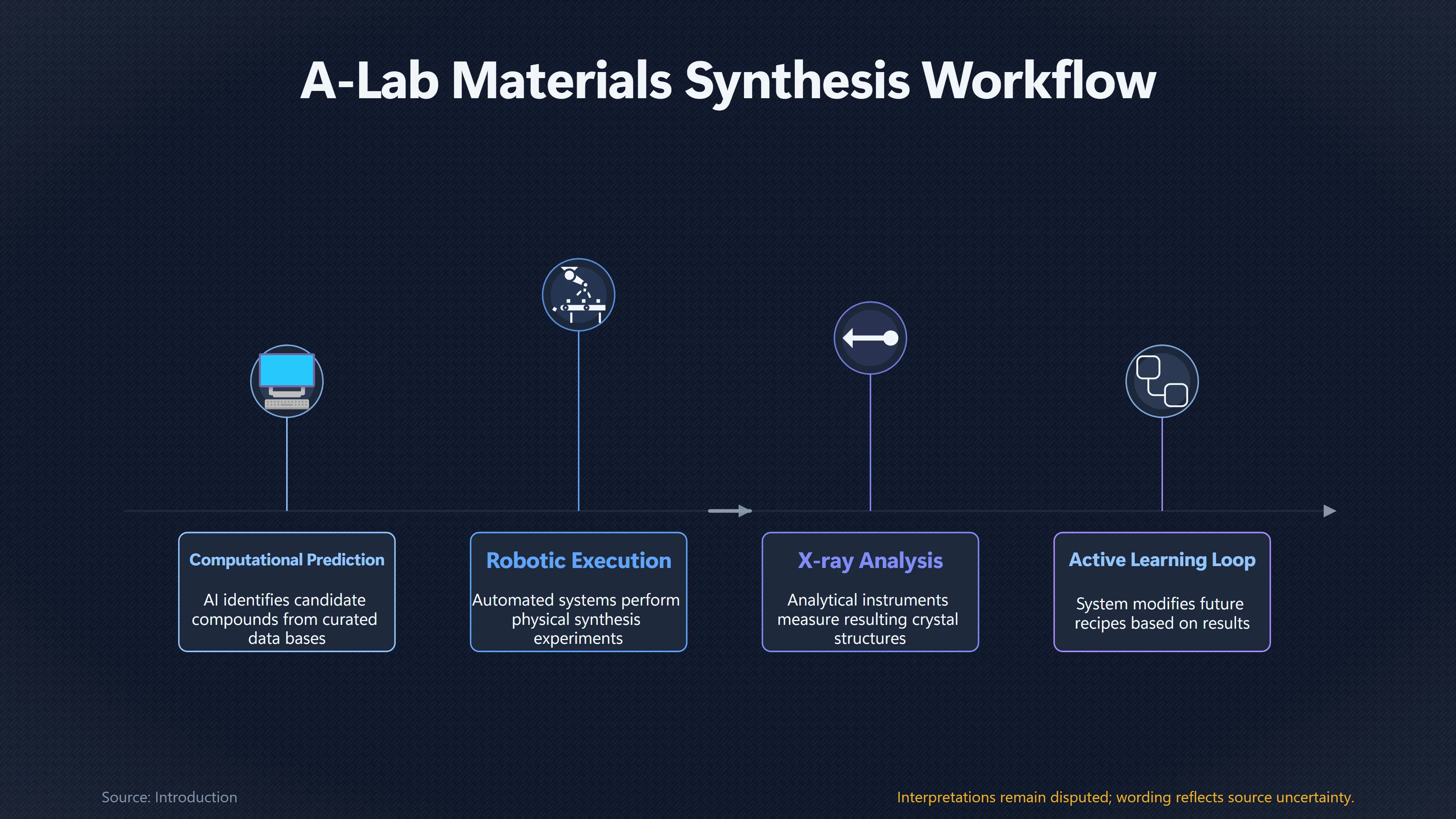
The system specialised in inorganic solid-state materials synthesis. It learned from published synthesis literature, proposed experimental recipes, instructed robotic equipment, analysed X-ray diffraction measurements and modified later experiments using active learning. Within that workflow, it could operate continuously without waiting for human instructions after each experiment.[nature.com]nature.comNovember 29, 2023…
That should not be confused with general scientific reasoning.
An independent scientist might notice that an unexpected result suggests an entirely different physical phenomenon, abandon the original hypothesis, invent a new measurement technique, collaborate with experts in another discipline and pursue a completely different research direction. A-Lab did none of these things. It optimised experiments inside a predefined search space.
Its own reported limitations illustrate this boundary. Several failed synthesis attempts resulted from reaction kinetics, precursor constraints or experimental procedures—such as repeated grinding, higher temperatures or alternative precursors—that fell outside the system’s permitted actions. Human researchers later performed some of these additional interventions manually, successfully synthesising materials the autonomous workflow had missed.[nature.com]nature.comNovember 29, 2023…
This highlights an important distinction:
- Laboratory autonomy means a machine can repeatedly improve experiments within defined rules.
- Scientific autonomy would require creating new questions, changing methods, redefining objectives and recognising entirely new opportunities without those rules already existing.
A-Lab demonstrates the first, not the second.

Verification Still Depends on Human Scientific Scrutiny
Perhaps the strongest evidence that human scientists remain essential came after A-Lab’s publication.
The original Nature paper attracted worldwide attention because it appeared to show an autonomous laboratory discovering dozens of entirely new materials in only a few weeks. Other materials scientists carefully re-examined the claims and argued that several supposedly novel compounds were already known or that the evidence supporting novelty was weaker than initially presented. These critiques prompted detailed public debate, follow-up analyses and, ultimately, corrections to aspects of the published paper.[nature.com]nature.comRobot chemist sparks row with claim it created new materials | NatureDecember 12, 2023…
This episode demonstrates something fundamental about science.
The verification process did not depend on another AI system. It depended on independent researchers examining databases, checking crystallographic evidence, questioning assumptions and openly challenging published conclusions. The scientific value of A-Lab ultimately rested not only on what its robots produced, but also on whether the wider research community accepted the interpretation.
The debate did not invalidate autonomous laboratories as a concept. Even critics generally recognised the technical achievement of integrating AI, robotics and active learning. Instead, the controversy focused on stronger claims about novelty and discovery, reinforcing the importance of independent human review.[nature.com]nature.comAI & robotics briefing: How ill-informed AI use is fuelling a reproducibility crisis | NatureDecember 12, 2023…
Why Human Judgement Still Matters
Science involves more than producing experimental results.
Researchers continually make value-laden and strategic decisions that are difficult to reduce to optimisation problems. They decide which risks are worth taking, when contradictory evidence justifies abandoning an established theory, whether surprising observations deserve years of follow-up work and how discoveries fit into wider bodies of knowledge.
These activities depend on interpretation rather than repetition.
In A-Lab’s case, the automated workflow could efficiently explore a defined chemical landscape, but humans still determined why those materials mattered—for example, whether they might improve batteries, solar technologies or other clean-energy applications. They also remained responsible for communicating findings, designing future experiments and integrating results into the broader scientific literature.[Berkeley Lab News Center]newscenter.lbl.govBerkeley Lab News Center Meet the Autonomous Lab of the FutureBerkeley Lab News CenterMeet the Autonomous Lab of the Future - Berkeley Lab – Berkeley Lab News Center…
As autonomous laboratories become more capable, human roles are therefore likely to shift rather than disappear. Scientists may spend less time carrying out repetitive laboratory procedures and more time framing problems, evaluating evidence, developing theories and deciding which discoveries deserve further investigation.

What A-Lab Means for AI Bloom
Within the broader vision of AI accelerating scientific progress, A-Lab offers a realistic rather than magical lesson.
Its success suggests that AI can substantially reduce one of modern science’s major bottlenecks: translating computational predictions into physical experiments. If similar systems spread across chemistry, biology, materials science and engineering, researchers could test vastly larger numbers of hypotheses than is possible today, potentially speeding advances in energy, medicine and manufacturing.[nature.com]nature.comNovember 29, 2023…
But A-Lab also shows why today’s evidence stops short of demonstrating independent machine science. The laboratory did not originate its own research mission, redefine its objectives or determine the wider meaning of its discoveries. Its achievements depended on extensive human expertise before, during and after the automated experimental loop.
For advocates of long-term AI-enabled scientific acceleration, this is not a weakness but a more credible picture of progress. The near-term opportunity is likely to come from partnerships in which AI systems automate increasingly complex experimental work while human scientists continue to shape research agendas, challenge conclusions and ensure that scientific acceleration serves broader human flourishing rather than merely producing more experiments.
Amazon book picks
Further Reading
Books and field guides related to Why A Lab Was Not an Independent Scientist. Use these as the next step if you want deeper reading beyond the article.
Reinventing Discovery
A pioneer of quantum computing describes how the Internet and powerful new online tools are democratising and accelerating scientific dis...
The Structure of Scientific Revolutions
A good book may have the power to change the way we see the world, but a great book actually becomes part of our daily consciousness, per...
Superintelligence
This profoundly ambitious and original book picks its way carefully through a vast tract of forbiddingly difficult intellectual terrain.
The Logic of Scientific Discovery
2014 Reprint of Original 1959 Edition. Exact facsimile of the original edition, not reproduced with Optical Recognition Software. This bo...
eBay marketplace picks
Marketplace Samples
Live-tested eBay searches with available results related to this page.
Selected fromscience poster oneBay.co.uk.
Endnotes
1.
Source: nature.com
Link:https://www.nature.com/articles/s41586-023-06734-w
Source snippet
November 29, 2023...
Published: November 29, 2023
2.
Source: nature.com
Title: Robot chemist sparks row with claim it created new materials | Nature
Link:https://www.nature.com/articles/d41586-023-03956-w
Source snippet
December 12, 2023...
Published: December 12, 2023
3.
Source: nature.com
Link:https://www.nature.com/articles/d41586-023-04014-1
Source snippet
AI & robotics briefing: How ill-informed AI use is fuelling a reproducibility crisis | NatureDecember 12, 2023...
Published: December 12, 2023
4.
Source: nature.com
Title: Why AI cannot do good science without humans
Link:https://www.nature.com/articles/d41586-026-01551-3
5.
Source: nature.com
Title: Autonomous experiments using active learning and AI | Nature Reviews Materials
Link:https://www.nature.com/articles/s41578-023-00588-4
6.
Source: newscenter.lbl.gov
Title: Berkeley Lab News Center Meet the Autonomous Lab of the Future
Link:https://newscenter.lbl.gov/2023/04/17/meet-the-autonomous-lab-of-the-future/
Source snippet
Berkeley Lab News CenterMeet the Autonomous Lab of the Future - Berkeley Lab – Berkeley Lab News Center...
7.
Source: newscenter.lbl.gov
Link:https://newscenter.lbl.gov/2023/08/14/natural-or-not-scientists-aid-in-quest-to-identify-genetically-engineered-organisms/
Additional References
8.
Source: scientificamerican.com
Title: [Autonomous labs]({{ ‘autonomous-labs/’ | relative_url }}) are running science experiments 24/7 | Scientific American
Link:https://www.scientificamerican.com/article/autonomous-labs-are-running-science-experiments-24-7/
Source snippet
Can the science keep up? Robots and AI are running experiments around the clock, from battery chemistry to cancer thera...
9.
Source: wired.com
Title: Google Deep Mind’s AI Dreamed Up 380,000 New Materials
Link:https://www.wired.com/story/an-ai-dreamed-up-380000-new-materials-the-next-challenge-is-making-them
Source snippet
The Next Challenge Is Making ThemGoogle DeepMind developed an AI program, GNoME, which has predicted 380,000 new stable materials, expand...
10.
Source: iotdigitaltwinplm.com
Title: autonomous materials discovery pipeline 2026
Link:https://iotdigitaltwinplm.com/autonomous-materials-discovery-pipeline-2026/
Source snippet
The screening models are trained on known, mostly-stable materials. Push them to propose genuinely novel chemistries and they extrapolate...
11.
Source: youtube.com
Link:https://www.youtube.com/watch?v=tLpwE3IXoS8
Source snippet
Robot Scientists — The Automated Systems Independently Running Lab Experiments...
12.
Source: youtube.com
Title: Robot Scientists — The Automated Systems Independently Running Lab Experiments
Link:https://www.youtube.com/watch?v=0dJaP2VCpzI
Source snippet
The Limits of AI in Science - Why We Need [Self-Driving]({{ 'lab-access/' | relative_url }}) Labs — Joseph Krause, Radical AI...
13.
Source: youtube.com
Title: Generative AI Futures
Link:https://www.youtube.com/watch?v=rtr4Ahs34-Y
Source snippet
This is how Kristin Persson uses AI to create the materials of tomorrow | VPRO Backlight...
14.
Source: youtube.com
Title: The Limits of AI in Science
Link:https://www.youtube.com/watch?v=4-sWFytOfRw
Source snippet
Episode 119: Closing the Discovery Loop with Radical AI...
15.
Source: osti.gov
Link:https://www.osti.gov/biblio/2281696
16.
Source: cen.acs.org
Link:https://cen.acs.org/research-integrity/Nature-robot-chemist-paper-corrected/104/web/2026/01
17.
Source: chemistryworld.com
Link:https://www.chemistryworld.com/news/new-analysis-raises-doubts-over-autonomous-labs-materials-discoveries/4018791.article