Within Distribution
Who Really Controls the Companies Building Advanced AI?
Equity stakes, cloud commitments and preferential access can give infrastructure giants lasting influence over emerging AI firms.
On this page
- How cloud AI partnerships are structured
- Why compute dependence can limit genuine competition
- What concentrated control means for access and innovation
Page outline Jump by section
Introduction
The companies building the most advanced AI systems do not operate on software alone. They depend on enormous computing infrastructure: specialised chips, giant data centres, electricity contracts, engineering teams and billions of pounds of investment. Increasingly, the firms supplying that infrastructure are also becoming strategic partners, investors and gatekeepers for the AI companies developing frontier models.
This creates a central question for the future of AI abundance: if advanced AI could eventually accelerate science, improve health, reduce scarcity and expand human potential, who controls the infrastructure that makes it possible? Cloud partnerships can help ambitious AI companies scale faster, but they can also concentrate influence over which models are built, who gets access to them and how the economic gains from AI are distributed.
The emerging pattern is not simple ownership. Cloud giants such as Microsoft, Amazon and Google are building networks of investments, exclusive or preferred compute arrangements, custom chips and service platforms that give them significant influence over the direction of advanced AI.[The Official Microsoft Blog]blogs.microsoft.comThe Official Microsoft Blog The next phase of the Microsoft-Open AI partnershipThe Official Microsoft BlogThe next phase of the Microsoft-OpenAI partnership - The Official Microsoft BlogApril 27, 2026… The challenge for policymakers is to preserve the enormous benefits of large-scale AI infrastructure while preventing a small number of infrastructure providers from becoming unavoidable controllers of the technology that may shape humanity’s long-term future.
How cloud-AI partnerships are structured
Frontier AI development has created an unusual relationship between model builders and infrastructure companies. Traditional software startups often rent computing power as a normal business expense. Advanced AI companies increasingly require such extraordinary amounts of computing that infrastructure decisions become part of their core strategy.
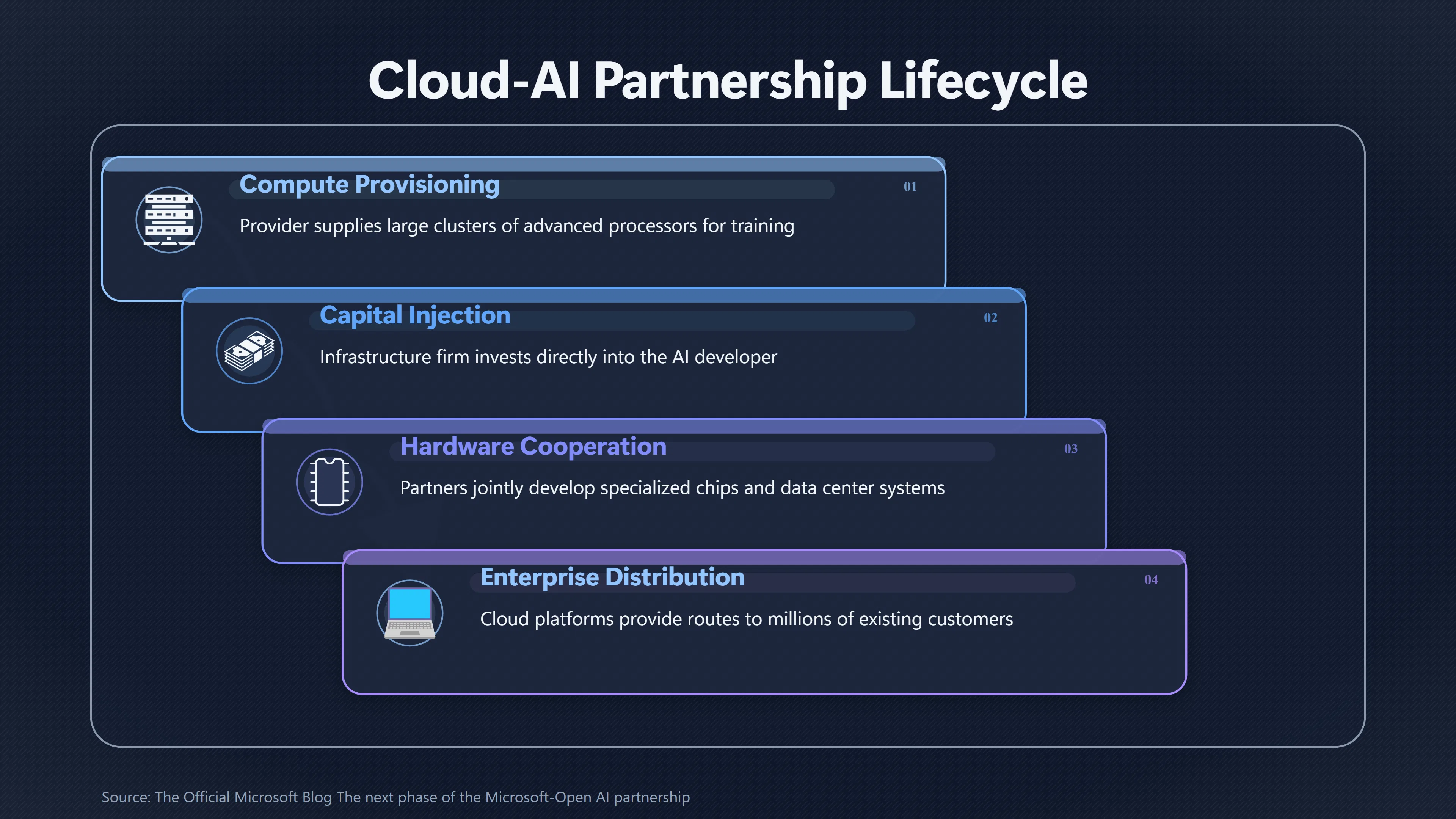
A cloud partnership can include several elements at once:
- Compute access: the cloud provider supplies large clusters of advanced processors needed for training and running AI models.
- Investment capital: the infrastructure company may invest directly in the AI developer.
- Preferred commercial access: the cloud provider may receive rights to distribute models through its own platforms.
- Hardware cooperation: companies may jointly develop specialised chips or data-centre systems.
- Enterprise distribution: cloud platforms provide a route for selling AI services to millions of existing customers.
This creates relationships that are deeper than ordinary supplier contracts. The cloud provider becomes both the electricity grid and the investor behind the factory producing a new industrial capability.
Microsoft and OpenAI: infrastructure as strategic partnership
The most prominent example is the long-running relationship between Microsoft and OpenAI. Microsoft invested heavily in OpenAI while providing access to Azure infrastructure for training and deploying advanced models. Microsoft has also integrated OpenAI technologies into products such as Copilot and enterprise services, linking its cloud business directly to AI development.[The Official Microsoft Blog]blogs.microsoft.comThe Official Microsoft BlogMicrosoft and OpenAI evolve partnership to drive the next phase of AI - The Official Microsoft BlogJanuary 21…
The arrangement illustrates both the advantages and tensions of cloud partnerships. OpenAI gained access to the computing resources needed to develop large-scale models, while Microsoft gained a close relationship with one of the leading AI developers. Later changes to the partnership gave OpenAI more flexibility to use additional infrastructure while preserving Microsoft’s role as a major cloud partner and investor.[The Official Microsoft Blog]blogs.microsoft.comThe Official Microsoft Blog The next phase of the Microsoft-Open AI partnershipThe Official Microsoft BlogThe next phase of the Microsoft-OpenAI partnership - The Official Microsoft BlogApril 27, 2026…
For the AI economy, the significance is broader than one company. A small number of firms with access to enormous computing capacity can move from being service providers to becoming central participants in the creation and distribution of advanced intelligence.
Amazon, Anthropic and the race for alternative AI infrastructure
Amazon’s partnership with Anthropic shows a similar model from a different angle. Amazon invested billions in Anthropic and made AWS a primary cloud provider for Anthropic’s Claude models. The partnership also involves Amazon’s custom AI chips, designed to reduce dependence on external hardware suppliers and provide specialised infrastructure for large-scale AI workloads.[aboutamazon.com]aboutamazon.comAmazon to invest additional $4B in AnthropicAmazon to invest additional $4B in Anthropic
Anthropic’s strategy also shows that frontier AI companies increasingly seek multiple infrastructure relationships rather than relying on one provider alone. Diversification can reduce dependence on a single cloud company, but the overall market remains concentrated because only a handful of firms can provide computing capacity at frontier scale.[arXiv]arxiv.orgarXiv Computing Power and the Governance of Artificial IntelligenceComputing Power and the Governance of Artificial IntelligenceFebruary 13, 2024…
Why compute dependence can limit genuine competition
The key issue is not simply that cloud companies are large. It is that advanced AI development depends on inputs that are expensive, scarce and difficult for newcomers to reproduce.
Training a frontier model requires vast numbers of advanced processors operating together in specialised facilities. Research on AI compute governance has highlighted that computing power is unusually important because it is measurable, controllable and concentrated within a relatively small supply chain.[arXiv]arxiv.orgarXiv Computing Power and the Governance of Artificial IntelligenceComputing Power and the Governance of Artificial IntelligenceFebruary 13, 2024…
This creates several possible barriers to competition.
The cost barrier
A new AI laboratory may have a strong research team and innovative ideas but still struggle to compete without access to enormous computing resources. Academic researchers have already documented a widening “compute divide” between industrial AI labs and universities, particularly in areas involving large foundation models.[arXiv]arxiv.orgThe Compute Divide in Machine Learning: A Threat to Academic Contribution and Scrutiny?January 4, 2024…
If the next generation of AI systems requires even greater scale, the number of organisations able to participate may shrink further. This could affect not only commercial competition but also scientific diversity, independent safety research and public-interest innovation.
The dependency problem
Cloud partnerships can create strategic dependence. An AI company may become tied to a provider’s infrastructure, pricing decisions, technical roadmap or commercial interests.
Dependence does not automatically mean abuse. Large cloud providers can create enormous value by investing billions in infrastructure that smaller firms could not build themselves. Without these partnerships, some breakthroughs might arrive more slowly.
The concern is that a future in which advanced AI becomes essential to medicine, education, scientific discovery and economic production could leave society reliant on a narrow group of infrastructure owners.

Control can shift without formal ownership
Cloud providers do not need to own an AI company outright to influence it. Control can come through:
- deciding how much computing capacity is available;
- setting access conditions for customers;
- controlling deployment platforms;
- owning key infrastructure layers;
- shaping which AI services reach businesses and governments.
This matters because AI systems may become general-purpose technologies, similar to electricity or the internet. Whoever controls essential infrastructure may gain influence over the wider economy.
What concentrated control means for access and innovation
A future of AI abundance depends not only on whether powerful systems can be created, but whether their benefits spread widely. Cloud concentration creates a tension between efficiency and openness.
Large infrastructure partnerships may accelerate progress because they allow researchers to build systems at unprecedented scale. The same concentration may also reduce the number of independent actors able to challenge leading companies, experiment with alternative approaches or provide public-interest oversight.
Faster progress can come from concentration
There is a strong argument that large-scale partnerships are necessary for rapid AI advancement. Frontier models require enormous capital investment, specialised engineering and reliable infrastructure. Cloud companies can provide these resources faster than most governments, universities or smaller firms.
This concentration has helped turn AI from a research field into a widely deployed technology. Businesses, scientists and public institutions can access advanced models through cloud platforms without building their own data centres.
For the AI bloom vision, this matters because faster scaling could mean earlier breakthroughs in areas such as scientific research, drug discovery, education and productivity.
But access must remain broad
The opposite risk is that the benefits of AI become concentrated among those who control the infrastructure. If only a few companies can afford to train frontier models, they may shape:
- which research areas receive investment;
- which communities receive access;
- which business models dominate;
- how much of the economic value flows to infrastructure owners.
This is why some researchers argue that AI governance should consider compute access as a public-interest issue, not only a commercial one. Policy discussions have examined whether governments should support shared computing infrastructure, research access programmes and transparency requirements for large-scale AI development.[arXiv]arxiv.orgarXiv Computing Power and the Governance of Artificial IntelligenceComputing Power and the Governance of Artificial IntelligenceFebruary 13, 2024…
The governance question: infrastructure providers as AI gatekeepers
Cloud companies may become important actors in AI governance because they sit between developers and the physical resources needed to build powerful systems.
Some researchers have argued that compute providers could help monitor and govern advanced AI by keeping records of large-scale workloads, improving visibility into major training runs and helping enforce safety requirements.[arXiv]arxiv.orgOpen source on arxiv.org.
This creates a difficult balance.
On one side, infrastructure providers may be among the few organisations capable of detecting and managing risks from extremely large AI systems. On the other, giving private companies too much authority over access to computing power could reinforce concentration of economic and political influence.
Regulation therefore faces a dual challenge:
- prevent dangerous or irresponsible uses of advanced AI;
- avoid creating a system where only the largest infrastructure companies can participate in shaping the future of intelligence.
The European Union’s AI Act reflects part of this wider shift by placing obligations on providers of general-purpose AI models, including documentation, transparency and risk-management requirements for the most advanced systems.[Digital Strategy]digital-strategy.ec.europa.euDigital StrategyGuidelines for providers of general-purpose AI models | Shaping Europe’s digital futureApril 28, 2026… Although these rules primarily target model providers rather than cloud companies, they show how governments are beginning to treat advanced AI infrastructure as a matter of public importance.
Building AI infrastructure that supports human flourishing
Cloud partnerships are likely to remain central to advanced AI. The scale of computing required means that some degree of concentration may be unavoidable. The question is not whether large infrastructure companies should exist, but how their power should be balanced.
A flourishing AI future would likely require several conditions:
- Multiple competing infrastructure providers so no single company becomes indispensable.
- Research access programmes so universities and public-interest groups can study advanced systems.
- Transparent rules for compute allocation so access is not determined only by wealth or strategic relationships.
- Interoperability and portability so AI companies are not permanently locked into one provider.
- Public oversight of critical infrastructure where AI capabilities become socially essential.
The optimistic case for advanced AI is that greater intelligence could help humanity overcome constraints that have limited civilisation for centuries: disease, energy scarcity, scientific bottlenecks and material shortages. But reaching that future depends partly on who controls the foundations beneath the technology.
Cloud partnerships can provide the resources needed for an intelligence revolution. They can also determine who has the power to participate in it. The central governance challenge is ensuring that the infrastructure of advanced AI becomes a foundation for broad human capability rather than a narrow source of control.
Amazon book picks
Further Reading
Books and field guides related to Who Really Controls the Companies Building Advanced AI?. Use these as the next step if you want deeper reading beyond the article.
The Big Nine
A call-to-arms about the broken nature of artificial intelligence, and the powerful corporations that are turning the human-machine relat...
The Coming Wave
"We are approaching a critical threshold in the history of our species. Everything is about to change. Soon you will live surrounded by A...
AI Superpowers
THE NEW YORK TIMES, USA TODAY, AND WALL STREET JOURNAL BESTSELLER "Kai-Fu Lee believes China will be the next tech-innovation superpower...
Chip War
***Winner of the 2022 Financial Times Business Book of the Year Award*** ***Selected as one of Barack Obama's Favourite Books of 2023***...
eBay marketplace picks
Marketplace Samples
Live-tested eBay searches with available results related to this page.
Selected fromdata center model oneBay.co.uk.



Endnotes
1.
Source: blogs.microsoft.com
Title: The Official Microsoft Blog The next phase of the [Microsoft-Open AI]({{ ‘microsoft-open-ai/’ | relative_url }}) partnership
Link:https://blogs.microsoft.com/blog/2026/04/27/the-next-phase-of-the-microsoft-openai-partnership/
Source snippet
The Official Microsoft BlogThe next phase of the Microsoft-OpenAI partnership - The Official Microsoft BlogApril 27, 2026...
Published: April 27, 2026
2.
Source: aboutamazon.com
Title: Amazon to invest additional $4B in Anthropic
Link:https://www.aboutamazon.com/news/aws/amazon-invests-additional-4-billion-anthropic-ai?tag=searcht-20
3.
Source: blogs.microsoft.com
Link:https://blogs.microsoft.com/blog/2025/01/21/microsoft-and-openai-evolve-partnership-to-drive-the-next-phase-of-ai/
Source snippet
The Official Microsoft BlogMicrosoft and OpenAI evolve partnership to drive the next phase of AI - The Official Microsoft BlogJanuary 21...
4.
Source: arxiv.org
Title: arXiv Computing Power and the Governance of Artificial Intelligence
Link:https://arxiv.org/abs/2402.08797
Source snippet
Computing Power and the Governance of Artificial IntelligenceFebruary 13, 2024...
Published: February 13, 2024
5.
Source: arxiv.org
Link:https://arxiv.org/abs/2401.02452
Source snippet
The Compute Divide in Machine Learning: A Threat to Academic Contribution and Scrutiny?January 4, 2024...
Published: January 4, 2024
6.
Source: arxiv.org
Link:https://arxiv.org/abs/2403.08501
7.
Source: blog.google
Title: Blackstone and Google to develop TPU cloud
Link:https://blog.google/innovation-and-ai/infrastructure-and-cloud/google-cloud/blackstone-tpu-cloud/
8.
Source: anthropic.com
Title: and Amazon expand collaboration for up to 5 gigawatts of new compute \ Anthropic
Link:https://www.anthropic.com/news/anthropic-amazon-compute?invite=1
9.
Source: anthropic.com
Link:https://www.anthropic.com/news/google-broadcom-partnership-compute?data=27%2F08%2F2025
10.
Source: anthropic.com
Link:https://www.anthropic.com/news/google-broadcom-partnership-compute?_hsmi=352996231
11.
Source: OpenAI
Title: continuing microsoft partnership
Link:https://openai.com/index/continuing-microsoft-partnership/
12.
Source: microsoft.com
Link:https://www.microsoft.com/en-us/investor/events/fy-2026/earnings-fy-2026-q2
13.
Source: press.aboutamazon.com
Link:https://press.aboutamazon.com/aws/2025/12/dartmouth-becomes-first-ivy-league-institution-to-partner-with-aws-and-anthropic-to-launch-ai-at-institutional-scale?tag=searcht-20
14.
Source: press.aboutamazon.com
Link:https://press.aboutamazon.com/2025/11/aws-and-humain-expand-partnership-with-nvidia-ai-infrastructure-and-aws-ai-chip-deal-to-drive-global-ai-innovation?tag=searcht-20
15.
Source: aboutamazon.com
Title: AW S and Open AI announce multi-year strategic partnership
Link:https://www.aboutamazon.com/news/aws/aws-open-ai-workloads-compute-infrastructure?tag=searcht-20
16.
Source: microsoft.com
Link:https://www.microsoft.com/en-us/investor/events/fy-2026/earnings-fy-2026-q1
17.
Source: OpenAI
Title: next chapter of microsoft openai partnership
Link:https://openai.com/index/next-chapter-of-microsoft-openai-partnership/
18.
Source: press.aboutamazon.com
Title: upstage and aws join forces to drive ai innovation in apac and the united states
Link:https://press.aboutamazon.com/aws/2025/8/upstage-and-aws-join-forces-to-drive-ai-innovation-in-apac-and-the-united-states?tag=searcht-20
19.
Source: anthropic.com
Title: Powering the next generation of AI development with AWS \ Anthropic
Link:https://www.anthropic.com/news/anthropic-amazon-trainium
20.
Source: microsoft.com
Link:https://www.microsoft.com/en-us/Investor/events/FY-2025/earnings-fy-2025-q1
21.
Source: blogs.microsoft.com
Link:https://blogs.microsoft.com/blog/2023/01/23/microsoftandopenaiextendpartnership/
22.
Source: news.microsoft.com
Link:https://news.microsoft.com/source/2019/07/22/openai-forms-exclusive-computing-partnership-with-microsoft-to-build-new-azure-ai-supercomputing-technologies/?return=https%3A%2F%2Fnews.microsoft.com%2Fabout%2F%3Fmsockid%3D2a52ae9cd2fd63fe0d82b857d3246257
23.
Source: en.ai-act.io
Link:https://en.ai-act.io/chapter/obligations-for-providers-of-general-purpose-ai-models
24.
Source: en.ai-act.io
Link:https://en.ai-act.io/article/general-purpose-ai-models/obligations-for-providers-of-general-purpose-ai-models/obligations-for-providers-of-general-purpose-ai-models
25.
Source: aboutamazon.com
Link:https://www.aboutamazon.com/news/company-news/amazon-invests-additional-5-billion-anthropic-ai?tag=searcht-20
26.
Source: aboutamazon.com
Link:https://www.aboutamazon.com/news/company-news/amazon-aws-anthropic-ai?tag=searcht-20
27.
Source: aboutamazon.com
Link:https://www.aboutamazon.com/news/company-news/amazon-ai-investment-us-federal-agencies?_sp=ca80175f-15e2-41ec-9c3c-28682b437114&tag=searcht-20
28.
Source: aboutamazon.com
Link:https://www.aboutamazon.com/news/aws/aws-project-rainier-ai-trainium-chips-compute-cluster?linkId=872917983&tag=searcht-20
29.
Source: digital-strategy.ec.europa.eu
Link:https://digital-strategy.ec.europa.eu/en/policies/guidelines-gpai-providers
Source snippet
Digital StrategyGuidelines for providers of general-purpose AI models | Shaping Europe’s digital futureApril 28, 2026...
Published: April 28, 2026
30.
Source: digital-strategy.ec.europa.eu
Link:https://digital-strategy.ec.europa.eu/en/factpages/general-purpose-ai-obligations-under-ai-act
31.
Source: digital-strategy.ec.europa.eu
Link:https://digital-strategy.ec.europa.eu/en/faqs/questions-and-answers-code-practice-general-purpose-ai
Source snippet
and answers on the code of practice for General-Purpose AI | Shaping Europe’s digital futureJuly 20, 2026 — QUESTIONS AND ANSWERS ON THE...
Published: July 20, 2026
32.
Source: digital-strategy.ec.europa.eu
Link:https://digital-strategy.ec.europa.eu/en/faqs/guidelines-obligations-general-purpose-ai-providers
33.
Source: digital-strategy.ec.europa.eu
Link:https://digital-strategy.ec.europa.eu/en/faqs/general-purpose-ai-models-ai-act-questions-answers
34.
Source: ai-act-service-desk.ec.europa.eu
Link:https://ai-act-service-desk.ec.europa.eu/en/ai-act/faq/what-legal-obligations-do-providers-general-purpose-ai-models-face-under-ai-act-2-august
35.
Source: digital-strategy.ec.europa.eu
Link:https://digital-strategy.ec.europa.eu/en/news/learn-more-about-guidelines-providers-general-purpose-ai-models
36.
Source: digital-strategy.ec.europa.eu
Link:https://digital-strategy.ec.europa.eu/en/news/commission-publishes-guidelines-providers-general-purpose-ai-models
37.
Source: ai-act-service-desk.ec.europa.eu
Link:https://ai-act-service-desk.ec.europa.eu/en/ai-act/article-53
38.
Source: ai-act-service-desk.ec.europa.eu
Link:https://ai-act-service-desk.ec.europa.eu/en/ai-act/article-55
Additional References
39.
Source: youtube.com
Link:https://www.youtube.com/watch?v=FwsAQqMQcDw
Source snippet
IREN vs. Nebius: Is This the Best AI Infrastructure Play?...
40.
Source: oecd.org
Link:https://www.oecd.org/en/publications/competition-in-artificial-intelligence-infrastructure_623d1874-en/full-report/component-7.html
41.
Source: youtube.com
Title: When Microsoft Took Over Open AI’s Stargate
Link:https://www.youtube.com/watch?v=Jn_SCieO848
Source snippet
Google, The AI Chip Hegemony War: Financial Engineering, Blackstone Joint Venture TPU Co. Establi...
42.
Source: youtube.com
Title: Why AI Micro Clouds are Making the Cloud Giants PANIC
Link:https://www.youtube.com/watch?v=YAPbh3KNu-o
Source snippet
AI Hardware Shift: Why Hyperscalers Are Leaving Nvidia...
43.
Source: gartner.com
Link:https://www.gartner.com/en/newsroom/press-releases/2025-08-06-gartner-says-worldwide-iaas-public-cloud-services-market-grew-22-point-5-percent-in-2024
44.
Source: youtube.com
Title: AI Hardware Shift: Why Hyperscalers Are Leaving Nvidia
Link:https://www.youtube.com/watch?v=Bim-VjJ-Sys
Source snippet
When Microsoft Took Over OpenAI's Stargate...
45.
Source: trendforce.com
Link:https://www.trendforce.com/presscenter/news/20260520-13053.html
46.
Source: googlecloudpresscorner.com
Link:https://www.googlecloudpresscorner.com/2023-02-03-Anthropic-Forges-Partnership-With-Google-Cloud-to-Help-Deliver-Reliable-and-Responsible-AI
47.
Source: techcrunch.com
Link:https://techcrunch.com/2026/04/07/anthropic-compute-deal-google-broadcom-tpus/
48.
Source: googlecloudpresscorner.com
Link:https://www.googlecloudpresscorner.com/global?l=25