Within Mining Safety
Why Human and Autonomous Mine Traffic Still Collides
Most remaining risks arise when people and autonomous vehicles misread each other's intentions rather than from driving failures.
On this page
- Shared operating assumptions
- Communicating vehicle intent
- Managing mixed traffic zones
Page outline Jump by section
Introduction
Autonomous haul trucks and other driverless mining vehicles can remove people from some of the most dangerous driving tasks, but they also create a new safety challenge: humans and machines must coordinate their movements without relying on the informal communication that human drivers use every day. In active mines, the remaining hazards increasingly arise not because an autonomous vehicle cannot follow a route, but because workers, manually driven vehicles and automated systems develop different assumptions about who has priority, what a vehicle intends to do next, or whether an area is safe to enter. This shift makes traffic coordination a central safety mechanism rather than a secondary operational concern. It also illustrates a broader lesson for AI-enabled robotics: achieving human flourishing through automation depends not only on capable machines, but on designing systems in which people and AI can reliably understand one another.[CDC Archive]archive.cdc.govCDC ArchiveHaul Truck Research Roadmap Report 2020 | Mining | NIOSH | CDCJanuary 7, 2025…
Shared operating assumptions matter more than perfect driving
A traditional mine relies heavily on experienced drivers making local judgements. They slow for uncertain situations, wave another vehicle through an intersection or negotiate unexpected obstacles through eye contact, hand signals or radio conversations.
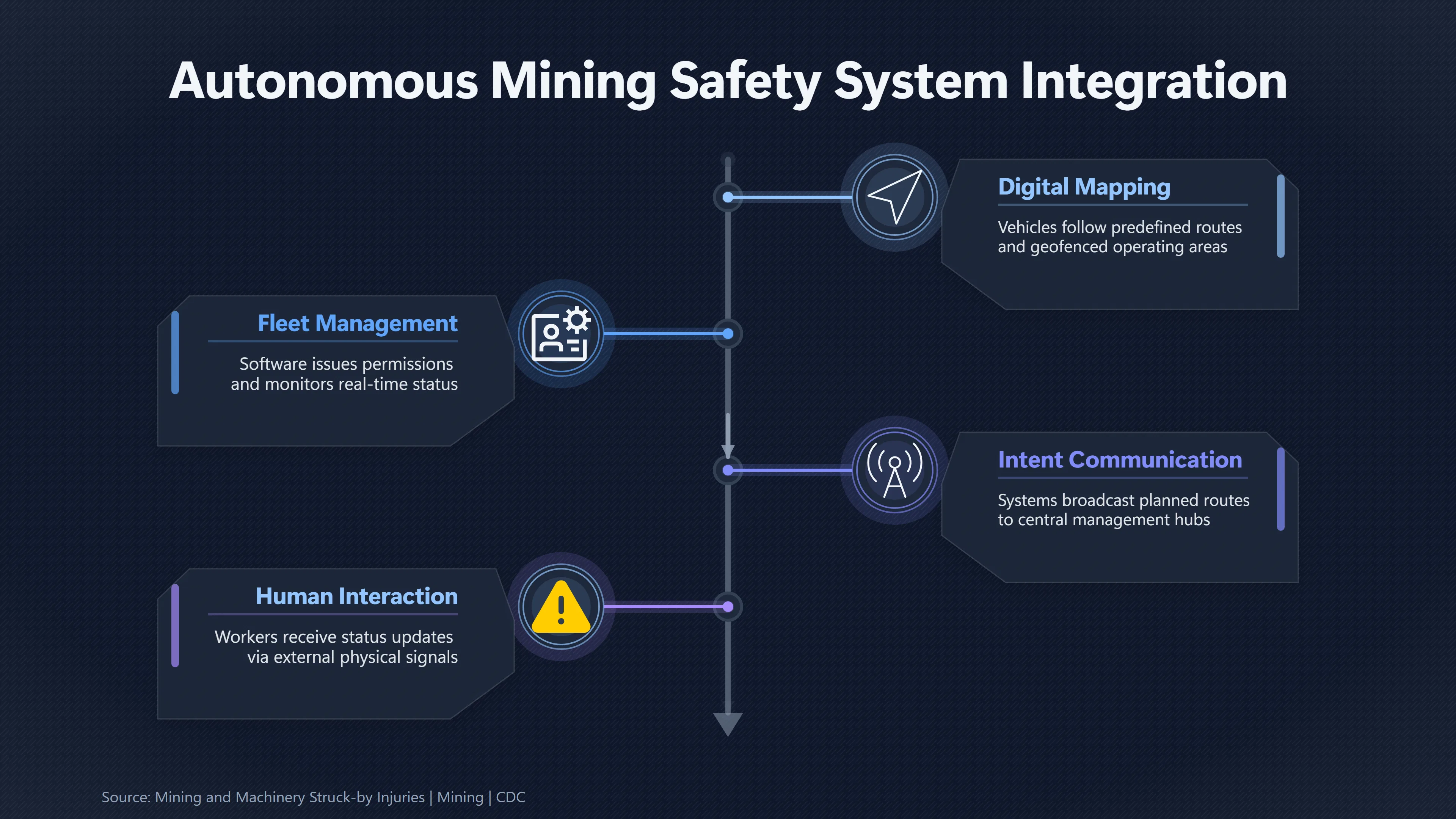
Autonomous vehicles work differently. They follow digital maps, predefined right-of-way rules, geofenced operating areas and permissions issued by fleet management software. ISO 17757, the international safety standard for autonomous and semi-autonomous mining machinery, therefore treats the vehicle, communications infrastructure, operating procedures and human interaction as one integrated safety system rather than independent components.[iso.org]iso.orgISO 17757:2019 - Earth-moving machinery and mining — Autonomous and semi-autonomous machine system safety…
This changes the nature of safe traffic management. Instead of asking whether each truck drives safely on its own, operators must ensure that everyone on site shares the same assumptions about:
- which roads belong to autonomous traffic;
- where manually driven vehicles may cross;
- who has priority at intersections;
- how temporary road closures are communicated;
- when maintenance personnel may enter operating zones; and
- what happens if communications or positioning systems degrade.
Small mismatches between these assumptions can create situations in which every participant behaves exactly as designed while the overall system still becomes unsafe.
Why predictable behaviour is not enough
One of the biggest misconceptions is that autonomous vehicles only need to behave predictably. Predictability certainly helps: autonomous haul trucks generally maintain consistent speeds, follow planned routes and brake in repeatable ways.
However, predictability alone does not communicate intent.
Human drivers constantly exchange information that never appears in formal traffic rules. A slight steering movement, a pause before an intersection or a hand gesture may signal who intends to proceed first. Removing the driver removes these informal communication channels as well.
The National Institute for Occupational Safety and Health (NIOSH) identifies intention communication as one of the most important unresolved research areas for autonomous haulage. Workers need to understand not only what an autonomous truck is doing now, but what it is about to do next. Without that shared awareness, predictable motion can still surprise nearby people.[CDC Archive]archive.cdc.govCDC ArchiveHaul Truck Research Roadmap Report 2020 | Mining | NIOSH | CDCJanuary 7, 2025…
Communicating vehicle intent
Modern autonomous mining systems therefore attempt to make machine intentions explicit rather than leaving people to infer them.
Digital awareness
Most large autonomous haulage systems continuously report vehicle position, planned routes and operational status to a central fleet management system. Supervisors and authorised vehicle operators can see where autonomous equipment intends to travel and whether particular haul roads or intersections are occupied.[iso.org]iso.orgISO 17757:2019 - Earth-moving machinery and mining — Autonomous and semi-autonomous machine system safety…
Digital awareness is particularly valuable because autonomous trucks often make route decisions that appear unusual to nearby drivers but are entirely consistent with fleet optimisation software.
External signals
Sites also use combinations of:
- warning lights indicating autonomous operation;
- audible alerts;
- dedicated radio channels;
- vehicle status displays;
- controlled access gates; and
- physical signage marking autonomous operating areas.
These signals are intended to replace some of the information that would otherwise come from observing a human driver.
Clear operational states
Workers also need confidence that they understand whether a vehicle is:
- fully autonomous;
- awaiting permission;
- stopped intentionally;
- operating under remote supervision;
- transitioning between manual and autonomous control; or
- experiencing a degraded mode following a fault.
Ambiguity during these transitions creates greater risk than routine autonomous driving because people may incorrectly assume how the machine will respond.
Managing mixed traffic zones
Completely separating autonomous and human-operated equipment is often impractical. Surveyors, maintenance crews, emergency responders, contractors, water carts and light vehicles still require access to production areas.
For that reason, many mines focus on carefully designed mixed-traffic management rather than complete segregation.
Typical measures include:
- Controlled crossing points. Manual vehicles cross autonomous haul routes only at designated locations with defined procedures.
- Geofenced exclusion zones. Entering an autonomous operating area requires formal permission or system acknowledgement.
- Temporary traffic control. Road maintenance, blasting or changing pit layouts trigger updates to both digital maps and operating procedures.
- Speed management. Lower speeds provide greater margins where human and autonomous traffic interact.
- Access control. Contractors and visitors often receive additional induction before entering autonomous areas.
The emphasis shifts from allowing individual drivers to negotiate each encounter independently towards designing the entire traffic system to minimise ambiguous interactions. ISO 17757 explicitly addresses this broader systems perspective.[iso.org]iso.orgISO 17757:2019 - Earth-moving machinery and mining — Autonomous and semi-autonomous machine system safety…
Lessons from real incidents
A widely discussed example described in the NIOSH Haul Truck Research Roadmap involved an autonomous haul truck colliding with a manned water truck at BHP’s Jimblebar mine in Western Australia in 2014.
The autonomous truck followed its programmed route and prepared to turn at an unmarked intersection. The operator of the manually driven water truck did not anticipate the turn, despite having access to information about the autonomous vehicle’s route. According to NIOSH, better communication of vehicle intent and clearer understanding of the site’s traffic controls could have prevented the collision.[CDC Archive]archive.cdc.govCDC ArchiveHaul Truck Research Roadmap Report 2020 | Mining | NIOSH | CDCJanuary 7, 2025…
The significance of the case lies less in the specific technology than in the type of failure. The autonomous system largely behaved as designed; the breakdown occurred because different participants understood the traffic situation differently.
Human factors remain central
As automation increases, the required human skills change rather than disappear.
Instead of continuously steering heavy equipment, workers increasingly need to:
- interpret automated system status correctly;
- recognise autonomous operating boundaries;
- understand traffic permissions;
- know how to approach stationary autonomous vehicles safely;
- follow standard procedures during abnormal situations; and
- intervene only through approved operational methods.
NIOSH argues that human-centred design should be built into autonomous mining systems from the beginning because poorly designed interfaces encourage workers to develop unsafe workarounds or ignore safety technologies altogether.[CDC Archive]archive.cdc.govCDC ArchiveHaul Truck Research Roadmap Report 2020 | Mining | NIOSH | CDCJanuary 7, 2025…
Training therefore extends beyond vehicle operation to building accurate mental models of how autonomous systems make decisions.

Remaining challenges
Although autonomous haulage has accumulated millions of operational kilometres at major mining sites, several coordination challenges remain active areas of research and engineering.
These include:
- communicating intent in unusual situations that fall outside routine traffic patterns;
- maintaining safe coordination when communications networks partially fail;
- handling temporary changes such as road diversions after blasting;
- ensuring contractors and occasional visitors understand autonomous traffic rules;
- integrating manually operated specialised equipment into autonomous workflows; and
- verifying that workers correctly interpret vehicle behaviour under degraded operating modes.
Researchers are also examining scenario-based testing methods that expose autonomous mining systems to rare but safety-critical interactions before deployment, recognising that unusual combinations of human behaviour, changing terrain and vehicle autonomy are often the hardest situations to anticipate.[arXiv]arxiv.orgarXiv Scenarios Engineering driven Autonomous Transportation in Open-Pit MinesScenarios Engineering driven Autonomous Transportation in Open-Pit MinesMarch 15, 2024…
What this means for AI-enabled mining and the broader AI bloom vision
Within the wider discussion of AI-enabled abundance and safer industrial work, autonomous mining demonstrates that the greatest gains often come from redesigning entire systems rather than replacing individual workers.
Removing drivers from massive haul trucks can substantially reduce exposure to longstanding hazards. Yet the next layer of progress depends on improving coordination between humans and autonomous machines. Better intention communication, clearer traffic rules, human-centred interfaces and shared operational understanding become as important as perception sensors or driving algorithms.
This broader lesson extends beyond mining. As AI increasingly works alongside people in factories, ports, hospitals and transport networks, long-term improvements in safety and productivity will depend not only on more capable autonomous systems, but on ensuring that humans and machines can reliably predict, interpret and trust one another’s actions. That systems-level coordination is one of the practical foundations required if advanced AI is to contribute to safer work and, ultimately, to a future in which dangerous and physically demanding labour is progressively reduced without introducing new forms of preventable risk.
Amazon book picks
Further Reading
Books and field guides related to Why Human and Autonomous Mine Traffic Still Collides. Use these as the next step if you want deeper reading beyond the article.
The Design of Everyday Things
Even the smartest among us can feel inept as we fail to figure out which light switch or oven burner to turn on, or whether to push, pull...
Safety-I and Safety-II: The Past and Future of Safety Management
Safety has traditionally been defined as a condition where the number of adverse outcomes was as low as possible (Safety-I). From a Safet...
Human Error
James Reason has produced a major theoretical integration of several previously isolated literatures in his new book Human Error. Much of...
Human Factors in Engineering and Design
First published 1994. Subjects: Engineering, Engineering design.
eBay marketplace picks
Marketplace Samples
Live-tested eBay searches with available results related to this page.
Selected frommining truck model oneBay.co.uk.


Endnotes
1.
Source: archive.cdc.gov
Link:https://archive.cdc.gov/www_cdc_gov/niosh/mining/strategicplan/HaulTruckRoadmap2020.html
Source snippet
CDC ArchiveHaul Truck Research Roadmap Report 2020 | Mining | NIOSH | CDCJanuary 7, 2025...
Published: January 7, 2025
2.
Source: iso.org
Link:https://www.iso.org/standard/76126.html
Source snippet
ISO 17757:2019 - Earth-moving machinery and mining — Autonomous and semi-autonomous machine system safety...
3.
Source: iso.org
Link:https://www.iso.org/cms/%20render/live/en/sites/isoorg/contents/data/standard/07/61/76126.html
Source snippet
ISO 17757:2019 - Earth-moving machinery and mining — Autonomous and semi-autonomous machine system safety...
4.
Source: cdc.gov
Title: Mining and Machinery Struck-by Injuries | Mining | CDC
Link:https://www.cdc.gov/niosh/mining/topics/machinery-struck-by-injuries.html
5.
Source: arxiv.org
Title: arXiv Scenarios Engineering driven Autonomous Transportation in Open-Pit Mines
Link:https://arxiv.org/abs/2405.00690
Source snippet
Scenarios Engineering driven Autonomous Transportation in Open-Pit MinesMarch 15, 2024...
Published: March 15, 2024
6.
Source: cdc.gov
Title: mining critical minerals
Link:https://www.cdc.gov/niosh/bulletin/2025/mining-critical-minerals.html
7.
Source: cdc.gov
Link:https://www.cdc.gov/niosh/mining/partnerships/automation.html
8.
Source: archive.cdc.gov
Link:https://archive.cdc.gov/www_cdc_gov/niosh/mining/Features/2021automationpartnershipmeeting.html
9.
Source: iso.org
Link:https://www.iso.org/cms/%20render/live/es/sites/isoorg/contents/data/standard/07/61/76126.html?browse=tc
10.
Source: iso.org
Link:https://www.iso.org/cms/%20render/live/en/sites/isoorg/contents/news/2017/11/Ref2244.html
11.
Source: archive.cdc.gov
Link:https://archive.cdc.gov/www_cdc_gov/niosh/mining/topics/proximitydetection.html
12.
Source: cdc.gov
Link:https://www.cdc.gov/niosh/docs/mining/works/coversheet1360.html
13.
Source: sis.se
Link:https://www.sis.se/en/produkter/[materials
Additional References
14.
Source: mdpi.com
Link:https://www.mdpi.com/2673-6489/6/3/48
Source snippet
July 2, 2026 — ^{ 2}^{}, Angelina Anani ImageAngelina Anani SciProfiles Scilit Preprints.org Google Scholar ^{ 1}^{} and Moe Momayez Imag...
Published: July 2, 2026
15.
Source: sciety.org
Title: A systematic review was conducted using the Preferred Reportin
Link:https://sciety.org/articles/activity/10.3390/mining6030048
Source snippet
Surface Mine Planning Adaptations for the Integration of Autonomous Haulage Systems: A Review | ScietyFebruary 26, 2026 — This study aims...
Published: February 26, 2026
16.
Source: onetunnel.org
Title: Ruff Thomas P. Holden Organization
Link:https://onetunnel.org/documents/preventing-collisions-involving-surface-mining-equipment-a-gps-based-approach
Source snippet
Preventing Collisions Involving Surface Mining Equipment: A GPS-Based ApproachJuly 5, 2026 — PREVENTING COLLISIONS INVOLVING...
Published: July 5, 2026
17.
Source: sciencedirect.com
Title: Autonomy for whom?
Link:https://www.sciencedirect.com/science/article/pii/S0003687025002200
Source snippet
implications of cyber–physical mining systems for operator work and organisation - ScienceDirectApril 1, 2026 — APPLIED ERGONOMICS Volume...
Published: April 1, 2026
18.
Source: youtube.com
Title: Mine-wide automation: Toyota ALV equipped with Komatsu’s Front Runner AHS
Link:https://www.youtube.com/watch?v=a2nKDfsmYKA
Source snippet
Scania's Autonomous Mining System explained – how it works...
19.
Source: youtube.com
Title: Drive productivity and safety with Komatsu’s Front Runner AHS
Link:https://www.youtube.com/watch?v=TJOFud7rguE
Source snippet
Mine-wide automation: Toyota ALV equipped with Komatsu's FrontRunner AHS...
20.
Source: youtube.com
Title: Scania’s Autonomous Mining System explained – how it works
Link:https://www.youtube.com/watch?v=K0B_F7XE7-Q
Source snippet
Witness Liebherr's Autonomous Haulage Solution (AHS) in action...
21.
Source: researchgate.net
Link:https://www.researchgate.net/publication/355707258_Infrastructural_requirements_for_the_implementation_of_autonomous_trucks_in_open-pit_mines
22.
Source: sciencedirect.com
Link:https://www.sciencedirect.com/science/article/pii/S0967070X26002283
23.
Source: iaarc.org
Link:https://www.iaarc.org/publications/2020_proceedings_of_the_37th_isarc/safety_concept_and_architecture_for_autonomous_haulage_system_in_mining.html