Within Mining Safety
What the Early Haul Truck Collision Really Taught
A well-known collision showed that poor traffic design and communication can defeat otherwise functioning autonomous systems.
On this page
- What happened at the intersection
- Where assumptions diverged
- Changes adopted afterwards
Page outline Jump by section
Introduction
One of the most influential early lessons from autonomous mining did not come from a catastrophic software failure, but from a collision at an intersection where humans and autonomous equipment were operating under different assumptions. The incident, widely cited by mining safety researchers and regulators, demonstrated that an autonomous haul truck can behave exactly as designed while the overall transport system still fails. For industries considering wider deployment of AI-controlled machinery, the case remains important because it shifted attention away from the question of whether autonomous vehicles can drive, towards whether an entire workplace shares the same understanding of routes, priorities and communications.
Within the broader discussion of autonomous mining vehicles and AI-enabled robotics, this incident illustrates an important principle: improving safety depends as much on organisational design as on advances in artificial intelligence. That lesson has influenced later autonomous haulage systems, mine traffic rules and human–machine interaction practices.
What happened at the intersection?
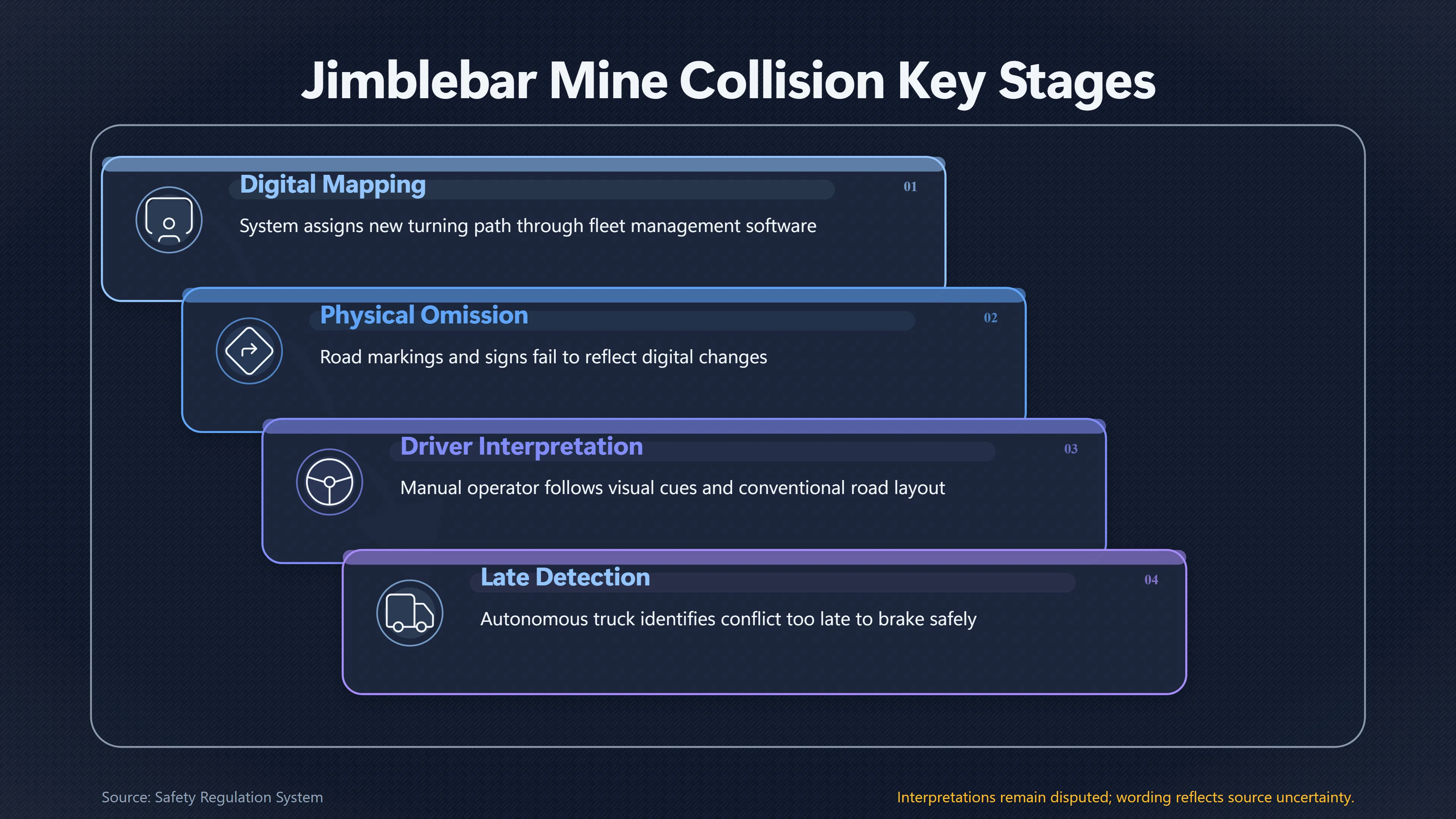
A frequently referenced early autonomous haul truck collision occurred at BHP’s Jimblebar iron ore operation in Western Australia in 2014, during the early expansion of autonomous haulage. According to the US National Institute for Occupational Safety and Health (NIOSH), an autonomous haul truck followed its programmed route and turned right at what existed in the digital mine map as an intersection. A manually operated water truck was travelling in the opposite direction, but its driver did not realise that the autonomous truck intended to make the turn. The autonomous truck detected the developing conflict too late to stop before impact.[CDC Archive]archive.cdc.govCDC ArchiveHaul Truck Research Roadmap Report 2020 | Mining | NIOSH | CDCJanuary 7, 2025…
A later Western Australian safety investigation into an almost identical type of collision explains the underlying mechanism in. The autonomous truck had been assigned a new turning path through the fleet management system, but the corresponding intersection had not been physically marked on the ground or adequately communicated to operators of manually driven vehicles. The water cart driver therefore interpreted the road differently from the autonomous system, even though each was acting consistently with the information available to them.[WorkSafe WA]worksafe.wa.gov.auWorkSafe WAMines Safety Significant Incident Report No. 226 Collision between an autonomous haul truck and manned water cart - WorkSafe –…
The significance of the case lies in the fact that no single dramatic technical malfunction was identified. Instead, multiple layers of coordination failed simultaneously.
Where assumptions diverged
The collision exposed a mismatch between human expectations and machine assumptions.
The autonomous truck relied on a digital map, centrally assigned permissions and predefined traffic rules. It assumed that the route authorised by the control system represented the current physical road network and that other authorised traffic would respect those permissions. The human driver, by contrast, relied primarily on visible road features, conventional driving expectations and the physical appearance of the intersection.
Because those two mental models no longer matched, each participant believed they understood the situation while neither possessed the complete picture. NIOSH later described the event as an example of insufficient communication about vehicle intent and mine-site context rather than simply inadequate obstacle detection.[CDC Archive]archive.cdc.govCDC ArchiveHaul Truck Research Roadmap Report 2020 | Mining | NIOSH | CDCJanuary 7, 2025…
The Western Australian regulator identified several interacting causes:
- the autonomous and manually driven vehicles were placed on intersecting travel paths;
- the digital road configuration had been introduced before equivalent physical traffic controls were established;
- change-management processes for road alterations were inadequate;
- the manually operated vehicle had access to awareness information about the autonomous truck’s intended route but that information was not effectively understood or acted upon;
- once the autonomous truck recognised the conflict, its speed and braking distance meant the collision could no longer be avoided.[WorkSafe WA]worksafe.wa.gov.auWorkSafe WAMines Safety Significant Incident Report No. 226 Collision between an autonomous haul truck and manned water cart - WorkSafe –…
The case therefore challenged the common assumption that better sensors alone would eliminate collisions. Heavy autonomous haul trucks have substantial stopping distances, making early coordination far more effective than last-second collision avoidance.
Changes adopted afterwards
The industry’s response focused less on redesigning autonomous driving algorithms than on redesigning the operating environment.
Common changes introduced across autonomous haulage operations included:
- Clear physical traffic design. Digital routes are expected to match visible road markings, intersection layouts and signage so that manually operated vehicles interpret roads in the same way as autonomous systems.
- Formal change management. New haul routes or intersection changes are typically required to pass structured approval processes before becoming operational, ensuring digital maps, traffic plans and field conditions remain synchronised.
- Improved awareness systems. Operators of support vehicles increasingly receive clearer displays showing the planned movement of autonomous trucks, reducing ambiguity about future vehicle paths.
- Defined interaction rules. Mines increasingly specify explicit right-of-way rules, stopping procedures and communication protocols whenever autonomous and manually operated equipment share operating areas.
- Greater segregation where practical. Many sites reduce opportunities for conflict by separating autonomous haul roads from routes used by maintenance vehicles, water carts and other manually operated equipment whenever mine design allows.[wa.gov.au]worksafe.wa.gov.auWorkSafe WAMines Safety Significant Incident Report No. 226 Collision between an autonomous haul truck and manned water cart - WorkSafe –…
Manufacturers have also continued expanding mixed-fleet capabilities, recognising that most mines transition gradually rather than moving overnight from fully manual to fully autonomous operations. Later generations of autonomous haulage systems place greater emphasis on safe interaction with conventional vehicles during this transition period.[コマツ 企業サイト]komatsu.jpstone inspires plans to accelerate pace of mining automation | Newsroom | Komatsu global site…
Why this case still matters
The collision remains influential because it illustrates a broader principle that extends well beyond mining.
AI systems often perform reliably within the assumptions built into their software. Problems arise when surrounding organisations, infrastructure or human expectations evolve more slowly than the technology itself. In this case, the autonomous truck was operating according to its authorised digital route, while the human driver interpreted the same location using conventional visual cues. Neither perspective alone represented the complete operational reality.
For the wider discussion of AI and human flourishing, this is an important reminder that AI-enabled robotics can remove people from dangerous work, but only when deployment is accompanied by equally careful redesign of workplaces, governance and communication. As autonomous machines become more common in industries ranging from mining to ports and logistics, safety increasingly depends on treating the workplace as an integrated human–AI system rather than assuming that better autonomous vehicles alone will eliminate risk.
Amazon book picks
Further Reading
Books and field guides related to What the Early Haul Truck Collision Really Taught. Use these as the next step if you want deeper reading beyond the article.
Normal Accidents: Living with High-Risk Technologies
Normal Accidents analyzes the social side of technological risk. Charles Perrow argues that the conventional engineering approach to ensu...
Safety-I and Safety-II: The Past and Future of Safety Management
Safety has traditionally been defined as a condition where the number of adverse outcomes was as low as possible (Safety-I). From a Safet...
The Field Guide to Understanding Human Error
The old Bad Apple Theory of human error promotes the idea that a system is basically safe, with the exception of a few unreliable people....
Human Error
James Reason has produced a major theoretical integration of several previously isolated literatures in his new book Human Error. Much of...
eBay marketplace picks
Marketplace Samples
Live-tested eBay searches with available results related to this page.
Selected fromhaul truck model oneBay.co.uk.

Endnotes
1.
Source: archive.cdc.gov
Link:https://archive.cdc.gov/www_cdc_gov/niosh/mining/strategicplan/HaulTruckRoadmap2020.html
Source snippet
CDC ArchiveHaul Truck Research Roadmap Report 2020 | Mining | NIOSH | CDCJanuary 7, 2025...
Published: January 7, 2025
2.
Source: mdpi.com
Link:https://www.mdpi.com/2673-6489/6/3/45
Source snippet
June 26, 2026 — Open Access Review GEOMETRIC AND OPERATIONAL DESIGN PRINCIPLES FOR AUTONOMOUS HAULAGE SYSTEMS IN OPEN-PIT MINING: A SYSTE...
Published: June 26, 2026
3.
Source: mdpi.com
Link:https://www.mdpi.com/2076-3417/15/17/9702
Source snippet
September 3, 2025 — Notably, a significant proportion of hauling operation risks are linked to mobile equipment, with accidents involving...
Published: September 3, 2025
4.
Source: worksafe.wa.gov.au
Link:https://www.worksafe.wa.gov.au/publications/mines-safety-significant-incident-report-no-226-collision-between-autonomous-haul
Source snippet
WorkSafe WAMines Safety Significant Incident Report No. 226 Collision between an autonomous haul truck and manned water cart - WorkSafe –...
5.
Source: srs.dmp.wa.gov.au
Title: Safety Regulation System
Link:https://srs.dmp.wa.gov.au/SRS/Public/PublicationSearch/PopupSummary/17258?publicationType=SignificantIncidentReport
Source snippet
Regulation System - Industry StoreSRS | Significant Incident Report | Area: Mining | Publications | | | REFERENCE ID: SI-659-17258| Statu...
6.
Source: komatsu.jp
Link:https://www.komatsu.jp/en/newsroom/2018/20180129
Source snippet
stone inspires plans to accelerate pace of mining [automation]({{ 'labour-share/' | relative_url }}) | Newsroom | Komatsu global site...
7.
Source: komatsu.com
Title: Autonomous Haulage marks 10 years in the market | Komatsu
Link:https://www.komatsu.com/en-us/blog/2018/autonomous-haulage-marks-10-years-in-the-market
Source snippet
March 28, 2018 — * Image: calendar March 28, 2018 * Image Staff writer * Image Surface mining, Safety, Innovation and technology 2 min re...
Published: March 28, 2018
Additional References
8.
Source: riotinto.com
Link:https://www.riotinto.com/news/releases/2026/battery-electric-haul-truck-trial-in-the-pilbara
Source snippet
BHP, Rio Tinto and Caterpillar launch battery-electric haul truck trial in the Pilbara | GlobalJune 23, 2026 — BHP, RIO TINTO AND CATERPI...
Published: June 23, 2026
9.
Source: geomechanics.io
Link:https://www.geomechanics.io/news/article/eacon-ahs-project-in-australia-ramp-design-and-traffic-lessons-for-mine-engineers
Source snippet
EACON AHS project in Australia: ramp design and traffic lessons for mine engineers | Geomechanics.io NewsMay 21, 2026 — EACON AHS PROJECT...
Published: May 21, 2026
10.
Source: riotinto.com
Link:https://www.riotinto.com/en/news/releases/2021/rio-tinto-teams-up-with-caterpillar-for-zero-emissions-autonomous-trucks
Source snippet
September 15, 2021 — RIO TINTO TEAMS UP WITH CATERPILLAR FOR ZERO-EMISSIONS AUTONOMOUS TRUCKS * * * 15 September 2021 MELBOURNE, Australi...
Published: September 15, 2021
11.
Source: openautonomy.com
Title: When Robots Collide: Autonomous Mining Safety Lessons | Open Autonomy.com
Link:https://www.openautonomy.com/article/autonomous-mining-safety-lessons-incidents
Source snippet
When Robots Collide: Autonomous Mining Safety Lessons | OpenAutonomy.comAugust 15, 2025 — WHEN ROBOTS COLLIDE: THE UNEXPECTED SAFETY LESS...
Published: August 15, 2025
12.
Source: sec.gov
Title: rio ex9930 584
Link:https://www.sec.gov/Archives/edgar/data/863064/000156459018001173/rio-ex9930_584.htm
Source snippet
January 30, 2018 — Rio Tinto’s autonomous haul trucks achieve one billion tonne milestone 30 January 2018 Rio Tinto’s fleet of autonomous...
Published: January 30, 2018
13.
Source: youtube.com
Title: How Can We Make Powered Haulage Safer in the Mining Industry?
Link:https://www.youtube.com/watch?v=osNwXd37Vz4
Source snippet
Inside autonomous mining operations | Volvo Autonomous Solutions...
14.
Source: youtube.com
Title: Preventing Powered Haulage Accidents at Surface Mines
Link:https://www.youtube.com/watch?v=q_4q8lm0tCs
Source snippet
How Can We Make Powered Haulage Safer in the Mining Industry?...
15.
Source: youtube.com
Title: Inside autonomous mining operations | Volvo Autonomous Solutions
Link:https://www.youtube.com/watch?v=wKKBS1XUtHQ
Source snippet
How autonomous trucks work in a quarry...
16.
Source: youtube.com
Title: How autonomous trucks work in a quarry
Link:https://www.youtube.com/watch?v=jt4oOtM-H54