Within Discovery
Which Experiment Should an AI Scientist Run Next?
Active learning helps AI systems spend limited laboratory time on experiments most likely to reduce uncertainty or improve results.
On this page
- Why scientific search spaces become unmanageable
- How uncertainty guides the next experiment
- When optimisation can miss surprising discoveries
Page outline Jump by section
Introduction
In many areas of modern science, the hardest question is not how to run an experiment but which experiment to run next. Researchers exploring new drugs, catalysts, batteries or proteins may face millions or even billions of possible candidates, while laboratory time, specialised equipment and funding remain limited. Active learning is a machine learning approach designed for exactly this problem: instead of testing options at random, it estimates which experiment is most likely to improve knowledge or produce a better result, then recommends that experiment first.[NIST]nist.govfly closed loop materials discovery bayesian active learningOn-the-fly closed-loop materials discovery via Bayesian active learning | NISTNovember 24, 2020…
Within the broader vision of AI scientists accelerating discovery, active learning is one of the core decision-making mechanisms. It allows an AI system to use each experimental result to decide what should happen next, creating a feedback loop in which every experiment makes future choices more informed. If this works reliably, laboratories can spend less time on redundant measurements and more time exploring the parts of scientific search spaces that matter most.[sciopen.com]sciopen.comProgress on Active Learning Assisted Materials DiscoveryJanuary 17, 2023…
Why scientific search spaces become unmanageable
Many scientific problems involve combinations so vast that exhaustive testing is impossible.
A materials scientist may be able to combine dozens of elements in thousands of different proportions. A medicinal chemist may search through an almost unimaginably large number of possible molecules. Protein engineering involves countless possible amino acid substitutions, while manufacturing processes may require optimisation across temperature, pressure, reaction time and many other variables simultaneously.
The consequence is that most potential experiments can never be performed. Even highly automated laboratories can only evaluate a tiny fraction of the possibilities. Choosing experiments intelligently therefore becomes as important as increasing laboratory speed.[nature.com]nature.comAutonomous experiments using active learning and AI | Nature Reviews MaterialsAutonomous experiments using active learning and AI | Nature Reviews Materials
A simple illustration shows the difference:
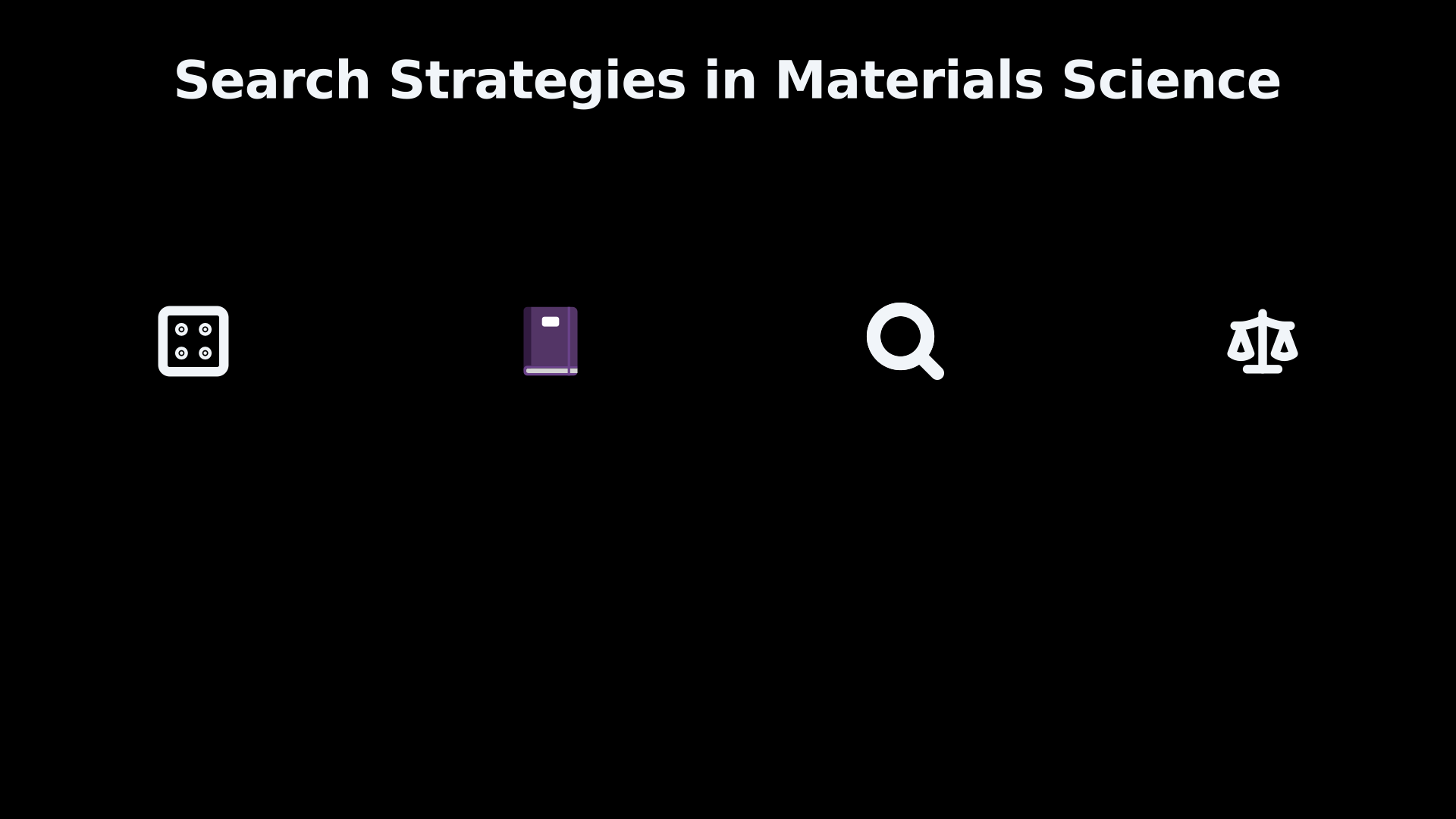
- Random search spends experiments almost uniformly across the available space.
- Expert-guided search follows human intuition but may overlook unfamiliar regions.
- Active learning continually updates its model after every result, concentrating effort where the expected scientific value is greatest.
This does not guarantee finding the best answer immediately. Instead, it aims to maximise what is learned from every costly experiment.
How uncertainty guides the next experiment
The defining feature of active learning is that it does not simply ask, “Which candidate looks best?” It also asks, “Where am I least certain?”
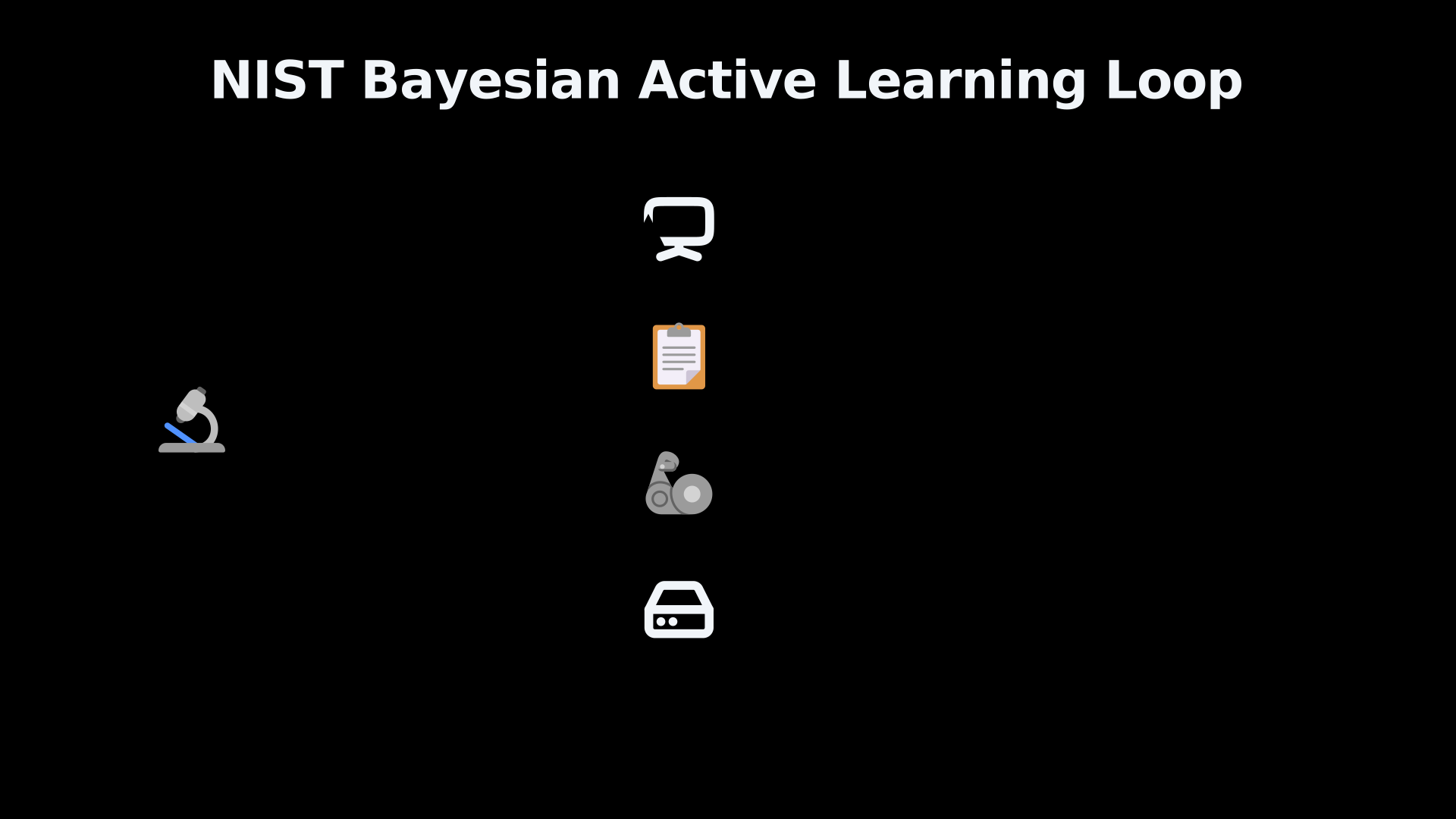
An AI model is first trained using existing experimental data. It then predicts outcomes for untested candidates while estimating how confident those predictions are. Rather than automatically selecting the candidate with the highest predicted performance, the system evaluates which new measurement would provide the greatest benefit.
Different strategies are used depending on the scientific goal.
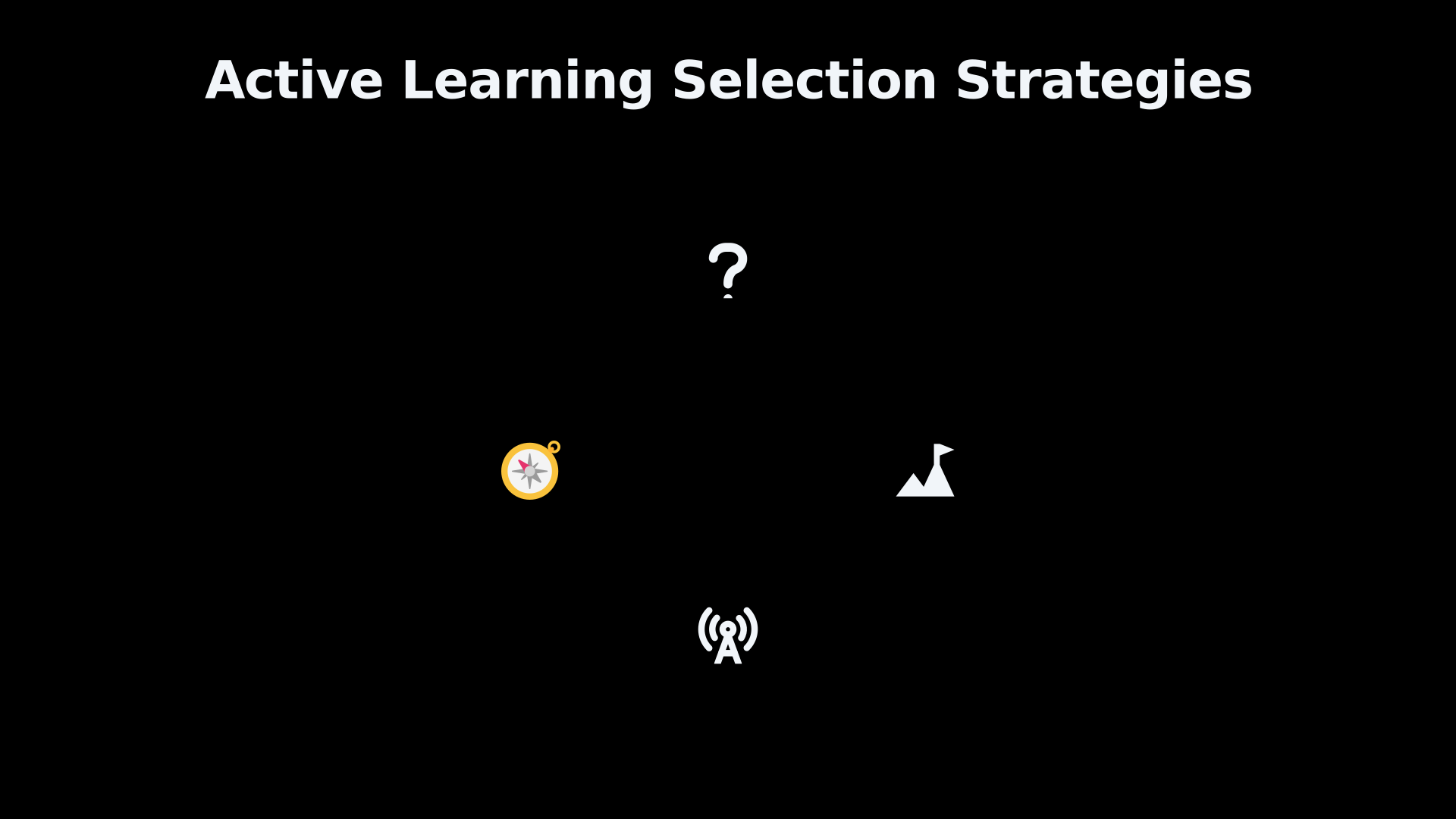
- Uncertainty sampling prioritises experiments where the model has low confidence.
- Expected improvement balances uncertainty with the possibility of discovering something better than the current best result.
- Information gain estimates which experiment would reduce overall uncertainty the most.
- Diversity-based selection avoids repeatedly sampling nearly identical candidates by deliberately exploring different regions of the search space.[nist.gov]nist.govBenchmarking Active Learning Strategies for Materials Optimization and Discovery | NIST…
After the selected experiment is completed, the new measurement is added to the training data. The model is retrained, its uncertainty estimates change, and another experiment is chosen. This repeated cycle forms a closed-loop discovery process in which every experiment directly influences the next decision.[NIST]nist.govfly closed loop materials discovery bayesian active learningOn-the-fly closed-loop materials discovery via Bayesian active learning | NISTNovember 24, 2020…
Why the “best-looking” experiment is often the wrong choice
A common misunderstanding is that AI should always recommend the experiment most likely to succeed.
In practice, repeatedly choosing only the highest-scoring prediction can cause the system to become trapped exploring a small region of the search space. If the model’s early assumptions are wrong, it may never discover better alternatives elsewhere.
Active learning therefore balances two competing objectives:
- Exploitation, which improves the current best solution.
- Exploration, which investigates uncertain regions that might contain even better solutions.
This trade-off resembles scientific research itself. A laboratory that only follows established ideas may improve existing technologies gradually but miss fundamentally new discoveries. A laboratory that explores only speculative ideas may never produce practical results. Active learning attempts to allocate limited experiments between these competing priorities in a systematic way.[NIST]nist.govBenchmarking Active Learning Strategies for Materials Optimization and Discovery | NIST…
Active learning inside autonomous laboratories
The value of active learning becomes especially clear when combined with robotic laboratories.
In a closed-loop autonomous system, software proposes an experiment, robotic equipment performs it, instruments measure the outcome, and the resulting data immediately updates the machine learning model. The next experiment is then selected automatically.
Rather than waiting until hundreds of experiments have finished, the system continuously learns throughout the campaign. Early failures become useful information because they reshape subsequent decisions.
Researchers at the US National Institute of Standards and Technology (NIST) and collaborators have demonstrated Bayesian active learning systems that iteratively discover promising materials while reducing unnecessary experimentation. Their work highlights how autonomous laboratories can “fail smarter” by treating every unsuccessful experiment as information that improves future choices rather than simply as wasted effort.[NIST]nist.govfly closed loop materials discovery bayesian active learningOn-the-fly closed-loop materials discovery via Bayesian active learning | NISTNovember 24, 2020…
Similar principles are increasingly used in materials discovery, catalyst optimisation and other experimental sciences where robotic platforms can rapidly execute the next AI-selected experiment.[nature.com]nature.comAutonomous experiments using active learning and AI | Nature Reviews MaterialsAutonomous experiments using active learning and AI | Nature Reviews Materials
When optimisation can miss surprising discoveries
Active learning is powerful, but it is not a guarantee of scientific creativity.
Everything depends on how uncertainty is estimated and how experiments are scored. If the underlying model has systematic blind spots, its uncertainty estimates may also be misleading. Poorly calibrated models can become overconfident in familiar regions while underestimating genuinely novel possibilities.
Several additional challenges arise in practice.
Models inherit historical bias. If previous experiments concentrated on familiar chemical families or manufacturing methods, the AI may initially recommend more of the same instead of exploring genuinely new directions.
Local optimisation can dominate. Acquisition functions that reward immediate improvement may overlook distant regions with greater long-term potential.
Scientific constraints matter. The mathematically most informative experiment may be impossible because required materials are unavailable, the experiment is unsafe, or laboratory equipment cannot perform it.
Measurement noise complicates decisions. Some experiments naturally produce variable results. Active learning must distinguish genuine uncertainty about the underlying science from random experimental variation.[rsc.org]pubs.rsc.orgRoyal Society of Chemistry PublicationsA critical examination of active learning workflows in materials science - Digital Discovery (RSC…
These limitations explain why many researchers increasingly combine statistical acquisition methods with domain expertise instead of relying solely on automated optimisation.
Why active learning matters for AI scientists
As AI systems become capable of generating thousands or millions of scientific hypotheses, the bottleneck shifts from generating ideas to deciding which ones deserve real-world testing.
Active learning addresses precisely this bottleneck. Instead of assuming that more computation alone will accelerate discovery, it focuses attention on the scarce resource that cannot easily be scaled: high-quality experiments.
In the optimistic vision of AI-assisted scientific acceleration, this mechanism could allow autonomous research systems to extract substantially more knowledge from the same laboratory budget. Better experiment selection could shorten development cycles for new medicines, cleaner energy technologies, advanced materials and industrial processes by reducing redundant work and identifying informative failures earlier.[The Innovation]the-innovation.orgOpen source on the-innovation.org.
At the same time, active learning should not be viewed as a replacement for scientific judgement. Choosing the next experiment remains partly a modelling decision, partly an engineering decision and partly a scientific one. The strongest systems are likely to combine statistical uncertainty, physical knowledge and human expertise rather than relying on any single source of guidance. This balance is one reason active learning is increasingly seen as a foundational component of AI scientists: not because it guarantees breakthroughs, but because it helps ensure that every experiment contributes as much as possible to the next discovery.[rsc.org]pubs.rsc.orgRoyal Society of Chemistry PublicationsA critical examination of active learning workflows in materials science - Digital Discovery (RSC…
Amazon book picks
Further Reading
Books and field guides related to Which Experiment Should an AI Scientist Run Next?. Use these as the next step if you want deeper reading beyond the article.
Hands-on Machine Learning with Scikit-Learn, Keras, and Tenso...
Now fully updated, this bestselling book uses concrete examples, minimal theory, and two production-ready Python frameworks--Scikit-Learn...
Pattern Recognition and Machine Learning
This is the first textbook on pattern recognition to present the Bayesian viewpoint. The book presents approximate inference algorithms t...
The Elements of Statistical Learning
Rating: 4.5/5 from 13 Google Books ratings
This book describes the important ideas in a common conceptual framework. While the approach is statistical, the emphasis is on concepts...
Deep Learning
Rating: 3.5/5 from 6 Google Books ratings
An introduction to a broad range of topics in deep learning, covering mathematical and conceptual background, deep learning techniques us...
eBay marketplace picks
Marketplace Samples
Live-tested eBay searches with available results related to this page.
Selected fromscience robot model oneBay.co.uk.

Endnotes
1.
Source: nist.gov
Title: fly closed loop materials discovery bayesian active learning
Link:https://www.nist.gov/publications/fly-closed-loop-materials-discovery-bayesian-active-learning
Source snippet
On-the-fly closed-loop materials discovery via Bayesian active learning | NISTNovember 24, 2020...
Published: November 24, 2020
2.
Source: nature.com
Title: Autonomous experiments using active learning and AI | Nature Reviews Materials
Link:https://www.nature.com/articles/s41578-023-00588-4
3.
Source: sciopen.com
Title: Progress on Active Learning Assisted Materials Discovery
Link:https://www.sciopen.com/article/10.14062/j.issn.0454-5648.20220924
Source snippet
January 17, 2023...
Published: January 17, 2023
4.
Source: nist.gov
Link:https://www.nist.gov/publications/benchmarking-active-learning-strategies-materials-optimization-and-discovery
Source snippet
Benchmarking Active Learning Strategies for Materials Optimization and Discovery | NIST...
5.
Source: the-innovation.org
Link:https://www.the-innovation.org/article/doi/10.59717/j.xinn-inform.2025.100013
6.
Source: nature.com
Link:https://www.nature.com/articles/s41524-026-02136-4
7.
Source: nature.com
Link:https://www.nature.com/articles/s41598-023-35257-7
8.
Source: nature.com
Link:https://www.nature.com/articles/s41524
9.
Source: pubs.rsc.org
Link:https://pubs.rsc.org/en/Content/ArticleLanding/2026/DD/D6DD00081A
Source snippet
Royal Society of Chemistry PublicationsA critical examination of active learning workflows in materials science - Digital Discovery (RSC...
10.
Source: pubs.rsc.org
Link:https://pubs.rsc.org/en/content/articlehtml/2026/dd/d5dd00525f
11.
Source: pubs.rsc.org
Link:https://pubs.rsc.org/en/content/articlehtml/2026/dd/d5dd00477b
12.
Source: pubs.rsc.org
Link:https://pubs.rsc.org/en/content/articlehtml/2026/dd/d5dd00436e
13.
Source: doi.org
Link:https://doi.org/10.59717/j.xinn-inform.2025.100013
14.
Source: doi.org
Link:https://doi.org/10.1007/s11831-024-10064-z
15.
Source: emdgroup.github.io
Title: Active Learning
Link:https://emdgroup.github.io/baybe/0.13.2/userguide/active_learning.html
Additional References
16.
Source: sciencedirect.com
Link:https://www.sciencedirect.com/science/article/pii/S1568494626009117
Source snippet
CA-SMART: An active learning framework for accelerating materials discovery under resource constraints - ScienceDirectSeptember 1, 2026 —...
Published: September 1, 2026
17.
Source: sciencedirect.com
Title: Exploration-exploitation stratified sampling for label shift in active learning
Link:https://www.sciencedirect.com/science/article/pii/S0957417426014806
Source snippet
October 1, 2026 — EXPLORATION-EXPLOITATION STRATIFIED SAMPLING FOR LABEL SHIFT IN ACTIVE LEARNING Author links open overlay...
Published: October 1, 2026
18.
Source: youtube.com
Link:https://www.youtube.com/watch?v=HJ6VbqwLh3Q
Source snippet
Roman Garnett: Active search for accelerating scientific discovery...
19.
Source: youtube.com
Title: The [Limits]({{ ‘limits/’ | relative_url }}) of AI in Science
Link:https://www.youtube.com/watch?v=4-sWFytOfRw
Source snippet
Mojmír Mutný - Optimal Experiment Design in Markov Chains...
20.
Source: youtube.com
Title: How to Design Better Experiments with Expected Information Gain
Link:https://www.youtube.com/watch?v=wm1YSf45KVM
Source snippet
The Limits of AI in Science - Why We Need [Self-Driving]({{ 'lab-access/' | relative_url }}) Labs — Joseph Krause, Radical AI...
21.
Source: sciencedirect.com
Title: By iterat
Link:https://www.sciencedirect.com/science/article/abs/pii/S1568494626009117
Source snippet
CA-SMART: An active learning framework for accelerating materials discovery under resource constraints - ScienceDirectSeptember 1, 2026 —...
Published: September 1, 2026
22.
Source: researchgate.net
Link:https://www.researchgate.net/publication/397350199_Accelerating_materials_discovery_through_active_learning_Methods_challenges_and_opportunities
23.
Source: cambridge.org
Link:https://www.cambridge.org/engage/chemrxiv/article-details/675aff077be152b1d0bff705
24.
Source: paperswithcode.com
Link:https://paperswithcode.com/paper/confidence-adjusted-surprise-measure-for
25.
Source: emergentmind.com
Link:https://www.emergentmind.com/papers/2503.21095