Within Socratic Tutors
When Does a Hint Help Too Much?
Hints protect learning when they become more specific only after the student has made a genuine attempt.
On this page
- From open questions to targeted clues
- How tutors judge when to increase support
- Why fading hints builds independent problem solving
Page outline Jump by section
Introduction
A hint is helpful only if it leaves the learner with meaningful thinking still to do. That simple principle sits at the heart of Socratic AI tutoring. Rather than supplying complete solutions as soon as a student hesitates, a well-designed tutor offers progressively more specific guidance only after the learner has made a genuine attempt. The goal is to preserve productive struggle: the level of challenge that requires real reasoning without becoming so difficult that the learner gives up.

This mechanism matters well beyond individual homework sessions. If AI is to contribute to the broader vision of human flourishing associated with AI-enabled abundance, it should amplify human intelligence rather than replace it. Progressive hints are one practical way to ensure that AI supports durable understanding, independent problem-solving and transferable reasoning instead of encouraging dependence on instant answers.
When does a hint help too much?
The difference between a useful hint and an unhelpful one is not simply how much information it contains. It is whether the learner still has to perform the critical reasoning that produces lasting learning.
Educational research has long identified an “assistance dilemma”: too little support leaves learners confused, while too much removes the cognitive work that builds understanding. The most effective tutoring systems therefore aim to provide the minimum assistance needed for continued progress rather than the maximum assistance possible.[Wiley Online Library]onlinelibrary.wiley.comWiley Online LibraryWorked Examples and Tutored Problem Solving: Redundant or Synergistic Forms of Support? - Salden - 2009 - Topics in C…
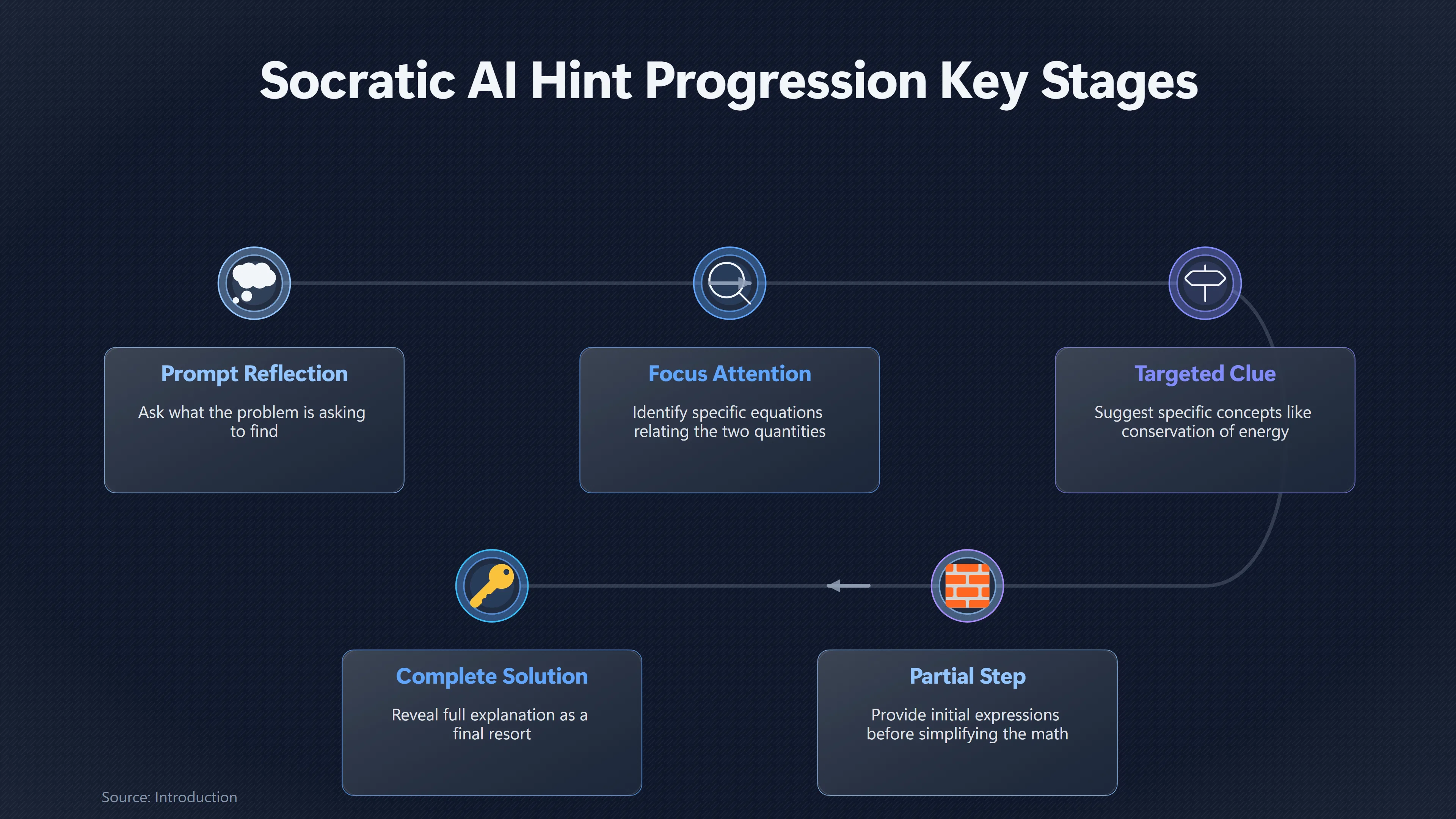
A progressive hint sequence might look like this:
- Prompt reflection: “What is the problem asking you to find?”
- Focus attention: “Which equation relates these two quantities?”
- Provide a targeted clue: “Think about conservation of energy rather than force.”
- Reveal a partial step: “Write the initial energy expression before simplifying.”
- Only as a last resort, explain the complete solution.
Each stage removes a little uncertainty while leaving the learner responsible for the remaining reasoning.
This differs sharply from an answer-first chatbot. Receiving a polished explanation may solve the immediate task, but it often bypasses retrieval, planning and error correction—the very mental activities that strengthen long-term memory and flexible knowledge.
From open questions to targeted clues
Progressive hints work because they gradually reduce the search space rather than replacing the search altogether.
Imagine a student solving an algebra problem.
An ineffective tutor immediately demonstrates every calculation. The student observes the process but performs very little reasoning.
A Socratic tutor instead asks an open question first:
“What do you already know?”
If that proves insufficient, the tutor narrows the focus:
“Which variable appears in both equations?”
If the learner still struggles:
“Try substituting the expression from the first equation into the second.”
Only if repeated attempts fail would the tutor demonstrate the algebra directly.
The key is that every additional hint responds to evidence about the learner’s current understanding rather than following a fixed script. This keeps the problem within the learner’s reach while preserving ownership of the solution process.
Research on intelligent tutoring systems consistently finds that adaptive support outperforms one-size-fits-all instruction because different learners require different amounts of assistance at different moments.[researchgate.net]researchgate.netLearning with intelligent tutors and worked examples: selecting learning activities adaptively leads to better learning outco…

How tutors judge when to increase support
An effective AI tutor does not simply count incorrect answers. It tries to infer whether the learner is making productive progress or becoming genuinely stuck.
Signals may include:
- repeated unsuccessful attempts using the same misconception
- increasingly inconsistent reasoning
- long pauses suggesting uncertainty
- requests for help after sustained effort
- explanations that reveal partial understanding.
Instead of treating every mistake identically, the tutor asks whether the learner remains within what educational psychologists often call the zone of proximal development—tasks that are challenging but achievable with limited assistance.
Modern AI tutors increasingly combine dialogue, learner history and knowledge-tracing models to estimate this changing state. Rather than deciding only whether an answer is correct, they estimate how much guidance is likely to move learning forward without eliminating the learner’s own contribution.[arXiv]arxiv.orgThe Path to Conversational AI Tutors: Integrating Tutoring Best Practices and Targeted Technologies to Produce Scalable AI AgentsFeb…
This makes hint progression dynamic. Two students facing the same problem may receive very different forms of assistance because one needs conceptual prompting while the other needs only a reminder about notation.
Why fading hints builds independent problem-solving
Progressive hinting is closely connected to another well-established instructional principle: fading.
Early in learning, students benefit from substantial support such as worked examples or partially completed solutions. As competence grows, that support is deliberately withdrawn until learners solve problems independently.
The important point is that support disappears because understanding increases—not because the lesson has simply reached a later page.
Studies of intelligent tutoring systems have repeatedly found that adaptive fading produces better transfer than maintaining either permanently high assistance or permanently low assistance. Learners become better at solving unfamiliar problems because they gradually assume responsibility for more of the reasoning process themselves.[wiley.com]onlinelibrary.wiley.comWiley Online LibraryWorked Examples and Tutored Problem Solving: Redundant or Synergistic Forms of Support? - Salden - 2009 - Topics in C…
For AI tutors, this means success is not measured by how quickly students finish today’s exercise. It is measured by whether tomorrow they need fewer hints than they needed today.
Productive struggle is calibrated, not endless
The phrase “productive struggle” can sound as though more difficulty is always better. Research suggests the opposite.
Struggle becomes counterproductive when learners lack enough prior knowledge to make meaningful progress, receive no feedback, or become overwhelmed by frustration. Effective tutors therefore calibrate challenge continuously rather than celebrating difficulty for its own sake.
Three ingredients work together:
- Appropriate challenge: problems are difficult enough to require new thinking but not impossible.
- Targeted scaffolding: hints address the immediate obstacle without solving the entire task.
- Psychological safety: learners can make mistakes, revise ideas and ask for help without feeling judged.
If any one of these elements is missing, productive struggle can become either aimless confusion or passive answer-following.[ASME Publications]asmepublications.onlinelibrary.wiley.comASME Publications When I say … productive struggleASME PublicationsWhen I say … productive struggle - Mucheli - Medical Education - Wiley Online LibraryJanuary 8, 2026…

Why conversational AI makes hint progression both easier and harder
Large language models can generate natural, personalised hints far more flexibly than earlier tutoring systems. Instead of selecting from a library of pre-written prompts, they can respond directly to a student’s reasoning.
That flexibility also creates a new risk.
Because modern language models are trained to be helpful, they often drift towards giving away answers during extended conversations, especially when learners repeatedly ask for them. Researchers have begun describing this failure mode as scaffolding collapse, where the tutoring strategy gradually gives way to answer generation.
Recent work explores methods for making conversational tutors preserve their progressive hinting behaviour even under sustained pressure from users requesting full solutions. Rather than relying solely on surface-level prompts, these approaches attempt to reinforce scaffold-preserving behaviour throughout longer tutoring dialogues.[arXiv]arxiv.orgOpen source on arxiv.org.
This illustrates that progressive hints are not simply a user-interface choice. They are increasingly treated as an architectural requirement for educational AI.
Why this mechanism matters for AI-enabled human flourishing
Within the wider vision of AI Bloom, education is valuable not merely because it helps students complete assignments more efficiently. Its deeper importance lies in expanding humanity’s collective capacity to reason, discover and create.
If advanced AI consistently removes intellectual effort, it risks creating a population that relies on increasingly capable systems while developing fewer independent cognitive skills.
Progressive hints point towards a different future. They use AI’s enormous knowledge not to replace thinking but to keep learners operating at the edge of their current ability. The AI supplies exactly enough support to sustain progress while preserving the mental work that strengthens understanding.
That distinction may appear subtle during a single tutoring session. Across millions of learners and years of education, however, it becomes significant. A society in which AI routinely helps people build stronger reasoning skills is better positioned to accelerate science, innovation and informed decision-making than one in which AI merely supplies finished answers.
Progressive hints therefore represent more than a tutoring technique. They embody a broader design philosophy for educational AI: use artificial intelligence to increase human intelligence, not to make it unnecessary.
Amazon book picks
Further Reading
Books and field guides related to When Does a Hint Help Too Much?. Use these as the next step if you want deeper reading beyond the article.
Make It Stick: The Science of Successful Learning
To most of us, learning something "the hard way" implies wasted time and effort. Good teaching, we believe, should be creatively tailored...
The Cambridge Handbook of the Learning Sciences
Learning sciences is an interdisciplinary field that studies teaching and learning. The sciences of learning include cognitive science, e...
Peak: Secrets from the New Science of Expertise
A survey of the psychology of expertise, providing techniques for developing mastery of any skill, drawn from the authors' extensive, pat...
How People Learn II: Learners, Contexts, and Cultures
There are many reasons to be curious about the way people learn, and the past several decades have seen an explosion of research that has...
eBay marketplace picks
Marketplace Samples
Live-tested eBay searches with available results related to this page.
Selected fromteacher mug oneBay.co.uk.




Endnotes
1.
Source: onlinelibrary.wiley.com
Link:https://onlinelibrary.wiley.com/doi/full/10.1111/j.1756-8765.2008.01011.x
Source snippet
Wiley Online LibraryWorked Examples and Tutored Problem Solving: Redundant or Synergistic Forms of Support? - Salden - 2009 - Topics in C...
2.
Source: onlinelibrary.wiley.com
Link:https://onlinelibrary.wiley.com/doi/abs/10.1111/j.1756-8765.2008.01011.x
Source snippet
Wiley Online LibraryWorked Examples and Tutored Problem Solving: Redundant or Synergistic Forms of Support? - Salden - 2009 - Topics in C...
3.
Source: researchgate.net
Link:https://www.researchgate.net/publication/309686919_Learning_with_intelligent_tutors_and_worked_examples_selecting_learning_activities_adaptively_leads_to_better_learning_outcomes_than_a_fixed_curriculum
Source snippet
Learning with intelligent tutors and worked examples: selecting learning activities adaptively leads to better learning outco...
4.
Source: arxiv.org
Link:https://arxiv.org/abs/2602.07308
5.
Source: arxiv.org
Link:https://arxiv.org/abs/2602.19303
Source snippet
The Path to Conversational AI Tutors: Integrating Tutoring Best Practices and Targeted Technologies to Produce Scalable AI AgentsFeb...
6.
Source: arxiv.org
Link:https://arxiv.org/abs/2605.12988
7.
Source: asmepublications.onlinelibrary.wiley.com
Title: ASME Publications When I say … productive struggle
Link:https://asmepublications.onlinelibrary.wiley.com/doi/full/10.1111/medu.70171
Source snippet
ASME PublicationsWhen I say … productive struggle - Mucheli - Medical Education - Wiley Online LibraryJanuary 8, 2026...
Published: January 8, 2026
8.
Source: arxiv.org
Link:https://arxiv.org/abs/2607.19371
9.
Source: doi.org
Link:https://doi.org/10.1145/3772318.3791631
Additional References
10.
Source: sciencedirect.com
Link:https://www.sciencedirect.com/science/article/abs/pii/S0959475212001016
Source snippet
How much is too much? Learning and motivation effects of adding instructional explanations to worked examples - ScienceDirect...
11.
Source: sciencedirect.com
Link:https://www.sciencedirect.com/science/article/pii/S1560429226001861
Source snippet
When Does Scaffolding Provide Too Much Assistance? A Code-Tracing Tutor Investigation - ScienceDirect...
12.
Source: youtube.com
Title: Harvard and Wharton Studied [AI Tutoring]({{ ‘ai-tutoring/’ | relative_url }}), Here’s What They Learned
Link:https://www.youtube.com/watch?v=iDwfBwC2Fnk
Source snippet
Productive struggle AI education tutoring Built For Learning: Preserving Productive Struggle in AI Tools for High-Impact Tutoring SCALE I...
13.
Source: youtube.com
Link:https://www.youtube.com/watch?v=LCqR5KsFCZk
Source snippet
How AI Could Save (Not Destroy) Education | Sal Khan | TED...
14.
Source: youtube.com
Title: Learning with AI: Tools, Truths, and the Science of Productive Struggle
Link:https://www.youtube.com/watch?v=eV55UOZcUzo
Source snippet
Harvard and Wharton Studied AI Tutoring, Here's What They Learned...
15.
Source: youtube.com
Title: How AI Could Save (Not Destroy) Education | Sal Khan | TED
Link:https://www.youtube.com/watch?v=hJP5GqnTrNo
Source snippet
Learning with AI: Tools, Truths, and the Science of Productive Struggle...
16.
Source: youtube.com
Title: How Productive Struggle Fires Up Learners
Link:https://www.youtube.com/watch?v=ZEaJ_VASrR0
Source snippet
Built For Learning: Preserving Productive Struggle in AI Tools for High-Impact Tutoring...
17.
Source: mdpi.com
Link:https://www.mdpi.com/2227-7102/16/8/1179
18.
Source: eric.ed.gov
Link:https://eric.ed.gov/?id=EJ1248039
19.
Source: eric.ed.gov
Link:https://eric.ed.gov/?id=EJ1276830