Within Eye Exams
What Clinics Need Before Autonomous Eye Screening Works
Successful autonomous screening depends on trained staff, usable images, record integration and a clear route from a positive result to specialist care.
On this page
- Training staff to capture usable retinal images
- Connecting instant results to records and referrals
- Lessons from the health centre that doubled completion
Page outline Jump by section
Introduction
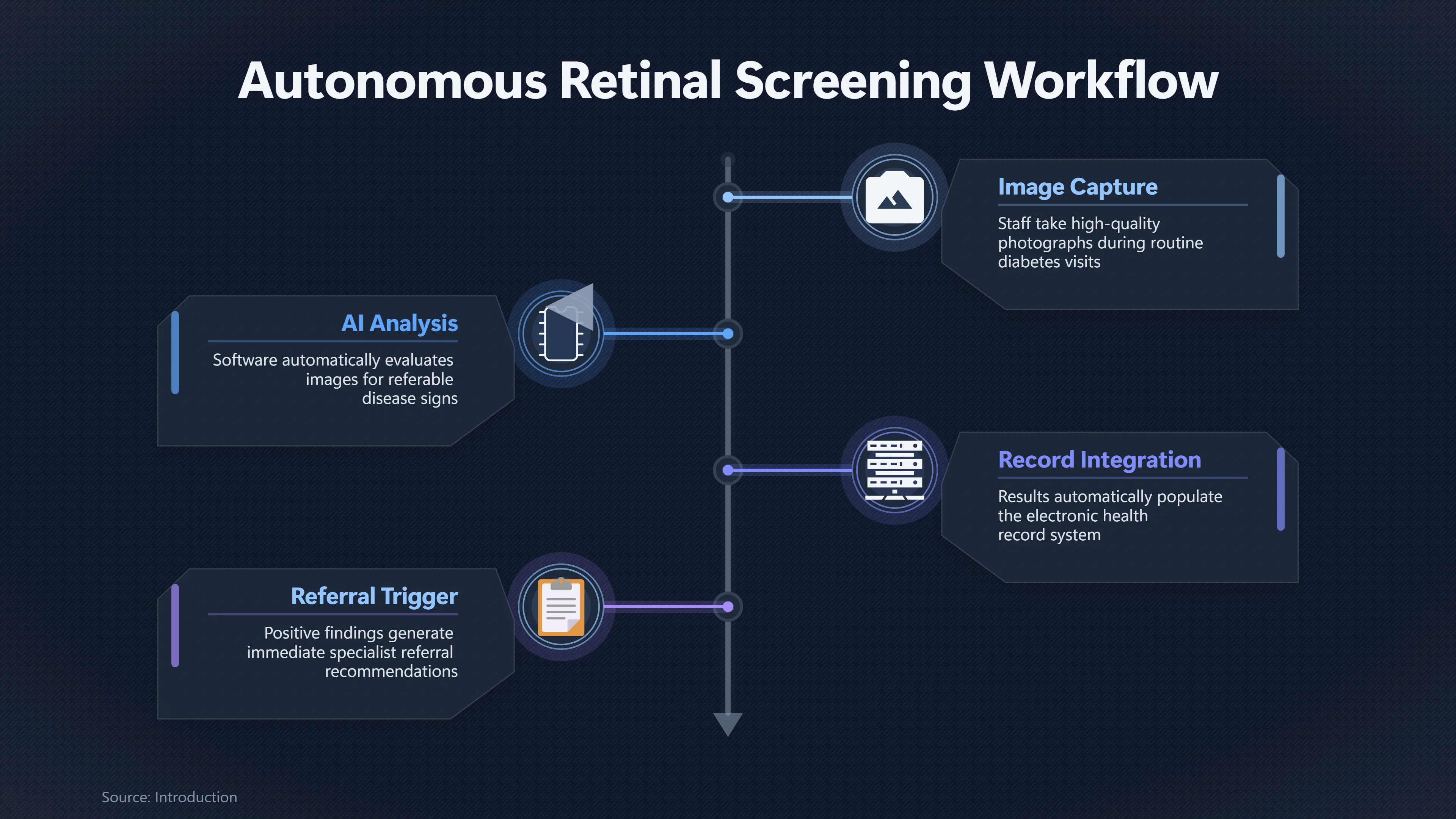
Autonomous eye screening does not succeed simply because an AI system can detect diabetic retinopathy accurately. It succeeds when primary care clinics redesign everyday diabetes care so that retinal imaging, AI analysis, documentation and referral happen as one smooth process during a routine visit. In practice, the technology is only one part of a larger service model.
This implementation focus matters beyond ophthalmology. Within the broader idea of AI helping expand access to healthcare, autonomous retinal screening shows how specialist expertise can be embedded into ordinary clinics rather than remaining concentrated in specialist centres. It offers a practical example of how AI can increase the reach of existing medical services, while also illustrating that lasting improvements depend on workflow, staff training and reliable follow-up rather than software alone.[PubMed]pubmed.ncbi.nlm.nih.govDiabetic Retinopathy Screening Among Federally Qualified Health Center Patients Using Point-of-Care AI: DRES-POCAI: A Trial Protoco…
Training staff to capture usable retinal images
The first requirement is surprisingly simple: someone in the clinic must be able to take consistently high-quality retinal photographs.
Most autonomous screening programmes train medical assistants, nurses or healthcare assistants rather than eye specialists. Capturing retinal photographs is a structured technical skill rather than an ophthalmology qualification. Staff learn how to position patients, align the camera, minimise reflections, recognise blurred images and repeat photographs when necessary.
This matters because autonomous systems can only analyse what they can see. If an image is obscured by poor focus, eyelid interference, small pupils or movement, the examination may be classified as non-diagnostic. That does not necessarily mean disease is present, but it usually triggers referral or repeat imaging, reducing efficiency and increasing costs. Studies of point-of-care retinal photography therefore treat image quality as one of the central implementation measures alongside diagnostic accuracy.[PubMed]pubmed.ncbi.nlm.nih.govTelemedical Diabetic Retinopathy Screening in a Primary Care Setting: Quality of Retinal Photographs and Accuracy of Automated Imag…
Successful clinics typically build image capture into existing diabetes appointments instead of creating a separate workflow. A patient may have blood pressure measured, laboratory tests reviewed, retinal photographs taken and diabetes management discussed during the same visit. This reduces disruption for both staff and patients while making eye screening a routine expectation rather than an optional extra.[PubMed]pubmed.ncbi.nlm.nih.govDiabetic Retinopathy Screening Among Federally Qualified Health Center Patients Using Point-of-Care AI: DRES-POCAI: A Trial Protoco…
Connecting instant results to records and referrals
Autonomous AI is most valuable when its output becomes part of the clinic’s normal clinical record rather than remaining on a separate device.
Modern implementations generally connect the retinal camera and AI system with the electronic health record (EHR). Once images are analysed, the result is automatically recorded alongside the patient’s diabetes care documentation. Clinicians can immediately see whether the examination is negative, positive for referable disease or technically insufficient.
That integration enables several practical improvements:
- screening completion is documented automatically;
- positive results trigger referral workflows before the patient leaves the clinic;
- non-diagnostic images prompt repeat photography or specialist referral;
- clinicians avoid duplicate paperwork;
- population health teams can monitor which patients remain overdue for screening.
The DRES-POCAI implementation trial in US federally qualified health centres was specifically designed around this principle. The workflow integrates AI screening into the electronic record, automatically returns results to clinicians and generates referral recommendations according to risk level, recognising that software alone cannot improve access unless it is connected to routine clinical operations.[PubMed]pubmed.ncbi.nlm.nih.govDiabetic Retinopathy Screening Among Federally Qualified Health Center Patients Using Point-of-Care AI: DRES-POCAI: A Trial Protoco…
Referral pathways matter as much as the AI
An autonomous examination is a screening decision, not a complete episode of care.
Patients with positive findings still require comprehensive assessment by an optometrist or ophthalmologist, confirmation of the diagnosis where appropriate and, if needed, treatment such as retinal laser therapy, anti-VEGF injections or ongoing monitoring.
For that reason, successful programmes establish referral arrangements before introducing the AI system. Clinics need agreed pathways that define:
- which findings require urgent referral;
- where patients will be sent;
- how appointments will be booked;
- how specialists report outcomes back to primary care;
- who contacts patients who miss follow-up appointments.
Without these downstream processes, screening can identify more disease without ensuring more treatment.
Recent research from Johns Hopkins found that autonomous AI programmes in primary care were associated with increased attendance at specialist eye care among patients referred after screening, suggesting that embedding referral into routine primary care can improve follow-through rather than simply increasing the number of diagnoses. The authors also noted that implementation may help reduce disparities in access for some underserved populations, although further validation is needed.[nature.com]nature.comtients | npj Digital MedicineMarch 5, 2026…
Lessons from the health centre that doubled completion
One of the clearest implementation examples comes from Zufall Health Center, a federally qualified health centre in the United States.
The organisation introduced an FDA-cleared autonomous AI system directly into routine diabetes appointments because demand for annual diabetic eye examinations exceeded the capacity of its on-site eye care service.
Rather than asking patients to arrange a separate appointment elsewhere, staff incorporated retinal photography into ordinary diabetes visits. Patients who screened negative avoided unnecessary specialist referrals, while those with suspected disease were referred promptly.
Between implementation in 2021 and mid-2023, completion of annual diabetic eye examinations increased from around 16% to approximately 35%, with hundreds of examinations performed using the autonomous system itself. Among patients examined by AI, roughly one quarter were identified as needing specialist referral, while the remainder avoided unnecessary referral because no referable disease was detected. The main operational gain was therefore not replacing ophthalmologists but allowing scarce specialist appointments to be focused on patients most likely to benefit.[Diabetes Journals]diabetesjournals.orgQualified Health Center | Diabetes | American Diabetes Association…
Although individual clinics differ in staffing, funding and patient populations, the experience illustrates a broader lesson: implementation succeeds when autonomous screening becomes another standard element of chronic disease management rather than an isolated technology project.
Practical challenges clinics still face
Despite encouraging results, implementation remains more demanding than purchasing an AI system.
Common operational challenges include:
- maintaining staff competency as personnel change;
- ensuring cameras remain calibrated and available;
- managing patients whose images are repeatedly ungradable;
- integrating software with different electronic record systems;
- securing reimbursement for screening;
- ensuring enough specialist capacity exists for referred patients.
These practical constraints explain why implementation research increasingly focuses on workflow design, staff acceptance and organisational change rather than algorithm accuracy alone. Clinical studies now evaluate whether AI screening can be sustained across multiple primary care sites, improve screening rates in underserved communities and fit naturally into existing diabetes services.[PubMed]pubmed.ncbi.nlm.nih.govDiabetic Retinopathy Screening Among Federally Qualified Health Center Patients Using Point-of-Care AI: DRES-POCAI: A Trial Protoco…
Why implementation is the real scalability challenge
From the perspective of AI-enabled human flourishing, autonomous retinal screening is valuable because it demonstrates that expanding access often depends less on creating a more capable model than on redesigning healthcare delivery.
The AI does not eliminate ophthalmologists. Instead, it enables primary care teams to perform the first stage of screening safely and consistently, reserving specialist expertise for diagnosis, treatment and complex cases. If similar implementation principles can be applied across other forms of preventive care, AI could gradually extend high-quality medical services to many more people without requiring a matching increase in specialist numbers.
That makes clinic rollout an important lesson for the wider AI abundance discussion. The greatest gains may come not from replacing professionals but from allowing existing expertise to reach far more patients through carefully designed clinical workflows that combine trained staff, reliable digital infrastructure and clear pathways into specialist care.[nih.gov]pubmed.ncbi.nlm.nih.govDiabetic Retinopathy Screening Among Federally Qualified Health Center Patients Using Point-of-Care AI: DRES-POCAI: A Trial Protoco…
Amazon book picks
Further Reading
Books and field guides related to What Clinics Need Before Autonomous Eye Screening Works. Use these as the next step if you want deeper reading beyond the article.

Deep Medicine: How Artificial Intelligence Can Make Healthcar...
First published 2019. Subjects: Artificial intelligence, Medical informatics, Medical applications, Diagnosis, Data processing.
The Digital Doctor: Hope, Hype, and Harm at the Dawn of Medic...
The New York Times Science Bestseller from Robert Wachter, Modern Healthcare’s #1 Most Influential Physician-Executive in the US While mo...

The Checklist Manifesto: How to Get Things Right
Rating: 3.9/5 from 35 Google Books ratings
First published 2010. Subjects: Listes, Emergency Medicine, Clinical Competence, Qualité, Lists.
Better: A Surgeon's Notes on Performance
The bestselling author of Complications' fascinating examination of how medical professionals strive for better, even in the face of adve...
eBay marketplace picks
Marketplace Samples
Live-tested eBay searches with available results related to this page.
Selected fromhealthcare poster oneBay.co.uk.

Current eBay listing
Vintage Healthcare Motivational Wall Art Poster Premium Quality

Current eBay listing
Vintage Medical Poster Wall Art - Inspirational Healthcare Print


Current eBay listing
Healthcare Human Care Framed Wall Art Poster Canvas Print Picture
Endnotes
1.
Source: nature.com
Link:https://www.nature.com/articles/s41467-023-44676-z
Source snippet
al | Nature Communications...
2.
Source: nature.com
Link:https://www.nature.com/articles/s41746-026-02460-5
Source snippet
tients | npj Digital MedicineMarch 5, 2026...
Published: March 5, 2026
3.
Source: nature.com
Link:https://www.nature.com/articles/s41746-026-02460-5.pdf
4.
Source: pubmed.ncbi.nlm.nih.gov
Link:https://pubmed.ncbi.nlm.nih.gov/41118165/
Source snippet
Diabetic Retinopathy Screening Among Federally Qualified Health Center Patients Using Point-of-Care AI: DRES-POCAI: A Trial Protoco...
5.
Source: diabetesjournals.org
Link:https://diabetesjournals.org/diabetes/article/73/Supplement_1/57-OR/156635/57-OR-Enhancing-Diabetic-Eye-Disease-Detection
Source snippet
Qualified Health Center | Diabetes | American Diabetes Association...
6.
Source: pubmed.ncbi.nlm.nih.gov
Link:https://pubmed.ncbi.nlm.nih.gov/34151725/
Source snippet
Telemedical Diabetic Retinopathy Screening in a Primary Care Setting: Quality of Retinal Photographs and Accuracy of [Automated]({{ 'auto-experiments/' | relative_url }}) Imag...
7.
Source: pubmed.ncbi.nlm.nih.gov
Link:https://pubmed.ncbi.nlm.nih.gov/41781569/
Source snippet
Autonomous AI-assisted diabetic retinopathy screening at primary care is associated with increased presentation to eye care by at r...
8.
Source: diabetesjournals.org
Link:https://diabetesjournals.org/diabetes/article/75/Supplement_1/2720-LB/168167/2720-LB-Bridging-Primary-Care-and-Ophthalmology-at
Source snippet
2720-LB: Bridging Primary Care and Ophthalmology at Emory Health Care: A Phase 1 Evaluation of AI Retinal Screening for Diabetic Retinopa...
9.
Source: pmc.ncbi.nlm.nih.gov
Link:https://pmc.ncbi.nlm.nih.gov/articles/PMC11754548/
10.
Source: pmc.ncbi.nlm.nih.gov
Link:https://pmc.ncbi.nlm.nih.gov/articles/PMC11703125/
11.
Source: pmc.ncbi.nlm.nih.gov
Link:https://pmc.ncbi.nlm.nih.gov/articles/PMC10784572/
12.
Source: pmc.ncbi.nlm.nih.gov
Link:https://pmc.ncbi.nlm.nih.gov/articles/PMC10788651/
13.
Source: pmc.ncbi.nlm.nih.gov
Link:https://pmc.ncbi.nlm.nih.gov/articles/PMC10361413/
14.
Source: pmc.ncbi.nlm.nih.gov
Link:https://pmc.ncbi.nlm.nih.gov/articles/PMC10232822/
15.
Source: pubmed.ncbi.nlm.nih.gov
Link:https://pubmed.ncbi.nlm.nih.gov/39118821/
16.
Source: pmc.ncbi.nlm.nih.gov
Link:https://pmc.ncbi.nlm.nih.gov/articles/PMC11309021/
17.
Source: diabetesjournals.org
Link:https://diabetesjournals.org/diabetes/article/68/Supplement_1/604-P/58462/604-P-Automated-Diabetic-Retinopathy-Screening-in
18.
Source: pubmed.ncbi.nlm.nih.gov
Link:https://pubmed.ncbi.nlm.nih.gov/18779547/
Additional References
19.
Source: youtube.com
Link:https://www.youtube.com/watch?v=Ruu57cV1eLI
Source snippet
RETINA AI Galaxy™ Autonomous Artificial Intelligence (AI) Detection of Diabetic Retinopathy...
20.
Source: youtube.com
Link:https://www.youtube.com/watch?v=reYQusRXecE
Source snippet
LumineticsCore™ Engineered by Digital Diagnostics: Revolutionizing Healthcare with AI...
21.
Source: pure.johnshopkins.edu
Title: Wolf *, Roomasa Channa *,
Link:https://pure.johnshopkins.edu/en/publications/autonomous-ai-assisted-diabetic-retinopathy-screening-at-primary-/
Source snippet
AI-assisted diabetic retinopathy screening at primary care is associated with increased presentation to eye care by at risk patients - Jo...
22.
Source: youtube.com
Link:https://www.youtube.com/watch?v=FmIDLPeJSjw
Source snippet
Autonomous AI for Diabetic Retinopathy Screening...
23.
Source: youtube.com
Title: Autonomous AI for Diabetic Retinopathy Screening
Link:https://www.youtube.com/watch?v=AUlv_GmR-KU
Source snippet
Benefits of Automated Diabetic Retinopathy Screening: A Discussion with Lauren Patty Daskivich, MD...
24.
Source: jamanetwork.com
Link:https://jamanetwork.com/journals/jamanetworkopen/fullarticle/2840380?guestAccessKey=4cf9c5aa-0c95-41c8-bc50-3b5a70f1fcbb
25.
Source: tandfonline.com
Link:https://www.tandfonline.com/doi/abs/10.1080/09286586.2021.1939886
26.
Source: youtube.com
Link:https://www.youtube.com/watch?v=8QQydaArg60
27.
Source: iro.uiowa.edu
Link:https://iro.uiowa.edu/esploro/outputs/journalArticle/Autonomous-AI-assisted-diabetic-retinopathy-screening-at/9985141867702771
28.
Source: bmjopen.bmj.com
Link:https://bmjopen.bmj.com/content/11/8/e044805