Within Who Benefits
Will AI Savings Reach Users or Platforms?
Cheaper AI output may raise platform profits more than lower prices when computing, data and distribution remain concentrated.
On this page
- Why lower production costs may not cut prices
- How compute, data and distribution reinforce market power
- Which competition rules could widen access
Page outline Jump by section
Introduction
If advanced AI makes writing, coding, analysis and other forms of knowledge work dramatically cheaper, many people assume that prices for AI-powered services will fall by a similar amount. That may happen in highly competitive markets, but it is far from guaranteed. When a small number of firms control the computing infrastructure, specialist chips, cloud platforms, data and customer relationships needed to deliver AI at scale, they can retain a large share of the efficiency gains instead of passing them on to users. This is one of the central distribution questions within the wider debate about AI-enabled abundance: not whether AI can become vastly more productive, but who captures the resulting value. The answer depends less on the technology itself than on competition, market structure and public policy.[oecd.org]oecd.orgcompetition in artificial intelligence infrastructure 623d1874 enCompetition in artificial intelligence infrastructure | OECDNovember 14, 2025…

Why Lower Production Costs May Not Cut Prices
Economic theory does not say that lower production costs automatically become lower consumer prices. Prices are shaped by competition as well as costs. Where many firms compete for customers, efficiency gains are often passed through as cheaper products. Where markets are concentrated, firms can instead expand profit margins.
AI creates an unusual combination of falling marginal costs and high fixed costs. Once a frontier model has been trained, producing another response may cost only a tiny amount in electricity and computing time. However, the infrastructure required to reach that point—including advanced chips, enormous data centres, networking equipment and engineering teams—requires investments measured in billions of pounds or dollars. Those high entry costs reduce the number of firms able to compete directly.[oecd.org]oecd.orgcompetition in artificial intelligence infrastructure 623d1874 enCompetition in artificial intelligence infrastructure | OECDNovember 14, 2025…
Even if the underlying cost of generating an answer falls sharply, customers may continue paying for services that bundle together trusted brands, enterprise support, integration with existing software, legal liability, security guarantees and regulatory compliance. The value retained by providers therefore reflects much more than the computational cost of producing text or images.
How Compute, Data and Distribution Reinforce Market Power
The most important mechanism is not any single monopoly but several reinforcing advantages operating together.
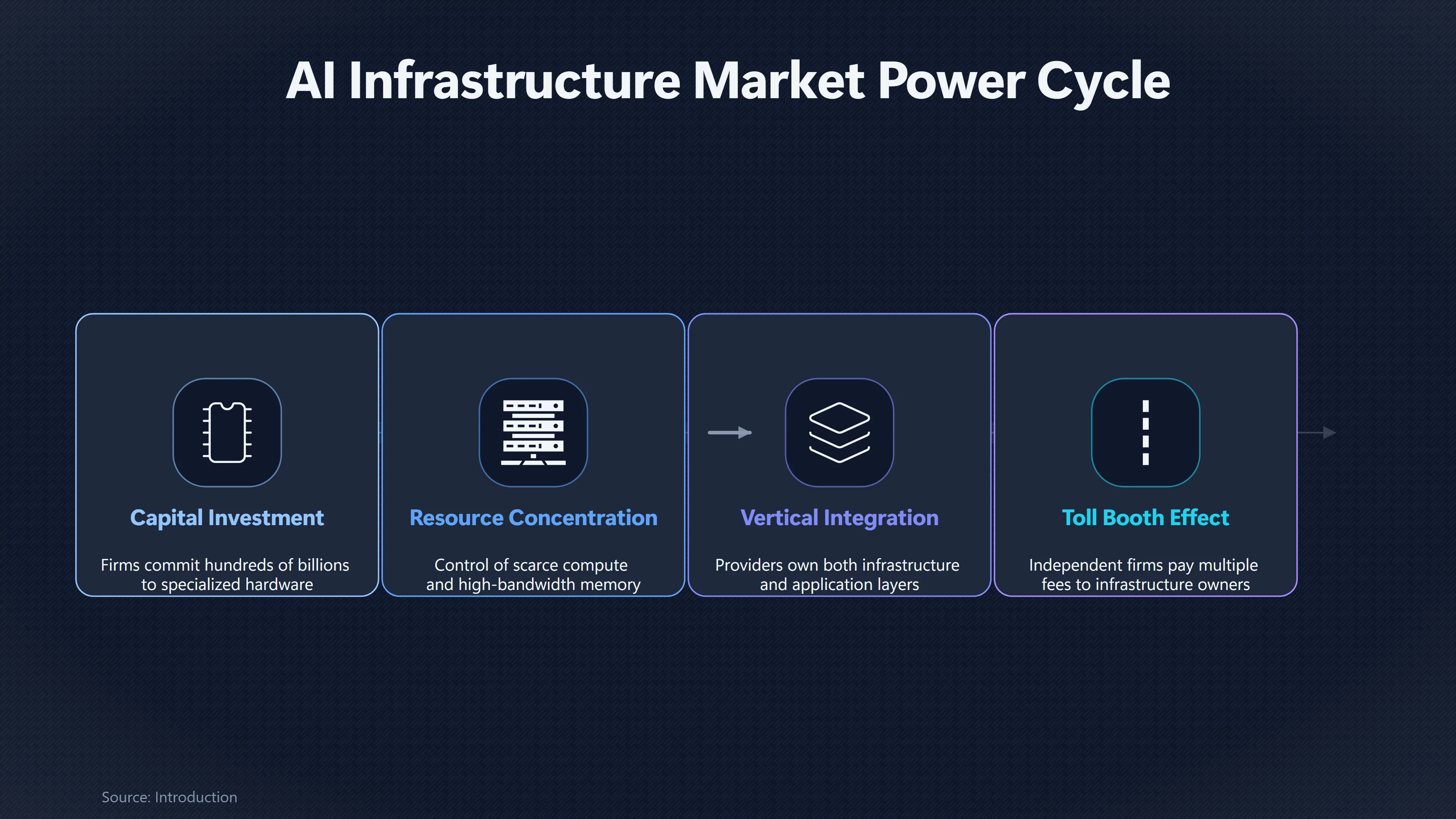
Scarce computing infrastructure. Frontier AI depends on specialised processors, high-bandwidth memory, advanced semiconductor manufacturing and data centres with reliable power and cooling. Several stages of this supply chain are already highly concentrated, with individual firms or a handful of companies dominating key components. This limits the number of organisations capable of building or serving the largest models efficiently.[oecd.org]oecd.orgcomponent 6Market features in AI infrastructure: Competition in artificial intelligence infrastructure | OECDNovember 14, 2025…
Cloud platforms. Most businesses do not operate their own AI supercomputers. Instead, they rent computing capacity from hyperscale cloud providers. If those providers also build their own AI models, they occupy both the infrastructure layer and the application layer, allowing them to benefit regardless of which AI products succeed. The OECD identifies increasing vertical integration across AI infrastructure as a growing competition issue.[oecd.org]oecd.orgsummary: Competition in artificial intelligence infrastructure | OECDNovember 14, 2025…
Proprietary data and ecosystems. Large technology firms often combine AI with search engines, productivity software, mobile operating systems, advertising platforms or online marketplaces. Existing customer relationships reduce marketing costs and make it easier to distribute new AI services. They also generate valuable behavioural data that can improve products over time.
Switching costs. Once a business builds internal tools around one cloud provider’s AI services, moving to another platform may require expensive engineering work, retraining staff and rebuilding software. Even if rival models become cheaper, customers may remain locked into existing ecosystems. The US Federal Trade Commission has highlighted contractual arrangements and technical dependencies that can increase switching costs in major AI partnerships.[ftc.gov]ftc.govOpen source on ftc.gov.
Together these mechanisms mean that infrastructure owners may capture value not because they charge high prices for every AI response, but because they become indispensable intermediaries across thousands of AI-powered businesses.
Why Infrastructure Can Become a Toll Booth
Many digital markets exhibit strong network effects: more users attract more developers, more complementary services and more data, making the platform increasingly valuable.
AI infrastructure adds another layer. A company that owns cloud computing, AI accelerators, developer tools and enterprise software can earn revenue at multiple stages of the same transaction. For example, an independent software company may pay for cloud computing, use the platform’s AI models, integrate with its productivity software and distribute applications through its marketplace.
This creates what economists sometimes describe as a bottleneck position. Rather than competing only through better end-user products, infrastructure providers earn returns because many other firms depend on access to their facilities. If AI dramatically expands the amount of digital work performed each day, ownership of these bottlenecks could become increasingly valuable even if individual AI services become inexpensive.
Recent investment trends illustrate the scale of this strategy. The largest technology companies are collectively committing hundreds of billions of dollars annually to AI infrastructure, reflecting expectations that control of computing capacity itself will generate long-term economic returns.[ft.com]ft.comMeta, despite lacking a cloud arm, is leveraging AI for advertising gains and is exploring monetizing its data center capacity. However…
Strategic Partnerships Can Deepen Concentration
The rapid growth of AI has been accompanied by unusually close partnerships between leading cloud providers and frontier AI developers.
These arrangements can accelerate innovation by giving AI laboratories access to capital and computing resources that would otherwise be difficult to obtain. At the same time, competition authorities have questioned whether such partnerships reinforce existing market power.
The US Federal Trade Commission’s study of partnerships involving Microsoft, OpenAI, Amazon and Anthropic, and Google and Anthropic identified several issues worth monitoring:
- preferential access to scarce computing resources;
- contractual rights that may increase dependence on particular cloud providers;
- potential sharing of commercially sensitive information;
- stronger barriers for rival infrastructure providers attempting to compete.[ftc.gov]ftc.govOpen source on ftc.gov.
These concerns do not prove anti-competitive behaviour. Rather, they illustrate how ownership structures and long-term commercial agreements can influence whether AI markets remain open to new entrants.

Will Competition Naturally Solve the Problem?
The optimistic view is that today’s concentration reflects a temporary phase rather than a permanent outcome.
Several developments could weaken incumbent advantages:
- open-weight AI models reduce dependence on proprietary systems;
- specialised AI hardware from additional suppliers may increase competition;
- falling hardware costs could make smaller-scale deployment more affordable;
- more efficient models reduce the amount of computing needed per task;
- new cloud providers or regional infrastructure may emerge as viable alternatives.
History provides examples supporting both possibilities. Personal computers, web hosting and smartphones all became substantially cheaper over time as competition intensified. By contrast, internet search, social networking and some cloud services have remained relatively concentrated despite rapid technological progress.
The eventual balance will depend on whether improvements in AI efficiency outpace the tendency for infrastructure ownership to concentrate.
Which Competition Rules Could Widen Access?
The goal of competition policy is not necessarily to prevent firms from earning returns on risky investments. Large investments in AI infrastructure require significant incentives. The challenge is ensuring those incentives do not become durable barriers to innovation or broad access.
Possible policy approaches include:
- Monitoring exclusive partnerships. Competition authorities increasingly examine whether strategic investments create unnecessary lock-in or foreclose rivals from essential computing resources.[ftc.gov]ftc.govOpen source on ftc.gov.
- Supporting interoperable standards. Easier migration between cloud platforms lowers switching costs and increases competitive pressure.
- Expanding public compute. Governments and research organisations can provide universities, startups and public-interest researchers with access to advanced computing infrastructure that would otherwise be unaffordable.
- Encouraging open models where appropriate. Open-weight systems can broaden participation in AI development while still allowing commercial competition around deployment, support and specialised services.
- Maintaining scrutiny of mergers and vertical integration. Competition authorities increasingly view AI infrastructure as a connected supply chain rather than isolated markets, recognising that market power can accumulate across multiple layers.[oecd.org]oecd.orgfull reportCompetition in artificial intelligence infrastructure | OECDNovember 14, 2025…
These measures do not guarantee lower prices, but they increase the likelihood that productivity gains will spread through competitive pressure rather than remaining concentrated.

Why This Matters for AI Bloom
The long-term vision of AI-enabled abundance depends on more than ever-improving models. It also depends on whether the economic benefits of those models diffuse widely enough to raise living standards, expand opportunity and accelerate scientific and social progress.
If infrastructure owners retain most productivity gains through persistent market power, AI could still generate extraordinary wealth while leaving access relatively unequal. Knowledge work might become cheaper to produce, yet the savings would appear mainly as higher corporate profits, larger returns on infrastructure investment and greater concentration of economic influence.
If, instead, competition, open technologies and effective governance encourage those efficiency gains to flow through lower prices, broader access and faster innovation across the economy, AI could contribute more directly to the wider human flourishing envisioned by the AI bloom perspective. The distribution of AI’s benefits is therefore not a secondary policy question but one of the mechanisms that will determine whether abundant intelligence becomes a broadly shared public good or primarily a source of platform power.
Amazon book picks
Further Reading
Books and field guides related to Will AI Savings Reach Users or Platforms?. Use these as the next step if you want deeper reading beyond the article.
The Age of Surveillance Capitalism
The challenges to humanity posed by the digital future, the first detailed examination of the unprecedented form of power called "surveil...
Platform Revolution
A practical guide to the new economy that is transforming the way we live, work, and play. Uber. Airbnb. Amazon. Apple. PayPal. All of th...

Capitalism and freedom
Rating: 3.8/5 from 6 Google Books ratings
First published 1962. Subjects: Business, Capitalism, Economic policy, Liberty, Nonfiction.
The Innovator's Dilemma
An innovation classic. From Steve Jobs to Jeff Bezos, Clay Christensen’s work continues to underpin today’s most innovative leaders and o...
eBay marketplace picks
Marketplace Samples
Live-tested eBay searches with available results related to this page.
Selected fromtechnology poster oneBay.co.uk.




Endnotes
1.
Source: oecd.org
Title: competition in artificial intelligence infrastructure 623d1874 en
Link:https://www.oecd.org/en/publications/competition-in-artificial-intelligence-infrastructure_623d1874-en.html
Source snippet
Competition in artificial intelligence infrastructure | OECDNovember 14, 2025...
Published: November 14, 2025
2.
Source: ftc.gov
Link:https://www.ftc.gov/news-events/news/press-releases/2025/01/ftc-issues-staff-report-ai-partnerships-investments-study
3.
Source: ft.com
Link:https://www.ft.com/content/dcf3873e-7b32-4a24-a90d-3bccf1d2c996
Source snippet
Meta, despite lacking a cloud arm, is leveraging AI for advertising gains and is exploring monetizing its data center capacity. However...
4.
Source: oecd.org
Title: component 6
Link:https://www.oecd.org/en/publications/competition-in-artificial-intelligence-infrastructure_623d1874-en/full-report/component-6.html
Source snippet
Market features in AI infrastructure: Competition in artificial intelligence infrastructure | OECDNovember 14, 2025...
Published: November 14, 2025
5.
Source: oecd.org
Link:https://www.oecd.org/en/publications/competition-in-artificial-intelligence-infrastructure_623d1874-en/full-report/component-3.html
Source snippet
summary: Competition in artificial intelligence infrastructure | OECDNovember 14, 2025...
Published: November 14, 2025
6.
Source: ftc.gov
Link:https://www.ftc.gov/policy/advocacy-research/tech-at-ftc/2025/01/behind-ftcs-6b-report-large-ai-partnerships-investments
7.
Source: oecd.org
Title: full report
Link:https://www.oecd.org/en/publications/competition-in-artificial-intelligence-infrastructure_623d1874-en/full-report.html
Source snippet
Competition in artificial intelligence infrastructure | OECDNovember 14, 2025...
Published: November 14, 2025
8.
Source: GOV.UK
Title: Cloud services market investigation
Link:https://www.gov.uk/cma-cases/cloud-services-market-investigation
9.
Source: oecd.org
Title: component 8
Link:https://www.oecd.org/en/publications/competition-in-artificial-intelligence-infrastructure_623d1874-en/full-report/component-8.html
10.
Source: oecd.org
Title: component 5
Link:https://www.oecd.org/en/publications/competition-in-artificial-intelligence-infrastructure_623d1874-en/full-report/component-5.html
11.
Source: oecd.org
Link:https://www.oecd.org/en/publications/competition-in-artificial-intelligence-infrastructure_623d1874-en/full-report/component-7.html
12.
Source: oecd.ai
Title: The geography of AI compute: Mapping what is available and where
Link:https://oecd.ai/en/wonk/the-geopgraphy-of-ai-compute-mapping-what-is-available-and-where
13.
Source: GOV.UK
Link:https://www.gov.uk/government/news/cma-independent-inquiry-group-publishes-provisional-findings-in-cloud-services-market-investigation
14.
Source: GOV.UK
Title: www.gov.uk CM A outlines growing concerns in markets for AI Foundation Models
Link:https://www.gov.uk/government/news/cma-outlines-growing-concerns-in-markets-for-ai-foundation-models
15.
Source: search.ftc.gov
Title: launches inquiry generative ai investments partnerships
Link:https://search.ftc.gov/news-events/news/press-releases/2024/01/ftc-launches-inquiry-generative-ai-investments-partnerships
16.
Source: ftc.gov
Link:https://www.ftc.gov/advice-guidance/competition-guidance/industry-guidance/competition-technology-marketplace
17.
Source: ftc.gov
Link:https://www.ftc.gov/reports/ftc-staff-report-ai-partnerships-investments-6b-study
18.
Source: ftc.gov
Title: Office of Technology | Federal Trade Commission Displaying 1
Link:https://www.ftc.gov/office-technology
19.
Source: ftc.gov
Link:https://www.ftc.gov/policy/advocacy-research/tech-at-ftc/2023/06/generative-ai-raises-competition-concerns?page=1
Additional References
20.
Source: oecd-ilibrary.org
Link:https://www.oecd-ilibrary.org/en/publications/competition-in-the-age-of-ai_6f88a1ea-en.html
Source snippet
e info MORE INFO Close DOI [https://doi.org/10.1787/6f88a1ea-en](https://doi.org/10.1787/6f88a1ea-en) Authors OECD Pages 75 Tags * Sci...
21.
Source: youtube.com
Title: Google’s Appeal to FTC: Ending [Microsoft-Open AI]({{ ‘microsoft-open-ai/’ | relative_url }}) Cloud Partnership
Link:https://www.youtube.com/watch?v=rz8bAXjboQQ
Source snippet
Who profits from AI infrastructure compute cloud monopolies economics The Trillion-Dollar AI Secret Nobody Is Talking About WISEWIRE...
22.
Source: theinformation.com
Link:https://www.theinformation.com/briefings/ftc-starts-inquiry-of-ai-deals-involving-microsoft-openai-google-amazon-anthropic/
23.
Source: alvarezandmarsal.com
Link:https://www.alvarezandmarsal.com/thought-leadership/rise-of-the-neoscalers-global-race-to-build-ai-infrastructure
24.
Source: computing.co.uk
Link:https://www.computing.co.uk/news/2025/legislation-regulation/uk-cma-accuses-microsoft-and-amazon-of-stifling-cloud-competition
25.
Source: datacenterdynamics.com
Link:https://www.datacenterdynamics.com/en/news/uks-cma-finds-elements-of-cloud-computing-market-has-adverse-effect-on-competition/
26.
Source: news.ftcpublications.com
Link:https://news.ftcpublications.com/core/coordinated-antitrust-probes-zero-in-on-big-techs-ai-partnerships-and-cloud-dominance/
27.
Source: youtube.com
Title: The Economics of an AI Data Center
Link:https://www.youtube.com/watch?v=869NxCb5o6k
Source snippet
Google's Appeal to FTC: Ending Microsoft-OpenAI Cloud Partnership...
28.
Source: datacenterdynamics.com
Link:https://www.datacenterdynamics.com/en/news/competition-is-not-working-well-says-uk-cma-concluding-cloud-market-investigation/
29.
Source: techcrunch.com
Link:https://techcrunch.com/2025/01/18/ftc-says-partnerships-like-microsoft-openai-raise-antitrust-concerns/