Within Materials Scale Up
Can Robotic Labs Keep Up With AI Discovery?
Robotic laboratories can test AI-predicted materials far faster, but their throughput still falls far short of computational discovery.
On this page
- How self driving laboratories run closed experimental loops
- What Berkeley Lab's A Lab achieved in continuous testing
- Why physical validation still lags behind prediction
Page outline Jump by section
Introduction
Can robotic laboratories keep up with AI-driven materials discovery? The short answer is: not yet, but they are beginning to narrow one of the most important bottlenecks in modern science. Machine learning systems can now propose millions of potentially useful materials for batteries, catalysts, semiconductors and clean-energy technologies. The limiting factor is no longer generating ideas but testing which of those ideas work in the physical world. Autonomous, or “self-driving”, laboratories address this gap by combining robotics, machine learning and automated measurement into continuous experimental loops that can run day and night. They dramatically increase the rate at which promising materials can be synthesised and evaluated, but physical experimentation remains orders of magnitude slower, more expensive and more constrained than computational prediction.[nature.com]nature.comNovember 29, 2023…
For the broader vision of AI accelerating scientific progress, this distinction matters. Faster prediction alone does not create new batteries or carbon-capture materials. Those advances depend on turning digital hypotheses into reliable physical evidence, and autonomous laboratories are becoming one of the most important bridges between the two.
How self-driving laboratories run closed experimental loops
Traditional materials research involves many manual hand-offs. A researcher designs an experiment, prepares chemicals, runs synthesis, measures the resulting material, interprets the data and then decides what to try next. Each iteration can take days or weeks.
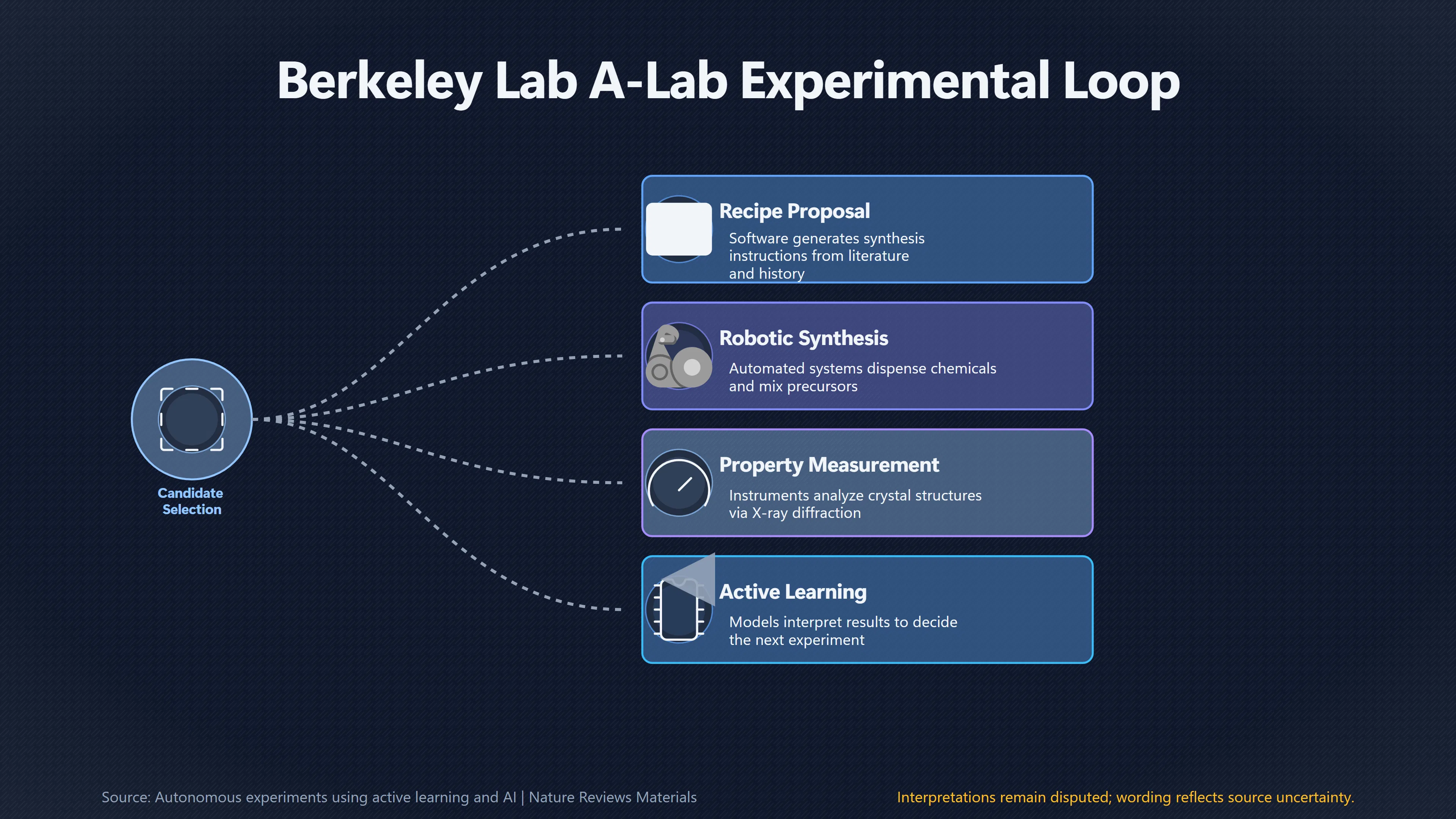
An autonomous laboratory compresses this process into a largely automated cycle:
- AI selects promising candidate materials.
- Software proposes synthesis recipes using prior experiments and published literature.
- Robotic systems dispense chemicals, mix precursors and perform synthesis.
- Automated instruments measure properties such as crystal structure.
- Machine-learning models interpret the results.
- An active-learning algorithm decides the next experiment based on everything learned so far.
Rather than executing a fixed batch of experiments, the laboratory continually updates its strategy as new evidence arrives. Failed experiments are treated as useful information, allowing the system to avoid repeating unproductive approaches and to refine future synthesis conditions. This “closed-loop” optimisation is one of the defining features of self-driving laboratories.[nature.com]nature.comNovember 29, 2023…
The approach is especially valuable because materials discovery is rarely a simple yes-or-no question. A theoretically stable material may require different temperatures, reaction times, precursor ratios or heating schedules before it can actually be produced. Active learning helps the laboratory search this experimental space far more efficiently than exhaustive trial and error.
What Berkeley Lab’s A-Lab demonstrated
Lawrence Berkeley National Laboratory’s A-Lab has become one of the clearest demonstrations of how autonomous experimentation can reduce the validation bottleneck.
The platform integrates robotics, data from the Materials Project, machine-learning models trained on published synthesis literature and automated X-ray diffraction analysis into a single experimental system. Researchers provided a list of predicted inorganic compounds, while the laboratory itself planned, executed and interpreted most of the experimental work.[nature.com]nature.comNovember 29, 2023…
The headline results were striking:
- the laboratory operated continuously for 17 days with minimal human intervention;
- it completed 353 synthesis experiments;
- it successfully synthesised 36 of 57 target compounds reported in the final published version of the study;
- every unsuccessful attempt fed back into the system to improve later experimental choices.[nature.com]nature.comNovember 29, 2023…
The significance is not simply the number of successful materials. More important is that the laboratory showed an automated system could perform an entire experimental learning cycle rather than acting as a robotic assistant carrying out pre-planned instructions.
The project also exposed why autonomous laboratories matter. Large computational searches such as Google DeepMind’s GNoME can predict hundreds of thousands of stable candidate materials. Even validating a tiny fraction of those predictions manually would require enormous amounts of laboratory time. A-Lab demonstrated one practical method for increasing experimental throughput enough to begin exploiting these computational advances.[nature.com]nature.comNovember 29, 2023…
Why physical validation still lags behind prediction
Despite this progress, autonomous laboratories remain far slower than AI systems that generate candidate materials.
Several constraints explain the gap.
Experiments obey physical limits. Robots cannot synthesise thousands of crystalline solids simultaneously in the way AI can evaluate thousands of hypothetical crystal structures every second. Heating, cooling, mixing and measurement each require real time.
Many predictions cannot be tested immediately. Some proposed materials require rare starting chemicals, specialised furnaces, air-free handling or extreme pressures that lie outside the capabilities of today’s automated platforms.[wired.com]wired.comGoogle Deep Mind's AI Dreamed Up 380,000 New MaterialsThe Next Challenge Is Making ThemNovember 29, 2023 — Google DeepMind developed an AI program, GNoME, which has predicted 380,000 new stab…
Synthesis is often harder than prediction. A material that is thermodynamically stable on paper may form only under highly specific reaction pathways or may compete with unwanted by-products. Discovering the correct recipe can require many rounds of experimentation.[nature.com]nature.comNovember 29, 2023…
Characterisation remains complex. Confirming that the intended material has actually formed can involve multiple analytical techniques and careful interpretation, particularly when samples contain several crystalline phases or impurities.[nature.com]nature.comNovember 29, 2023…
As a result, the fundamental mismatch remains. AI may generate hundreds of thousands—or even millions—of promising candidates, while autonomous laboratories can validate only a comparatively small number over weeks or months.
What autonomous labs actually accelerate
Because experimentation cannot match computational scale, the greatest benefit of autonomous laboratories is not unlimited throughput but smarter allocation of scarce experimental effort.
Instead of testing candidates randomly, self-driving laboratories prioritise experiments expected to provide the greatest information. This changes the economics of discovery in several ways:
- reducing time spent on uninformative experiments;
- identifying failed synthesis routes earlier;
- automatically refining recipes after unsuccessful attempts;
- operating continuously rather than only during working hours;
- producing structured experimental datasets that improve future AI models.
In effect, autonomous laboratories increase the information gained from every experiment rather than simply multiplying the number of experiments performed. Active-learning systems aim to reach useful discoveries with fewer physical trials, which is often more valuable than attempting exhaustive testing.[nist.gov]nist.govOn-the-fly closed-loop materials discovery via Bayesian active learning | NISTOn-the-fly closed-loop materials discovery via Bayesian active learning | NIST

Remaining bottlenecks beyond robotics
Even highly automated laboratories do not eliminate the broader challenges of bringing a new material into practical use.
Successfully synthesising a compound is only an early milestone. Researchers must still determine whether it:
- performs reliably outside carefully controlled laboratory conditions;
- can be manufactured consistently at industrial scale;
- uses affordable and available raw materials;
- remains stable over years of operation;
- satisfies environmental and safety requirements;
- delivers enough improvement to justify replacing existing materials.
These downstream stages often take far longer than initial synthesis and involve engineering, manufacturing and regulatory work that autonomous laboratories cannot automate away. The path from promising crystal to commercial battery, catalyst or solar cell typically spans many years.[axios.com]axios.comSelf-driving labs are the new AI assetThese labs autonomously conduct experiments in a closed-loop system, learning from outcomes to refine future experimentation. The goal is…
What this means for AI-driven scientific acceleration
For the broader idea of AI accelerating scientific discovery, autonomous laboratories represent an essential complement rather than a complete solution.
Prediction without experimentation produces large catalogues of hypothetical materials but little practical impact. Conversely, robotics without AI still struggles to search enormous chemical spaces efficiently. Combining the two creates a feedback loop in which computational models generate better hypotheses, experiments produce better data and improved data strengthen future models.
Researchers are now exploring more capable “agentic” laboratory systems that coordinate multiple experimental platforms, optimise measurement costs and manage broader research campaigns rather than isolated experiments. These developments remain early, but they point towards laboratories that spend less time on low-value trials and more quickly converge on promising materials.[nature.com]nature.comJuly 8, 2026…
The evidence today therefore supports a balanced conclusion. Autonomous laboratories are substantially reducing one of the biggest obstacles in AI-enabled materials discovery, but they are not closing it entirely. The testing gap has become narrower, not disappeared. For visions of long-term AI-enabled abundance, that distinction is important: scientific acceleration depends not only on generating more ideas but on building experimental systems capable of turning those ideas into reliable physical knowledge at ever greater speed.
Amazon book picks
Further Reading
Books and field guides related to Can Robotic Labs Keep Up With AI Discovery?. Use these as the next step if you want deeper reading beyond the article.
Energy and Civilization
A comprehensive account of how energy has shaped society throughout history, from pre-agricultural foraging societies through today's fos...
The Fourth Paradigm: Data-Intensive Scientific Discovery
Foreword. A transformed scientific method. Earth and environment. Health and wellbeing. Scientific infrastructure. Scholarly communication.
The Coming Wave: Technology, Power, and the Twenty-first Cent...
"We are approaching a critical threshold in the history of our species. Everything is about to change. Soon you will live surrounded by A...
The Age of A.I.: And Our Human Future
Traditional Chinese edition of The Age of A.I.: And Our Human Future
eBay marketplace picks
Marketplace Samples
Live-tested eBay searches with available results related to this page.
Selected fromrobotics kit oneBay.co.uk.

Endnotes
1.
Source: nature.com
Link:https://www.nature.com/articles/s41586-023-06734-w
Source snippet
November 29, 2023...
Published: November 29, 2023
2.
Source: nature.com
Title: Autonomous experiments using active learning and AI | Nature Reviews Materials
Link:https://www.nature.com/articles/s41578-023-00588-4
3.
Source: nist.gov
Title: On-the-fly closed-loop materials discovery via Bayesian active learning | NIST
Link:https://www.nist.gov/publications/fly-closed-loop-materials-discovery-bayesian-active-learning
4.
Source: wired.com
Title: Google Deep Mind’s AI Dreamed Up 380,000 New Materials
Link:https://www.wired.com/story/an-ai-dreamed-up-380000-new-materials-the-next-challenge-is-making-them
Source snippet
The Next Challenge Is Making ThemNovember 29, 2023 — Google DeepMind developed an AI program, GNoME, which has predicted 380,000 new stab...
Published: November 29, 2023
5.
Source: axios.com
Title: Self-driving labs are the new AI asset
Link:https://www.axios.com/2024/08/09/ai-self-driving-science-labs-research
Source snippet
These labs autonomously conduct experiments in a closed-loop system, learning from outcomes to refine future experimentation. The goal is...
6.
Source: nature.com
Link:https://www.nature.com/articles/s43246-026-01219-5
Source snippet
July 8, 2026...
Published: July 8, 2026
7.
Source: nature.com
Link:https://www.nature.com/articles/s41467-025-59231-1
8.
Source: nature.com
Title: Robot chemist sparks row with claim it created new materials | Nature
Link:https://www.nature.com/articles/d41586-023-03956-w
9.
Source: nature.com
Title: Google AI and robots join forces to build new materials
Link:https://www.nature.com/articles/d41586-023-03745-5
10.
Source: ceder.berkeley.edu
Title: a lab paper published in nature featured in news story
Link:https://ceder.berkeley.edu/news/a-lab-paper-published-in-nature-featured-in-news-story/
11.
Source: nature.com
Link:https://www.nature.com/articles/s41467-020-19597-w
12.
Source: natureasia.com
Title: Nature ハイライト:新規材料を合成する自律型実験室 | Nature | Nature Portfolio
Link:https://www.natureasia.com/index.php/ja-jp/nature/highlights/111088
Additional References
13.
Source: hharesearch.org
Link:https://hharesearch.org/research/briefs/autonomous-self-driving-laboratories-materials-discovery
Source snippet
PROBLEM STATEMENT Discovering a new material and bringing it to market takes 10 to 20 ye...
14.
Source: youtube.com
Title: Self-Driving Laboratories: Accelerating Chemistry and Materials Science
Link:https://www.youtube.com/watch?v=3bnGTS113nU
Source snippet
The Limits of AI in Science - Why We Need Self-Driving Labs — Joseph Krause, Radical AI...
15.
Source: youtube.com
Title: Andy Cooper: Materials discovery and innovation | Digital futures
Link:https://www.youtube.com/watch?v=ifQ_ecdfEBk
Source snippet
The Rise of Autonomous Self-Driving Laboratories | AI, Robotics & the Scientific Discovery...
16.
Source: youtube.com
Link:https://www.youtube.com/watch?v=_uyFHvC5Tvc
Source snippet
Science 101: What is Autonomous Discovery?...
17.
Source: arxiv.org
Link:https://arxiv.org/abs/2607.04508
18.
Source: osti.gov
Link:https://www.osti.gov/biblio/2281696
19.
Source: youtube.com
Title: Science 101: What is Autonomous Discovery?
Link:https://www.youtube.com/watch?v=IAa09O1T4BY
Source snippet
Self-Driving Laboratories: Accelerating Chemistry and Materials Science...
20.
Source: cen.acs.org
Link:https://cen.acs.org/research-integrity/Nature-robot-chemist-paper-corrected/104/web/2026/01
Source snippet
acs.org‘Nature’ robot chemist paper corrected, but some questions remain unansweredJanuary 29, 2026 — ‘Nature’ robot chemist paper correc...
Published: January 29, 2026
21.
Source: mendeley.com
Link:https://www.mendeley.com/catalogue/0d6d00b0-4902-37c6-b635-d6963778f67b/
22.
Source: phys.org
Link:https://phys.org/news/2025-07-automated-labs-materials.html