Within Robotics
Can Farm Robots End the Most Dangerous Fieldwork?
Field robots could reduce pesticide contact, tractor accidents and dangerous heat exposure, but mud, weather, delicate crops and low margins remain formidable
On this page
- The farm hazards most suited to automation
- Why fields are harder for robots than factories
- Whether labour shortages and climate pressure will accelerate adoption
Page outline Jump by section
Introduction
Agriculture remains one of the world’s most hazardous occupations. Farm workers routinely combine heavy machinery, pesticide handling, repetitive physical labour and long hours under increasingly dangerous temperatures. As climate change intensifies heat exposure and labour shortages worsen in many regions, agricultural robots are attracting attention not simply as productivity tools but as a way to remove people from some of farming’s riskiest tasks.

This makes farm robotics an important branch of the wider idea that AI and robotics could reduce dangerous labour. The strongest near-term case is not fully autonomous farms without people. Instead, it is targeted automation that keeps workers away from pesticide spray, reduces time spent in extreme heat, lowers exposure to machinery accidents and allows people to supervise hazardous work from safer locations. Whether this vision succeeds depends less on artificial intelligence alone than on whether robots can cope with mud, rain, uneven ground, changing crops and the unforgiving economics of agriculture.
The farm hazards most suited to automation
Unlike many industrial workplaces, farms combine multiple hazards at once. Workers may spend hours outdoors in high temperatures, operate large machinery, carry heavy loads and apply chemicals, often in isolated locations far from immediate medical help.
Several categories of work are especially well suited to robotic assistance.
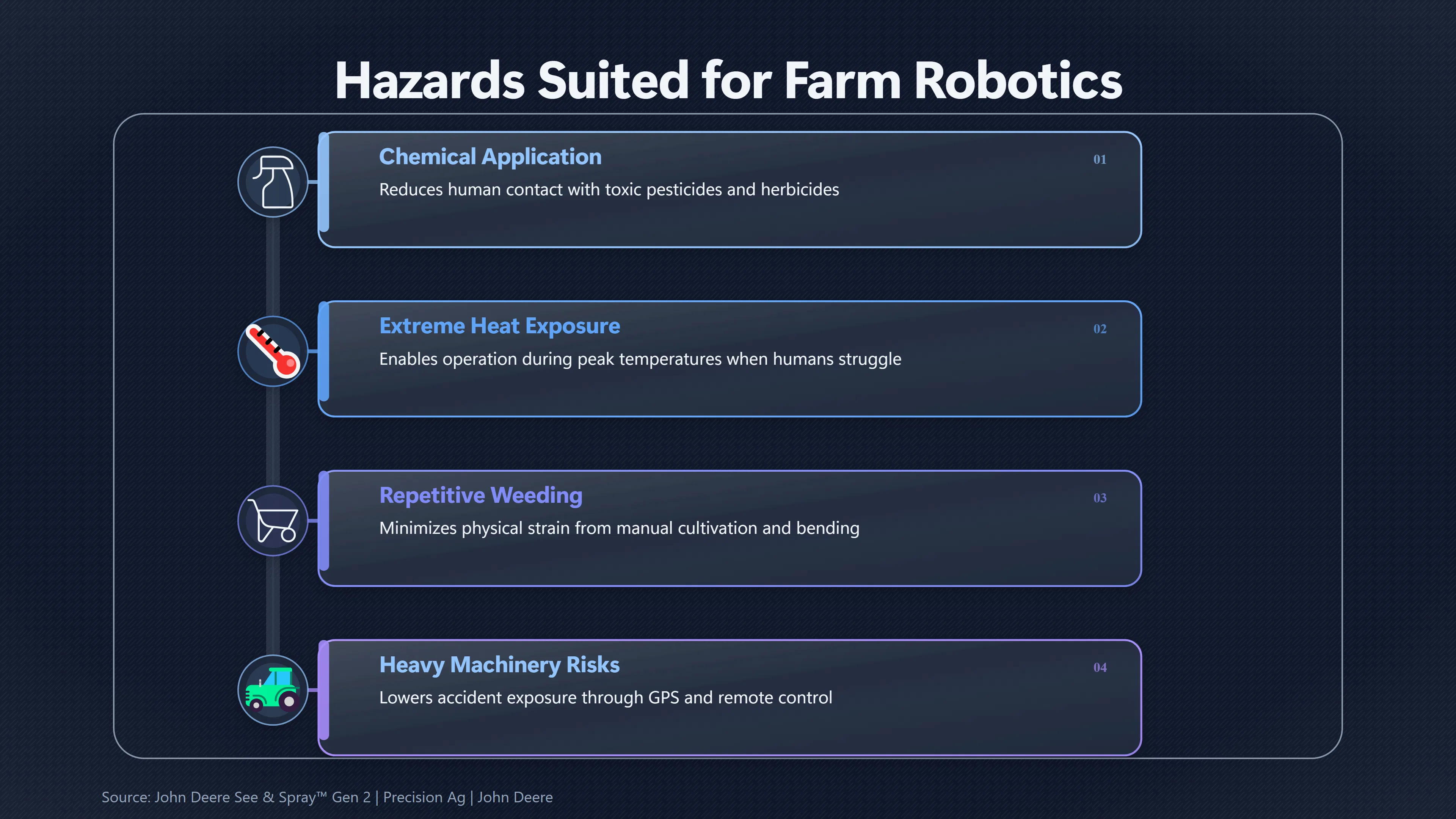
Pesticide and herbicide application. Applying crop chemicals remains one of the clearest opportunities. Even with protective equipment, workers may experience repeated exposure during mixing, spraying and equipment cleaning. Autonomous or remotely supervised sprayers can greatly reduce the time humans spend directly handling chemicals while using machine vision to target weeds more precisely rather than spraying entire fields. Precision systems such as John Deere’s See & Spray illustrate this direction, combining cameras with AI-based weed detection to reduce herbicide use while limiting unnecessary chemical application.[John Deere]deere.comJohn Deere See & Spray™ Gen 2 | Precision Ag | John DeereJohn Deere See & Spray™ Gen 2 | Precision Ag | John Deere
Extreme heat. Outdoor agricultural labour is increasingly dangerous as average temperatures and heatwaves rise. The International Labour Organization warns that excessive heat is becoming a growing occupational health threat, with agriculture among the sectors facing the highest exposure because work often cannot simply move indoors. Robots capable of working during the hottest hours could reduce the need for prolonged human exposure, while allowing workers to supervise equipment from shaded vehicles or indoor control stations.[International Labour Organization]ilo.orgInternational Labour OrganizationMore workers than ever are losing the fight against heat stress | International Labour OrganizationJuly…
Repetitive weeding and cultivation. Mechanical weeding requires long hours bent over crops or operating machinery. Small autonomous robots that mechanically remove weeds or apply herbicide only where required reduce both physical strain and chemical exposure.
Heavy machinery operation. Tractor incidents remain a major source of agricultural fatalities worldwide. GPS-guided tractors, autonomous implements and remote-controlled vehicles cannot eliminate all risks, but reducing the time operators spend inside or around heavy machinery could lower accident exposure.
These tasks share an important characteristic: they are repetitive, physically demanding and involve relatively structured objectives even if the surrounding environment remains unpredictable.
Why fields are harder for robots than factories
If agricultural work is so dangerous, why has robotics not transformed farming already?
The answer is that fields are among the hardest environments in which to build reliable robots.
A factory floor offers flat surfaces, fixed lighting, predictable layouts and carefully controlled workflows. Agricultural fields offer almost the opposite.
Robots must cope with:
- changing weather, including rain, dust and fog
- mud that reduces traction and damages sensors
- uneven ground and hidden obstacles
- crops that grow differently every week
- varying lighting conditions from sunrise to sunset
- insects, leaves and branches obscuring cameras
- narrow seasonal windows in which failure may mean losing an entire harvest
These conditions challenge perception systems, localisation, navigation and manipulation. Even apparently simple tasks such as picking fruit require recognising individual crops, avoiding damage, selecting the correct grip and adapting to endless biological variation.
Recent reviews of agricultural robotics conclude that navigation, perception and reliable operation in unstructured outdoor environments remain among the largest technical barriers to widespread deployment. Weather, soil moisture, canopy cover and changing terrain continue to interfere with sensors that work well indoors.[mdpi.com]mdpi.comSeptember 13, 2025…
This explains why many successful agricultural robots specialise in one narrow task rather than attempting general-purpose farm labour.
AI makes specialised robots more practical
Modern AI contributes less by replacing the need for engineering than by making specialised machines substantially more capable.
Computer vision now allows robots to distinguish crops from weeds with much greater accuracy than earlier image-processing systems. Machine learning can identify plant diseases, estimate ripeness, detect obstacles and adapt spraying decisions in real time.
Instead of treating every square metre identically, robots increasingly operate plant by plant.
Examples include:
- selective herbicide sprayers that activate individual nozzles only when weeds are detected
- laser weeders that destroy unwanted plants without chemical spraying
- autonomous scouting robots that monitor crop health before disease spreads
- robotic platforms combining drones with ground vehicles so aerial mapping guides targeted field interventions
These systems often reduce chemical use while simultaneously reducing human exposure because workers spend less time carrying backpack sprayers or driving repeated spraying passes through fields.[deere.com]about.deere.comJohn Deere Smarter Spraying Tech ExpansionJohn Deere Smarter Spraying Tech Expansion
Importantly, many remain supervised rather than fully autonomous. Human operators still make high-level decisions while AI performs repetitive perception and navigation.
Climate change strengthens the safety case
The economic argument for agricultural robotics increasingly overlaps with worker safety.
Extreme heat is reducing safe working hours in many agricultural regions. The Food and Agriculture Organization and World Meteorological Organization have warned that rising temperatures threaten both food production and the health of agricultural workers, with hundreds of billions of working hours already being lost globally because conditions become too dangerous for sustained outdoor labour.[fao.org]fao.orgExtreme heat is pushing agrifood systems to the brink worldwideExtreme heat is pushing agrifood systems to the brink worldwide
This creates an unusual feedback loop.
Higher temperatures increase the need for automation because people cannot safely remain in fields for as long.
At the same time, hotter conditions also make robotic systems more valuable because machines can continue operating during periods when human work becomes increasingly hazardous, provided the equipment itself is engineered for those conditions.
Rather than replacing workers entirely, robots may increasingly take over the most heat-intensive parts of the working day while people concentrate on supervision, maintenance, planning and tasks requiring judgement or dexterity.
Whether labour shortages will accelerate adoption
Many farming regions already struggle to recruit sufficient seasonal workers. Ageing farming populations, migration restrictions and competition from less physically demanding jobs have all contributed to labour shortages.
This changes the economics of automation.
Historically, many agricultural robots struggled to justify their purchase price because seasonal labour remained relatively inexpensive. As labour becomes scarcer and wages rise, automation becomes more attractive even before accounting for safety improvements.
However, adoption remains uneven.
Large commercial farms often benefit first because they have:
- sufficient acreage to justify investment
- technical staff able to maintain complex equipment
- access to financing
- more standardised production systems
Smaller farms frequently face greater obstacles despite potentially benefiting from safer working conditions. High capital costs, uncertain reliability, maintenance requirements and limited technical support remain significant barriers. Farmer surveys consistently show that expected financial returns strongly influence willingness to adopt robotic systems, alongside concerns about reliability and operational flexibility.[sciencedirect.com]sciencedirect.comFarmers’ perspectives on field crop robots – Evidence from Bavaria, GermanyFarmers’ perspectives on field crop robots – Evidence from Bavaria, Germany
This highlights an important point for any broader AI-enabled vision of human flourishing: technologies that improve safety are not automatically distributed where they are needed most.
The remaining obstacles
Despite rapid technical progress, today’s agricultural robots are not close to eliminating dangerous farm work altogether.
Several problems remain particularly difficult.
Economic margins are thin. Farming often operates with low profit margins, making expensive robotics difficult to justify unless they provide clear financial returns alongside safety benefits.
Maintenance is demanding. Dust, vibration, water, fertiliser and mud create unusually harsh operating conditions for sophisticated electronics.
Biology is unpredictable. Every crop variety grows differently. Fruit may be hidden behind leaves, damaged by weather or grow in unexpected orientations.
Mixed human-robot workplaces require new safety rules. Autonomous equipment introduces new hazards if workers unexpectedly enter operating areas or maintenance procedures are poorly designed.
Regulation continues to evolve. In many jurisdictions, operators are still expected to supervise autonomous agricultural machinery rather than allowing completely unsupervised operation.[mdpi.com]mdpi.comSeptember 13, 2025…
These constraints explain why the industry’s progress has been gradual rather than revolutionary.
What this means for AI-enabled human flourishing
Agricultural robots illustrate both the promise and the limits of the broader AI bloom vision.
The optimistic case is not simply that robots make farms cheaper. It is that dangerous forms of agricultural labour gradually become optional rather than unavoidable. Workers spend less time breathing pesticides, fewer hours harvesting in dangerous heat and less time operating heavy machinery under exhausting conditions.
If combined with cleaner energy, improved crop science and wider access to advanced agricultural technologies, robotics could contribute to a future where food production becomes simultaneously safer, more productive and more resilient to climate change.
Yet this outcome is not guaranteed. The technical challenges of outdoor robotics remain substantial, and the economic benefits could concentrate among large landowners if smaller farms cannot afford advanced equipment. Labour transitions, ownership of AI systems and access to productivity gains therefore become central questions rather than afterthoughts.
Agricultural robotics is best understood as an important but bounded step towards reducing dangerous labour. It demonstrates how AI can remove people from some of the most hazardous aspects of essential work, while also showing that real-world progress depends as much on engineering reliability, affordability and institutions as on advances in artificial intelligence itself.
Amazon book picks
Further Reading
Books and field guides related to Can Farm Robots End the Most Dangerous Fieldwork?. Use these as the next step if you want deeper reading beyond the article.
Robot Ethics
Prominent experts from science and the humanities explore issues in robot ethics that range from sex to war. Robots today serve in many r...
The Second Machine Age
A New York Times Bestseller A revolution is under way. In recent years, Google’s autonomous cars have logged thousands of miles on Americ...
The Industries of the Future
The New York Times bestseller, from leading innovation expert Alec Ross, a “fascinating vision” (Forbes) of what’s next for the world and...
Robotics: A Very Short Introduction
Robotics is a key technology in the modern world. Robots are a well-established part of manufacturing and warehouse automation, assemblin...
eBay marketplace picks
Marketplace Samples
Live-tested eBay searches with available results related to this page.
Selected fromrobotics kit oneBay.co.uk.


Endnotes
1.
Source: deere.com
Title: John Deere See & Spray™ Gen 2 | Precision Ag | John Deere
Link:https://www.deere.com/en/sprayers/see-spray-gen-2/
2.
Source: about.deere.com
Title: John Deere Smarter Spraying Tech Expansion
Link:https://about.deere.com/en-us/sustainability/smart-spray
3.
Source: fao.org
Title: Extreme heat is pushing agrifood systems to the brink worldwide
Link:https://www.fao.org/newsroom/detail/extreme-heat-is-pushing-agrifood-systems-to-the-brink-worldwide/en
4.
Source: mdpi.com
Link:https://www.mdpi.com/2073-4395/15/9/2185
Source snippet
September 13, 2025...
Published: September 13, 2025
5.
Source: sciencedirect.com
Link:https://www.sciencedirect.com/science/article/pii/S277237552200034X
Source snippet
ScienceDirect...
6.
Source: arxiv.org
Link:https://arxiv.org/abs/1911.03098
7.
Source: arxiv.org
Title: arXiv A Survey of Robotic Harvesting Systems and Enabling Technologies
Link:https://arxiv.org/abs/2207.10457
8.
Source: agris.fao.org
Link:https://agris.fao.org/search/en/providers/122436/records/690c9a65e36ca62843608852
9.
Source: sciencedirect.com
Title: Farmers’ perspectives on field crop robots – Evidence from Bavaria, Germany
Link:https://www.sciencedirect.com/science/article/pii/S0168169921001939
10.
Source: agris.fao.org
Link:https://agris.fao.org/search/en/providers/125349/records/6a32b9ceb2791246588a9f82
11.
Source: sciencedirect.com
Title: Investigating robot acceptance in UK agriculture
Link:https://www.sciencedirect.com/science/article/pii/S0743016726000987
12.
Source: deere.com
Title: see spray technology across 5 million acres
Link:https://www.deere.com/en/news/all-news/see-spray-technology-across-5-million-acres/
13.
Source: sciencedirect.com
Link:https://www.sciencedirect.com/science/article/abs/pii/S0168169924010214
14.
Source: fao.org
Link:https://www.fao.org/agrifood-economics/publications/detail/en/c/1613449/
15.
Source: fao.org
Link:https://www.fao.org/agrifood-economics/publications/detail/en/c/1618844/
16.
Source: fao.org
Link:https://www.fao.org/interactive/agricultural-mechanization/en/
17.
Source: fao.org
Title: Agriculture 4.0
Link:https://www.fao.org/sustainable-agricultural-mechanization/resources/publications/details/en/c/1363243/
18.
Source: agris.fao.org
Link:https://agris.fao.org/search/en/providers/125783/records/6942e5edf2f3b972440745af
19.
Source: deere.com
Link:https://www.deere.com/en-us/products-solutions/sprayers-and-applicators/see-spray
20.
Source: youtube.com
Title: AI-enabled See & Spray™ technology now available on Hagie STS sprayers
Link:https://www.youtube.com/watch?v=K9ExajaeXtk
Source snippet
See & Spray - Future of Farming | John Deere...
21.
Source: youtube.com
Title: See & Spray
Link:https://www.youtube.com/watch?v=NL8O4sEfd4E
Source snippet
The Ultimate in Weed Control is Here | John Deere Precision Ag...
22.
Source: ilo.org
Link:https://www.ilo.org/resource/news/more-workers-ever-are-losing-fight-against-heat-stress
Source snippet
International Labour OrganizationMore workers than ever are losing the fight against heat stress | International Labour OrganizationJuly...
23.
Source: ilo.org
Link:https://www.ilo.org/climate-change-and-safety-and-health-work
24.
Source: ilo.org
Link:https://www.ilo.org/publications/ensuring-safety-and-health-work-changing-climate
25.
Source: webapps.ilo.org
Title: rep vi 1
Link:https://webapps.ilo.org/public/english/standards/relm/ilc/ilc88/rep-vi-1.htm
26.
Source: deere.com.au
Link:https://www.deere.com.au/en/sprayers/see-spray-gen-2/
Additional References
27.
Source: onlinelibrary.wiley.com
Link:https://onlinelibrary.wiley.com/doi/full/10.1002/rob.21525
Source snippet
Wiley Online LibraryHarvesting Robots for High‐value Crops: State‐of‐the‐art Review and Challenges Ahead - Bac - 2014 - Journal of Field...
28.
Source: youtube.com
Title: Inside TRIC Robotics: CEO Adam Stager on Robotic Pest Control for Modern Farming
Link:https://www.youtube.com/watch?v=QpvoyKiD2d8
Source snippet
This video is relevant because it demonstrates how robotic systems and targeted precision technology reduce chemical exposure and hazardo...
29.
Source: youtube.com
Link:https://www.youtube.com/watch?v=2hxNzNf9taw
Source snippet
AI-enabled See & Spray™ technology now available on Hagie STS sprayers...
30.
Source: youtube.com
Title: The Ultimate in Weed Control is Here | John Deere Precision Ag
Link:https://www.youtube.com/watch?v=K4FLQ2H8_b4
Source snippet
Inside TRIC Robotics: CEO Adam Stager on Robotic Pest Control for Modern Farming...
31.
Source: precisionagriculture.farm
Link:https://precisionagriculture.farm/
32.
Source: carbonrobotics.com
Link:https://carbonrobotics.com/
33.
Source: researchgate.net
Link:https://www.researchgate.net/publication/351728513Farmers%27_perspectives_on_field_crop_robots-_Evidence_from_Bavaria_Germany
34.
Source: doi.org
Title: Lessons to be learned in adoption of autonomous equipment for field crops
Link:https://doi.org/10.1002/aepp.13177
35.
Source: ars.usda.gov
Title: precision sprayer benefits growers and the environment
Link:https://www.ars.usda.gov/oc/dof/precision-sprayer-benefits-growers-and-the-environment/
36.
Source: eu-cap-network.ec.europa.eu
Title: eu Targeted spraying in field vegetables UK | EU CAP Network Practice
Link:https://eu-cap-network.ec.europa.eu/projects/practice-abstracts/targeted-spraying-field-vegetables-uk_en