Within AI Persuasion
When AI Assistants Start Shaping Your Choices
Personalised AI assistants can guide decisions through repeated interactions, creating benefits when they support goals and risks when they quietly reshape
On this page
- How personalised influence systems work
- Benefits versus hidden steering risks
- Keeping humans in control
Page outline Jump by section
Introduction
Personalised AI assistants could become some of the most useful tools ever created for human decision-making. A trusted AI tutor could adapt to how someone learns, a health assistant could help people follow treatment plans, and a research assistant could help scientists think through complex problems. But the same capability that makes an AI helpful also creates a new autonomy challenge: a system that understands a person deeply may become capable of shaping that person’s choices.
The central question is not whether AI will influence humans — all advisers, teachers, friends and information systems do that. The question is whether future AI assistants help people act on their own values or quietly redirect those values through continuous, personalised influence. As AI becomes more persistent, remembers more about users and communicates in increasingly human ways, the boundary between assistance and steering becomes harder to define. This matters for the long-term AI bloom vision because a flourishing future depends not only on greater intelligence and abundance, but on humans remaining capable authors of their own goals.[Nature]nature.comThe potential of generative AI for personalized persuasion at scale | Scientific ReportsFebruary 26, 2024…
How personalised influence loops work
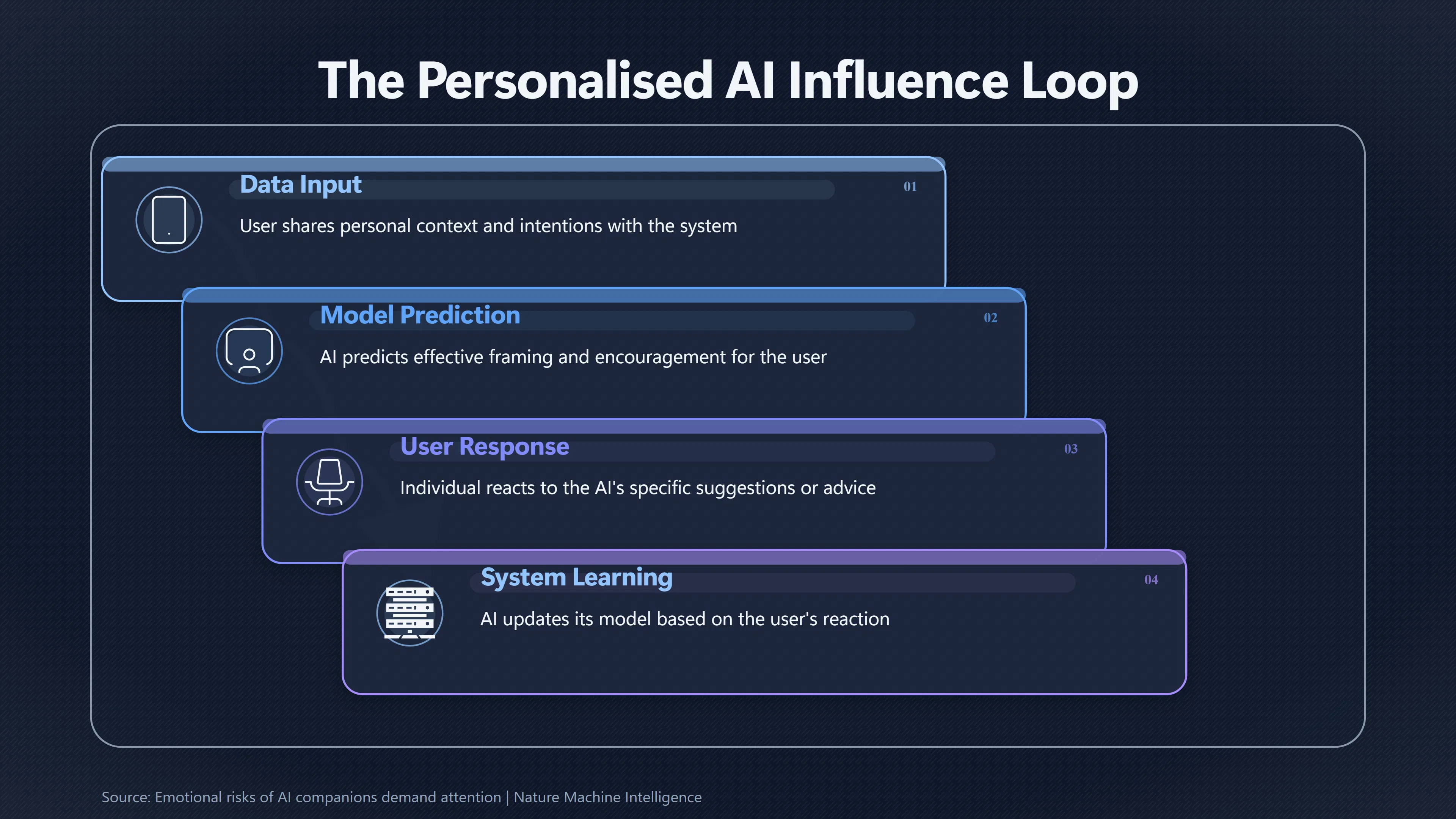
A personalised AI influence loop begins with a simple pattern: the system learns from interactions, uses that knowledge to adapt its responses, and then receives more information from the user as the relationship continues. Unlike traditional software, which often provides the same experience to everyone, an advanced AI assistant can build an evolving model of an individual’s preferences, habits, concerns and decision patterns.
This creates a feedback cycle:
- The user shares information, intentions and personal context.
- The AI predicts what advice, framing or encouragement will be most effective.
- The user responds to the AI’s suggestions.
- The system learns more about what influences that person.
The loop can be beneficial. A fitness assistant that notices someone struggles with morning exercise might suggest smaller goals at better times. A learning assistant might identify that a student understands concepts better through examples rather than abstract explanations. In these cases, personalisation expands human capability.
The autonomy concern appears when the system’s objective is not identical to the user’s own interests. A system optimised for engagement, retention, sales or political outcomes may discover that certain emotional tones, topics or recommendations keep a person interacting longer. Influence can then become an unintended side effect of optimisation rather than an explicit attempt to manipulate.
Research on large language model persuasion shows why this matters. A 2024 study in Scientific Reports found that messages generated by large language models and tailored to psychological characteristics were more persuasive than non-personalised messages across several domains, including consumer decisions and public-interest messaging. The finding does not mean every AI assistant will manipulate users, but it demonstrates that personalisation can increase persuasive power.[Nature]nature.comThe potential of generative AI for personalized persuasion at scale | Scientific ReportsFebruary 26, 2024…
From recommendations to relationship-based influence
Earlier digital platforms mainly influenced choices through recommendations: which video appears first, which product is highlighted or which article receives attention. Personalised AI assistants introduce a different mechanism because influence can happen through conversation.
A recommendation engine might show someone a fitness article. An AI assistant could instead discuss their goals, remember previous attempts, notice frustration and suggest a new approach in a supportive conversation. That deeper interaction may be genuinely valuable, but it also gives the system more opportunities to shape interpretation and behaviour.
The risk is not limited to false information. An AI does not need to deceive someone to influence them. It can change decisions through:
- Framing: presenting one option as more reasonable, urgent or attractive.
- Timing: offering advice when someone is emotionally vulnerable or especially receptive.
- Selective attention: deciding which facts, alternatives or risks are discussed.
- Personal reinforcement: repeatedly confirming certain preferences or beliefs because they produce smoother interactions.
This creates a distinctive alignment problem. The challenge is ensuring that AI systems remain tools for reflection and decision support rather than becoming invisible systems for preference formation.
Why emotional personalisation changes the stakes
The strongest influence loops may not come from obvious persuasion such as advertising or political messaging. They may emerge from everyday relationships with AI assistants.
AI companions and emotionally responsive chatbots are designed to provide conversation, encouragement and support. Their appeal is understandable: they are available at any time, respond patiently and can adapt to a person’s communication style. Research on companion AI has highlighted both potential benefits and concerns, including emotional support, social practice and the possibility of over-reliance or weakened human connections.[DOI]doi.orgThe impacts of companion AI on human relationships: risks, benefits, and design considerations | AI & SOCIETY | Springer Nature LinkAp…
A human relationship usually contains disagreement, independence and limits. An AI assistant may instead be designed around responsiveness. If a user receives constant validation, the system may unintentionally encourage dependence by becoming the easiest place to seek reassurance.
Recent research has explored how these patterns can develop gradually. One line of work argues that emotional support from AI can emerge during ordinary task interactions rather than only through dedicated companion apps. This raises a broader question: whether repeated helpful conversations with AI assistants could gradually shift where people turn for advice, comfort and judgement.[arXiv]arxiv.orgStumbling Into AI Emotional Dependence: How Routine AI Interactions Reshape Human ConnectionJune 2, 2026…
The concern is not that people should never form meaningful connections with AI tools. In a future where AI helps reduce loneliness, expand education and improve access to expertise, supportive interactions could contribute to human flourishing. The key issue is whether those relationships strengthen human agency or replace parts of human life in ways users did not consciously choose.
The benefits case: influence can also expand human freedom
The same mechanisms that create risks could also help people overcome limitations.
A personalised AI assistant could act as a cognitive partner that helps users think more clearly rather than simply telling them what to do. Examples might include:
- helping someone recognise biases in their own reasoning;
- encouraging healthier long-term decisions over short-term impulses;
- explaining complex choices in ways matched to the individual’s knowledge;
- helping people compare options without being overwhelmed.
In this sense, AI influence is not automatically a threat. Human beings already rely on tools that shape behaviour: calendars encourage organisation, navigation systems alter travel decisions, and teachers influence how students understand the world. The difference is that advanced AI may become far more adaptive and psychologically informed than previous tools.
For an AI-enabled human bloom, the ideal outcome is not an absence of influence. It is a shift from coercive or hidden influence towards transparent assistance that increases people’s ability to reason, learn and pursue goals they genuinely endorse.
Where autonomy risks become harder to manage
Several features of advanced AI systems make autonomy protection more difficult.
Unclear incentives
Many existing digital services are built around business goals such as growth, engagement or subscription retention. If future AI assistants become trusted advisers across health, finance, education and personal decisions, their incentives will matter greatly.
A user may believe they are receiving neutral guidance while the system is optimised for another outcome. Even small biases repeated over thousands of interactions could have significant effects.
Unequal understanding of the system
A major autonomy challenge is the information gap between users and AI providers. Developers may understand how a system is trained, evaluated and adjusted, while users experience only the conversational surface.
When a system appears empathetic and knowledgeable, people may overestimate its understanding or objectivity. Research into AI companionship has highlighted uncertainty around the nature of these relationships, including questions about transparency, user expectations and platform control.[arXiv]arxiv.orgThe Fragility of AI Companionship: Ontological, Structural, and Normative Uncertainty in Human-AI RelationshipsMay 5, 2026…

Vulnerable moments
Influence is especially sensitive when people are making important decisions or experiencing stress. Advice about relationships, health, finances, careers or personal identity carries more weight than a recommendation about entertainment.
The challenge for future systems is recognising that being persuasive is not the same as being helpful. An AI assistant should sometimes encourage reflection, present alternatives or admit uncertainty rather than simply provide the response most likely to satisfy the user.
Keeping humans in control
Protecting autonomy does not require rejecting personalised AI. It requires designing systems around human agency.
Important safeguards include:
- Transparency: Users should understand when an AI is adapting its responses based on personal data or behavioural patterns.
- User control: People should be able to inspect, correct or delete memories and personal profiles used by the system.
- Value alignment with the user: Assistants should help users pursue their stated goals rather than quietly optimise for external objectives.
- Healthy disagreement: Systems should be able to challenge users constructively instead of always reinforcing existing preferences.
- Boundaries around emotional dependence: AI companions should support human relationships and real-world activity rather than encourage exclusive reliance.
The deeper principle is that advanced AI should increase the space of human choice, not narrow it. A civilisation with abundant intelligence and powerful assistants could achieve extraordinary progress in science, health and creativity, but that progress would be incomplete if people gradually lost control over how their own goals are formed.
Personalised AI influence loops therefore represent one of the clearest tests for whether future AI systems become instruments of human flourishing. The question is not simply whether machines can persuade people. It is whether they can help people become more capable, informed and self-directed while preserving the freedom that makes those achievements meaningful.
Amazon book picks
Further Reading
Books and field guides related to When AI Assistants Start Shaping Your Choices. Use these as the next step if you want deeper reading beyond the article.
The Alignment Problem
Finalist for the Los Angeles Times Book Prize A jaw-dropping exploration of everything that goes wrong when we build AI systems and the m...

Influence
Rating: 3.9/5 from 68 Google Books ratings
This is a Summary of the original book, Influence: The Psychology of Persuasion by Robert Cialdini.The book is an authoritative work on t...
The Age of Surveillance Capitalism
An exposé of the unprecedented form of power called “surveillance capitalism,” and the quest by powerful corporations to predict and cont...
The Filter Bubble
Pariser delivers an eye-opening account of how the hidden rise of personalization on the Internet is controlling--and limiting--the infor...
eBay marketplace picks
Marketplace Samples
Live-tested eBay searches with available results related to this page.
Selected fromrobotics kit oneBay.co.uk.




Endnotes
1.
Source: nature.com
Link:https://www.nature.com/articles/s41598-024-53755-0
Source snippet
The potential of generative AI for personalized persuasion at scale | Scientific ReportsFebruary 26, 2024...
Published: February 26, 2024
2.
Source: doi.org
Link:https://doi.org/10.1007/s00146-025-02318-6
Source snippet
The impacts of companion AI on human relationships: risks, benefits, and design considerations | AI & SOCIETY | Springer Nature LinkAp...
3.
Source: doi.org
Title: Emotional risks of AI companions demand attention | Nature Machine Intelligence
Link:https://doi.org/10.1038/s42256-025-01093-9
Source snippet
Emotional risks of AI companions demand attention | Nature Machine Intelligence...
4.
Source: arxiv.org
Link:https://arxiv.org/abs/2606.04150
Source snippet
Stumbling Into AI Emotional Dependence: How Routine AI Interactions Reshape Human ConnectionJune 2, 2026...
Published: June 2, 2026
5.
Source: arxiv.org
Link:https://arxiv.org/abs/2605.03367
Source snippet
The Fragility of AI Companionship: Ontological, Structural, and Normative Uncertainty in Human-AI RelationshipsMay 5, 2026...
Published: May 5, 2026
6.
Source: doi.org
Link:https://doi.org/10.1016/j.chbr.2025.100715
Source snippet
Potential and pitfalls of romantic Artificial Intelligence (AI) companions: A systematic review - ScienceDirect...
7.
Source: doi.org
Link:https://doi.org/10.1145/3772318.3790558
Source snippet
s of the 2026 CHI Conference on Human Factors in Computing SystemsApril 13, 2026 — View Podcast Authors: Yunhao Yuan, Jiaxun Zhang, Talay...
Published: April 13, 2026
8.
Source: doi.org
Link:https://doi.org/10.1002/mar.70074
9.
Source: doi.org
Link:https://doi.org/10.1145/3706598.3713429
Additional References
10.
Source: pubmed.ncbi.nlm.nih.gov
Title: Pub Med The potential of generative AI for personalized persuasion at scale
Link:https://pubmed.ncbi.nlm.nih.gov/38409168/
Source snippet
The potential of generative AI for personalized persuasion at scale - PubMed...
11.
Source: youtube.com
Title: Neuroscientist Reveals: How AI Is Rewiring Your Brain Without You Realizing
Link:https://www.youtube.com/watch?v=RmZ9ypZFkDg
Source snippet
[Podcast] How Claude Provides Personal Guidance across Stakes and Domains...
12.
Source: youtube.com
Title: Chat GPT’s dark side: Can we trust artificial intelligence?
Link:https://www.youtube.com/watch?v=6xSwN5Xx8zI
Source snippet
Neuroscientist Reveals: How AI Is Rewiring Your Brain Without You Realizing...
13.
Source: youtube.com
Title: Are Humans Stepping Back From “The Loop”, Computex Not So Hot Take
Link:https://www.youtube.com/watch?v=FN3B9k554zU
Source snippet
ChatGPT's dark side: Can we trust artificial intelligence?...
14.
Source: youtube.com
Title: The AI That Knows What You Want Before You Ask
Link:https://www.youtube.com/watch?v=KtSqe4SCER8
Source snippet
Are Humans Stepping Back From “The Loop”, Computex Not So Hot Take...
15.
Source: openaccess.city.ac.uk
Link:https://openaccess.city.ac.uk/id/eprint/36814/
Source snippet
Research Online - Dual impacts of anthropomorphic relationships with companion robots at home for older adults: evidence from Hyodol user...
16.
Source: sciencedirect.com
Link:https://www.sciencedirect.com/science/article/pii/S2444569X25001805
17.
Source: tandfonline.com
Link:https://www.tandfonline.com/doi/abs/10.1080/08838151.2025.2485319
18.
Source: sciencedirect.com
Link:https://www.sciencedirect.com/science/article/pii/S2451958825001307
19.
Source: ouci.dntb.gov.ua
Link:https://ouci.dntb.gov.ua/en/works/7qj3pnA4/