Within Who Benefits
Who Benefits First From AI Across Countries?
Global usage data suggests AI value can concentrate among small skilled groups where infrastructure, education and access remain uneven.
On this page
- What global AI usage data measures
- Why gains concentrate in some developing economies
- How skills, language and connectivity shape diffusion
Page outline Jump by section
Introduction
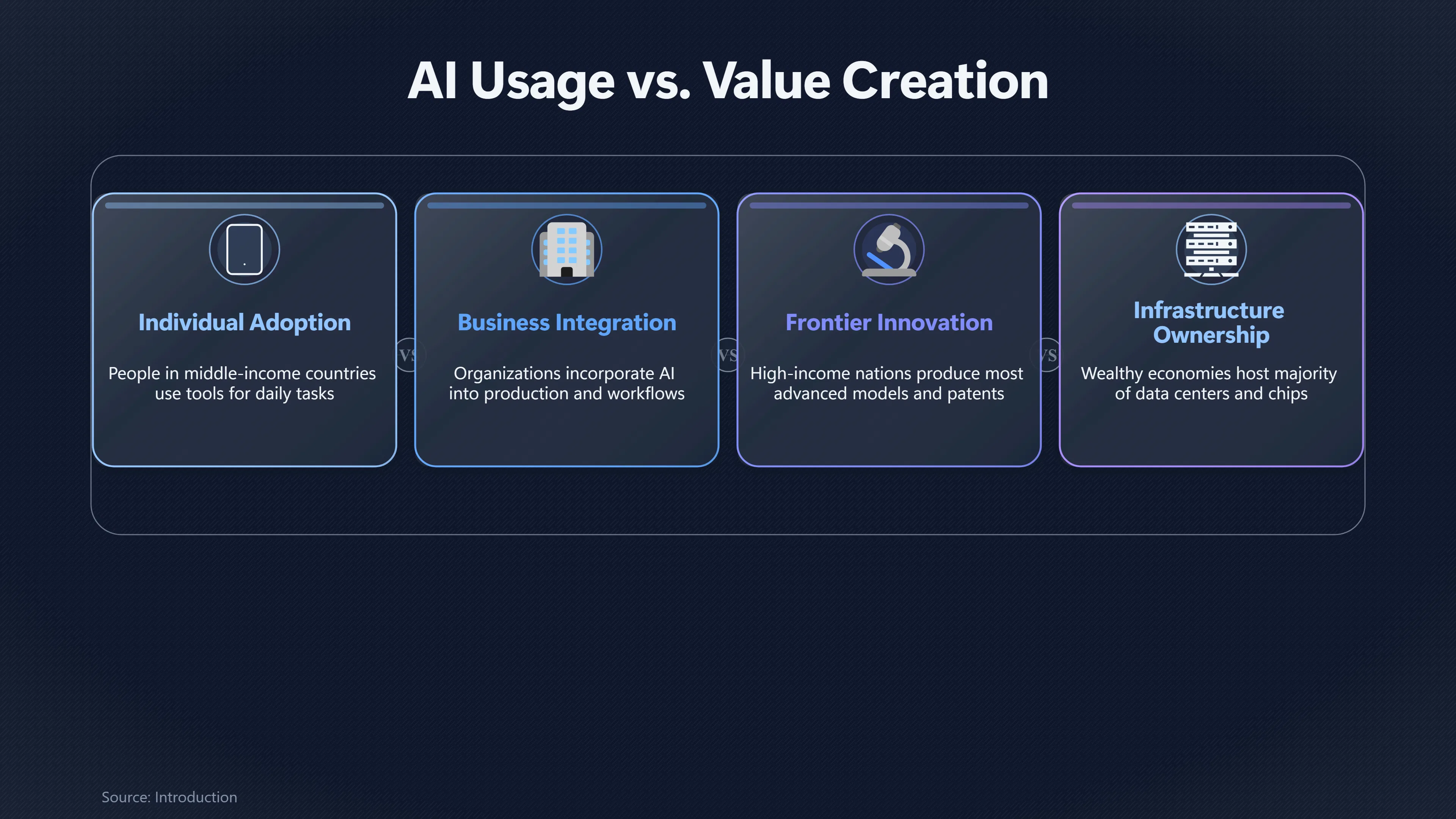
Global AI adoption is spreading remarkably quickly, but the benefits are not spreading equally. Evidence from international usage data shows that people in middle-income countries are embracing generative AI at impressive rates, often matching or exceeding adoption in wealthier nations. Yet the economic gains from that usage remain highly uneven. The countries producing the most advanced models, controlling the largest computing infrastructure, attracting most investment, and employing the deepest pools of AI specialists continue to capture a disproportionate share of the value. This gap matters for the broader question of AI-enabled human flourishing. If AI is to contribute to a future of greater abundance rather than deeper inequality, widespread access alone will not be enough. The evidence increasingly suggests that infrastructure, skills, language support and institutional capacity determine who benefits first.

What global AI usage data actually measures
One of the most important distinctions in the current evidence is between AI use and AI value creation.
International datasets measure different things:
- Individual adoption, such as how many people regularly use generative AI tools.
- Business adoption, measuring whether organisations integrate AI into production.
- Innovation, including publication of frontier models, patents and AI startups.
- Infrastructure, such as cloud computing, data centres and specialised chips.
- Economic outcomes, including productivity, investment and wages.
These indicators often move at different speeds.
For example, the World Bank’s 2025 Digital Progress and Trends Report finds that individuals in many middle-income countries have become enthusiastic AI users, with countries such as Brazil, India, Indonesia and Viet Nam contributing a substantial share of global ChatGPT traffic. However, the same report shows that high-income economies still dominate the underlying AI ecosystem, producing the overwhelming majority of notable AI models, attracting most venture capital investment and hosting most large-scale data-centre capacity.[World Bank]worldbank.orgWorld Bank ReportWorld Bank Report
This distinction is essential. High usage does not necessarily mean that a country captures comparable economic gains.
Why heavy AI use does not automatically produce broad prosperity
A common assumption is that if millions of people begin using AI assistants, national productivity should quickly rise. The available evidence suggests the relationship is much more complicated.
Much AI use today involves relatively low-cost activities such as:
- drafting documents;
- language translation;
- homework assistance;
- coding support;
- information searches;
- creative experimentation.
These activities can save time and improve individual capability, but they do not automatically create high-value industries.
Countries gain much larger economic returns when they also own parts of the AI value chain, including:
- advanced research laboratories;
- semiconductor manufacturing;
- cloud infrastructure;
- AI software companies;
- specialised consulting firms;
- local deployment businesses.
The World Bank estimates that although middle-income countries account for a large share of AI users, high-income countries continue to dominate frontier innovation, venture funding and computing resources. As a result, many developing economies currently consume AI services without capturing an equivalent share of profits or intellectual property.[World Bank]worldbank.orgOpen source on worldbank.org.
Why gains concentrate inside developing economies
Global averages can hide important inequalities within countries.
Even where AI adoption is growing rapidly, early benefits frequently concentrate among relatively small groups:
- software developers;
- entrepreneurs;
- export-oriented firms;
- English-speaking professionals;
- university graduates;
- workers with reliable broadband access.
Meanwhile, many citizens remain excluded by unreliable electricity, expensive internet connections, limited computing access or insufficient digital skills.
The World Bank describes this as a gap in the foundations required for AI participation. It identifies four essential components:
- Connectivity (affordable internet and electricity)
- Compute (access to cloud infrastructure and processing power)
- Context (local languages and relevant data)
- Competency (digital and AI skills)
Countries lacking these foundations may see enthusiastic individual adoption without achieving economy-wide productivity improvements.[World Bank]worldbank.orgWorld Bank ReportWorld Bank Report
This pattern resembles earlier digital transformations, where mobile phones spread rapidly but digital industries remained concentrated in regions with stronger educational systems, infrastructure and investment.

Language remains an important source of unequal gains
One of the clearest findings from recent global usage research is that language strongly shapes how AI is used.
Large language models initially performed best in English and other widely represented languages. Users whose native languages received weaker support often relied on English instead, limiting accessibility for many populations.
A large-scale study of anonymised chatbot interactions across countries found notable differences:
- users in lower-income countries disproportionately used AI for education and learning;
- higher-income countries showed more leisure and lifestyle uses;
- English remained overrepresented even where it was not the dominant national language, suggesting model quality influenced usage patterns.[arXiv]arxiv.orgHow Early Adopters Used Generative AI Worldwide: Variation by Country Income and LanguageMay 29, 2026…
This matters because language quality affects far more than convenience. AI systems that poorly understand local languages, dialects, legal systems or cultural contexts are less useful for business, healthcare, education and public administration.
As multilingual models improve, some of today’s barriers may shrink. But language remains an important mechanism through which AI benefits diffuse unevenly.
Infrastructure determines who captures the largest rewards
Perhaps the strongest evidence of unequal gains comes from infrastructure rather than user numbers.
The World Bank reports that high-income countries host around three-quarters of global co-location data-centre capacity, while low-income countries account for only a tiny fraction. Similarly, advanced economies produce the overwhelming majority of notable frontier AI models and attract most venture capital investment.[World Bank]worldbank.orgOpen source on worldbank.org.
These advantages reinforce one another.
Countries with abundant computing infrastructure can:
- train larger models;
- attract AI companies;
- employ highly skilled researchers;
- generate valuable intellectual property;
- reinvest profits into further innovation.
Countries without those assets often depend on imported cloud services and foreign models.
For readers interested in AI abundance, this illustrates an important distinction. Intelligence may become cheaper to access globally, while ownership of the systems generating that intelligence remains relatively concentrated.
Usage data also shows reasons for optimism
The evidence is not entirely one-sided.
Several datasets suggest that middle-income countries are adopting AI much faster than many previous digital technologies.
The World Bank notes that more than 40% of ChatGPT traffic in 2025 came from middle-income economies, and demand for AI-related jobs has expanded rapidly outside traditional technology centres. Open-weight models and lower-cost cloud services are also reducing barriers for local adaptation and entrepreneurship.[World Bank]worldbank.orgOpen source on worldbank.org.
The Stanford AI Index likewise reports rapidly increasing organisational AI adoption and growing evidence that AI tools can improve productivity while helping narrower skill gaps in many work settings, although the scale of long-term economic gains remains uncertain.[Stanford HAI]hai.stanford.edu2025 ai index reportStanford HAIThe 2025 AI Index Report | Stanford HAI…
This creates a more nuanced picture than a simple “AI divide”. Adoption is broadening quickly, but the transition from widespread use to widespread prosperity is still incomplete.
What this means for an AI-enabled future of abundance
For the broader vision of AI-driven human flourishing, current global usage patterns offer both encouragement and caution.
The encouraging evidence is that advanced AI is no longer confined to a handful of wealthy countries. Millions of people across the developing world are already incorporating AI into education, work and everyday problem-solving.
The caution is that access alone does not guarantee equal gains. Today’s evidence consistently shows that value concentrates where complementary assets already exist: strong education systems, reliable infrastructure, computing capacity, local language support, competitive businesses and institutions capable of adapting new technologies.
If future AI systems become vastly more capable, these complementary factors may become even more important. A world in which everyone can query powerful AI but only a few countries own the infrastructure, talent and capital needed to build on it could still produce significant global inequalities.
Conversely, continued improvements in multilingual models, falling inference costs, open-weight AI, cloud access, digital education and local innovation ecosystems could allow many more countries to convert widespread AI use into broader economic and social gains. The present evidence does not determine which path will prevail, but it strongly suggests that distribution will depend as much on investments in connectivity, skills and institutions as on advances in AI capability itself.
Amazon book picks
Further Reading
Books and field guides related to Who Benefits First From AI Across Countries?. Use these as the next step if you want deeper reading beyond the article.
Why Nations Fail
Shortlisted for the Financial Times and Goldman Sachs Business Book of the Year Award 2012.Why are some nations more prosperous than othe...
AI Superpowers
THE NEW YORK TIMES, USA TODAY, AND WALL STREET JOURNAL BESTSELLER "Kai-Fu Lee believes China will be the next tech-innovation superpower...
The Wealth and Poverty of Nations
"Readers cannot but be provoked and stimulated by this splendidly iconoclastic and refreshing book." —Andrew Porter, New York Times Book...

Capitalism and freedom
Rating: 3.8/5 from 6 Google Books ratings
First published 1962. Subjects: Business, Capitalism, Economic policy, Liberty, Nonfiction.
eBay marketplace picks
Marketplace Samples
Live-tested eBay searches with available results related to this page.
Selected fromtechnology poster oneBay.co.uk.




Endnotes
1.
Source: arxiv.org
Link:https://arxiv.org/abs/2605.30685
Source snippet
How Early Adopters Used Generative AI Worldwide: Variation by Country Income and LanguageMay 29, 2026...
Published: May 29, 2026
2.
Source: hai.stanford.edu
Title: 2025 ai index report
Link:https://hai.stanford.edu/ai-index/2025-ai-index-report?sf223786129=1
Source snippet
Stanford HAIThe 2025 AI Index Report | Stanford HAI...
3.
Source: arxiv.org
Link:https://arxiv.org/abs/2504.07139
Source snippet
Artificial Intelligence Index Report 2025...
4.
Source: digitaleconomy.stanford.edu
Link:https://digitaleconomy.stanford.edu/project/indicators/adoptionmonitor/
Source snippet
← Research 2. ← All Work 3. ← The AI Economic Indicators ADOPTION MONITOR HOW FAST ARE INDIVIDUALS AND FIRMS ADOPTING AI AND RELATED TECH...
5.
Source: hai.stanford.edu
Title: public opinion
Link:https://hai.stanford.edu/ai-index/2026-ai-index-report/public-opinion
6.
Source: hai.stanford.edu
Title: 2026 ai index report
Link:https://hai.stanford.edu/ai-index/2026-ai-index-report%C2%A0
7.
Source: hai.stanford.edu
Title: 2026 ai index report
Link:https://hai.stanford.edu/ai-index/2026-ai-index-report?truid=%2A%7CLINKID%7C%2A
8.
Source: hai.stanford.edu
Title: 2026 ai index report
Link:https://hai.stanford.edu/ai-index/2026-ai-index-report
9.
Source: hai.stanford.edu
Title: 2025 ai index report
Link:https://hai.stanford.edu/ai-index/2025-ai-index-report?authuser=0
10.
Source: worldbank.org
Title: World Bank Report
Link:https://www.worldbank.org/en/publication/dptr2025-ai-foundations/report
11.
Source: worldbank.org
Link:https://www.worldbank.org/en/news/factsheet/2025/11/21/strengthening-ai-foundations-emerging-opportunities-for-developing-countries
12.
Source: worldbank.org
Title: dptr2025 ai foundations
Link:https://www.worldbank.org/en/publication/dptr2025-ai-foundations
Source snippet
World BankDigital Progress and Trends Report 2025: AI Foundations...
13.
Source: data360.worldbank.org
Title: artificial intelligence
Link:https://data360.worldbank.org/en/atlas/artificial-intelligence/
14.
Source: worldbank.org
Link:https://www.worldbank.org/en/programs/govtech/gtmi
15.
Source: worldbank.org
Link:https://www.worldbank.org/ext/en/topic/digital-and-ai/data-and-ai
16.
Source: worldbank.org
Link:https://www.worldbank.org/en/publication/dptr2025-ai-foundations/resources
17.
Source: oecd.org
Link:https://www.oecd.org/en/topics/generative-ai.html
18.
Source: oecd.org
Link:https://www.oecd.org/en/topics/sub-issues/generative-ai.html
Additional References
19.
Source: oecd.org
Link:https://www.oecd.org/en/about/news/announcements/2026/01/ai-use-by-individuals-surges-across-the-oecd-as-adoption-by-firms-continues-to-expand.html
Source snippet
AI use by individuals surges across the OECD as adoption by firms continues to expandJanuary 28, 2026 — AI USE BY INDIVIDUALS SURGES ACRO...
Published: January 28, 2026
20.
Source: imf.org
Title: Aggregate Gains from AI and Their Distribution: Global Evidence from Usage Data
Link:https://www.imf.org/en/publications/wp/issues/2026/07/10/aggregate-gains-from-ai-and-their-distribution-global-evidence-from-usage-data-577586
Source snippet
July 10, 2026 — AGGREGATE GAINS FROM AI AND THEIR DISTRIBUTION: GLOBAL EVIDENCE FROM USAGE DATA ByRachel Yuting Fan, Ha Minh Nguyen July...
Published: July 10, 2026
21.
Source: youtube.com
Link:https://www.youtube.com/watch?v=5XzAvzZB2kI
Source snippet
This video features global leaders discussing how AI adoption and infrastructure gaps create unequal economic outcomes between advanced a...
22.
Source: microsoft.com
Title: Global AI Adoption 2025
Link:https://www.microsoft.com/en-us/corporate-responsibility/topics/AI-Economy-Institute/reports/Global-AI-Adoption-2025
Source snippet
Global AI Adoption in 2025 – AI Economy Institute | MicrosoftJanuary 8, 2026 — AI DIFFUSION REPORT GLOBAL AI ADOPTION IN 2025—A WIDENING...
Published: January 8, 2026
23.
Source: youtube.com
Title: Which countries are leading the way in AI adoption? | Global Stage
Link:https://www.youtube.com/watch?v=sF7v52a8xoI
Source snippet
AI Digital Gap: Making AI [Accessible]({{ 'accessible-tutors/' | relative_url }}) to All | New Economy Forum...
24.
Source: youtube.com
Title: AI Digital Gap: Making AI Accessible to All | New Economy Forum
Link:https://www.youtube.com/watch?v=cSElxdnrTf4
Source snippet
AI, Jobs and Inequality: The IMF's Warning to World Leaders...
25.
Source: youtube.com
Title: AI, Jobs and Inequality: The IMF’s Warning to World Leaders
Link:https://www.youtube.com/watch?v=n5QEMuZKqz0
Source snippet
Workers' exposure to AI across development stages...
26.
Source: youtube.com
Title: Workers’ exposure to AI across development stages
Link:https://www.youtube.com/watch?v=AXqSQsUA4Hw
Source snippet
AI: The Great Equaliser? | Davos 2024 | World Economic Forum...
27.
Source: ebs.publicnow.com
Link:https://ebs.publicnow.com/view/2E9061E0583FF218AD210731E9A3597F8AD1EAEE
28.
Source: blogs.microsoft.com
Title: global ai adoption in 2025
Link:https://blogs.microsoft.com/on-the-issues/2026/01/08/global-ai-adoption-in-2025/