Within Energy Limits
Can Data Centres Help Balance the Grid?
AI data centres can ease peak demand by shifting or slowing workloads, but flexibility depends on contracts, software and reliable performance limits.
On this page
- How flexible computing changes electricity demand
- What the Phoenix GPU trial actually demonstrated
- Limits, incentives and risks of grid responsive data centres
Page outline Jump by section
Introduction
AI data centres are becoming some of the largest new electricity users on modern power grids. That has raised an obvious concern: will AI simply make electricity shortages and grid congestion worse? Increasingly, researchers, utilities and data-centre operators are exploring a different possibility. Instead of behaving as fixed, always-on electricity consumers, some AI facilities may be able to adjust when and where they perform parts of their computing workload, temporarily reducing demand during periods of grid stress and increasing it when renewable electricity is abundant.
This flexibility does not eliminate the need for new power stations, transmission lines or substations. Nor can every AI task be delayed without consequence. But if implemented carefully, flexible computing could turn part of AI’s growing electricity demand into a grid-balancing resource. Within the broader question of whether AI can support an era of greater material abundance, this is a practical example of software helping existing infrastructure work harder before expensive physical expansion is complete.
How flexible computing changes electricity demand
Traditional electricity planning assumes that a large data centre behaves much like a factory: once connected, it consumes a fairly predictable amount of power and expects uninterrupted service.
Modern AI computing is more varied. Large facilities typically run several classes of work simultaneously:
- Real-time inference, where users expect immediate responses from AI systems.
- Interactive enterprise workloads, where delays may be acceptable only for seconds.
- Training runs, which often last days or weeks and can tolerate carefully managed interruptions.
- Background processing, testing and batch jobs that may be delayed with relatively little effect on users.
This mixture creates opportunities that did not exist with conventional industrial loads. Rather than switching an entire facility off, operators may selectively:
- postpone lower-priority jobs;
- reduce GPU power limits temporarily;
- migrate workloads to another region with more available electricity;
- slow rather than stop long-running AI training;
- schedule energy-intensive work for periods of lower prices or abundant renewable generation.
The objective is not to maximise electricity savings. Instead, the goal is to reduce demand precisely when the grid is under the greatest stress, helping system operators avoid expensive emergency measures or unnecessary investment designed solely to meet short-lived demand peaks. Recent research and demonstrations suggest that software-controlled workload management can provide this flexibility without requiring additional batteries or major hardware modifications.[nature.com]nature.comA I data centres as grid-interactive assets | Nature EnergyAI data centres as grid-interactive assets | Nature EnergyDecember 5, 2025…
What the Phoenix GPU trial actually demonstrated
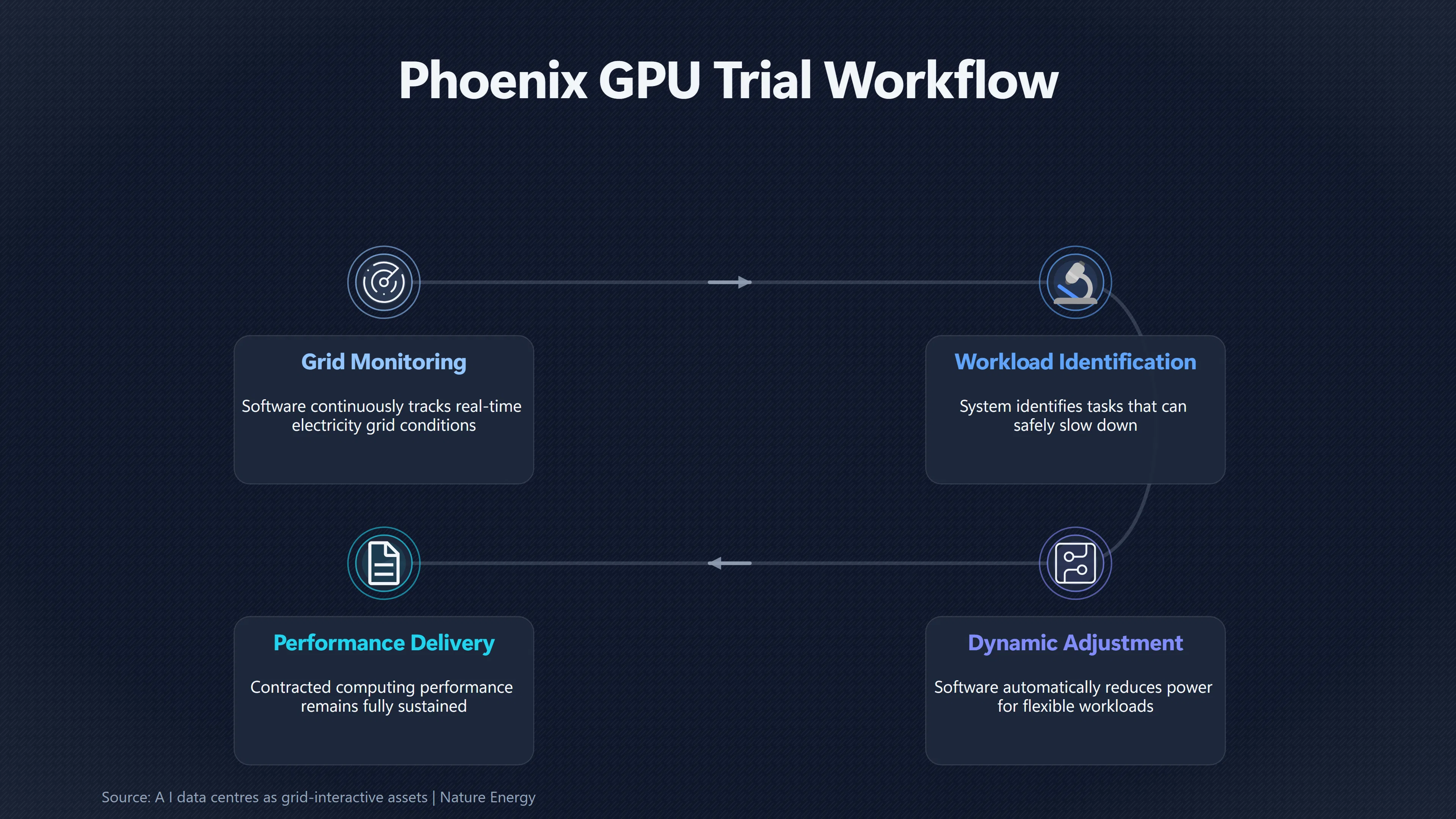
The most widely cited real-world demonstration took place in Phoenix, Arizona, using a commercial hyperscale AI facility operating a 256-GPU cluster.
Researchers developed software that continuously monitored grid conditions and automatically adjusted computing workloads in response. Rather than interrupting important AI services, the system identified workloads that could safely slow down while preserving agreed quality-of-service guarantees.
During grid stress events, the demonstration achieved:
- approximately 25% lower cluster power consumption;
- sustained reductions lasting three hours;
- no hardware modifications;
- no dedicated battery storage;
- continued delivery of contracted computing performance.[nature.com]nature.comA I data centres as grid-interactive assets | Nature EnergyAI data centres as grid-interactive assets | Nature EnergyDecember 5, 2025…
The importance of this experiment lies less in the absolute electricity saved than in the proof of concept. Utilities generally assume that very large computing facilities are effectively inflexible. The Phoenix demonstration showed that at least some AI workloads can instead behave like controllable demand-response resources.
The system achieved this by coordinating workload scheduling rather than simply disconnecting equipment. Higher-priority tasks continued normally, while workloads with greater scheduling flexibility absorbed most of the temporary reduction. This distinction matters because conventional demand-response programmes often require industrial customers to halt production entirely, whereas AI facilities may instead degrade gracefully under software control.[nature.com]nature.comA I data centres as grid-interactive assets | Nature EnergyAI data centres as grid-interactive assets | Nature EnergyDecember 5, 2025…

Why flexibility could matter for renewable electricity
Electricity systems with growing shares of solar and wind increasingly experience periods when renewable generation is plentiful but arrives at inconvenient times.
Flexible AI computing can potentially help in several ways.
First, workloads may be shifted towards hours of abundant renewable generation, increasing utilisation of clean electricity that might otherwise be curtailed.
Second, temporary reductions during evening demand peaks reduce pressure on transmission networks and expensive peaking generators.
Third, geographically distributed cloud infrastructure creates the possibility of spatial flexibility, moving suitable computing between regions according to electricity availability, transmission constraints or carbon intensity.
Emerging modelling studies suggest that this geographical flexibility could reduce transmission congestion and improve renewable utilisation, although these findings remain largely simulation-based rather than demonstrated at large commercial scale.[arXiv]arxiv.orgGrid Operational Benefit Analysis of Data Center Spatial Flexibility: Congestion Relief, Renewable Energy Curtailment Reduction, and…
This does not mean AI automatically becomes environmentally beneficial. Total electricity demand from AI may still rise substantially. Flexibility simply improves the chances that existing infrastructure and renewable generation can accommodate more computing before additional network investment becomes unavoidable.
What makes a data centre genuinely flexible?
Achieving useful flexibility requires much more than installing smart software.
Several conditions must exist simultaneously.
Suitable workloads. Some AI tasks can tolerate delays or slower execution. Others, such as customer-facing inference or financial transactions, often cannot.
Software orchestration. Scheduling systems must understand workload priorities and predict how reducing GPU power affects completion times and service guarantees.
Commercial agreements. Operators require contracts with utilities or electricity markets that reward temporary reductions in demand.
Reliable measurement. Grid operators need confidence that promised load reductions will occur predictably during system stress.
Operational safeguards. Any flexibility programme must preserve thermal limits, cybersecurity, hardware reliability and customer service commitments.
Research by the Electric Power Research Institute (EPRI) groups these sources of flexibility across computing workloads, cooling systems and electrical infrastructure within the facility, emphasising that different data centres possess very different technical capabilities depending on ownership, design and customer requirements.[LBL ETA Publications]eta-publications.lbl.govETA Publications Large Load Literature ReviewLBL ETA PublicationsLarge Load Literature ReviewMay 30, 2026…
Limits, incentives and risks of grid-responsive data centres
The idea remains promising but should not be overstated.
The first limitation is that only part of AI demand is flexible. Interactive services increasingly dominate commercial AI, and many customers purchase guaranteed availability. Facilities cannot simply reduce computing whenever electricity becomes scarce.
Second, computing hardware is extremely expensive. Owners typically seek high utilisation because idle GPUs generate no revenue. Grid flexibility therefore requires financial incentives large enough to compensate operators for delaying work.
Third, flexibility does not replace physical infrastructure. If electricity demand continues growing rapidly, transmission upgrades, substations, transformers and new generation remain necessary. Flexible operation can postpone some investments and reduce peak demand, but it cannot permanently substitute for expanding electricity systems.
There are also governance questions. Utilities must ensure that participation is reliable enough for system planning, while regulators need transparent market rules so that flexibility benefits electricity consumers rather than only reducing operating costs for hyperscale computing companies.
Finally, flexibility itself introduces operational complexity. Automated power adjustments must avoid damaging hardware, violating customer contracts or creating cybersecurity vulnerabilities within increasingly automated computing environments.[lbl.gov]eta-publications.lbl.govETA Publications Large Load Literature ReviewLBL ETA PublicationsLarge Load Literature ReviewMay 30, 2026…
What this means for AI abundance
Within the broader vision of AI-enabled abundance, flexible data centres illustrate an important principle: software can sometimes expand the effective capacity of physical infrastructure without immediately building more of it.
That does not create energy from nothing. Instead, it makes better use of existing generation, transmission and renewable resources by aligning electricity demand more closely with changing supply.
If these techniques mature, AI infrastructure could become less like an inflexible industrial load and more like an active participant in electricity markets, capable of responding to grid conditions in minutes rather than years. Such flexibility could modestly reduce costs, ease renewable integration and accelerate connection of new computing facilities while larger investments in clean generation and transmission continue.
The significance is therefore practical rather than transformational. Flexible computing is unlikely to solve the energy demands of AI on its own, but it demonstrates that the software intelligence driving AI may also help operate one of civilisation’s most important physical systems—the electricity grid—with greater efficiency, resilience and adaptability.
Amazon book picks
Further Reading
Books and field guides related to Can Data Centres Help Balance the Grid?. Use these as the next step if you want deeper reading beyond the article.
Energy and Civilization
A comprehensive account of how energy has shaped society throughout history, from pre-agricultural foraging societies through today's fos...
The Grid: The Fraying Wires Between Americans and Our Energy...
One of Bill Gates's Favorite Books of 2016 A revelatory look at our national power grid--how it developed, its current flaws, and how it...

The Big Switch
A hundred years ago, companies stopped producing their own power with steam engines and plugged into the newly built electric grid. The c...
Power Hungry
The promise of "green jobs" and a "clean energy future" has roused the masses. But as Robert Bryce makes clear in this provocative book,...
eBay marketplace picks
Marketplace Samples
Live-tested eBay searches with available results related to this page.
Selected fromserver rack model oneBay.co.uk.
![Listing image for Dell PowerEdge R730xd 16LFF+2SFF Server /IndigoVision NVR-AS 4000/32GB RAM [16D]](/assets/images/marketplace-covers/18895e58d071ea980a50.jpg)

Endnotes
1.
Source: nature.com
Title: A I data centres as grid-interactive assets | Nature Energy
Link:https://www.nature.com/articles/s41560-025-01927-1
Source snippet
AI data centres as grid-interactive assets | Nature EnergyDecember 5, 2025...
Published: December 5, 2025
2.
Source: arxiv.org
Title: arXiv Power-Flexible AI Data Centers: A New Paradigm for Grid-Responsive Compute
Link:https://arxiv.org/abs/2606.25098
3.
Source: arxiv.org
Link:https://arxiv.org/abs/2507.00909
4.
Source: arxiv.org
Link:https://arxiv.org/abs/2511.08759
Source snippet
Grid Operational Benefit Analysis of Data Center Spatial Flexibility: Congestion Relief, Renewable Energy Curtailment Reduction, and...
5.
Source: arxiv.org
Link:https://arxiv.org/abs/2511.07159
6.
Source: eta-publications.lbl.gov
Title: ETA Publications Large Load Literature Review
Link:https://eta-publications.lbl.gov/sites/default/files/2025-09/lbnl_lllreview_august_update_2025.pdf
Source snippet
LBL ETA PublicationsLarge Load Literature ReviewMay 30, 2026...
Published: May 30, 2026
7.
Source: dcflex.epri.com
Title: DCFLEXDemonstrations | DCFlex
Link:https://dcflex.epri.com/demonstrations
8.
Source: nature.com
Link:https://www.nature.com/articles/s41560-025-01927-1.pdf
Source snippet
AI data centres as grid-interactive assets | Nature EnergyDecember 5, 2025 — * Article *...
Published: December 5, 2025
9.
Source: arxiv.deeppaper.ai
Link:https://arxiv.deeppaper.ai/papers/2507.00909v1
10.
Source: arxiv.deeppaper.ai
Link:https://arxiv.deeppaper.ai/papers/2504.04982v1/similar
Additional References
11.
Source: youtube.com
Title: Data centres as engines of Europe’s digital future
Link:https://www.youtube.com/watch?v=A2-9BmtwnH8
Source snippet
Data centers double grid size: who pays the $7B bill? | Energy Gang...
12.
Source: youtube.com
Title: AI Datacenters act as Grid-Responsive Flexible Loads
Link:https://www.youtube.com/watch?v=awat_Tp1sY0
Source snippet
Data centres as engines of Europe's digital future - Can they power a sustainable energy transition?...
13.
Source: emergentmind.com
Link:https://www.emergentmind.com/papers/2507.00909
14.
Source: papers.cool
Link:https://papers.cool/arxiv/2507.00909
15.
Source: themoonlight.io
Link:https://www.themoonlight.io/en/review/turning-ai-data-centers-into-grid-interactive-assets-results-from-a-field-demonstration-in-phoenix-arizona
16.
Source: atiro.turing.ac.uk
Link:https://atiro.turing.ac.uk/esploro/outputs/preprint/Turning-AI-Data-Centers-into-Grid-Interactive/9922424709548
17.
Source: youtube.com
Title: Leveraging data centers to keep the grid in balance
Link:https://www.youtube.com/watch?v=_pYdwM1hfSM
Source snippet
The mechanics of data center flexibility...
18.
Source: youtube.com
Title: The mechanics of data center flexibility
Link:https://www.youtube.com/watch?v=yVYraiZR-jw
Source snippet
AI Datacenters act as Grid-Responsive Flexible Loads...
19.
Source: doi.org
Link:https://doi.org/10.1038/s41560-025-01927-1?urlappend=%3Futm_source%3Dresearchgate.net%26utm_medium%3Darticle
Source snippet
AI data centres as grid-interactive assets | Nature EnergyDecember 5, 2025 — * Article *...
Published: December 5, 2025
20.
Source: youtube.com
Title: Data centers double grid size: who pays the $7B bill? | Energy Gang
Link:https://www.youtube.com/watch?v=aTpeQ3306ko