Within Explosion Evidence
Can AI Agents Improve AI Itself?
AI agents may accelerate scientific work, but the key question is whether they can improve AI development itself rather than just assist researchers.
On this page
- From task assistants to research partners
- Evidence for longer autonomous tasks
- Limits on recursive improvement
Page outline Jump by section
Introduction
AI agents could become one of the most important mechanisms linking today’s AI progress to the possibility of an intelligence explosion. The key question is not simply whether AI can help scientists and engineers work faster, but whether AI systems can become capable contributors to the process of improving AI itself. If agents can design experiments, write and test code, analyse results, discover better methods and coordinate research activities, they could create a feedback loop in which AI accelerates the development of more capable AI systems.

The evidence for this possibility is growing, but it remains incomplete. Modern AI agents can already perform increasingly long sequences of tasks, and research systems are beginning to automate parts of scientific and machine learning workflows. However, there is still a large gap between an AI assistant that makes researchers more productive and a system that can independently drive sustained improvements in AI capability. The future of an intelligence explosion may depend on whether that gap can be crossed.[Metr]metr.orgTask-Completion Time Horizons of Frontier AI ModelsTask-Completion Time Horizons of Frontier AI Models - METRMay 8, 2026…
From task assistants to research partners
The first stage of AI acceleration is not self-improvement but augmentation: AI systems helping humans carry out research more effectively. Coding assistants, mathematical reasoning systems and scientific tools already show that AI can reduce the time required for some intellectual tasks. The more ambitious vision is an AI research partner that can take a broad goal, explore possible approaches, run experiments, learn from failures and suggest new directions with limited human intervention.
This matters because AI development itself is heavily dependent on research labour. Improving models requires writing software, designing architectures, cleaning data, running experiments, analysing results and making engineering decisions. If AI agents become capable in these areas, they could increase the productivity of the researchers building future systems.
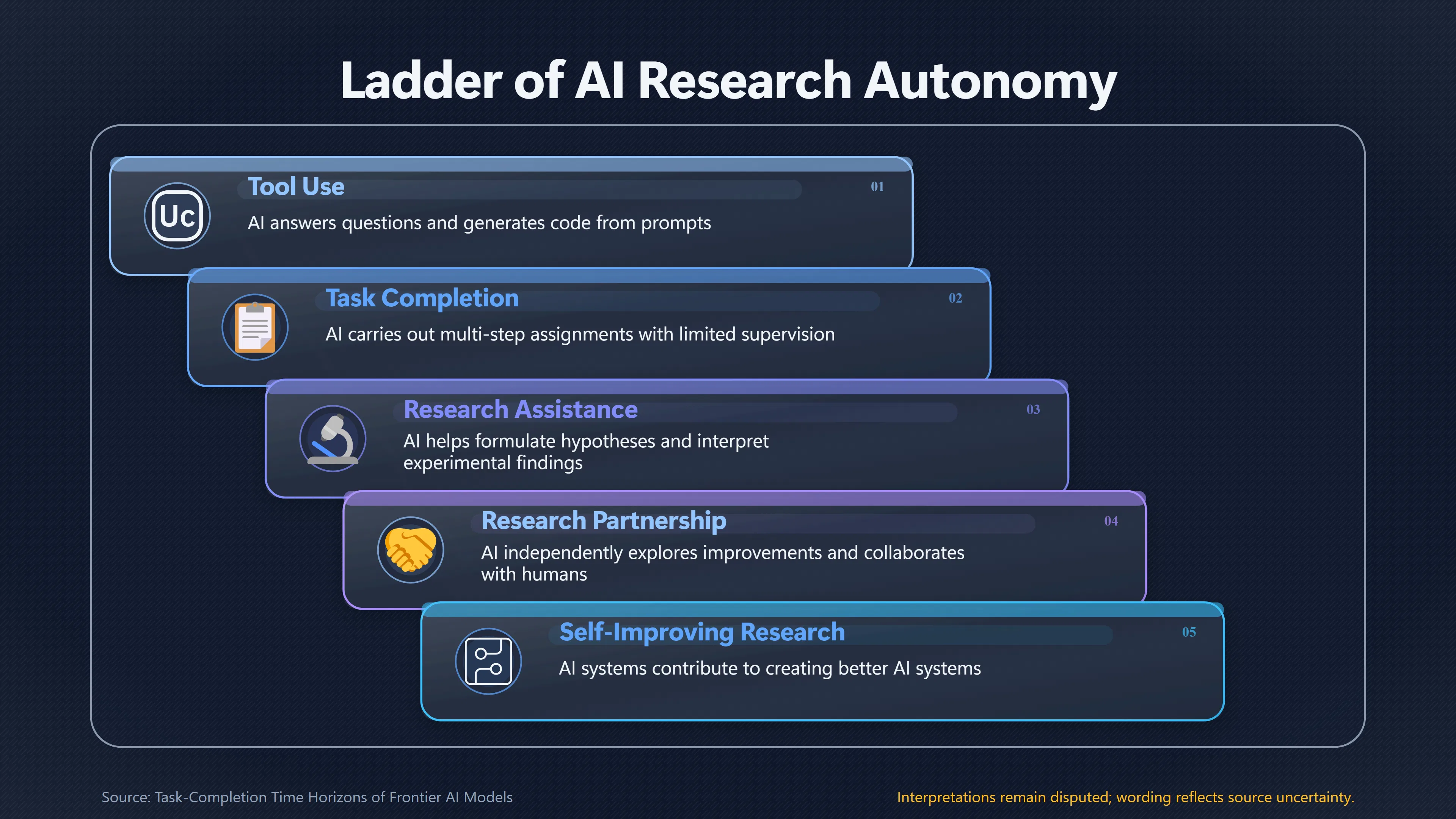
A useful way to think about the transition is a ladder of autonomy:
- Tool use: AI answers questions, generates code or explains papers when prompted.
- Task completion: AI carries out multi-step assignments with limited supervision.
- Research assistance: AI helps formulate hypotheses, run experiments and interpret findings.
- Research partnership: AI independently explores improvements and collaborates with human scientists.
- Self-improving research: AI systems contribute substantially to creating better AI systems, potentially accelerating the entire development process.
The significance of the later stages is that they introduce the possibility of a positive feedback loop. A better AI researcher could help build a better AI researcher, which could then accelerate further improvements. This is the mechanism behind many arguments for an intelligence explosion. It is also the point where uncertainty becomes greatest.
Evidence for longer autonomous tasks
One important sign that AI agents may eventually contribute to research acceleration is that they are becoming capable of completing longer and more complex sequences of work.
The Model Evaluation and Threat Research (METR) organisation measures this using “task horizons”: estimates of how long a human-expert task an AI agent can complete with a given probability of success. Its evaluations suggest that the length of software tasks frontier agents can handle has increased substantially over recent years, although METR cautions that these measurements are limited and should not be interpreted as a direct prediction of future intelligence growth.[Metr]metr.orgTask-Completion Time Horizons of Frontier AI ModelsTask-Completion Time Horizons of Frontier AI Models - METRMay 8, 2026…
Longer task horizons matter because research is naturally sequential. A scientist does not usually make a discovery through one isolated action. The process involves reading existing work, choosing a question, developing a method, testing ideas, correcting mistakes and refining conclusions. An agent that can only complete individual steps remains a useful assistant. An agent that can manage many connected steps begins to resemble a research collaborator.
Early examples show movement in this direction. Systems such as Agent Laboratory have attempted to automate parts of the research pipeline, including literature review, experimentation and report writing, while still allowing human researchers to provide feedback and oversight. These systems do not demonstrate fully autonomous scientific discovery, but they show how AI agents may gradually move from answering research questions to helping conduct research.[ACL Anthology]aclanthology.orgACL Anthology Agent Laboratory: Using LLM Agents as Research AssistantsACL AnthologyAgent Laboratory: Using LLM Agents as Research Assistants - ACL Anthology…
Why improving AI itself is a harder challenge
Helping with research is not the same as improving AI. The hardest step is creating a reliable loop in which AI systems can discover better algorithms, training methods or architectures.
Current AI systems often perform well when the goal is clear and the evaluation process is available. AI coding agents, for example, can modify software and solve defined programming tasks. But improving AI requires identifying valuable research directions among many possibilities, judging whether an apparent improvement is real, and avoiding solutions that only work in narrow tests.
Several obstacles make recursive improvement difficult:[youtube.com]youtube.comRecursive Self-ImprovementDaniel Kokotajlo on how superintelligent AIs could build a self-replicating robot economy in months…
Research requires judgement, not only execution.
A large part of scientific progress comes from deciding which problems are worth pursuing. Human researchers use intuition, experience and knowledge of the field to distinguish promising ideas from dead ends. AI systems are improving at generating hypotheses, but their ability to consistently choose the most valuable research paths remains uncertain.
Experiments are expensive and slow.
AI systems can generate ideas quickly, but testing them often requires large amounts of computing power, data and engineering effort. A faster idea generator does not automatically create faster scientific progress unless the surrounding infrastructure can keep pace.
Evaluation becomes harder as systems become more capable.
A research agent improving AI needs reliable ways to know whether it has genuinely discovered something better. In machine learning, many apparent improvements disappear when tested more broadly or compared against stronger baselines.
Reliability is still a central bottleneck.
A human researcher can spend days reviewing whether an experiment was performed correctly. An autonomous agent operating at scale would need strong safeguards against mistakes, fabricated results, poor assumptions and inefficient exploration.
These limitations mean that the path from AI-assisted research to self-improving research is not a simple continuation of current trends. It requires advances in reliability, scientific reasoning, experimentation and oversight.
Early experiments in autonomous AI research
Recent research projects provide hints of what a more agent-driven research environment might look like.
Agent-based scientific systems are increasingly designed around complete workflows rather than isolated tasks. Some frameworks combine language models with coding tools, databases, simulation environments and scientific software so that an AI system can move between generating ideas, implementing them and analysing outcomes. Surveys of “agentic science” describe this as a shift from AI as a specialised scientific instrument towards AI systems that participate more actively in the discovery process.[arXiv]arxiv.orgAutonomous Agents for Scientific Discovery: Orchestrating Scientists, Language, Code, and PhysicsOctober 10, 2025…
Another direction is collaboration between multiple AI agents. Research such as AgentRxiv explores whether AI systems can share discoveries, build on previous work and improve collectively rather than operating as isolated assistants. These experiments are early and narrow, but they investigate a key idea behind intelligence explosion arguments: that networks of capable agents may produce faster progress than individual systems working alone.[arXiv]arxiv.orgarXiv Agent Rxiv: Towards Collaborative Autonomous ResearchAgentRxiv: Towards Collaborative Autonomous ResearchMarch 23, 2025…
However, current demonstrations should be interpreted carefully. Producing a research report, generating code or proposing experiments is not equivalent to producing major scientific breakthroughs. The most impressive systems today still depend heavily on human guidance, carefully chosen tasks and external evaluation.
The difference between faster research and recursive improvement
A crucial distinction in the intelligence explosion debate is the difference between accelerating human-led AI research and creating a self-improving AI research process.
The first scenario appears increasingly plausible. AI tools may allow researchers to write code faster, test more ideas, summarise technical information and manage complex workflows. Even without autonomous breakthroughs, this could significantly speed up scientific and technological progress.
The second scenario is much more uncertain. A genuine self-improving loop would require AI systems to make meaningful contributions to improving their own successors. That may involve discovering new training methods, improving reasoning abilities, creating better architectures or finding more efficient ways to use computing resources.
The distinction matters because many optimistic forecasts about AI abundance and superintelligence depend not only on AI being useful, but on AI accelerating the rate of invention itself. If AI agents mainly amplify human researchers, progress may continue rapidly but remain constrained by human capacity. If AI agents become effective AI researchers, the pace of improvement could change more dramatically.
What would count as strong evidence for self-improving AI research?
Clear evidence would require more than impressive demonstrations. Several milestones would make the case stronger:
- Independent discovery of useful AI improvements: AI systems finding methods that expert researchers did not already know and that produce measurable gains.
- Reliable end-to-end research ability: Agents managing substantial research projects with limited intervention.
- Repeated improvement cycles: Evidence that AI-generated improvements lead to better systems that can then generate further improvements.
- Generalisation beyond narrow benchmarks: Success across different areas of AI research rather than highly specialised tasks.
At present, the strongest evidence points to increasing AI assistance and growing agent capability, not a proven recursive improvement process. The transition remains one of the central uncertainties in predictions about superintelligence.
The long-term significance for human flourishing
If AI agents eventually become capable research partners, the consequences could extend far beyond AI development itself. Faster AI research could contribute to advances in medicine, materials, energy, robotics and scientific understanding. In the optimistic AI bloom scenario, intelligence becomes a more abundant resource: humanity gains greater capacity to solve problems that currently appear limited by human time and expertise.
But the benefits would depend on more than technical capability. A world where AI accelerates research would still face questions about access, concentration of power, safety and whether breakthroughs are directed towards broad human flourishing. Faster progress alone does not guarantee a better future.
The central question is therefore not simply whether AI agents can improve AI. It is whether increasingly autonomous research systems can become reliable partners in a civilisation-scale effort to expand knowledge, reduce suffering and increase humanity’s ability to shape a flourishing long-term future.

Amazon book picks
Further Reading
Books and field guides related to Can AI Agents Improve AI Itself?. Use these as the next step if you want deeper reading beyond the article.
Human Compatible: Artificial Intelligence and the Problem of...
A leading artificial intelligence researcher lays out a new approach to AI that will enable us to coexist successfully with increasingly...
Life 3.0: Being Human in the Age of Artificial Intelligence
'This is the most important conversation of our time, and Tegmark's thought-provoking book will help you join it' Stephen Hawking THE INT...
Co-Intelligence: Living and Working with AI
**A New York Times Bestseller** 'Co-Intelligence is the very best book I know about the ins, outs, and ethics of generative AI. Drop ever...
eBay marketplace picks
Marketplace Samples
Live-tested eBay searches with available results related to this page.
Selected fromrobotics kit oneBay.co.uk.



Endnotes
1.
Source: metr.org
Title: Task-Completion Time Horizons of Frontier AI Models
Link:https://metr.org/time-horizons/
Source snippet
Task-Completion Time Horizons of Frontier AI Models - METRMay 8, 2026...
Published: May 8, 2026
2.
Source: metr.org
Link:https://metr.org/research/
Source snippet
Research - METR...
3.
Source: arxiv.org
Link:https://arxiv.org/abs/2510.09901
Source snippet
Autonomous Agents for Scientific Discovery: Orchestrating Scientists, Language, Code, and PhysicsOctober 10, 2025...
Published: October 10, 2025
4.
Source: arxiv.org
Link:https://arxiv.org/abs/2508.14111
5.
Source: arxiv.org
Title: arXiv Agent Rxiv: Towards Collaborative Autonomous Research
Link:https://arxiv.org/abs/2503.18102
Source snippet
AgentRxiv: Towards Collaborative Autonomous ResearchMarch 23, 2025...
Published: March 23, 2025
6.
Source: evaluations.metr.org
Title: deepseek qwen report
Link:https://evaluations.metr.org/deepseek-qwen-report/
7.
Source: evaluations.metr.org
Title: openai o3 report
Link:https://evaluations.metr.org/openai-o3-report/
8.
Source: evaluations.metr.org
Title: claude 3 7 report
Link:https://evaluations.metr.org/claude-3-7-report/
9.
Source: metr.org
Link:https://metr.org/index.html
10.
Source: aclanthology.org
Title: ACL Anthology Agent Laboratory: Using LLM Agents as Research Assistants
Link:https://aclanthology.org/2025.findings-emnlp.320/
Source snippet
ACL AnthologyAgent Laboratory: Using LLM Agents as Research Assistants - ACL Anthology...
11.
Source: aclanthology.org
Title: Auto SD T: Scaling Data-Driven Discovery Tasks Toward Open Co-Scientists
Link:https://aclanthology.org/2025.emnlp-main.1546/
12.
Source: doi.org
Link:https://doi.org/10.48550/ARXIV.2407.01502
13.
Source: aclanthology.org
Link:https://aclanthology.org/2025.findings-acl.692/
Additional References
14.
Source: evals.[alignment]({{ ‘alignment/’ | relative_url }}). org
Link:https://evals.alignment.org/time-horizons/
Source snippet
alignment.orgTask-Completion Time Horizons of Frontier AI Models - METRMay 8, 2026 — FREQUENTLY ASKED QUESTIONS DOES “TIME HORIZON” MEAN...
Published: May 8, 2026
15.
Source: metr.substack.com
Title: Our estimates of time horizons for m
Link:https://metr.substack.com/p/2026-1-29-time-horizon
Source snippet
Horizon 1.1 - METRJanuary 29, 2026 — TIME HORIZON 1.1 METR Jan 29, 2026 Share We’re releasing a new version of our time horizon estimates...
Published: January 29, 2026
16.
Source: nature.com
Link:https://www.nature.com/articles/s43588-025-00849-y
17.
Source: youtube.com
Title: Recursive Self-Improvement Just Got Real (Anthropic + Recursive)
Link:https://www.youtube.com/watch?v=RB8vjn1QPeM
Source snippet
Self-Improving AI Agents | Evolving the Harness, Not the Model...
18.
Source: youtube.com
Title: Recursive Self-Improvement
Link:https://www.youtube.com/watch?v=t7_ZXgfJVG8
Source snippet
Daniel Kokotajlo on how superintelligent AIs could build a self-replicating robot economy in months...
19.
Source: mlanthology.org
Link:https://mlanthology.org/iclrw/2025/gridach2025iclrw-agentic/
20.
Source: iclr.cc
Link:https://iclr.cc/virtual/2025/10000470
21.
Source: proceedings.iclr.cc
Link:https://proceedings.iclr.cc/paper_files/paper/2025/hash/a3cc50126338b175e56bb3cad134db0b-Abstract-Conference.html
22.
Source: proceedings.mlr.press
Link:https://proceedings.mlr.press/v267/zhou25ah.html
23.
Source: proceedings.mlr.press
Title: press Agent Instructs Large Language Models to be General Zero-Shot Reasoners
Link:https://proceedings.mlr.press/v235/crispino24a.html