Within Pandemic Defence
Can AI spot pandemics before they spread?
AI surveillance networks could help spot emerging disease threats earlier by combining many signals while keeping experts in control of decisions.
On this page
- How AI finds weak outbreak signals
- Why prediction is harder than detection
- Building trusted global surveillance networks
Page outline Jump by section
Introduction
Can AI spot pandemics before they spread? It cannot reliably predict the next pandemic with certainty, but it can improve one of the most important parts of pandemic defence: noticing unusual signals early enough for humans to investigate and act. AI outbreak surveillance networks work by combining many weak clues — such as health reports, scientific publications, online information, animal disease signals, climate data and wastewater measurements — and helping experts find patterns that would be difficult to detect manually.[PubMed Central (PMC)]pmc.ncbi.nlm.nih.govPubMed Central (PMC)Artificial intelligence in early warning systems for infectious disease surveillance: a systematic review - PMCJune 2…
The importance of earlier detection is simple: infectious diseases gain power from delay. A warning that arrives days or weeks earlier can create more time for testing, public communication, medical preparation and targeted interventions. In the broader vision of AI-enabled human flourishing, outbreak surveillance is a practical example of how greater intelligence and coordination could reduce one of civilisation’s persistent vulnerabilities: being surprised by biological threats. But the strongest systems are not autonomous “pandemic predictors”; they are decision-support networks that keep scientists, public health officials and communities in control.[World Health Organization]who.intfrequently asked questions about eiosWorld Health OrganizationFrequently Asked Questions about EIOSApril 23, 2021…
How AI finds weak outbreak signals
Emerging outbreaks rarely begin with a clear announcement. The first signs may appear as scattered, low-confidence clues: several unusual illness reports from one area, an increase in certain symptoms, changes in animal health, laboratory findings, or unusual patterns in environmental samples. AI’s advantage is its ability to process large amounts of information quickly and identify connections between signals that might otherwise remain separate.
Modern outbreak surveillance systems increasingly use machine learning, natural language processing and other AI techniques to analyse diverse sources of information. A 2025 systematic review of AI-based infectious disease early warning systems found that researchers are combining epidemiological records, online information, climate data and wastewater signals to improve detection and risk assessment. The review also highlighted that AI systems are generally designed to support earlier warning rather than replace epidemiological judgement.[PubMed Central (PMC)]pmc.ncbi.nlm.nih.govPubMed Central (PMC)Artificial intelligence in early warning systems for infectious disease surveillance: a systematic review - PMCJune 2…
One important example is the World Health Organization’s Epidemic Intelligence from Open Sources (EIOS) initiative. EIOS combines public information sources with technology and expert analysis to help identify and assess potential health threats. Rather than waiting only for formal disease notifications, it helps public health teams examine a wider stream of available information and prioritise events that require attention.[World Health Organization]who.intfrequently asked questions about eiosWorld Health OrganizationFrequently Asked Questions about EIOSApril 23, 2021…
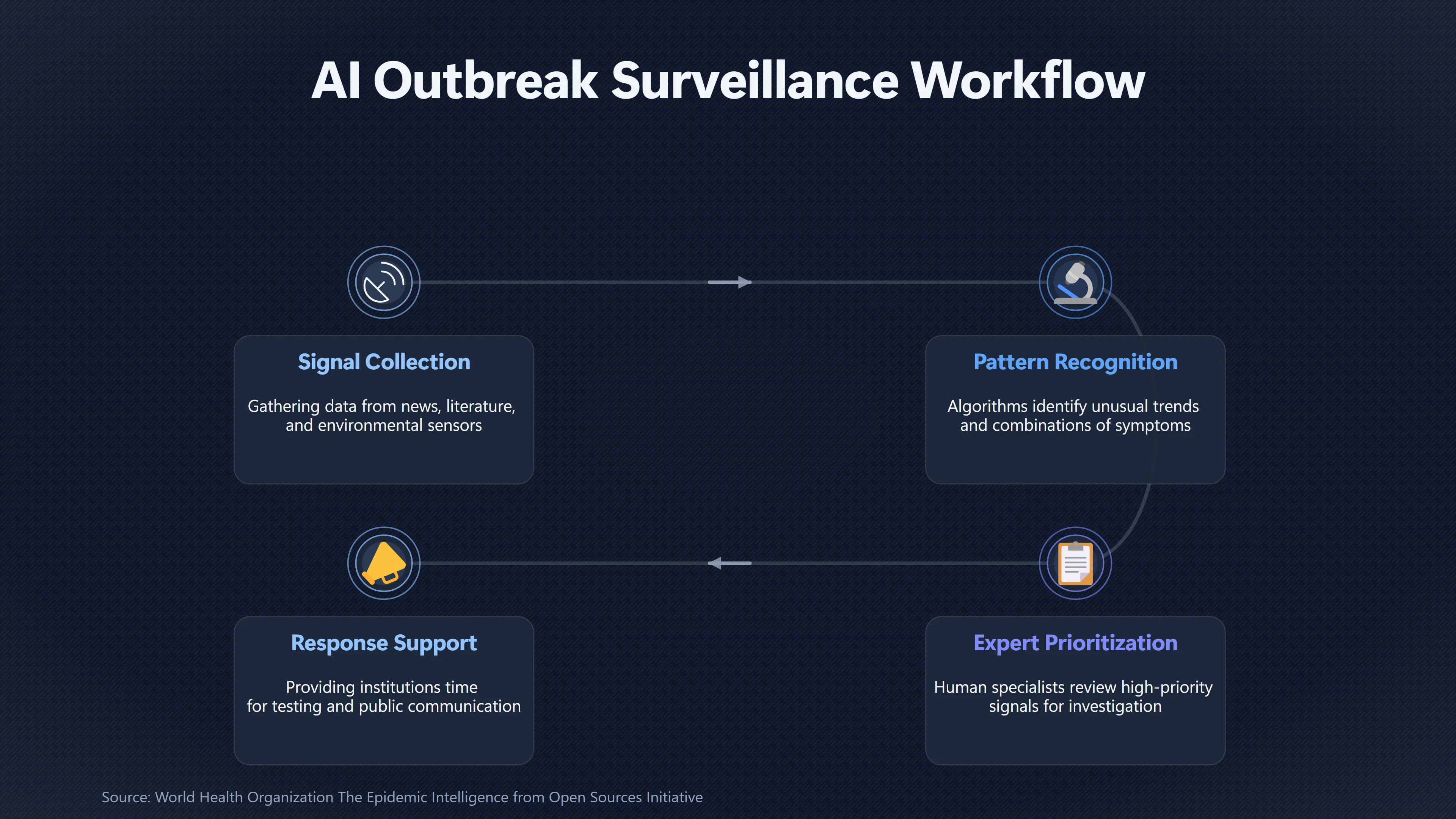
The mechanism can be understood as a chain:
- Collect signals: AI systems gather information from sources such as health reports, scientific literature, official alerts, news and environmental monitoring.
- Recognise patterns: Algorithms search for unusual combinations, trends or changes that may indicate a developing threat.
- Prioritise investigation: Human experts review the most important signals and decide whether further action is needed.
- Support response: Better awareness gives institutions more time to prepare, communicate and coordinate.
This changes the role of surveillance from a mainly reactive process into a more continuous form of biological situational awareness.
Why prediction is harder than detection
The phrase “AI predicting pandemics” can create unrealistic expectations. Detecting that something unusual is happening is easier than forecasting exactly what will happen next. A cluster of unexplained illnesses may be harmless, localised or caused by factors that do not lead to a wider outbreak. A successful surveillance system must therefore balance sensitivity — finding possible threats — with accuracy, avoiding a flood of false alarms.
Disease emergence is shaped by many interacting factors: pathogen biology, animal-human contact, travel patterns, healthcare capacity, social behaviour and environmental change. Even a highly advanced AI system cannot remove this uncertainty. Its value lies in improving human decision-making under uncertainty rather than producing a perfect forecast.
The COVID-19 pandemic illustrated both the promise and the limits of early-warning technology. AI-supported systems helped identify and organise information about emerging risks, but governments still depended on laboratory confirmation, epidemiological investigation and public health capacity. Early detection only creates an opportunity; it does not automatically produce a successful response.
This distinction matters for the long-term AI bloom case. More intelligence can expand humanity’s ability to protect itself, but intelligence must be connected to trustworthy institutions. A warning ignored, misunderstood or hidden provides little benefit.

From isolated tools to global surveillance networks
The biggest potential gains come from connected networks rather than individual AI models. A future outbreak defence system could combine many forms of monitoring into a shared intelligence layer.
Combining human, animal and environmental signals
Many future outbreaks are expected to involve interactions between humans, animals and ecosystems. This is why public health organisations increasingly use a “One Health” approach, linking human medicine with veterinary and environmental monitoring. AI is particularly suited to this challenge because it can combine information from different domains that are difficult for any single team to track manually.[World Health Organization]who.intWorld Health Organization EIOS CollaborationWorld Health Organization EIOS Collaboration
Wastewater surveillance is one example of this broader approach. During COVID-19, monitoring sewage samples helped identify community-level changes in viral activity before traditional case reporting fully captured them. Researchers and public health agencies are now exploring wider use of environmental surveillance for other pathogens, where AI could help analyse complex genetic and epidemiological data streams.[The Guardian]theguardian.comDos estudios demuestran que la monitorización de patógenos en sistemas de alcantarillado, incluso en aviones, puede revelar qué virus y b…
Creating earlier warnings without replacing experts
The most realistic model is a partnership between machines and institutions. AI can scan, rank and summarise information at a scale beyond human capacity, while experts provide context, verification and judgement.
The WHO’s EIOS system reflects this model. Its purpose is not to allow an algorithm to declare that a pandemic has begun, but to strengthen public health intelligence by helping people detect, assess and respond to threats more effectively. The system has expanded as part of broader efforts to improve global health security and connect technology with public health expertise.[World Health Organization]who.intWorld Health Organization EIOS CollaborationWorld Health Organization EIOS Collaboration
The hardest challenge is building trust
A global AI outbreak surveillance network would need more than powerful algorithms. It would require international cooperation, shared standards, reliable data and public confidence.
Data quality is a major limitation. Many regions have weaker laboratory systems, limited reporting infrastructure or fewer resources for surveillance. An AI model trained mainly on wealthy countries’ data may perform poorly elsewhere. A truly global system would need investment in local capacity rather than simply deploying technology from the outside.
Privacy and governance also matter. Some surveillance approaches may involve sensitive health information, location data or large-scale digital monitoring. The goal of pandemic preparedness is to increase safety without creating unnecessary systems of intrusion or unequal control.
There is also a risk of overconfidence. A warning system that appears highly advanced could encourage leaders to assume that technology has solved pandemic risk. In reality, AI works best as one layer in a wider defence system that includes healthcare infrastructure, scientific research, manufacturing capacity and international coordination.

AI detection as part of a larger human bloom
AI outbreak surveillance networks represent a relatively near-term example of a broader possibility: advanced intelligence helping civilisation become more resilient. The value is not only in preventing individual outbreaks, but in increasing humanity’s ability to understand complex threats and coordinate responses.
In an optimistic long-term scenario, increasingly capable AI systems could help societies move from repeatedly reacting to crises towards anticipating and reducing them. Disease surveillance is one piece of that transition. It shows how AI could transform information overload into actionable knowledge — not by replacing human judgement, but by expanding the range of problems humans can see and solve.[PubMed Central (PMC)]pmc.ncbi.nlm.nih.govPubMed Central (PMC)Artificial intelligence in early warning systems for infectious disease surveillance: a systematic review - PMCJune 2…
The strongest case for AI-powered outbreak detection is therefore not that machines will foresee every pandemic. It is that better collective intelligence could give humanity more time, more options and a greater ability to protect the long future.
Amazon book picks
Further Reading
Books and field guides related to Can AI spot pandemics before they spread?. Use these as the next step if you want deeper reading beyond the article.
The Rules of Contagion
An Observer Book of the Year A Times Science Book of the Year A New Statesman Book of the Year A Financial Times Science Book of the Year...
Spillover
A masterpiece of science reporting that tracks the animal origins of emerging human diseases, Spillover is “fascinating and terrifying …...
How to Survive a Pandemic
A vital, timely text on the viruses that cause pandemics and how to face them, by the New York Times bestselling author of How Not to Die...
eBay marketplace picks
Marketplace Samples
Live-tested eBay searches with available results related to this page.
Selected frommedical science poster oneBay.co.uk.


Endnotes
1.
Source: who.int
Title: World Health Organization The Epidemic Intelligence from Open Sources Initiative
Link:https://www.who.int/initiatives/eios
2.
Source: who.int
Title: frequently asked questions about eios
Link:https://www.who.int/news-room/questions-and-answers/item/frequently-asked-questions-about-eios
Source snippet
World Health OrganizationFrequently Asked Questions about EIOSApril 23, 2021...
Published: April 23, 2021
3.
Source: who.int
Link:https://www.who.int/publications/i/item/who-wer10016
Source snippet
World Health OrganizationImpact of using the Epidemic Intelligence from Open Sources (EIOS) system for early detection of public health t...
4.
Source: who.int
Title: World Health Organization EIOS Collaboration
Link:https://www.who.int/initiatives/eios/eios-collaboration
5.
Source: time.com
Link:https://time.com/6966800/amy-kirby/
Source snippet
Through a 2018 grant, she initially researched antibiotic-resistant bacteria in wastewater. With the onset of COVID-19 in 2020, Kirby pro...
6.
Source: pandemichub.who.int
Link:https://pandemichub.who.int/news-room/news/item/13-10-2025-who-upgrades-its-public-health-intelligence-system-to-boost-global-health-security
7.
Source: who.int
Link:https://www.who.int/publications/i/item/B09476
8.
Source: who.int
Link:https://www.who.int/initiatives/eios/eios-publications
9.
Source: who.int
Link:https://www.who.int/initiatives/eios/eios-technology
10.
Source: pmc.ncbi.nlm.nih.gov
Link:https://pmc.ncbi.nlm.nih.gov/articles/PMC12230060/
Source snippet
PubMed Central (PMC)Artificial intelligence in early warning systems for infectious disease surveillance: a systematic review - PMCJune 2...
11.
Source: pubmed.ncbi.nlm.nih.gov
Link:https://pubmed.ncbi.nlm.nih.gov/40626156/
Source snippet
Artificial intelligence in early warning systems for infectious disease surveillance: a systematic review - PubMed...
12.
Source: theguardian.com
Link:https://www.theguardian.com/science/2025/mar/05/wastewater-disease-flu-outbreaks
Source snippet
Dos estudios demuestran que la monitorización de patógenos en sistemas de alcantarillado, incluso en aviones, puede revelar qué virus y b...
13.
Source: pubmed.ncbi.nlm.nih.gov
Link:https://pubmed.ncbi.nlm.nih.gov/41576591/
14.
Source: pubmed.ncbi.nlm.nih.gov
Link:https://pubmed.ncbi.nlm.nih.gov/41260128/
15.
Source: pubmed.ncbi.nlm.nih.gov
Link:https://pubmed.ncbi.nlm.nih.gov/40038598/
16.
Source: pmc.ncbi.nlm.nih.gov
Link:https://pmc.ncbi.nlm.nih.gov/articles/PMC11877865/
17.
Source: pmc.ncbi.nlm.nih.gov
Link:https://pmc.ncbi.nlm.nih.gov/articles/PMC10052500/
18.
Source: pmc.ncbi.nlm.nih.gov
Link:https://pmc.ncbi.nlm.nih.gov/articles/PMC7878557/
19.
Source: pmc.ncbi.nlm.nih.gov
Link:https://pmc.ncbi.nlm.nih.gov/articles/PMC7711608/
20.
Source: researchportal.ukhsa.gov.uk
Link:https://researchportal.ukhsa.gov.uk/en/publications/analysis-insights-to-support-the-use-of-wastewater-and-environmen/
21.
Source: researchportal.ukhsa.gov.uk
Link:https://researchportal.ukhsa.gov.uk/en/publications/a-narrative-review-of-wastewater-surveillance-pathogens-of-concer/
Additional References
22.
Source: mdpi.com
Link:https://www.mdpi.com/2076-0817/15/7/690
Source snippet
h SurveillanceJune 30, 2026 — ABSTRACT Introduction: Integrated One Health-based surveillance of pathogens in wastewater suggests its pot...
Published: June 30, 2026
23.
Source: youtube.com
Title: Data Science and Machine Learning for Public Health Microbiology Practice
Link:https://www.youtube.com/watch?v=0ySrNxs4PrU
Source snippet
Prometheus Unbound: The Potential and Risks of Large Language Models in Public Health...
24.
Source: youtube.com
Link:https://www.youtube.com/watch?v=za-p2LNV-qk
Source snippet
March 2026 Edition of the GET Webinar Series...
Published: March 2026
25.
Source: youtube.com
Link:https://www.youtube.com/watch?v=QKTdW8AskzI
Source snippet
New centre for AI in public health to be launched early next year...
Published: March 2026
26.
Source: youtube.com
Title: Stopping Outbreaks Before They Start
Link:https://www.youtube.com/watch?v=ndfO2BnIgq4
Source snippet
Data Science and Machine Learning for Public Health Microbiology Practice...
27.
Source: lifescience.net
Link:https://www.lifescience.net/publications/1361023/artificial-intelligence-in-early-warning-systems-f/
28.
Source: scienceopen.com
Link:https://www.scienceopen.com/document?vid=cd0e3707-5159-4ded-a129-a96fa3bd3323
29.
Source: bluedot.global
Link:https://bluedot.global/
30.
Source: frontiersin.org
Link:https://www.frontiersin.org/journals/public-health/articles/10.3389/fpubh.2025.1609615/full
31.
Source: deptmedicine.utoronto.ca
Link:https://deptmedicine.utoronto.ca/news/tracking-coronavirus-pandemic-ai-bluedot-featured-60-minutes