Within Rentosertib
Why One AI Drug Trial Is Not Enough
One small early trial cannot show that AI-designed drugs will win approval more often, work better or reduce development costs across the industry.
On this page
- How small samples and short follow up can mislead
- Why promising drugs often fail in later trials
- What evidence would show that AI improves drug development
Page outline Jump by section
Introduction
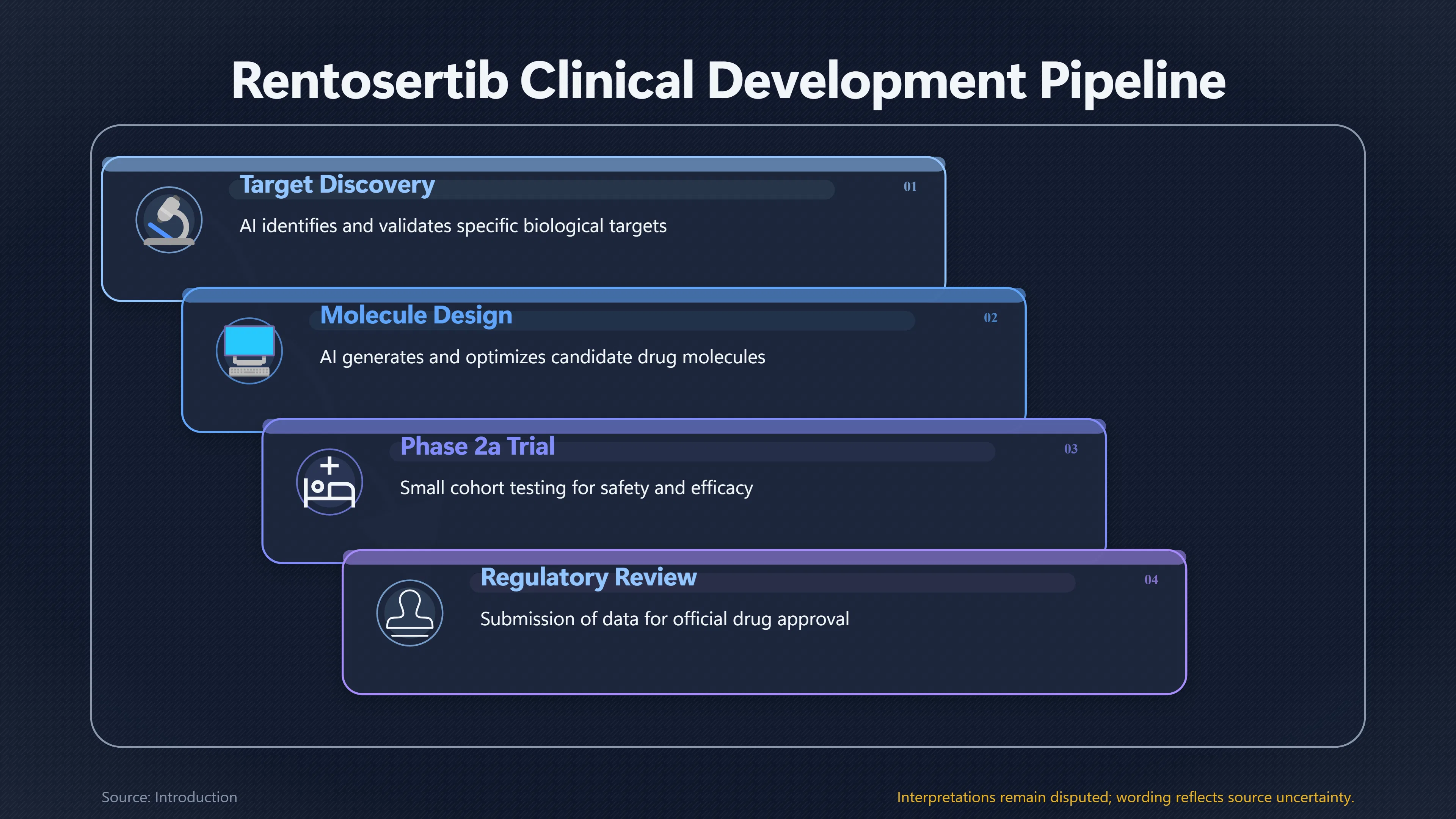
Rentosertib is an important milestone for AI-assisted drug discovery, but it is not yet proof that artificial intelligence has transformed pharmaceutical research. The drug’s phase 2a trial shows that an AI-discovered target and AI-designed molecule can survive laboratory work, regulatory review and early human testing. That is a genuine achievement. However, one encouraging early-stage study cannot establish that AI-designed drugs are more likely to succeed, reach approval faster, cost less to develop, or produce better treatments than conventional approaches.[nature.com]nature.comJune 3, 2025…
For readers interested in the broader idea of AI-driven scientific acceleration and human flourishing, this distinction matters. If AI is eventually to help produce an era of dramatically faster medical progress, the evidence must show improvements across many programmes and many diseases, not just one promising candidate. Rentosertib is best understood as an encouraging signal rather than decisive validation.
Why one successful phase 2a trial proves less than it appears
Clinical drug development is deliberately designed to filter out promising ideas that ultimately fail. Every stage asks a different question.
Rentosertib has answered some important early questions. Researchers demonstrated that the compound could be manufactured, administered to patients with idiopathic pulmonary fibrosis (IPF), and studied in a randomised, placebo-controlled trial. The study also produced encouraging signs that the highest dose improved lung function over twelve weeks while maintaining an acceptable safety profile for further investigation.[nature.com]nature.comJune 3, 2025…
Those findings do not answer several much larger questions:
- Will the benefits persist over many months or years?
- Will larger trials reproduce the same results?
- Will the drug improve outcomes that matter most to patients, such as disease progression, hospitalisation or survival?
- Will rare safety problems emerge once hundreds or thousands of patients receive treatment?
- Will regulators ultimately conclude that benefits outweigh risks?
Drug development is full of compounds that looked encouraging in early trials but failed when tested more rigorously. Rentosertib has not yet escaped that historical pattern.
How small samples and short follow-up can mislead
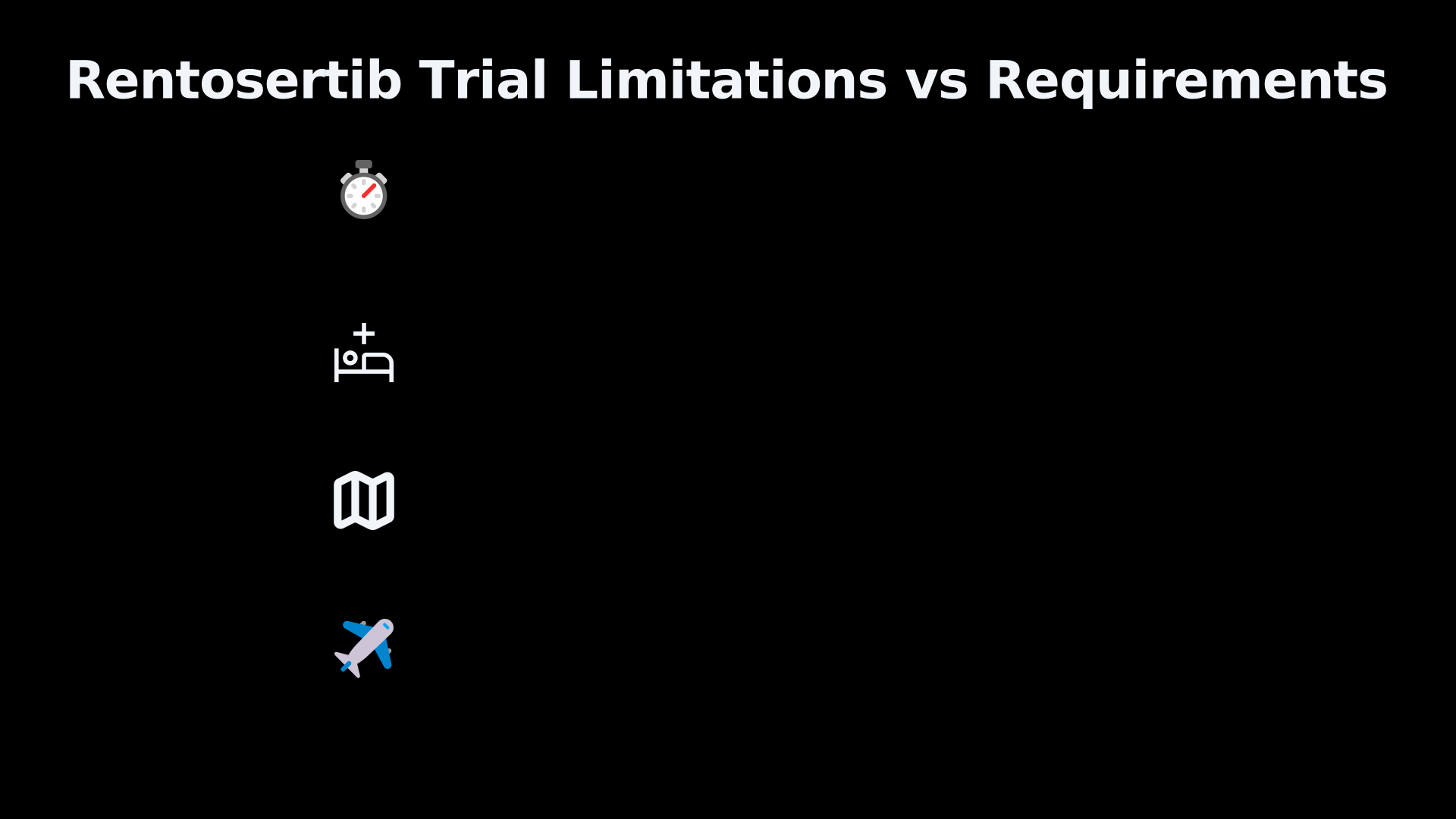
The published phase 2a trial enrolled only 71 patients, divided across four treatment groups, and followed them for just 12 weeks. That design is appropriate for an exploratory study but limits the certainty of the conclusions.[nature.com]nature.comJune 3, 2025…
Several features make caution necessary.
First, small studies produce more variable results. A handful of unusually good or unusually poor responses can noticeably affect average outcomes.
Second, IPF is a chronic disease that progresses over years rather than weeks. A treatment that appears promising over three months may not maintain its effect over a year or longer.
Third, uncommon adverse effects are unlikely to appear in a trial involving only a few dozen treated patients. Many important drug safety issues emerge only after much larger populations have been exposed.
The trial authors themselves identify these limitations, noting the relatively small cohort, the short follow-up period and the demographic homogeneity of participants, who were all recruited in China. They conclude that larger, longer and more geographically diverse studies are needed before firm conclusions can be drawn.[nature.com]nature.comJune 3, 2025…
Why promising drugs often fail in later trials
The history of medicine is filled with treatments that generated excitement in phase 2 before disappointing in phase 3.
Later-stage failures occur for several reasons:
- Initial results may overestimate benefit. Random variation tends to be larger in small trials.
- Patient populations change. Larger international studies include more diverse patients with different ages, genetics and co-existing illnesses.
- Longer observation reveals new risks. Side effects may accumulate over time or appear only after prolonged exposure.
- Clinical endpoints become more demanding. Regulators usually require evidence that treatments produce meaningful improvements in patients’ lives, not simply encouraging changes in intermediate measurements.
None of these risks is specific to AI-designed drugs. They are fundamental features of pharmaceutical development. AI cannot eliminate the biological uncertainty involved in testing a new medicine inside the human body.
Rentosertib cannot yet prove AI improves drug discovery
Even if Rentosertib eventually succeeds, it would remain only one example.
The larger claim—that AI improves pharmaceutical research—requires evidence across an entire portfolio of drug programmes.
Several alternative explanations remain possible.
AI may have helped discover one particularly good candidate without changing average industry performance.
Alternatively, AI may accelerate the earliest discovery stages while leaving the expensive and failure-prone clinical stages largely unchanged.
It is also possible that AI proves especially useful in some disease areas but offers little advantage in others because the limiting factor is incomplete biological understanding rather than molecule design.
The Nature Medicine investigators acknowledge this uncertainty directly, noting that few AI-discovered drugs have reached human trials, that none has yet completed phase 3, and that the broader question of whether AI meaningfully transforms drug development remains unanswered.[DOI]doi.orgA generative AI-discovered TNIK inhibitor for idiopathic pulmonary fibrosis: a randomized phase 2a trial | Nature Medicine…
What evidence would actually validate AI drug discovery?
A convincing case would require repeated success rather than an isolated milestone.
Evidence would become substantially stronger if researchers observed several developments over the coming years.
Consistently higher clinical success rates. AI-originated drug candidates would need to progress through phases 2 and 3 more often than conventionally discovered drugs after accounting for disease area and trial difficulty.
Multiple regulatory approvals. Approval by major regulators would demonstrate that AI-discovered medicines can satisfy the same standards applied to every other therapy.
Replication across companies. Success would be more persuasive if it came from many organisations using different AI approaches rather than one company or one platform.
Better productivity. AI would need to demonstrate measurable reductions in discovery time, lower research costs, or higher numbers of successful medicines reaching patients without sacrificing safety.
Independent validation. Results should be reproduced in peer-reviewed studies rather than relying primarily on company announcements or investor presentations.
Only a broad body of evidence can establish whether AI changes the overall economics and effectiveness of pharmaceutical research.

What this means for the wider AI bloom argument
Within the broader vision of AI accelerating science and expanding human flourishing, Rentosertib occupies an important but limited place.
Optimists argue that increasingly capable AI systems could dramatically increase the pace of medical discovery, helping address diseases that currently resist treatment and ultimately contributing to longer, healthier lives. Rentosertib offers one concrete example suggesting that AI can contribute meaningfully to the earliest stages of discovering new medicines.[nature.com]nature.comJune 3, 2025…
However, the leap from “AI helped produce one promising drug candidate” to “AI will transform medicine” remains an inference rather than an established fact. The pharmaceutical industry has seen many technologies—from combinatorial chemistry to genomics and high-throughput screening—that initially promised sweeping improvements but required years of evidence before their true impact became clear. Recent reporting on the field likewise notes that, despite renewed optimism, AI has yet to produce an approved drug or demonstrate industry-wide improvements in late-stage success.[ft.com]ft.comBreakthroughs such as DeepMind’s AlphaFold2 and the rise of generative AI have renewed optimism, enabling more sophisticated modeling of…
The strongest interpretation is therefore neither scepticism nor hype. Rentosertib increases the plausibility that AI can become a powerful scientific tool. It does not yet validate the broader claim that AI has fundamentally changed drug discovery. That judgement will depend on whether many AI-originated medicines repeatedly succeed in the long, difficult clinical pathway that still lies ahead.
Amazon book picks
Further Reading
Books and field guides related to Why One AI Drug Trial Is Not Enough. Use these as the next step if you want deeper reading beyond the article.

Deep Medicine: How Artificial Intelligence Can Make Healthcar...
First published 2019. Subjects: Artificial intelligence, Medical informatics, Medical applications, Diagnosis, Data processing.
The Emperor of All Maladies: A Biography of Cancer
A historical assessment of cancer addresses both the courageous battles against the complex disease and the misperceptions and hubris tha...
The Drug Hunters: The Improbable Quest to Discover New Medicines
The surprising, behind-the-scenes story of how our medicines are discovered, told by a veteran drug hunter. The search to find medicines...

eBay marketplace picks
Marketplace Samples
Live-tested eBay searches with available results related to this page.
Selected frommolecule model oneBay.co.uk.



Endnotes
1.
Source: nature.com
Link:https://www.nature.com/articles/s41591-025-03743-2
Source snippet
June 3, 2025...
Published: June 3, 2025
2.
Source: doi.org
Link:https://doi.org/10.1038/s41591-025-03743-2
Source snippet
A generative AI-discovered TNIK inhibitor for idiopathic pulmonary fibrosis: a randomized phase 2a trial | Nature Medicine...
3.
Source: ft.com
Link:https://www.ft.com/content/9a8aee4e-9cf6-4bb3-b7ea-d95ddd0d5e79
Source snippet
Breakthroughs such as DeepMind’s AlphaFold2 and the rise of generative AI have renewed optimism, enabling more sophisticated modeling of...
Additional References
4.
Source: mdpi.com
Link:https://www.mdpi.com/1424-8247/19/6/916
Source snippet
Clinical performance of first-wave AI drugs. Data compiled from company disclosures, ClinicalTrials.gov records, investor reports, and pu...
5.
Source: p05.org
Link:https://www.p05.org/patentability-of-ai-discovered-medicines-navigating-legal-frameworks-and-clinical-progress/
Source snippet
September 29, 2025 — RENTOSERTIB BREAKTHROUGH VALIDATES AI DISCOVERY AS CLINICAL PIPELINES EXPAND Insilico Medicine's rentosertib achieve...
Published: September 29, 2025
6.
Source: readingtheevidence.org
Title: The First AI-Designed Drug Reached Phase 2a: What the Trial Actually Showed | Dr
Link:https://readingtheevidence.org/articles/first-ai-designed-drug-phase-2a-readout/
Source snippet
Damon TojjarApril 27, 2026 — THE FIRST AI-DESIGNED DRUG REACHED PHASE 2A: WHAT THE TRIAL ACTUALLY SHOWED By Dr. Damon Tojjar27 April 2026...
Published: April 27, 2026
7.
Source: p05.org
Title: Generation feeds cheap in-silico f
Link:https://www.p05.org/grounding-the-machine-how-ai-drug-design-actually-handles-hallucination/
Source snippet
Grounding the Machine: How AI Drug Design Actually Handles HallucinationJune 8, 2026 — THE VALIDATION FUNNEL, AND THE FAILURE IT CANNOT P...
Published: June 8, 2026
8.
Source: youtube.com
Title: AI in Drug Discovery — Episode 15: Case Study: Rentosertib, End to End
Link:https://www.youtube.com/watch?v=_cuuL6hXTI4
Source snippet
Coding the Impossible Cure: The First AI-Powered Drug with Safety and Efficacy Proved in Phase IIa...
9.
Source: youtube.com
Link:https://www.youtube.com/watch?v=RMYkvbhOezo
Source snippet
AI in Drug Discovery: From Hype to Clinical Reality...
10.
Source: sciencedirect.com
Link:https://www.sciencedirect.com/science/article/pii/S0031699725075118
Source snippet
PIPELINE AND 2024–2025 PROGRESS Insilico’s lead drug, ISM001-055 (Rentosertib), has become a milestone for the field, the first fully AI...
11.
Source: communities.springernature.com
Title: ai meets ipf taking an ai designed drug from target discovery to phase iia
Link:https://communities.springernature.com/amp/posts/ai-meets-ipf-taking-an-ai-designed-drug-from-target-discovery-to-phase-iia
12.
Source: biopharmatrend.com
Link:https://www.biopharmatrend.com/news/ai-designed-tnik-inhibitor-shows-lung-function-gains-in-ipf-1282/
13.
Source: youtube.com
Title: Story of Rentosertib ISM001-055
Link:https://www.youtube.com/watch?v=KyUDHnePu6M
Source snippet
AI in Drug Discovery — Episode 15: Case Study: Rentosertib, End to End...