Within Pandemic Defence
What COVID 19 taught about AI medicine
The COVID-19 response showed how AI can speed biological research while revealing the limits of technology without strong scientific systems.
On this page
- AI tools used during the pandemic
- Where acceleration helped scientists
- Why laboratories and trials still matter
Page outline Jump by section
Introduction
The COVID-19 pandemic became one of the first global health crises to test whether artificial intelligence could meaningfully accelerate medical response. The answer was mixed: AI helped scientists process biological information, analyse medical images, search research literature and explore possible treatments, but it did not replace the slower foundations of medicine — laboratory experiments, clinical trials, manufacturing and public health coordination.[World Health Organization]who.intWorld Health Organization R&D Blueprint and COVID-19World Health Organization R&D Blueprint and COVID-19
The lasting lesson is important for the wider AI bloom vision: advanced intelligence could help humanity respond faster to biological threats, but the benefit comes from combining powerful tools with strong scientific systems. COVID-19 showed an early glimpse of AI-accelerated medicine while also revealing that intelligence alone is not enough. A future in which AI helps reduce disease and extend healthy human life will depend on trustworthy data, rigorous testing, global cooperation and institutions capable of turning discoveries into real-world improvements.[World Health Organization]who.intWorld Health Organization Harnessing artificial intelligence for healthWorld Health OrganizationHarnessing artificial intelligence for healthMay 27, 2024…
AI tools used during the pandemic
During COVID-19, researchers explored AI across several stages of the medical response. Some applications were highly practical, while others were early demonstrations of what future systems might achieve.
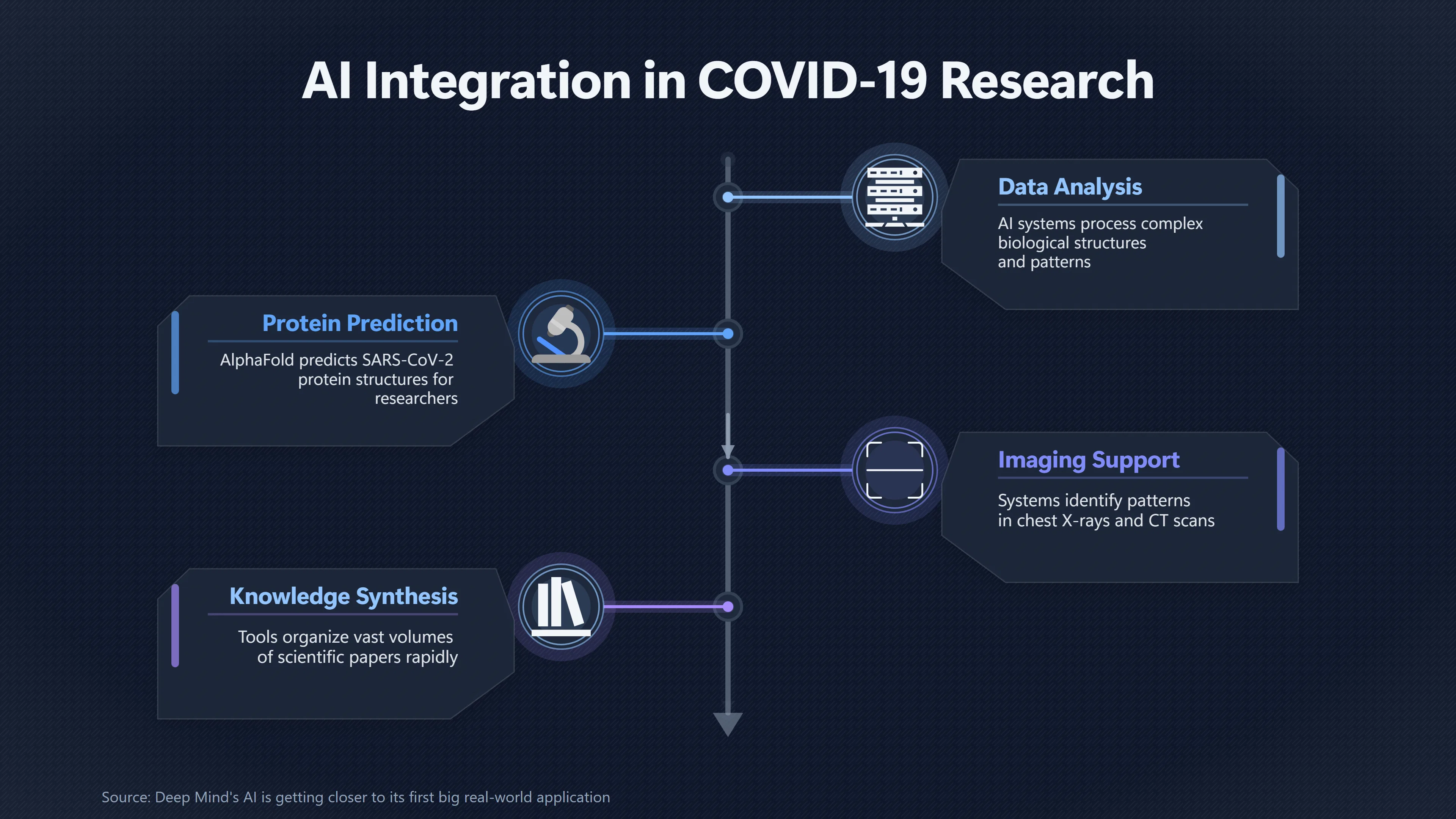
One major area was biological research acceleration. AI systems can analyse complex biological structures and patterns that are difficult for humans to process directly. In early 2020, Google DeepMind released AI-generated predictions of the structures of several SARS-CoV-2 proteins using its AlphaFold system. These predictions were not substitutes for experimental biology, but they gave researchers additional information about viral components and demonstrated how machine learning could contribute to urgent scientific work.[Google DeepMind]deepmind.googleGoogle DeepMindComputational predictions of protein structures associated with COVID-19 — Google DeepMindAugust 4, 2020…
The importance of this approach was not that AI immediately produced a finished medicine. Instead, it showed a different model of scientific acceleration: AI can shorten some parts of the research cycle by helping scientists explore possibilities faster. This same principle later became central to broader AI biology efforts, where models assist with understanding proteins, molecules and genetic information.[wired.com]wired.comDeep Mind's AI is getting closer to its first big real-world applicationWhile it has made contributions in healthcare and data center efficiency, its most groundbreaking work now focuses on protein folding, a…
AI was also applied to medical imaging. Researchers developed systems designed to identify COVID-related patterns in chest X-rays and CT scans, aiming to support diagnosis when healthcare systems faced pressure. However, many of these systems remained research projects rather than widely deployed clinical tools because medical AI requires careful validation across different hospitals, populations and equipment.[arXiv]arxiv.orgMedical Imaging with Deep Learning for COVID- 19 Diagnosis: A Comprehensive ReviewJuly 13, 2021…
Another important use was information processing. The pandemic produced an enormous volume of scientific papers, clinical reports and public health information. AI-assisted tools helped researchers search and organise rapidly expanding knowledge, supporting faster access to relevant findings during a period when conventional review processes struggled to keep pace. Reviews of COVID-19 AI applications identified uses ranging from data analysis and medical imaging to drug discovery and epidemic monitoring.[arXiv]arxiv.orgMedical Imaging with Deep Learning for COVID- 19 Diagnosis: A Comprehensive ReviewJuly 13, 2021…
Where acceleration helped scientists
The clearest success of AI during COVID-19 was not replacing researchers but increasing their capacity.
Faster biological understanding
A pandemic creates a race between scientific discovery and viral spread. Researchers need to understand the pathogen, identify vulnerabilities, design experiments and evaluate possible interventions. AI can contribute by finding patterns in large datasets, predicting molecular relationships and prioritising promising research directions.
This is especially relevant to the long-term AI bloom idea because medical progress is often limited by the speed at which humans can analyse information. If future AI systems become much more capable, they could potentially compress parts of the scientific process that currently take months or years. COVID-19 provided an early example of this possibility, although at a modest scale.[Google DeepMind]deepmind.googleGoogle DeepMindComputational predictions of protein structures associated with COVID-19 — Google DeepMindAugust 4, 2020…
Faster research coordination
The World Health Organization’s COVID-19 Research and Development Blueprint focused on accelerating diagnostics, vaccines and therapeutics by improving coordination among scientists and global health organisations. The pandemic demonstrated that scientific speed depends not only on algorithms but also on networks of researchers sharing information and working towards common goals.[World Health Organization]who.intWorld Health Organization R&D Blueprint and COVID-19World Health Organization R&D Blueprint and COVID-19
This distinction matters. AI can increase the amount of useful information available to researchers, but discoveries still require institutions that can organise experiments, fund studies and move successful ideas into healthcare systems.
Faster identification of possibilities
AI helped researchers explore potential treatments and understand disease mechanisms, but its main contribution was often narrowing the search space rather than delivering final answers. In drug discovery, for example, AI may suggest promising molecules or biological targets, but those candidates must still pass laboratory testing and clinical trials before they can benefit patients.
The pandemic therefore showed a realistic pathway for AI-driven medicine: not instant cures, but faster cycles of hypothesis generation, testing and refinement.
Why laboratories and trials still matter
COVID-19 also exposed the limits of AI enthusiasm. Many proposed AI applications sounded transformative in theory but struggled when confronted with real medical conditions.
A central problem was that healthcare data is complicated. AI systems learn from existing examples, but a new pandemic creates unfamiliar situations. Data can be incomplete, inconsistent or collected under emergency conditions. A model that performs well in one hospital may not work equally well elsewhere. Researchers studying AI deployment during COVID-19 highlighted the difficulty of translating promising models into frontline healthcare because clinical needs changed rapidly and systems had to match local conditions.[arXiv]arxiv.orgOpen source on arxiv.org.
Medical validation also remains essential. A prediction is not the same as a proven treatment, and a computer-generated result is not automatically a clinical breakthrough. COVID-19 diagnostic tools, tests and medical devices still required regulatory assessment and evidence that they worked safely in real-world settings. The US Food and Drug Administration’s emergency authorisation system illustrated this balance: urgent access could be accelerated during the crisis, but medical products still operated within frameworks designed to assess safety and effectiveness.[U.S. Food and Drug Administration]fda.govcovid 19 emergency use authorizations medical devicesU.S. Food and Drug AdministrationCOVID-19 Emergency Use Authorizations for Medical Devices | FDANovember 8, 2023…
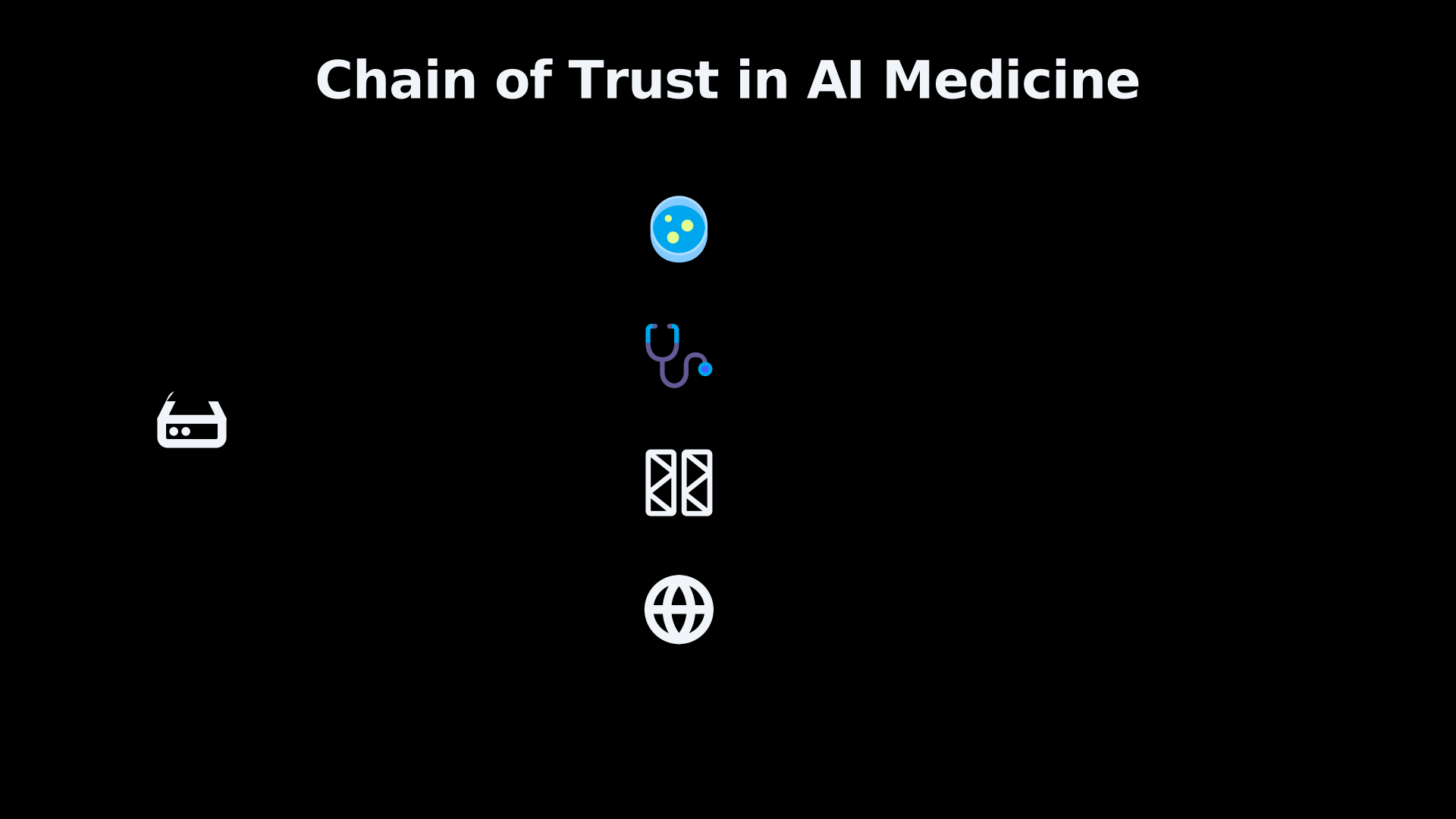
This is one of the most important lessons for future AI-powered healthcare. Intelligence can accelerate discovery, but medicine depends on a chain of trust:
- Reliable data so AI systems learn from meaningful information.
- Experimental science to test whether predictions match reality.
- Clinical trials to show benefits and identify risks.
- Regulation and oversight to protect patients.
- Health systems capable of delivery so breakthroughs reach people.
Without these foundations, faster computation does not automatically become better health outcomes.
The lesson for future AI pandemic defence
COVID-19 suggests that future AI pandemic defence networks should not be imagined as a single machine predicting and defeating every outbreak. A more realistic model is a connected scientific system where AI strengthens many parts of the response.
Such a system could help researchers recognise threats earlier, analyse biological information faster, design experiments more efficiently and support decision-makers with better evidence. The pandemic showed that these capabilities are valuable, but it also showed that resilience depends on human institutions.
For the AI bloom vision, this is a crucial distinction. The optimistic case for advanced AI is not that machines independently solve humanity’s problems. It is that AI could expand humanity’s ability to understand, coordinate and act. In medicine, that could mean faster discovery, better prevention and eventually major improvements in healthy lifespan. But reaching that future requires pairing powerful intelligence with scientific openness, global cooperation and safeguards that ensure benefits are widely shared.[World Health Organization]who.intWorld Health Organization Harnessing artificial intelligence for healthWorld Health OrganizationHarnessing artificial intelligence for healthMay 27, 2024…
COVID-19 was therefore less a demonstration that AI can defeat pandemics today and more a demonstration of the direction in which civilisation could move: from slower, reactive responses towards increasingly intelligent systems that help humanity anticipate threats and protect more lives.
Amazon book picks
Further Reading
Books and field guides related to What COVID 19 taught about AI medicine. Use these as the next step if you want deeper reading beyond the article.
The Song of the Cell
**Longlisted for the Baillie Gifford Prize 2023** A NEW YORK TIMES, DAILY TELEGRAPH, ECONOMIST, MAIL ON SUNDAY and GUARDIAN BOOK OF THE Y...
The Rules of Contagion
An Observer Book of the Year A Times Science Book of the Year A New Statesman Book of the Year A Financial Times Science Book of the Year...
The Premonition
NEW YORK TIMES BESTSELLER For those who could read between the lines, the censored news out of China was terrifying. But the president in...
The Code Breaker
"A gripping account of how the pioneering scientist Jennifer Doudna, along with her colleagues and rivals, launched a revolution that wil...
eBay marketplace picks
Marketplace Samples
Live-tested eBay searches with available results related to this page.
Selected frommedical poster oneBay.co.uk.

Endnotes
1.
Source: arxiv.org
Link:https://arxiv.org/abs/2005.12137
2.
Source: deepmind.google
Link:https://deepmind.google/blog/computational-predictions-of-protein-structures-associated-with-covid-19/
Source snippet
Google DeepMindComputational predictions of protein structures associated with COVID-19 — Google DeepMindAugust 4, 2020...
Published: August 4, 2020
3.
Source: wired.com
Title: Deep Mind’s AI is getting closer to its first big real-world application
Link:https://www.wired.com/story/deepmind-protein-folding-alphafold
Source snippet
While it has made contributions in healthcare and data center efficiency, its most groundbreaking work now focuses on protein folding, a...
4.
Source: arxiv.org
Link:https://arxiv.org/abs/2107.09602
Source snippet
Medical Imaging with Deep Learning for COVID- 19 Diagnosis: A Comprehensive ReviewJuly 13, 2021...
Published: July 13, 2021
5.
Source: deepmind.google
Title: [Alpha Fold]({{ ‘alpha-fold/’ | relative_url }}): Five Years of Impact — Google Deep Mind
Link:https://deepmind.google/blog/alphafold-five-years-of-impact/
6.
Source: deepmind.google
Title: Alpha Fold — Google Deep Mind
Link:https://deepmind.google/science/alphafold/
7.
Source: deepmind.google
Title: Alpha Fold: Using AI for scientific discovery — Google Deep Mind
Link:https://deepmind.google/blog/alphafold-using-ai-for-scientific-discovery/
8.
Source: deepmind.google
Link:https://deepmind.google/blog/enabling-high-accuracy-protein-structure-prediction-at-the-proteome-scale/
9.
Source: deepmind.google
Title: Alpha Fold: Using AI for scientific discovery — Google Deep Mind
Link:https://deepmind.google/blog/alphafold-using-ai-for-scientific-discovery-2020/
10.
Source: who.int
Title: World Health Organization R&D Blueprint and COVID-19
Link:https://www.who.int/teams/blueprint/covid-19
11.
Source: who.int
Title: World Health Organization Harnessing artificial intelligence for health
Link:https://www.who.int/teams/digital-health-and-innovation/harnessing-artificial-intelligence-for-health
Source snippet
World Health OrganizationHarnessing artificial intelligence for healthMay 27, 2024...
Published: May 27, 2024
12.
Source: fda.gov
Title: covid 19 emergency use authorizations medical devices
Link:https://www.fda.gov/medical-devices/emergency-use-authorizations-medical-devices/covid-19-emergency-use-authorizations-medical-devices
Source snippet
U.S. Food and Drug AdministrationCOVID-19 Emergency Use Authorizations for Medical Devices | FDANovember 8, 2023...
Published: November 8, 2023
13.
Source: fda.gov
Link:https://www.fda.gov/medical-devices/covid-19-emergency-use-authorizations-medical-devices/faqs-emergency-use-authorizations-euas-medical-devices-related-covid-19
14.
Source: pandemichub.who.int
Title: Berlin Hub Four Years of the WHO Hub for Pandemic and Epidemic Intelligence
Link:https://pandemichub.who.int/news-room/news/02-09-2025-four-years-of-the-who-hub-for-pandemic-and-epidemic-intelligence
15.
Source: accessdata.fda.gov
Link:https://www.accessdata.fda.gov/scripts/cdrh/cfdocs/cfPCD/classification.cfm?ID=QLN
16.
Source: who.int
Link:https://www.who.int/news/item/02-06-2026-new-who-discussion-paper-sets-out-opportunities-and-risks-of-ai-in-evidence-informed-health-policy
17.
Source: pandemichub.who.int
Link:https://pandemichub.who.int/news-room/news/item/16-04-2026-who-regional-office-for-the-eastern-mediterranean-launches-ai-community-of-practice-for-disaster-and-emergency-response-surveillance
18.
Source: pandemichub.who.int
Link:https://pandemichub.who.int/news-room/news/item/13-10-2025-who-upgrades-its-public-health-intelligence-system-to-boost-global-health-security
19.
Source: fda.gov
Title: coronavirus covid 19 and medical devices
Link:https://www.fda.gov/medical-devices/emergency-situations-medical-devices/coronavirus-covid-19-and-medical-devices
20.
Source: fda.gov
Title: notifications and emergency use authorizations faqs testing sars cov 2
Link:https://www.fda.gov/medical-devices/coronavirus-covid-19-and-medical-devices/notifications-and-emergency-use-authorizations-faqs-testing-sars-cov-2
21.
Source: fda.gov
Title: registration and listing medical devices relating covid 19
Link:https://www.fda.gov/medical-devices/coronavirus-covid-19-and-medical-devices/registration-and-listing-medical-devices-relating-covid-19
22.
Source: fda.gov
Title: remote or wearable patient monitoring devices euas
Link:https://www.fda.gov/medical-devices/covid-19-emergency-use-authorizations-medical-devices/remote-or-wearable-patient-monitoring-devices-euas
23.
Source: fda.gov
Title: other medical device euas
Link:https://www.fda.gov/medical-devices/covid-19-emergency-use-authorizations-medical-devices/other-medical-device-euas
24.
Source: fda.gov
Title: faqs emergency use authorizations euas medical devices related covid 19
Link:https://www.fda.gov/medical-devices/covid-19-emergency-use-authorizations-medical-devices/faqs-emergency-use-authorizations-euas-medical-devices-related-covid-19?_cldee=V7kqCjGb87haIpKjj-WEb0DfQQnSnVigjWZZ0mjXxDOczayYAdD3OjZcFXP5CwPk&esid=f2f4f07a-7dcd-ed11-b597-000d3a314cf4&recipientid=contact-e224ab3ac7cfe81180d102bfc0a80172-70b4a8fe79a74e9996b106e5dde5e204
25.
Source: GOV.UK
Title: www.gov.uk COVI D-19 test validation approved products
Link:https://www.gov.uk/government/publications/covid-19-test-validation-approved-products
26.
Source: who.int
Link:https://www.who.int/news/item/28-06-2021-who-issues-first-global-report-on-ai-in-health-and-six-guiding-principles-for-its-design-and-use
27.
Source: who.int
Title: SAR S-Co V-2 Antigen detecting rapid diagnostic test implementation projects
Link:https://www.who.int/news-room/articles-detail/sars-cov-2-antigen-detecting-rapid-diagnostic-test-implementation-projects
28.
Source: who.int
Link:https://www.who.int/news-room/articles-detail/coronavirus-disease-%28covid-19%29-pandemic-emergency-use-listing-procedure-%28eul%29-open-for-in-vitro-diagnostics
29.
Source: who.int
Title: advice on the use of point of care immunodiagnostic tests for covid 19
Link:https://www.who.int/news-room/commentaries/detail/advice-on-the-use-of-point-of-care-immunodiagnostic-tests-for-covid-19
30.
Source: who.int
Link:https://www.who.int/our-work/health-emergencies
Additional References
31.
Source: youtube.com
Link:https://www.youtube.com/watch?v=V73Kf8V3g1Y
Source snippet
A breakthrough unfolds explores the monumental impact of AlphaFold and machine learning models on biological research and medical acceler...
32.
Source: youtube.com
Link:https://www.youtube.com/watch?v=oJEHoTJHf9Q
Source snippet
Global Race for Protein Structure Prediction AI: A Paradigm Shift in Drug Development / YTN...
33.
Source: youtube.com
Title: How does AI help fight the COVID-19 pandemic?
Link:https://www.youtube.com/watch?v=HbByXkHYswM
Source snippet
MIDL 2020, Keynote by Nikos Paragios: AI-Driven Quantification, Staging and Prognosis of COVID-19 - YouTube...
34.
Source: nature.com
Link:https://www.nature.com/articles/s42256-021-00421-z
35.
Source: nature.com
Link:https://www.nature.com/articles/s41392-023-01381-z
36.
Source: nature.com
Link:https://www.nature.com/articles/s42256-021-00307-0
37.
Source: nature.com
Link:https://www.nature.com/articles/s41591-023-02540-z
38.
Source: nature.com
Link:https://www.nature.com/articles/s41591-021-01506-3
39.
Source: nature.com
Link:https://www.nature.com/articles/s41591-020-1034-x
40.
Source: nature.com
Link:https://www.nature.com/articles/s42256