Within Accessible Tutors
What Makes an AI Tutor Truly Accessible?
Accessible tutors work best when captions, speech, image descriptions and alternative communication are built into one flexible system.
On this page
- Combining visual, audio and text based support
- Giving learners control over pace and presentation
- Where teachers and specialists must remain involved
Page outline Jump by section
Introduction
An AI tutor becomes truly accessible not when it offers a single assistive feature, but when it allows learners to move naturally between text, speech, images, captions, symbols and alternative communication according to their individual needs. For a blind learner, that may mean rich audio descriptions and keyboard navigation. For a deaf learner, it may mean accurate captions, visual explanations and sign-language support where available. For someone with dyslexia, autism, cerebral palsy or a speech impairment, the best combination may be entirely different.
This multimodal approach matters far beyond convenience. Within the broader vision of AI-enabled human flourishing, accessible tutoring can widen access to education for millions of people who have historically been underserved by conventional classrooms. Yet the promise depends on careful implementation. Accessibility is not created by adding isolated AI features after a product is built. It depends on designing flexible communication from the beginning, giving learners meaningful control, and ensuring teachers and specialists remain central to educational decisions rather than being replaced by automated systems.[UNESCO]unesco.orgguidance generative ai education and researchGuidance for generative AI in education and research | UNESCOSeptember 7, 2023…
Combining Visual, Audio and Text-Based Support
Many disabilities affect communication rather than intelligence. A learner may fully understand a scientific idea once it is presented in the right form. The challenge for AI tutors is therefore to present the same concept through multiple channels without forcing every learner into one mode of interaction.
Instead of producing only written explanations, an accessible tutor can provide:
- Natural-sounding speech alongside readable text.
- Accurate captions for spoken explanations.
- Audio descriptions of diagrams, photographs and charts.
- Visual summaries of spoken information.
- Speech-to-text for learners who cannot type comfortably.
- Text-to-speech for learners who struggle with reading.
- Symbol-supported communication where appropriate.
- Adjustable contrast, text size, spacing and colour schemes.
These features work best together rather than separately. A learner with low vision might begin by listening to an explanation, inspect a high-contrast diagram, ask follow-up questions through speech recognition and receive a written summary afterwards. Someone with dyslexia may alternate between reading and listening while individual words are highlighted.
Research on Universal Design for Learning (UDL) argues that educational systems should anticipate this natural variation rather than treating accessibility as an exception. AI strengthens this approach because it can adapt presentation dynamically instead of requiring separate versions of every lesson.[CAST]cast.orgArtificial Intelligence & UDL | CASTArtificial Intelligence & UDL | CAST…
A multimodal tutor also reduces unnecessary cognitive effort. Rather than forcing learners to decode inaccessible material, it allows them to devote more attention to understanding mathematics, science, history or languages themselves.
Giving Learners Control Over Pace and Presentation
Accessibility is also about control. Two learners with the same diagnosis may require entirely different learning environments, while one person’s needs may change depending on fatigue, stress or the complexity of the topic.
Well-designed AI tutors should therefore allow learners to decide how information is presented instead of making assumptions based on medical labels.
Important controls include:
- Switching instantly between reading, listening and speaking.
- Slowing or speeding speech without distorting voices.
- Repeating explanations indefinitely without embarrassment.
- Adjusting vocabulary complexity while preserving academic accuracy.
- Requesting alternative examples when the first explanation is unclear.
- Expanding or simplifying diagrams.
- Choosing shorter learning sessions with more frequent breaks.
- Saving preferred accessibility settings across devices.
Personalisation becomes especially valuable for learners with fluctuating conditions. Someone experiencing migraine symptoms may temporarily rely more on audio. Another learner with attention difficulties may prefer shorter explanations combined with interactive questioning.
Generative AI can increasingly recognise when a learner appears confused, repeatedly revisits the same topic or changes interaction patterns. However, these observations should support adaptation rather than becoming hidden assessments about disability or ability. Learners need transparency about what information is collected and genuine control over personalised features. UNESCO’s guidance consistently argues that AI systems should strengthen learner agency rather than reducing it through opaque automation.[UNESCO]unesco.orgguidance generative ai education and researchGuidance for generative AI in education and research | UNESCOSeptember 7, 2023…

Accessibility Depends on Flexible Communication, Not Diagnosis
One common misconception is that accessible AI tutors should be designed separately for each disability category.
In practice, communication needs overlap considerably.
For example:
- A learner with hearing loss may benefit from captions, but so might someone studying in a noisy environment.
- Audio descriptions designed for blind learners can also help students who are learning while travelling.
- Simplified language can support learners with intellectual disabilities, second-language learners and people encountering unfamiliar technical vocabulary.
- Voice interaction benefits some learners with motor impairments while creating difficulties for others with speech disorders.
This overlap makes multimodal design particularly powerful. Rather than creating separate educational products for different groups, developers can build flexible systems that allow each learner to combine communication methods as needed.
Such flexibility also makes education more resilient. A tutor designed around multiple forms of interaction can continue supporting learners when internet bandwidth falls, microphones fail, classrooms become noisy or visual materials cannot be displayed clearly.
Where Teachers and Specialists Must Remain Involved
Even highly capable AI tutors cannot replace the expertise of teachers, special educational needs professionals, speech and language therapists, occupational therapists or orientation and mobility specialists.
Their continuing role includes:
- Deciding which accommodations genuinely improve learning.
- Detecting misunderstandings that AI may overlook.
- Identifying when apparent learning problems arise from inaccessible materials rather than cognitive ability.
- Supporting social development alongside academic progress.
- Monitoring emotional wellbeing and motivation.
- Ensuring accessibility settings remain appropriate over time.
Current evidence also shows important technical limitations. Automatic captions still make errors, particularly with specialist vocabulary, multiple speakers and some accents. Image descriptions generated by general-purpose AI can omit educationally important details. Speech recognition often performs less accurately for people with atypical speech patterns, potentially excluding precisely those learners who would benefit most from voice interaction. UNESCO therefore recommends that educators validate accessibility tools before relying upon them and verify that AI outputs genuinely improve learning rather than merely increasing technological complexity.[UNESCO in the UK]unesco.org.ukguidance for generative ai in education and researchUNESCO in the UKGuidance for generative AIApril 15, 2026…
Teachers also provide something AI cannot reliably reproduce: professional judgement about when a learner needs encouragement, independent practice, specialist assessment or human intervention beyond what an automated tutor can safely provide.

Building Accessibility Into AI Tutors From the Beginning
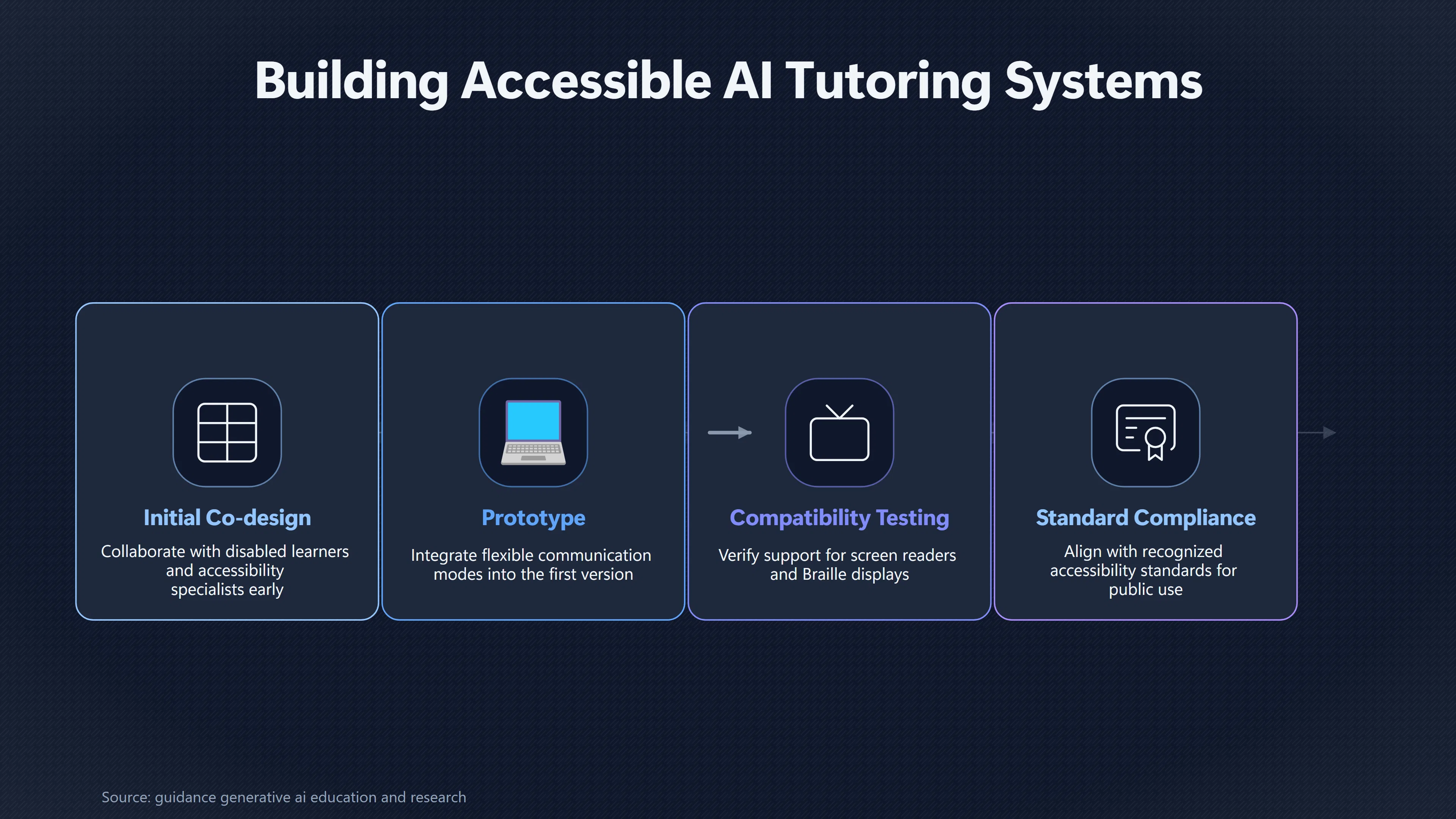
Retrofitting accessibility after an AI tutor has already been designed is often expensive and incomplete. A stronger approach is to treat accessibility as a core design principle from the first prototype.
Effective implementation typically includes:
- Co-design with disabled learners, families and accessibility specialists.
- Testing with users who rely on different assistive technologies.
- Compatibility with screen readers, refreshable Braille displays, switch devices and alternative input methods.
- Compliance with recognised accessibility standards rather than proprietary features alone.
- Clear explanations of AI limitations and confidence levels.
- Strong privacy protections for sensitive educational and disability-related information.
- Regular evaluation to ensure new AI updates do not unintentionally reduce accessibility.
Organisations promoting Universal Design for Learning increasingly argue that AI should reduce predictable barriers before they affect learners, rather than expecting individuals to request special treatment after problems emerge.[CAST]cast.orgArtificial Intelligence & UDL | CASTArtificial Intelligence & UDL | CAST…
Why Multimodal Design Matters for Human Flourishing
Accessible AI tutoring illustrates an important aspect of the wider AI Bloom perspective. The greatest educational gains may not come from making already successful learners marginally more efficient, but from enabling people who have long faced unnecessary barriers to participate more fully in learning, employment, creativity and civic life.
If multimodal AI tutors become widely available, responsibly governed and designed around genuine accessibility rather than superficial compliance, they could expand educational opportunity for millions of learners with disabilities throughout their lives. That would not eliminate the need for human educators or specialist services, nor would it solve wider inequalities in connectivity, affordability or inclusive education. But it would represent an important shift: making high-quality teaching more adaptable to human diversity instead of expecting human diversity to adapt to rigid educational systems. Such progress offers one practical pathway by which increasingly capable AI could contribute to broader human flourishing, provided inclusion, equity and learner autonomy remain central design goals rather than afterthoughts.[UNESCO]unesco.orgArtificial intelligence in educationArtificial intelligence in education - AI | UNESCO…
Amazon book picks
Further Reading
Books and field guides related to What Makes an AI Tutor Truly Accessible?. Use these as the next step if you want deeper reading beyond the article.
Universal Design for Learning: Theory and Practice
Anne Meyer and David Rose, who first laid out the principles of UDL, provide an ambitious, engaging discussion of new research and best p...

Inclusive Design for a Digital World
What is inclusive design? It is simple. It means that your product has been created with the intention of being accessible to as many dif...
The End of Average
'Must the tyranny of the group rule us from cradle to grave? Absolutely not, says Todd Rose in a subversive and readable introduction to...
Designing with the Mind in Mind
First published 2010. Subjects: Graphical user interfaces (computer systems), Computer science, General, User interfaces, Site design.
eBay marketplace picks
Marketplace Samples
Live-tested eBay searches with available results related to this page.
Selected fromteacher mug oneBay.co.uk.
Endnotes
1.
Source: unesco.org
Title: guidance generative ai education and research
Link:https://www.unesco.org/en/articles/guidance-generative-ai-education-and-research?hub=686
Source snippet
Guidance for generative AI in education and research | UNESCOSeptember 7, 2023...
Published: September 7, 2023
2.
Source: cast.org
Title: Artificial Intelligence & UDL | CAST
Link:https://www.cast.org/what-we-do/artificial-intelligence/
Source snippet
Artificial Intelligence & UDL | CAST...
3.
Source: unesco.org
Title: AI and education: Protecting the rights of learners | UNESCO
Link:https://www.unesco.org/en/articles/ai-and-education-protecting-rights-learners?hub=195885
Source snippet
September 4, 2025 — Publication AI AND EDUCATION: PROTECTING THE RIGHTS OF LEARNERS The rapid digitalization of education and the develop...
Published: September 4, 2025
4.
Source: unesco.org.uk
Title: guidance for generative ai in education and research
Link:https://unesco.org.uk/site/assets/files/10375/guidance_for_generative_ai_in_education_and_research.pdf
Source snippet
UNESCO in the UKGuidance for generative AIApril 15, 2026...
Published: April 15, 2026
5.
Source: iite.unesco.org
Link:https://iite.unesco.org/publications/digital-technologies-for-inclusive-education-recommendations/
Source snippet
Technologies for Inclusive Education: Recommendations for Promoting an ICT-Based Learning Environment for Resource Centers and Schools –...
6.
Source: unesco.org
Title: Artificial intelligence in education
Link:https://www.unesco.org/en/digital-education/artificial-intelligence?hub=66708
Source snippet
Artificial intelligence in education - AI | UNESCO...
7.
Source: iite.unesco.org
Title: technologies for inclusive education a review of best practices
Link:https://iite.unesco.org/publications/technologies-for-inclusive-education-a-review-of-best-practices/
Source snippet
Technologies for Inclusive Education: A Review of Best Practices from Global Resource Centers – UNESCO IITEJanuary 10, 2025 — INNOVATIVE...
Published: January 10, 2025
8.
Source: iicba.unesco.org
Title: guidance generative ai education and research
Link:https://www.iicba.unesco.org/en/africa-education-knowledge-platform/guidance-generative-ai-education-and-research
9.
Source: unesco.org
Title: Artificial intelligence in education
Link:https://www.unesco.org/en/digital-education/artificial-intelligence?hub=83250
10.
Source: unesco.org
Title: Artificial intelligence in education
Link:https://www.unesco.org/en/digital-education/artificial-intelligence?hub=67832
11.
Source: connect.unevoc.unesco.org
Link:https://connect.unevoc.unesco.org/home/UNEVOC%2BPublications/lang%3Den/akt%3Ddetail/qs%3D6696
12.
Source: unesdoc.unesco.org
Title: document Viewer.xhtml
Link:https://unesdoc.unesco.org/in/documentViewer.xhtml?ark=%2Fark%3A%2F48223%2Fpf0000386693%2FPDF%2F386693eng.pdf.multi&file=%2Fin%2Frest%2FannotationSVC%2FDownloadWatermarkedAttachment%2Fattach_import_ab3dfd25-729d-41e8-877f-176076322557%3F_%3D386693eng.pdf&fullScreen=true&id=p%3A%3Ausmarcdef_0000386693&locale=fr&updateUrl=updateUrl9665&v=2.1.196
Additional References
13.
Source: arxiv.org
Link:https://arxiv.org/abs/2401.00832
Source snippet
Taking the Next Step with Generative Artificial Intelligence: The Transformative Role of Multimodal Large Language Models in Science...
14.
Source: youtube.com
Title: Multimodalities and Multiliteracies with Professor Kathy Mills
Link:https://www.youtube.com/watch?v=CSG7bcStF90
Source snippet
Artificial Intelligence in Education and Learning...
15.
Source: youtube.com
Title: Generative AI in Education
Link:https://www.youtube.com/watch?v=qFe4pxNVP6g
Source snippet
AI for Inclusion: How Generative AI can support students with disability...
16.
Source: youtube.com
Title: AI for Inclusion: How Generative AI can support students with disability
Link:https://www.youtube.com/watch?v=Y5aiBF9RiwM
Source snippet
Annie Webinar: AI in Special Education...
17.
Source: youtube.com
Title: Annie Webinar: AI in Special Education
Link:https://www.youtube.com/watch?v=fKF4jLVZCks
18.
Source: gcedclearinghouse.org
Link:https://gcedclearinghouse.org/en/node/129341