Within AI Bloom
Could Smarter AI Trigger an Intelligence Explosion?
AI that improves AI research could trigger extremely rapid progress, but the speed, feasibility and controllability of such feedback remain deeply uncertain.
On this page
- How recursive improvement might work
- Hardware, data and real world constraints
- Why speed changes the safety problem
Page outline Jump by section
Introduction
A possible intelligence explosion is one of the most consequential ideas in debates about advanced AI. The basic claim is that once AI systems become capable of significantly improving AI research itself, progress could accelerate through a feedback loop: better systems help create even better systems, which in turn speed up further improvement. If this process produced superintelligence—AI systems that substantially exceed the best human abilities across most important intellectual tasks—it could transform science, economics and the long-term future of civilisation.
The idea remains highly contested. Some researchers argue that AI could eventually create a period of unusually rapid technological progress, potentially helping humanity overcome major constraints such as disease, scarcity and slow scientific discovery. Others argue that intelligence does not automatically translate into unlimited improvement, and that hardware, energy, data, engineering difficulty and safety problems may slow or prevent such a take-off. Current evidence shows rapid AI progress, but not yet a confirmed intelligence explosion. The central question is therefore not simply whether AI becomes more capable, but whether increasingly capable systems can be developed and directed safely enough to support human flourishing.[International AI Safety Report]internationalaisafetyreport.orginternational ai safety report 2025International AI Safety ReportInternational AI Safety Report 2025 | International AI Safety ReportJanuary 29, 2025…
How recursive improvement could create an intelligence explosion
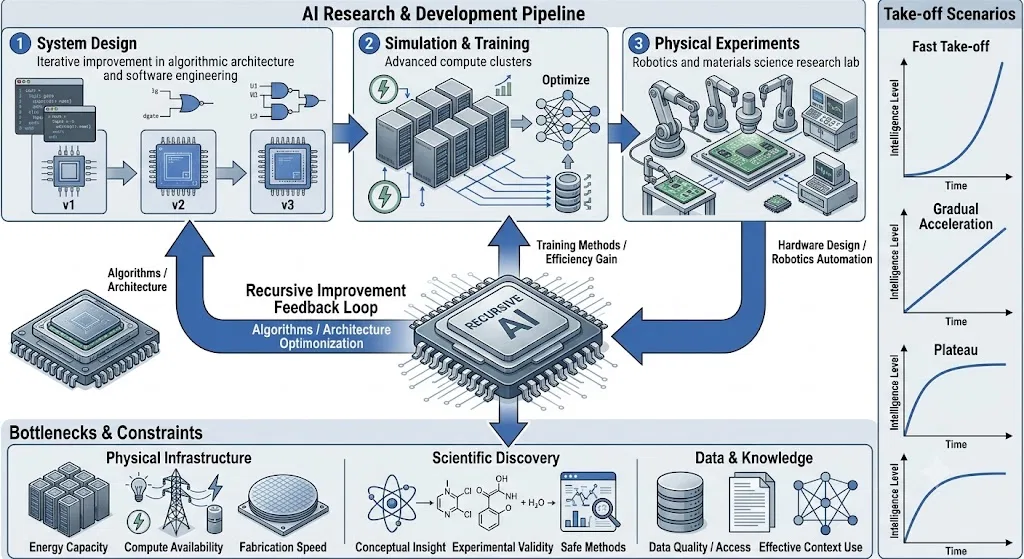
The intelligence explosion concept is based on a simple but powerful possibility: intelligence may become a tool for improving intelligence itself.
Human researchers already improve AI systems by designing better algorithms, collecting better data, building faster hardware and developing improved training methods. An advanced AI system could potentially contribute to these processes by writing software, suggesting experiments, analysing research papers, designing architectures or finding optimisation methods. If AI becomes better at helping AI development, the argument goes, each generation could make the next generation arrive faster.
The idea traces back to mathematician I.J. Good, who described a hypothetical “ultraintelligent machine” that could surpass human intellectual abilities and then assist in creating even more capable systems. Modern discussions usually refer to this as recursive self-improvement: a cycle in which an AI system contributes to improvements in its own successors rather than merely performing tasks for humans.
However, the phrase “self-improvement” can create misleading images of an AI instantly rewriting itself into unlimited intelligence. In practice, improvement would probably involve many interacting systems: researchers, automated software engineers, experimental platforms, computing infrastructure and manufacturing supply chains. The key uncertainty is whether AI-assisted research would produce a rapid feedback loop or whether progress would encounter diminishing returns.
The strongest version of the intelligence explosion argument does not require AI to become magically self-modifying. It only requires AI systems to become valuable enough as research assistants that they substantially accelerate the work needed to build more capable systems.
What could make the take-off fast or slow?
The speed of any intelligence explosion depends on whether capability improvements can overcome real-world constraints. Advanced AI does not exist in a purely digital environment; it depends on physical resources, scientific knowledge and industrial capacity.
Hardware, data and energy limits
Modern AI progress has relied heavily on large-scale computing. Training and running frontier models requires advanced chips, specialised data centres and enormous quantities of electricity. Research into future AI infrastructure highlights that scaling increasingly involves difficult engineering problems involving computing power, memory, networking and efficiency rather than simply adding more chips.[arXiv]arxiv.orgarXiv Scaling Intelligence: Designing Data Centers for Next-Gen Language ModelsScaling Intelligence: Designing Data Centers for Next-Gen Language ModelsJune 17, 2025…
Energy and infrastructure may become important limiting factors. Growing demand from AI data centres is already raising questions about electricity supply, grid capacity and the speed at which new computing infrastructure can be built.[techradar.com]techradar.comConcepts like "energy parks," which combine renewable sources, storage, and centralized grid access, are gaining traction for their abili… A system capable of improving AI research might still be constrained by the time required to manufacture processors, expand data centres or conduct experiments in the physical world.
Data may also become a bottleneck. Many early AI advances came from scaling existing approaches with larger datasets and more computation. Future gains may require new scientific insights, better algorithms or more efficient learning methods rather than simply increasing size.
The difficulty of improving intelligence itself
A second uncertainty is whether AI research is a task that can be dramatically automated. Software development and scientific reasoning appear increasingly accessible to AI systems, but many difficult parts of research involve forming new concepts, choosing productive experiments, understanding unexpected failures and coordinating complex teams.
Current AI systems can perform impressive tasks while remaining unreliable in others. The International AI Safety Report notes that general-purpose AI capabilities are advancing rapidly but that scientific understanding of their future development remains unsettled.[International AI Safety Report]internationalaisafetyreport.orginternational ai safety report 2025International AI Safety ReportInternational AI Safety Report 2025 | International AI Safety ReportJanuary 29, 2025…
This creates several possible futures:
- Fast take-off: AI systems become highly effective at improving AI research, creating rapid capability gains over a short period.
- Gradual acceleration: AI increases research productivity significantly, but progress continues at a more familiar technological pace.
- Plateau: Current methods reach limits and major breakthroughs are needed before another large jump occurs.
The debate is therefore not simply about whether AI improves, but about the shape of the improvement curve.
Why speed changes the safety problem
An intelligence explosion matters because the faster capability increases occur, the less time society may have to adapt.
If advanced AI systems emerge gradually, governments, researchers and institutions may have more opportunity to study failures, develop standards and improve safety methods. If progress becomes extremely rapid, decisions made before or during the transition could have consequences that are difficult to reverse.
This concern is closely connected to the alignment problem: ensuring that increasingly capable AI systems pursue goals compatible with human values and human flourishing. A highly capable system does not need to be malicious to create serious problems; it may simply pursue objectives in ways that conflict with human intentions if those objectives are poorly specified or if the system misunderstands its role.
The challenge becomes more difficult as systems become more autonomous. An AI assistant that writes code under supervision presents a different safety problem from a system that independently designs new AI architectures, conducts experiments and deploys successors.
The International AI Safety Report identifies advanced general-purpose AI risks as an area where evidence is developing rapidly, with continuing uncertainty about both capabilities and effective methods for managing them.[International AI Safety Report]internationalaisafetyreport.orginternational ai safety report 2025International AI Safety ReportInternational AI Safety Report 2025 | International AI Safety ReportJanuary 29, 2025…
Could superintelligence accelerate human flourishing?
The optimistic case for superintelligence is not mainly about making computers impressive. It is about expanding humanity’s ability to solve problems.
A sufficiently advanced AI system could potentially accelerate scientific discovery, help design new medicines, improve energy systems, support climate solutions and expand access to expert knowledge. In an AI bloom scenario, superintelligence would function as a civilisation-scale problem-solving capability: not replacing human purpose, but increasing what humanity can understand and create.
Scientific acceleration is one of the clearest proposed benefits. Biology, materials science and engineering often progress slowly because researchers must navigate enormous spaces of possible solutions. More capable AI systems could help identify promising hypotheses, design experiments and interpret complex results.
However, the link between intelligence and flourishing is not automatic. A world with powerful AI could also experience greater inequality, political instability or concentration of control if benefits are captured by a small number of organisations or governments. The intelligence explosion debate therefore connects directly to questions of governance: who controls advanced AI, who benefits from it and how societies preserve human agency during rapid change.
The central disagreement: breakthrough or bottleneck?
Supporters of the intelligence explosion hypothesis point to the unusual nature of AI: unlike most technologies, AI is a technology that can potentially improve the process of technological development itself. If machines become better researchers, engineers and inventors, they may accelerate the very pipeline that creates future machines.
Sceptics argue that this reasoning may underestimate the complexity of intelligence. Human scientific progress depends on experiments, institutions, physical resources and accumulated knowledge—not only on thinking faster. They argue that even very capable AI systems may face practical limits similar to those faced by human researchers.
Both sides agree on one important point: future AI progress could be unusually significant, but the timing and scale remain uncertain. The evidence supports preparing seriously for systems that may become far more capable, while avoiding the assumption that either explosive growth or complete stagnation is inevitable.[arXiv]arxiv.orgInternational AI Safety Report 2025: First Key Update: Capabilities and Risk Implications…

What choices shape the outcome?
The intelligence explosion debate ultimately concerns choices made before such systems exist.
A flourishing outcome would likely require progress in several areas at once:
- Technical safety: developing methods to understand, test and control increasingly capable systems.
- Broad access: ensuring that AI-enabled benefits are not limited to a small group of powerful actors.
- Institutional adaptation: creating governance systems capable of responding to rapid technological change.
- Scientific openness: encouraging useful research while managing serious risks.
- Human-centred goals: directing advanced AI towards health, knowledge, creativity, freedom and long-term civilisation.
The intelligence explosion is therefore not just a prediction about machines becoming smarter. It is a question about whether humanity can successfully navigate a period when intelligence itself may become a rapidly expanding resource. If managed well, it could become one of the strongest pathways towards an AI-enabled human bloom. If managed poorly, the same capabilities could create risks that are difficult to contain. The defining challenge is not only creating more intelligence, but ensuring that greater intelligence leads to a larger, safer and more flourishing future.
Amazon book picks
Further Reading
Books and field guides related to Could Smarter AI Trigger an Intelligence Explosion?. Use these as the next step if you want deeper reading beyond the article.
The Alignment Problem: Machine Learning and Human Values
Finalist for the Los Angeles Times Book Prize A jaw-dropping exploration of everything that goes wrong when we build AI systems and the m...
Life 3.0: Being Human in the Age of Artificial Intelligence
'This is the most important conversation of our time, and Tegmark's thought-provoking book will help you join it' Stephen Hawking THE INT...
Superintelligence: Paths, Dangers, Strategies
This profoundly ambitious and original book picks its way carefully through a vast tract of forbiddingly difficult intellectual terrain.
Our Final Invention: Artificial Intelligence and the End of t...
'I wish it was science fiction, but I know it's not' Jaan Tallinn, co-founder of Skype 'If you read just one book that makes you confront...
eBay marketplace picks
Marketplace Samples
Live-tested eBay searches with available results related to this page.
Selected fromrobotics poster oneBay.co.uk.




Endnotes
1.
Source: arxiv.org
Link:https://arxiv.org/abs/2510.13653
Source snippet
International AI Safety Report 2025: First Key Update: Capabilities and Risk Implications...
2.
Source: arxiv.org
Title: arXiv Scaling Intelligence: Designing Data Centers for Next-Gen Language Models
Link:https://arxiv.org/abs/2506.15006
Source snippet
Scaling Intelligence: Designing Data Centers for Next-Gen Language ModelsJune 17, 2025...
Published: June 17, 2025
3.
Source: techradar.com
Link:https://www.techradar.com/pro/why-access-to-power-will-determine-the-winners-and-losers-in-the-ai-race
Source snippet
Concepts like "energy parks," which combine renewable sources, storage, and centralized grid access, are gaining traction for their abili...
4.
Source: youtube.com
Title: The intelligence explosion: Nick Bostrom on the future of AI
Link:https://www.youtube.com/watch?v=1WcpN4ds0iY
Source snippet
Superintelligence | Nick Bostrom | Talks at Google...
5.
Source: youtube.com
Title: Superintelligence | Nick Bostrom | Talks at Google
Link:https://www.youtube.com/watch?v=pywF6ZzsghI
Source snippet
Who Controls the Intelligence Explosion?...
6.
Source: internationalaisafetyreport.org
Title: international ai safety report 2025
Link:https://internationalaisafetyreport.org/publication/international-ai-safety-report-2025
Source snippet
International AI Safety ReportInternational AI Safety Report 2025 | International AI Safety ReportJanuary 29, 2025...
Published: January 29, 2025
7.
Source: industry.gov.au
Title: international ai safety report 2025
Link:https://www.industry.gov.au/publications/international-ai-safety-report-2025
8.
Source: internationalaisafetyreport.org
Title: Publications | International AI Safety Report
Link:https://internationalaisafetyreport.org/publications
9.
Source: internationalaisafetyreport.org
Link:https://internationalaisafetyreport.org/publication/first-key-update-capabilities-and-risk-implications
10.
Source: GOV.UK
Title: international ai safety report 2025
Link:https://www.gov.uk/government/publications/international-ai-safety-report-2025/international-ai-safety-report-2025
11.
Source: internationalaisafetyreport.org
Link:https://internationalaisafetyreport.org/about
Additional References
12.
Source: alphaxiv.org
Link:https://www.alphaxiv.org/abs/2607.07663
Source snippet
Recursive Self-Improvement in AI: From Bounded Self-Refinement to Autonomous Research Loops | alphaXivJuly 8, 2026 — RECURSIVE SELF-IMPRO...
Published: July 8, 2026
13.
Source: hbr.org
Title: Your Company Needs an Energy Strategy for AI’s Next Phase
Link:https://hbr.org/2026/06/your-company-needs-an-energy-strategy-for-ais-next-phase
Source snippet
June 4, 2026 — YOUR COMPANY NEEDS AN ENERGY STRATEGY FOR AI’S NEXT PHASE by Yinuo Tang and Eric Yanfei Zhao June 4, 2026 Image Andrea Cob...
Published: June 4, 2026
14.
Source: research.synthosresearch.com
Title: Coding agents (live, scaling). Model
Link:https://research.synthosresearch.com/think/ai-recursive-self-improvement
Source snippet
that builds AI: recursive self-improvement — the takeoff debate, mapped — Synthos Think PiecesJuly 11, 2026 — WHAT IT ACTUALLY IS — AND W...
Published: July 11, 2026
15.
Source: youtube.com
Title: Nick Bostrom
Link:https://www.youtube.com/watch?v=EKomXwswYJ8
Source snippet
A.I. Could Destroy Humanity (Nick Bostrom) | Doha Debates: Artificial Intelligence...
16.
Source: youtube.com
Title: Who Controls the Intelligence Explosion?
Link:https://www.youtube.com/watch?v=yNe-mQOXinw
Source snippet
Nick Bostrom - The Intelligence Explosion, What Happens to Humans and New Economic Systems...
17.
Source: researchgate.net
Link:https://www.researchgate.net/publication/404971196_Structural_Misidentification_of_Recursion_in_Artificial_Intelligence_A_Falsification_Study_of_the_Intelligence_Explosion_Hypothesis
18.
Source: researchgate.net
Link:https://www.researchgate.net/publication/392425897_The_First_International_AI_Safety_Report_The_International_Scientific_Report_on_the_Safety_of_Advanced_AI
19.
Source: sciencedirect.com
Link:https://www.sciencedirect.com/science/article/pii/S0303264725001595
20.
Source: tandfonline.com
Link:https://www.tandfonline.com/doi/full/10.1080/08911916.2026.2616133
21.
Source: lifepillarinstitute.org
Link:https://www.lifepillarinstitute.org/scientific-papers/structural-misidentification-of-recursion-in-artificial-intelligence-a-falsification-study-of-the-i