Within Socratic Tutors
Do Socratic AI Tutors Improve Coding Skills?
Programming studies suggest guided questions promote reflection and iteration, while direct answers encourage copying and trial-and-error.
On this page
- How Socratic and direct answer support were compared
- Differences in reflection, iteration and copying
- What the evidence can and cannot establish
Page outline Jump by section
Introduction
Programming education provides some of the clearest evidence available for evaluating Socratic AI tutoring because success can be measured in two different ways. Researchers can assess not only whether a program eventually works, but also how the learner reached the solution. That makes it possible to distinguish genuine understanding from copying, guessing, or repeated trial and error.
Across intelligent tutoring systems developed before the large language model era and newer AI-powered coding assistants, a consistent pattern is emerging. Systems that rely on guided questions, progressive hints and learner explanations tend to encourage reflection and iterative problem solving, whereas systems that immediately provide finished code often make it easier to complete a task without building transferable programming skills. The evidence is still developing, and many studies remain small, but programming research offers unusually direct insight into how Socratic AI can help prevent shortcut learning while supporting the broader goal of AI as a tool for expanding human capabilities rather than replacing human thinking.[nih.gov]pmc.ncbi.nlm.nih.govPub Med Central (PMC)A Socratic Tutor for Source Code ComprehensionPubMed Central (PMC)A Socratic Tutor for Source Code Comprehension - PMCJune 10, 2020…
How Socratic and direct-answer support were compared
Programming researchers have compared instructional approaches in several different ways, but they generally contrast two broad styles of AI support.
The direct-answer approach allows learners to ask for code, complete solutions or debugging fixes. The AI behaves much like an extremely knowledgeable programming assistant whose primary objective is solving the immediate problem.
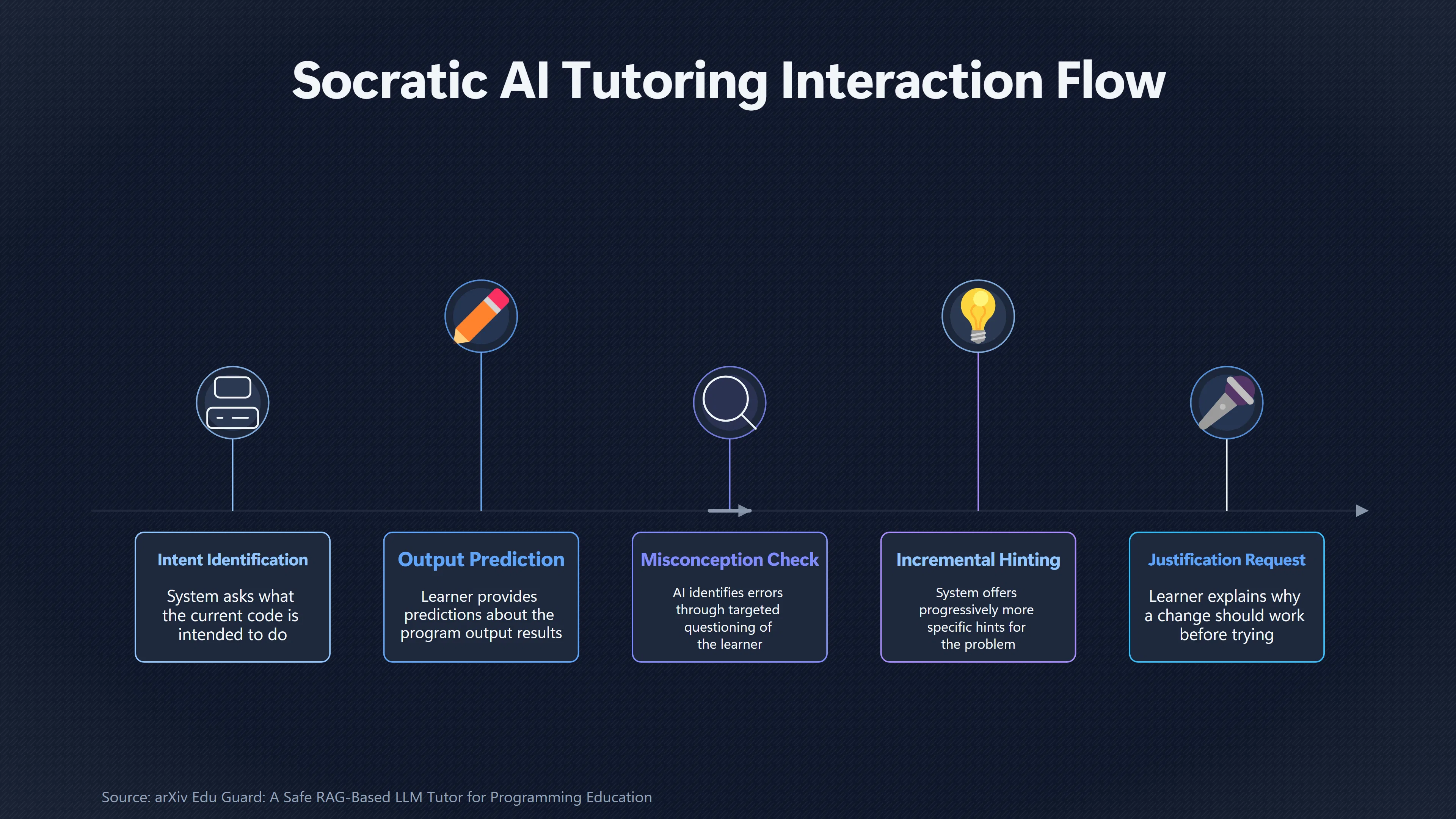
The Socratic approach deliberately withholds complete solutions until the learner has demonstrated understanding or made meaningful attempts. Instead, the system may:
- ask what the current code is intended to do;
- request predictions about program output;
- identify a misconception through questioning;
- offer progressively more specific hints;
- ask learners to explain why a change should work before trying it.
These comparisons are especially valuable because programming produces observable evidence. Researchers can analyse conversation logs, editing behaviour, debugging sequences, revisions and assessment results rather than relying only on student opinions. Recent studies have therefore examined not only final grades but also interaction quality, persistence, prompting behaviour, self-explanations and metacognitive reflection.[wiley.com]onlinelibrary.wiley.comWiley Online LibraryWhen Generative AI Meets Socratic Method: Investigating Programming Learning Dynamics Through Behaviours, Interaction…
Differences in reflection, iteration and copying
One reason programming is such a useful testing ground is that shortcut learning leaves visible traces.
When learners receive complete code immediately, they often evaluate success using a simple criterion: does the program run? If it fails, they frequently enter a cycle of copying, tweaking and rerunning code without understanding the underlying concepts.
By contrast, Socratic tutors interrupt this pattern. Rather than allowing endless trial and error, they repeatedly require learners to predict behaviour, justify choices or explain why a bug occurred before offering further guidance.
A recent quasi-experimental study comparing GPT used in a Socratic, scaffolded mode with GPT providing direct answers found notable differences in learning behaviour. Students working with the Socratic version showed more iterative reasoning, sustained engagement and reflective dialogue, while direct-answer users were more likely to exhibit superficial solution-seeking and trial-and-error interaction. The researchers argue that structured questioning encourages students to build richer mental models rather than merely obtaining functioning code.[Wiley Online Library]onlinelibrary.wiley.comWiley Online LibraryWhen Generative AI Meets Socratic Method: Investigating Programming Learning Dynamics Through Behaviours, Interaction…
Similar observations appear in newer classroom studies of introductory programming. A mixed-methods analysis of a custom Socratic AI tutor examined detailed conversation features—including prompting strategies, struggle types and conversational turns—to understand how students interacted with guided questioning instead of complete solutions. Rather than focusing only on test scores, the work investigates behavioural evidence of self-regulated learning, reflecting an increasing emphasis on how students solve programming problems rather than simply whether they finish them.[AIS eLibrary]aisel.aisnet.orgAIS e Library Socratic AI Tutors in Introductory ProgrammingAIS e Library Socratic AI Tutors in Introductory Programming
Earlier intelligent tutoring systems pointed in the same direction
The idea of questioning rather than telling did not begin with generative AI.
Long before modern language models, intelligent tutoring systems for programming used carefully designed Socratic dialogue to improve code comprehension. One influential line of work asked students to explain code, predict outputs and answer concept questions before receiving increasingly detailed feedback.
In controlled experiments, learners using the full Socratic tutor generally achieved greater learning gains than students who simply viewed examples without guided questioning. Importantly, the intervention focused on understanding program behaviour rather than writing more code, making it possible to isolate conceptual learning from programming speed.[PubMed Central (PMC)]pmc.ncbi.nlm.nih.govPub Med Central (PMC)A Socratic Tutor for Source Code ComprehensionPubMed Central (PMC)A Socratic Tutor for Source Code Comprehension - PMCJune 10, 2020…
This continuity matters because it suggests that the apparent benefits are not unique to today’s language models. Instead, large language models may make an older educational principle far more scalable by enabling flexible dialogue rather than fixed question trees.
New AI tutors increasingly build in Socratic constraints
Many recent programming tutors are deliberately designed to resist becoming answer machines.
The participatory design project SocratiCode, developed for beginner Python learners, illustrates this trend. Researchers initially found that more open-ended AI explanations often overwhelmed novices or encouraged passive reading. Through repeated refinement, the system shifted towards guided questioning, misconception checks, incremental hints and mandatory learner responses. The resulting design was judged to better support engagement and conceptual understanding, particularly when combined with human teaching rather than replacing it.[arXiv]arxiv.orgOpen source on arxiv.org.
Other research prototypes reach similar conclusions. Systems such as SocraticAI and EduGuard introduce explicit pedagogical controls that discourage direct solution dumping, enforce reflective interaction and monitor attempts to bypass the learning process. These projects remain experimental, but they reflect a broader movement away from unrestricted code generation towards AI designed as a cognitive scaffold.[arXiv]arxiv.orgSocraticAI: Transforming LLMs into Guided CS Tutors Through Scaffolded InteractionDecember 3, 2025…
What programming evidence can and cannot establish
Programming studies provide unusually rich evidence, but they also have important limitations.
Several strengths make this research especially informative:
- learners’ reasoning is observable through code revisions and dialogue;
- objective tests can distinguish conceptual understanding from working code;
- debugging provides repeated opportunities to study reflection and revision;
- AI interactions can be logged in detail, allowing analysis of learning behaviour rather than only final outcomes.
At the same time, the evidence remains incomplete.
Many recent studies involve relatively small cohorts, pilot deployments or short instructional periods. Improvements in engagement or immediate post-tests do not automatically prove stronger long-term retention or better performance months later. Some studies measure interaction quality more thoroughly than academic achievement, while others evaluate prototype systems that have not yet been widely deployed.[wiley.com]onlinelibrary.wiley.comWiley Online LibraryWhen Generative AI Meets Socratic Method: Investigating Programming Learning Dynamics Through Behaviours, Interaction…
Another challenge is separating the effect of Socratic questioning from other improvements. Better interface design, instructor involvement, course-specific knowledge and higher-quality feedback may all contribute alongside the questioning strategy itself.
For these reasons, the programming literature currently provides strong evidence that guided questioning changes how students interact with AI and moderate evidence that it improves deeper learning. It does not yet justify claims that Socratic tutoring always outperforms direct instruction across every context or learner.

Why this evidence matters for AI-enabled human flourishing
Within the wider vision of AI contributing to long-term human flourishing, programming education illustrates a broader principle.
If future AI systems become increasingly capable of solving intellectual tasks directly, they could either expand human expertise or gradually replace the cognitive work through which expertise develops. Programming research suggests that design choices matter. An AI that continually supplies finished solutions risks creating dependence, while an AI that asks productive questions can help users construct knowledge that transfers to new problems.
Coding is only one domain, but it offers unusually transparent evidence because both the process and the outcome are measurable. As a result, programming studies have become one of the strongest empirical test beds for the idea that advanced AI should not simply automate thinking, but should help people become better thinkers. That distinction is likely to remain central if AI is to support a future of greater scientific discovery, wider educational opportunity and genuine human cognitive empowerment rather than merely faster task completion.
Amazon book picks
Further Reading
Books and field guides related to Do Socratic AI Tutors Improve Coding Skills?. Use these as the next step if you want deeper reading beyond the article.
Make It Stick: The Science of Successful Learning
To most of us, learning something "the hard way" implies wasted time and effort. Good teaching, we believe, should be creatively tailored...
Think Like a Programmer
The real challenge of programming isn't learning a language's syntax—it's learning to creatively solve problems so you can build somethin...
The Pragmatic Programmer
Using anecdotes, analogies, examples and parables, this user-friendly guide offers techniques for getting any programming job done effect...
Computer Science Distilled
A walkthrough of computer science concepts you must know. Designed for readers who don't care for academic formalities, it's a fast and e...
eBay marketplace picks
Marketplace Samples
Live-tested eBay searches with available results related to this page.
Selected fromcoding poster oneBay.co.uk.

Endnotes
1.
Source: onlinelibrary.wiley.com
Link:https://onlinelibrary.wiley.com/doi/10.1002/jcal.70210
Source snippet
Wiley Online LibraryWhen Generative AI Meets Socratic Method: Investigating Programming Learning Dynamics Through Behaviours, Interaction...
2.
Source: arxiv.org
Link:https://arxiv.org/abs/2510.03884
3.
Source: arxiv.org
Link:https://arxiv.org/abs/2605.17857
4.
Source: arxiv.org
Link:https://arxiv.org/abs/2512.03501
Source snippet
SocraticAI: Transforming LLMs into Guided CS Tutors Through Scaffolded InteractionDecember 3, 2025...
Published: December 3, 2025
5.
Source: arxiv.org
Title: arXiv Edu Guard: A Safe RAG-Based LLM Tutor for Programming Education
Link:https://arxiv.org/abs/2607.15738
6.
Source: pmc.ncbi.nlm.nih.gov
Title: Pub Med Central (PMC)A Socratic Tutor for Source Code Comprehension
Link:https://pmc.ncbi.nlm.nih.gov/articles/PMC7334736/
Source snippet
PubMed Central (PMC)A Socratic Tutor for Source Code Comprehension - PMCJune 10, 2020...
Published: June 10, 2020
7.
Source: aisel.aisnet.org
Title: AIS e Library Socratic AI Tutors in Introductory Programming
Link:https://aisel.aisnet.org/treos_amcis2026/74/
8.
Source: doi.org
Title: “Let Them Try to Figure It Out First”
Link:https://doi.org/10.1145/3649217.3653530
9.
Source: doi.org
Link:https://doi.org/10.1145/3613904.3642773
Additional References
10.
Source: repository.eduhk.hk
Link:https://repository.eduhk.hk/en/publications/ai-chatbot-as-socratic-butler-effects-on-metacognitive-awareness-/
Source snippet
EdUHK Research RepositoryAI chatbot as Socratic Butler: Effects on metacognitive awareness, cognitive load, and learning performance in i...
11.
Source: huggingface.co
Title: Hugging Face Paper page
Link:https://huggingface.co/papers/2605.17857
Source snippet
Hugging FacePaper page - Towards SocratiCode: Designing a Generative AI-Based Programming Tutor for K-12 Students through a 4-Week Partic...
12.
Source: youtube.com
Title: Socratic Questioning with Chat GPT
Link:https://www.youtube.com/watch?v=fAeYkunfIq4
Source snippet
Learning New Skills and Languages in the AI Era...
13.
Source: par.nsf.gov
Link:https://par.nsf.gov/biblio/10188362-experiments-socratic-intelligent-tutoring-system-source-code-understanding
14.
Source: par.nsf.gov
Link:https://par.nsf.gov/biblio/10189538-experiments-socratic-intelligent-tutoring-system-source-code-understanding
15.
Source: researchgate.net
Link:https://www.researchgate.net/publication/404597953_Codify_An_Intelligent_Socratic_Tutoring_System_for_Programming_Education
16.
Source: digitalcommons.memphis.edu
Link:https://digitalcommons.memphis.edu/facpubs/2805/
17.
Source: sciencedirect.com
Link:https://www.sciencedirect.com/science/article/pii/S2666920X24001127
18.
Source: paperswithcode.com
Link:https://paperswithcode.com/paper/the-widening-gap-the-benefits-and-harms-of
19.
Source: aclanthology.org
Link:https://aclanthology.org/2023.bea-1.57/