Within Smart Infrastructure
Can AI Prevent Power Grid Failures?
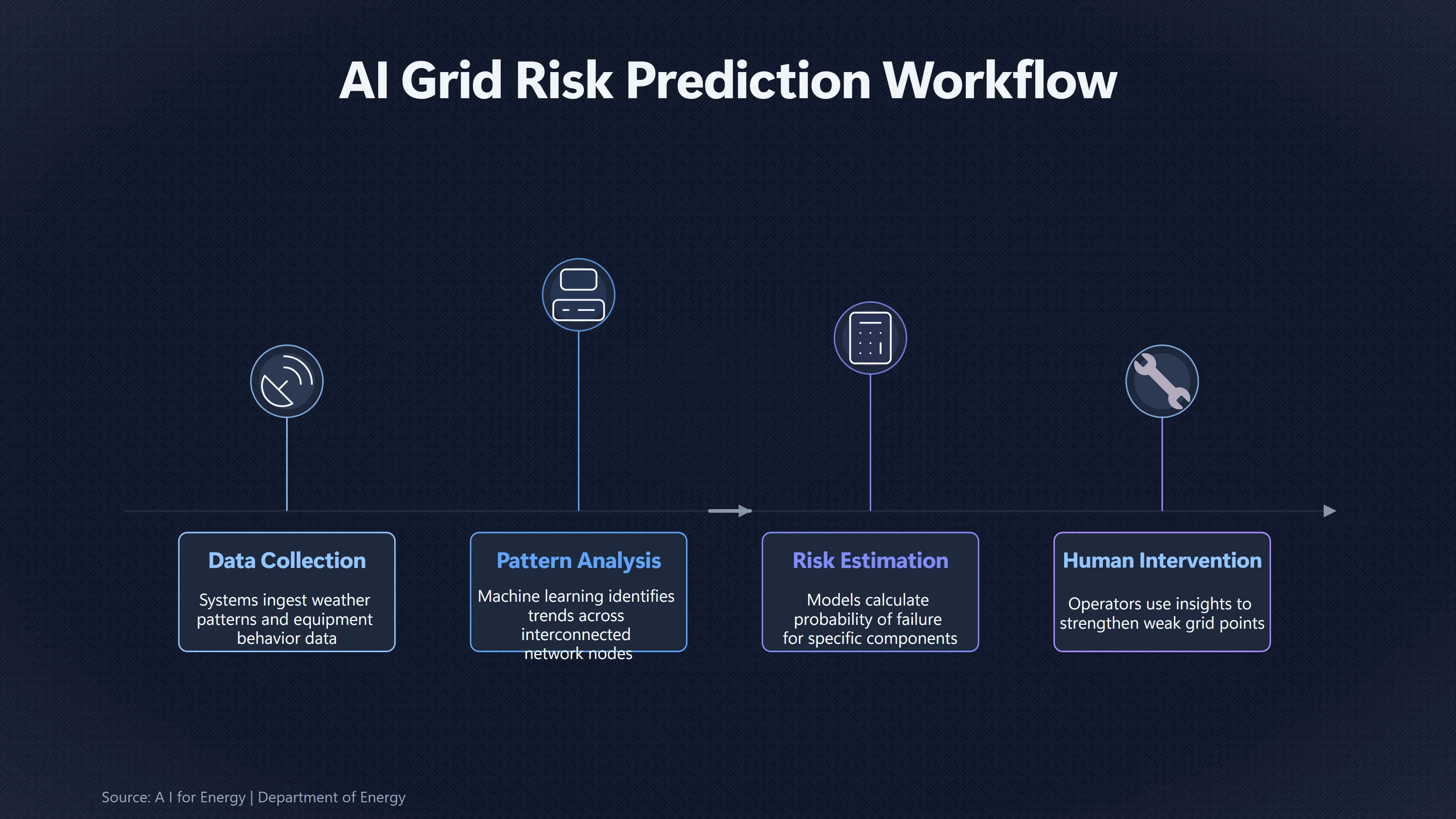
AI systems are helping electricity operators identify vulnerable grid components and strengthen power networks before major outages occur.
On this page
- Finding weak points in electricity networks
- Predicting risks before outages spread
- The challenge of human led grid decisions
Page outline Jump by section
Introduction
Can AI prevent power grid failures? It cannot make electricity networks immune to storms, equipment breakdowns or sudden demand shocks, but it can help operators see danger earlier and act before local problems become widespread outages. AI grid risk prediction uses machine learning to analyse weather, equipment data, electricity flows and network conditions to identify vulnerable parts of the grid and estimate where failures are most likely. This matters because a resilient power system is a foundation for a more capable civilisation: reliable electricity supports hospitals, communication, industry, scientific research and the infrastructure needed for long-term human flourishing.
The most promising role for AI is not replacing grid engineers with automated decisions. It is creating a more aware electricity system that can continuously assess risk, test possible failures and help humans strengthen weak points before crises occur. Research from the US Department of Energy identifies AI as a potential tool for improving grid planning, operations, reliability and resilience, while stressing that deployment must fit the safety requirements of critical infrastructure.[energy.gov]energy.govA I for Energy | Department of EnergyAI for Energy | Department of EnergyApril 29, 2024…
Finding weak points in electricity networks
Electricity grids are among the most complex machines built by humans. They are not single devices but interconnected networks of generators, transmission lines, substations, transformers and distribution systems. A failure in one location can create pressure elsewhere, and under extreme conditions a sequence of small failures can become a major outage.
Traditional grid management relies heavily on engineering models, inspections and operational experience. These remain essential, but AI adds a different capability: finding patterns across large amounts of changing data. Machine-learning systems can examine historical outages, equipment behaviour, weather conditions, electricity demand and network structure to estimate which components are becoming risky.
One important development is the use of graph neural networks (GNNs). These are AI models designed for systems made of connected elements, which makes them suitable for power grids because a grid is naturally a network of nodes and links. Researchers have shown that GNN-based models can predict risky grid conditions several hours ahead by estimating system states such as overloaded transmission branches or potential load-shedding risks. Studies using large simulated grids found that these models can act as faster substitutes for some computationally expensive reliability calculations.[ScienceDirect]sciencedirect.comGraph neural networks for power grid operational risk assessment under evolving unit commitment - ScienceDirectFebruary 15…
This approach changes the question facing grid operators. Instead of asking only, “Where did the failure happen?”, AI can help ask, “Which parts of the system are becoming fragile, and what intervention would reduce the risk most effectively?”
Predicting risks before outages spread
The biggest value of AI grid prediction comes from moving maintenance and emergency planning from reaction towards anticipation.
A utility facing a major storm, heatwave or wildfire risk has limited resources. Engineers need to know which lines, substations or transformers deserve attention first. AI models can combine weather forecasts, asset condition information and historical failure patterns to estimate the probability of damage before an event arrives.
Research on extreme-event outage prediction has explored machine-learning methods that use factors such as hurricane conditions to estimate which grid components are most likely to fail. These approaches aim to support preparation decisions, including where to position repair crews and which assets require protection before severe weather strikes.[Digital Commons]digitalcommons.du.eduDigital CommonsMachine Learning Based Power Grid Outage Prediction in Response to Extreme EventsJuly 1, 2017…
The same principle applies beyond storms. Modern grids are changing because renewable energy introduces more variable generation from sources such as wind and solar, while electrification increases demand from vehicles, heating and industry. AI can help operators manage this uncertainty by rapidly analysing many possible future conditions. The challenge is not simply producing more electricity; it is maintaining a stable balance between supply, demand and network limits as conditions change.[energy.gov]energy.govA I for Energy | Department of EnergyAI for Energy | Department of EnergyApril 29, 2024…
For a future shaped by advanced AI, this capability has a broader significance. A civilisation that can predict infrastructure stress before failure is better able to preserve continuity during shocks. Electricity resilience is not an isolated engineering improvement: it is part of building systems that allow societies to keep advancing through crises rather than repeatedly losing capacity to recover.

The challenge of human-led grid decisions
AI predictions are only useful if they can be trusted and integrated into real operational decisions. Electricity networks are safety-critical systems, and operators cannot rely on a model simply because it produces accurate predictions in testing.
One difficulty is that real-world grid data is incomplete. Some failures are rare, meaning there may be limited examples for AI systems to learn from. Conditions also change: new power plants, renewable installations, demand patterns and extreme weather events can make historical data less reliable as a guide to future risks.
Another challenge is explainability. A grid operator deciding whether to replace equipment, reroute power or prepare emergency crews needs more than a risk score. They need to understand why the system believes a component is vulnerable and what action is likely to reduce danger. Research into grid-focused AI therefore increasingly combines prediction with engineering models and reliability analysis rather than treating AI as a standalone decision-maker.[arXiv]arxiv.orgarXiv Power Graph: A power grid benchmark dataset for graph neural networksPowerGraph: A power grid benchmark dataset for graph neural networksFebruary 5, 2024…
Human judgement also remains central because grid resilience involves trade-offs. Strengthening every possible weakness would be too expensive, while delaying upgrades can increase vulnerability. AI may improve the quality of these decisions, but governments, utilities and regulators still decide how much resilience a society is willing to fund and how those benefits are distributed.
From outage response to infrastructure that learns
The long-term promise of AI grid risk prediction is a shift from static infrastructure towards adaptive infrastructure. Instead of inspecting assets according to fixed schedules and responding after breakdowns, electricity networks could continuously learn from new conditions.
A mature AI-enabled grid could combine real-time monitoring, forecasting, simulation and human expertise. It could identify emerging weaknesses, test possible responses and help operators strengthen the system before disruption occurs. The result would not be a fully autonomous grid, but a more informed and responsive one.
This matters within the wider vision of AI-enabled human flourishing because reliable energy is a multiplier for almost every other capability. Scientific laboratories, healthcare systems, manufacturing, communications and future AI infrastructure all depend on dependable power. The ability to predict and prevent infrastructure failures is therefore one small but important part of a broader question: whether advanced AI can help civilisation become more resilient, capable and prepared for a much larger future.
At the same time, AI grid prediction should be judged by practical outcomes rather than promises. The strongest evidence today shows improved forecasting, risk assessment and decision support, not the elimination of outages. The path towards more resilient power systems will depend on combining AI with better data, investment, engineering expertise and public choices about how critical infrastructure should be protected.[energy.gov]energy.govA I for Energy | Department of EnergyAI for Energy | Department of EnergyApril 29, 2024…
Amazon book picks
Further Reading
Books and field guides related to Can AI Prevent Power Grid Failures?. Use these as the next step if you want deeper reading beyond the article.
The Grid: The Fraying Wires Between Americans and Our Energy...
One of Bill Gates's Favorite Books of 2016 A revelatory look at our national power grid--how it developed, its current flaws, and how it...
Powering the Future: How We Will (Eventually) Solve the Energ...
In Powering the Future, Nobel laureate Robert B. Laughlin transports us two centuries into the future, when we've ceased to use carbon fr...
How Infrastructure Works: Inside the Systems That Shape Our W...
NAMED A BEST BOOK OF 2023 BY PUBLISHERS WEEKLY "Revelatory, superbly written, and pulsing with wisdom and humanity, How Infrastructure Wo...
The Smart Enough City
Why technology is not an end in itself, and how cities can be "smart enough," using technology to promote democracy and equity. Smart cit...
eBay marketplace picks
Marketplace Samples
Live-tested eBay searches with available results related to this page.
Selected fromengineering poster oneBay.co.uk.



Endnotes
1.
Source: energy.gov
Title: A I for Energy | Department of Energy
Link:https://www.energy.gov/cet/articles/ai-energy
Source snippet
AI for Energy | Department of EnergyApril 29, 2024...
Published: April 29, 2024
2.
Source: sciencedirect.com
Link:https://www.sciencedirect.com/science/article/pii/S0306261924021767
Source snippet
Graph neural networks for power grid operational risk assessment under evolving unit commitment - ScienceDirectFebruary 15...
3.
Source: arxiv.org
Link:https://arxiv.org/abs/2311.12309
4.
Source: arxiv.org
Title: arXiv Power Graph: A power grid benchmark dataset for graph neural networks
Link:https://arxiv.org/abs/2402.02827
Source snippet
PowerGraph: A power grid benchmark dataset for graph neural networksFebruary 5, 2024...
Published: February 5, 2024
5.
Source: energy.gov
Title: Scaling the Grid to Power the American Economy | Department of Energy
Link:https://www.energy.gov/undersecretaryforscience/genesis-mission/scaling-grid-power-american-economy
6.
Source: GOV.UK
Title: www.gov.uk Interim AI Adoption Plan: Clean Energy
Link:https://www.gov.uk/government/publications/ai-champions-ai-adoption-plans/interim-ai-adoption-plan-clean-energy
7.
Source: sciencedirect.com
Title: M P-Grid: Detecting power grid outages with topological machine learning
Link:https://www.sciencedirect.com/science/article/pii/S0306261926001534
8.
Source: energy.gov
Title: Reliability | Department of Energy
Link:https://www.energy.gov/topics/reliability
9.
Source: energy.gov
Link:https://www.energy.gov/articles/department-energy-releases-report-evaluating-us-grid-reliability-and-security
10.
Source: sciencedirect.com
Link:https://www.sciencedirect.com/science/article/abs/pii/S0306261924021767
11.
Source: energy.gov
Link:https://www.energy.gov/oe/resource-adequacy
12.
Source: energy.gov
Link:https://www.energy.gov/oe/grid-control-and-data-science
13.
Source: sciencedirect.com
Link:https://www.sciencedirect.com/science/article/pii/S1877050926018612
14.
Source: sciencedirect.com
Link:https://www.sciencedirect.com/science/article/pii/S0951832024002436
15.
Source: digitalcommons.du.edu
Link:https://digitalcommons.du.edu/electrical_engineering_faculty/6/
Source snippet
Digital CommonsMachine Learning Based Power Grid Outage Prediction in Response to Extreme EventsJuly 1, 2017...
Published: July 1, 2017
16.
Source: ira.lib.polyu.edu.hk
Link:https://ira.lib.polyu.edu.hk/handle/10397/118687
17.
Source: digitalcommons.du.edu
Link:https://digitalcommons.du.edu/etd/1656/
18.
Source: research.polyu.edu.hk
Link:https://research.polyu.edu.hk/en/publications/real-time-multi-stability-risk-assessment-and-visualization-of-po/
Additional References
19.
Source: pnnl.gov
Title: and amazon partner advance ai tools more reliable secure and affordable grid
Link:https://www.pnnl.gov/news-media/pnnl-and-amazon-partner-advance-ai-tools-more-reliable-secure-and-affordable-grid
Source snippet
PNNL and Amazon Partner to Advance AI Tools for a More Reliable, Secure and Affordable Grid | News Release | PNNLJuly 27, 2026 — July 27...
Published: July 27, 2026
20.
Source: doi.org
Link:https://doi.org/10.1016/j.egyai.2026.100819
Source snippet
SafePowerGraph: A safety-aware benchmarking framework for scalable graph neural networks in power flow and optimal power flow - ScienceDi...
21.
Source: youtube.com
Title: Building Resilient Energy Systems with AI: Innovation Meets Efficiency
Link:https://www.youtube.com/watch?v=XDhGl63Sirw
Source snippet
This selection of videos explores how artificial intelligence applications, such as machine learning and predictive maintenance, assist o...
22.
Source: youtube.com
Title: AI in Utility Infrastructure: Smart Grids and Predictive Maintenance | Uplatz
Link:https://www.youtube.com/watch?v=Nv17rxCpKpU
Source snippet
How AI Runs the Power Grid — and What Happens When It Fails...
23.
Source: youtube.com
Title: Artificial Intelligence for Power Grid Optimization | Load Forecasting & Control
Link:https://www.youtube.com/watch?v=jdXZbFU1sAA
Source snippet
AI-Controlled Energy Grids Preventing Blackouts...
24.
Source: youtube.com
Title: How AI Runs the Power Grid — and What Happens When It Fails
Link:https://www.youtube.com/watch?v=Xv0PXUGvcMA
Source snippet
Building Resilient Energy Systems with AI: Innovation Meets Efficiency...
25.
Source: youtube.com
Title: AI-Controlled Energy Grids Preventing Blackouts
Link:https://www.youtube.com/watch?v=HIZYjwO0410
Source snippet
AI in Utility Infrastructure: Smart Grids and Predictive Maintenance | Uplatz...
26.
Source: journals.plos.org
Link:https://journals.plos.org/plosone/article?id=10.1371%2Fjournal.pone.0349513
Source snippet
on fault diagnosis of substation grounding grid based on graph neural network and multi source information fusion | PLOS OneJune 10, 2026...
Published: June 10, 2026
27.
Source: colab.ws
Link:https://colab.ws/articles/10.1016%2Fj.apenergy.2024.124793
28.
Source: semanticscholar.org
Link:https://www.semanticscholar.org/paper/86852922b65df0c9d3ce87448bb0d4fc8e2582aa