Within Flexible Compute
Which AI Jobs Can Wait for Cleaner Power?
Training and batch jobs can often slow or shift, while real-time inference usually needs uninterrupted power and fast responses.
On this page
- Why training and batch jobs are more flexible
- Where inference and service guarantees set limits
- How schedulers prioritise work during grid stress
Page outline Jump by section
Introduction
Not every AI task needs electricity at exactly the moment it is requested. That simple fact is what makes flexible AI data centres a potentially valuable tool for balancing increasingly renewable electricity grids. Some computing jobs can be delayed, slowed, paused or moved to another location with little practical impact, while others must run continuously to meet strict response-time guarantees.

The distinction matters because it determines whether an AI data centre can temporarily reduce its electricity demand during periods of grid stress without noticeably affecting users. Rather than treating an entire facility as either “on” or “off”, operators can increasingly classify workloads by how much scheduling freedom they have. This approach is emerging as one of the most promising mechanisms for turning AI infrastructure into a controllable electricity demand that complements, rather than simply strains, the power system. Field demonstrations have already shown that software-based workload orchestration can reduce power consumption significantly while maintaining agreed service levels for priority AI applications.[nature.com]nature.comA I data centres as grid-interactive assets | Nature EnergyAI data centres as grid-interactive assets | Nature EnergyDecember 5, 2025…
Why training and batch jobs are more flexible
The greatest opportunity for grid-responsive computing comes from workloads that care more about finishing eventually than about finishing immediately.
Large AI model training is the clearest example. Training a frontier model can run for days or weeks across thousands of graphics processing units (GPUs). Although restarting failed training runs is undesirable, carefully managed reductions in computing speed, temporary power caps or short pauses can often be absorbed without affecting anyone outside the engineering team. Researchers increasingly distinguish between deadline-sensitive training, which has contractual or research milestones, and throughput-sensitive training, where completing slightly later is acceptable if electricity is cheaper or cleaner.
Other highly flexible workloads include:
- Offline data preparation before training.
- Batch inference, where millions of requests are processed together rather than individually.
- Model evaluation and benchmarking.
- Software testing and validation.
- Dataset indexing and storage maintenance.
- Backup, replication and archival processing.
- Internal analytics and reporting.
These jobs already spend time waiting for storage systems, networking or queue availability. Adding a modest delay to align with grid conditions often has little effect on users but can substantially change when electricity is consumed. Studies using production workload traces suggest that roughly one-fifth of data-centre computing demand may come from latency-tolerant tasks that can be deferred during demand-response events while preserving service quality.[sciencedirect.com]sciencedirect.comScienceDirect…
An important point is that flexibility is rarely all-or-nothing. Instead of stopping work entirely, schedulers may simply reduce the number of GPUs assigned to lower-priority jobs or temporarily lower GPU power limits. Progress slows rather than stops.
Where inference and service guarantees set limits
The least flexible workloads are those directly serving people or other computer systems.
When someone asks an AI assistant a question, translates a document or generates code, they expect an answer within seconds. Enterprise applications may have legally binding service-level agreements that specify maximum response times. Hospitals, financial systems or industrial control software may depend on predictable performance.
These interactive inference workloads therefore place strict limits on grid flexibility.
Typical examples include:
- Conversational AI assistants.
- Search augmentation.
- Customer-service chatbots.
- Real-time translation.
- Interactive coding assistants.
- Fraud detection.
- Clinical decision-support systems.
- AI services embedded in consumer applications.
For these workloads, operators generally prioritise uninterrupted availability over electricity optimisation. If power reductions increase response times too much, user experience deteriorates and contractual obligations may be breached.
That does not mean inference is completely inflexible. Modern serving systems often include spare capacity to handle demand spikes. During short grid events they may reduce batching efficiency, limit lower-priority requests, or route traffic to other regions. Emerging research also explores modest reductions in inference throughput or batch-size adjustments that remain invisible to most users while reducing power fluctuations, although these techniques are much more constrained than shifting long-running training jobs.[arXiv]arxiv.orgInference as Flexibility: Ramp Management for Transmission-Connected AI Data CentresJune 20, 2026…
The practical rule is straightforward: the closer a workload is to a waiting human, the less scheduling freedom it usually has.
How schedulers decide what can wait
Modern AI clusters already use sophisticated scheduling software to allocate GPUs among competing jobs. Grid-responsive operation adds another decision layer.
Instead of asking only, “Which job should run next?”, the scheduler also considers questions such as:
- Is the electricity grid currently under stress?
- Are renewable generation levels unusually high?
- Has the utility requested temporary demand reduction?
- Which jobs have the longest completion deadlines?
- Which customers have premium response guarantees?
- Can work be moved to another data centre?
Every workload receives a priority based on both computing requirements and business importance.
A simplified hierarchy might look like this:
WorkloadTypical flexibilityEmergency or safety-critical inferenceVery lowInteractive customer inferenceLowEnterprise production servicesLow to moderateBatch inferenceModerateInternal analyticsHighModel evaluationHighAI trainingHighBackground maintenanceVery high
The scheduler then attempts to satisfy two objectives simultaneously: maintaining promised computing performance while reducing electricity demand whenever the power system most needs relief. This software-first approach differs from traditional industrial demand response, where factories often have little choice except to stop production completely.[nature.com]nature.comA I data centres as grid-interactive assets | Nature EnergyAI data centres as grid-interactive assets | Nature EnergyDecember 5, 2025…
Flexibility is also about place, not just time
Some AI workloads can move geographically as well as temporally.
Cloud providers increasingly operate multiple AI regions connected by high-speed networks. If one region experiences electricity shortages, high prices or low renewable generation, suitable workloads may be redirected elsewhere.
This works best for:
- Distributed AI training.
- Batch inference.
- Internal company workloads.
- Data processing pipelines.
It works much less well for latency-sensitive consumer applications, where moving requests hundreds or thousands of kilometres away would noticeably increase response times.
Geographical flexibility therefore complements, rather than replaces, time-shifting. Together they allow operators to follow cleaner electricity, avoid local transmission congestion and reduce pressure on individual grids. Recent research argues that combining temporal deferral with geographical migration offers substantially greater flexibility than either technique alone.[microsoft.com]microsoft.comMicrosoft Research…
What happens during a period of grid stress?
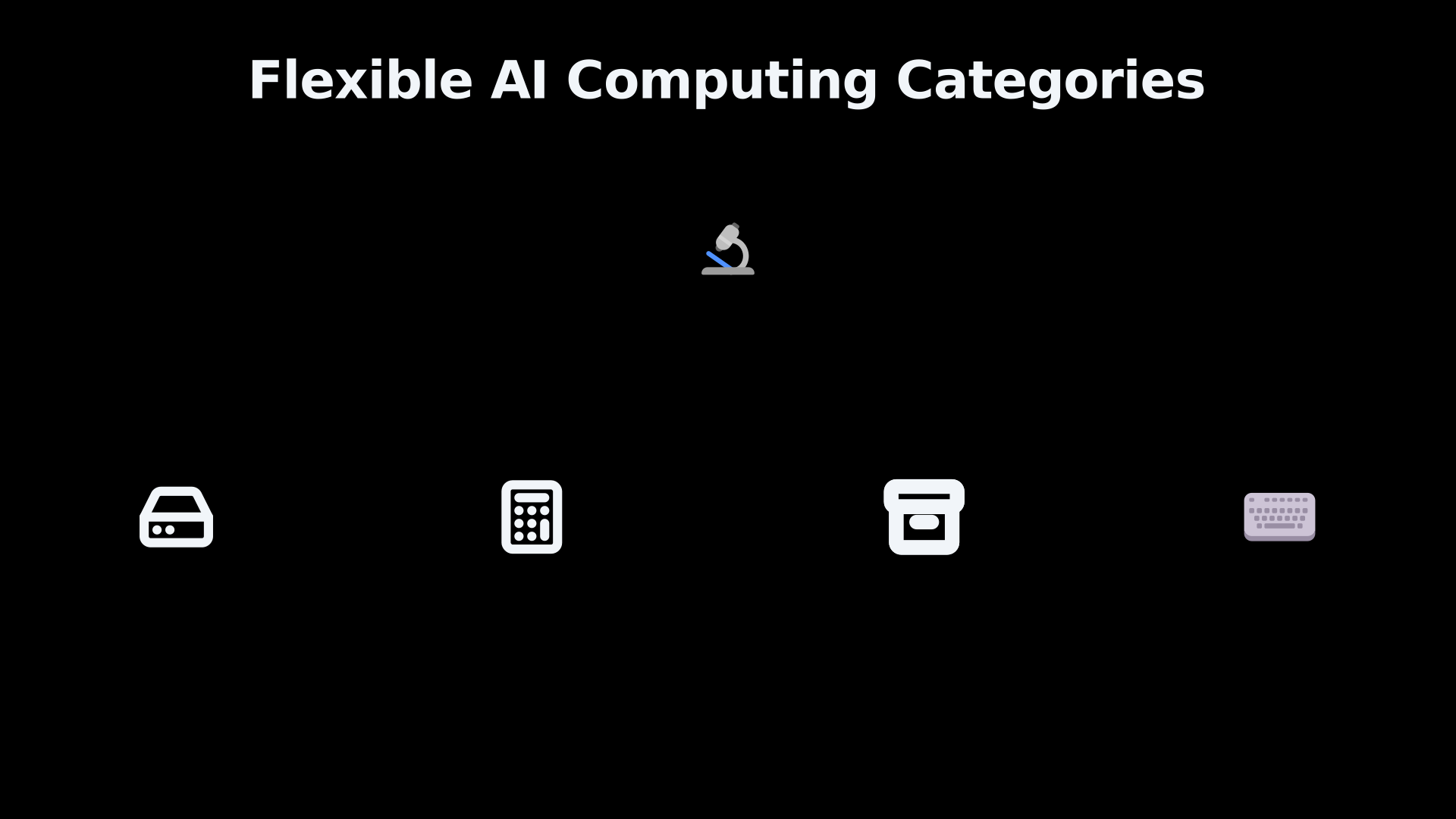
The Phoenix field demonstration provides a useful illustration of how workload prioritisation works in practice.
Researchers connected software controlling a commercial 256-GPU AI cluster to real-time utility signals. When the grid requested lower demand, the system did not simply disconnect servers. Instead, it identified workloads with spare scheduling flexibility, reduced computing power allocated to those tasks and preserved quality-of-service guarantees for higher-priority applications.
During the demonstrations, cluster power consumption fell by about 25% for roughly three hours without requiring batteries or hardware modifications and while maintaining contractual computing performance. The significance of the result lies not only in the size of the power reduction but in showing that selective workload management can provide meaningful grid services without treating all AI computation equally.[nature.com]nature.comA I data centres as grid-interactive assets | Nature EnergyAI data centres as grid-interactive assets | Nature EnergyDecember 5, 2025…
Why workload classification matters for an AI-enabled future
Within the broader idea of AI contributing to long-term human flourishing, workload flexibility is a practical rather than speculative innovation. If advanced AI ultimately requires enormous computing resources to accelerate science, medicine and engineering, electricity infrastructure will become a critical bottleneck.
Treating every AI workload as inflexible would require substantially more generation and transmission capacity to satisfy occasional demand peaks. By recognising that many forms of computation can wait while others cannot, operators may reduce congestion, make better use of renewable electricity and shorten delays to connecting new computing facilities.
The approach has important limits. Real-time AI services will always require reliable power, and excessive deferral can simply shift demand to later periods if not carefully managed. Operators must also balance electricity optimisation against customer contracts, cybersecurity, hardware utilisation and fairness between users.
Nevertheless, separating AI computation into flexible and inflexible classes transforms grid balancing from a question of shutting data centres down into one of intelligently deciding which AI jobs genuinely need to run now and which can safely wait for cleaner or less constrained electricity. That distinction is likely to become increasingly important as AI systems grow larger and electricity systems rely more heavily on variable renewable generation.[nature.com]nature.comA I data centres as grid-interactive assets | Nature EnergyAI data centres as grid-interactive assets | Nature EnergyDecember 5, 2025…
Amazon book picks
Further Reading
Books and field guides related to Which AI Jobs Can Wait for Cleaner Power?. Use these as the next step if you want deeper reading beyond the article.
Artificial Intelligence: A Guide for Thinking Humans
“After reading Mitchell’s guide, you’ll know what you don’t know and what other people don’t know, even though they claim to know it. And...
Designing Data-intensive Applications
Want to know how the best software engineers and architects structure their applications to make them scalable, reliable, and maintainabl...
Computer Architecture: A Quantitative Approach
Computer Architecture: A Quantitative Approach, has been considered essential reading by instructors, students and practitioners of compu...
The Cloud at Your Service: The When, How, and Why of Enterpri...
Cloud Computing is here to stay. As an economically viable way for businesses of all sizes to distribute computing, this technology shows...
eBay marketplace picks
Marketplace Samples
Live-tested eBay searches with available results related to this page.
Selected fromserver rack model oneBay.co.uk.
![Listing image for Dell PowerEdge R730xd 16LFF+2SFF Server /IndigoVision NVR-AS 4000/32GB RAM [16D]](/assets/images/marketplace-covers/18895e58d071ea980a50.jpg)

Endnotes
1.
Source: nature.com
Title: A I data centres as grid-interactive assets | Nature Energy
Link:https://www.nature.com/articles/s41560-025-01927-1
Source snippet
AI data centres as grid-interactive assets | Nature EnergyDecember 5, 2025...
Published: December 5, 2025
2.
Source: arxiv.org
Link:https://arxiv.org/abs/2507.00909
3.
Source: sciencedirect.com
Link:https://www.sciencedirect.com/science/article/pii/S0142061526003820
Source snippet
ScienceDirect...
4.
Source: arxiv.org
Link:https://arxiv.org/abs/2606.21833
Source snippet
Inference as Flexibility: Ramp Management for Transmission-Connected AI Data CentresJune 20, 2026...
Published: June 20, 2026
5.
Source: microsoft.com
Link:https://www.microsoft.com/en-us/research/publication/carbon-aware-compute-power-scheduling-for-ai-data-centers-with-microgrid-prosumer-operations/
Source snippet
Microsoft Research...
6.
Source: arxiv.org
Title: arXiv Power-Flexible AI Data Centers: A New Paradigm for Grid-Responsive Compute
Link:https://arxiv.org/abs/2606.25098
7.
Source: nature.com
Link:https://www.nature.com/articles/s44432-026-00013-5
8.
Source: nature.com
Link:https://www.nature.com/articles/s41467-026-72324-9
9.
Source: nature.com
Title: A I data centres as grid-interactive assets | Nature Energy
Link:https://www.nature.com/articles/s41560-025-01927-1.pdf
Additional References
10.
Source: ietresearch.onlinelibrary.wiley.com
Link:https://ietresearch.onlinelibrary.wiley.com/doi/full/10.1049/ein2.70031
Source snippet
IET Research JournalsWhy Computing–Electricity Coordination Has Not Scaled in Practice - Luo - 2026 - Energy Internet - Wiley Online Library...
11.
Source: epic.uchicago.edu
Title: quantifying ai data center flexibility as a resource adequacy asset
Link:https://epic.uchicago.edu/working-papers/quantifying-ai-data-center-flexibility-as-a-resource-adequacy-asset/
Source snippet
AI data center flexibility as a resource adequacy asset - EPICJuly 28, 2026 — Journal Article·Jul 28, 2026 QUANTIFYING AI DATA CENTER FLE...
Published: July 28, 2026
12.
Source: youtube.com
Title: Build an Onchain AI dapp with 0G’s Storage and Inferencing I Gathin T
Link:https://www.youtube.com/watch?v=xS1Txc5HF-4
Source snippet
Leveraging data centers to keep the grid in balance...
13.
Source: youtube.com
Title: Solving AI Power Spikes with Batteries
Link:https://www.youtube.com/watch?v=Cb7R9zGP9FI
Source snippet
Build an Onchain AI dapp with 0G's Storage and Inferencing I Gathin T...
14.
Source: youtube.com
Title: Leveraging data centers to keep the grid in balance
Link:https://www.youtube.com/watch?v=_pYdwM1hfSM
Source snippet
The mechanics of data center flexibility...
15.
Source: youtube.com
Title: The Energy Layer of AI: Powering the Next Wave of Inference
Link:https://www.youtube.com/watch?v=8LY8Hngibt0
Source snippet
Solving AI Power Spikes with Batteries...
16.
Source: anvilfield.com
Title: Data center grid flexibility and demand response
Link:https://anvilfield.com/field-guides/datacenter/data-center-grid-flexibility-demand-response/
17.
Source: youtube.com
Title: The mechanics of data center flexibility
Link:https://www.youtube.com/watch?v=yVYraiZR-jw
18.
Source: doi.org
Link:https://doi.org/10.1145/3765611.3815593
19.
Source: papers.ssrn.com
Link:https://papers.ssrn.com/sol3/Delivery.cfm/cee11caa-154a-4c17-ae76-00741879e030-MECA.pdf?abstractid=7038285&mirid=1