Within AI Bias
When AI Learns Old Hiring Bias
Recruitment AI can repeat historical hiring patterns when previous decisions reflect unequal opportunities.
On this page
- How recruitment predictions learned from history
- Why past success can mislead AI
- Creating fairer employment systems
Page outline Jump by section
Introduction
AI hiring tools promise a more efficient and objective way to find talent, but they can also automate the inequalities already present in the labour market. When a recruitment system learns from past hiring decisions, it may treat historical patterns as evidence of merit, even when those patterns were shaped by unequal access, discrimination or narrow ideas of what a “successful” candidate looks like. The result is not necessarily a machine making openly biased choices; it is often a system quietly repeating old advantages at much larger scale.[EEOC]eeoc.govEEOC Hearing Explores Potential Benefits and Harms of Artificial Intelligence and other Automated Systems in Employment Decisions | U…
This matters for the wider promise of AI and human flourishing. If advanced AI is to expand opportunity, improve economic mobility and help more people contribute their talents, employment systems must avoid turning past inequality into future barriers. Hiring is one of the clearest examples of a broader challenge: powerful AI systems can amplify human capabilities, but they can also amplify historical mistakes unless their goals, data and oversight are carefully designed.
How recruitment predictions learned from history
AI hiring systems usually do not “understand” fairness or talent in the human sense. Many are trained to find patterns that correlate with previous outcomes: which applicants were hired, which employees stayed, which candidates performed well according to an organisation’s chosen measures, or which applications recruiters previously advanced.
That approach can be useful. A system may help employers handle large numbers of applications, identify overlooked candidates and reduce some forms of human inconsistency. But the same mechanism creates a central risk: past hiring decisions are not a neutral measure of ability.
If an organisation historically hired mostly from a narrow group of universities, preferred candidates with uninterrupted career histories, or unconsciously rewarded traits associated with certain social backgrounds, an AI system trained on those outcomes may learn those patterns as signals of success. The algorithm is not necessarily copying an individual recruiter’s prejudice; it is learning from the consequences of many past decisions.
Research on algorithmic hiring has repeatedly identified this problem: the choice of what an AI predicts matters as much as the technical method used. A system trained to predict “who looked like successful employees in the past” may reproduce past selection patterns rather than identify who could succeed under fairer conditions. Researchers studying algorithmic hiring have warned that the design of training data, prediction targets and evaluation methods can embed assumptions about work and ability.[arXiv]arxiv.orgarXiv Mitigating Bias in Algorithmic Hiring: Evaluating Claims and PracticesMitigating Bias in Algorithmic Hiring: Evaluating Claims and PracticesJune 21, 2019…
Amazon’s recruiting tool showed how old patterns become automated
The most widely discussed example came from Amazon’s experimental AI recruitment system. The company developed a tool intended to help review job applications, but internal testing found that it was disadvantaging women applicants for technical roles. The system had been trained on historical CVs submitted over a decade, most of which came from men because the technology industry had historically been male-dominated.[The Guardian]theguardian.comOpen source on theguardian.com.
The system did not need an instruction saying “prefer men”. Instead, it learned patterns from previous hiring data. Because previous recruitment outcomes reflected a gender imbalance, the model found signals associated with those past outcomes and treated them as useful predictors.
The case became influential because it challenged a common assumption: that replacing human judgement with mathematics automatically makes decisions fairer. An algorithm can remove some human inconsistencies, but it can also give historical inequalities the appearance of scientific neutrality.
The lesson is especially important for future AI systems. A more capable system does not automatically become more aligned with human values. If its objective is poorly chosen, greater intelligence can simply make it more effective at optimising the wrong thing.
Why past success can mislead AI
Hiring data records opportunity as well as ability
A CV is not only a record of individual achievement. It is also a record of the opportunities someone had access to.
A candidate’s education, previous employers, job titles and career progression may reflect ability, but they may also reflect differences in wealth, geography, social networks, discrimination, caring responsibilities or access to professional opportunities.
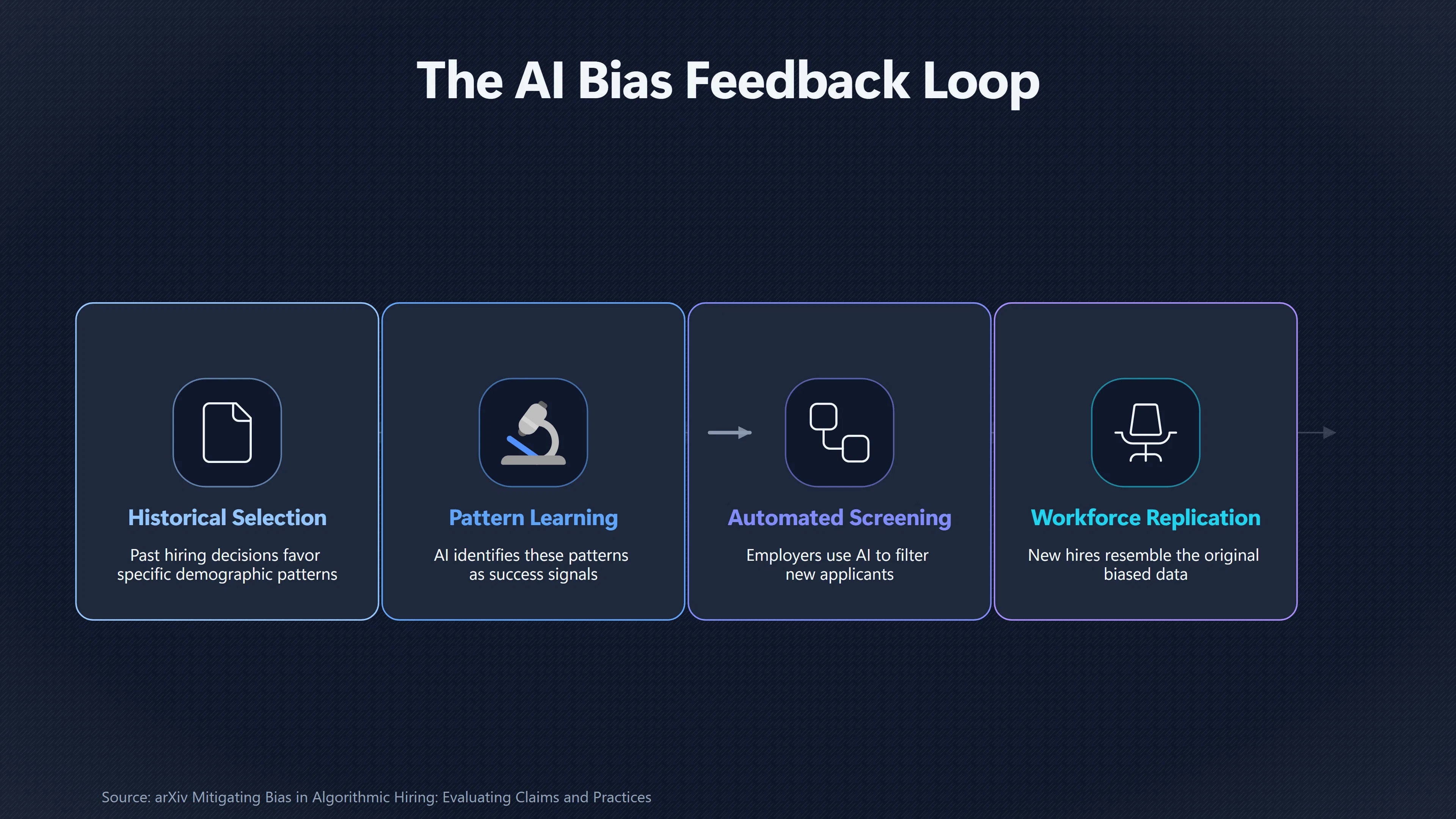
An AI model that treats these signals as straightforward indicators of potential can accidentally reward groups that already had advantages. This creates a feedback loop:
- Past hiring decisions favour certain patterns.
- AI learns those patterns as predictors of success.
- Employers use the AI recommendations.
- The resulting workforce resembles the original data.
- Future training data continues to reinforce the same pattern.
This is one reason why fairness cannot be reduced to simply removing obvious demographic information. Even if a system does not directly use gender, ethnicity or age, other features can act as indirect signals.
A system can be accurate and still produce unfair outcomes
One of the hardest questions in AI hiring is that a model can be statistically accurate while still creating unequal effects.
Suppose an employer asks an AI system to predict which applicants resemble previous high performers. If previous high performers came mostly from one group because of historical opportunity gaps, the system may achieve good prediction accuracy while narrowing opportunities for others.
This creates a tension between two goals:
- Prediction accuracy: Does the system correctly identify patterns associated with past outcomes?
- Fair opportunity: Does the system give qualified people a reasonable chance regardless of historical disadvantage?
These goals can sometimes align, but not always. Improving one does not automatically improve the other.
Beyond Amazon: evidence from hiring audits and research
Researchers have increasingly used “audit studies” to test hiring systems. Instead of analysing only internal company data, these studies create controlled comparisons, such as sending similar applications with different demographic signals and measuring differences in outcomes.
A 2022 National Bureau of Economic Research study by Kline, Rose and Walters examined racial discrimination in the labour market using large-scale resume audit methods. Such research provides a baseline showing that unequal treatment can exist before AI is introduced, which matters because AI systems may inherit the patterns they are trained on rather than create them from nothing.[National Bureau of Economic Research]nber.orgNational Bureau of Economic ResearchMeasuring Bias in Job Recommender Systems: Auditing the Algorithms | NBERAugust 27, 2024…
More recent research has examined algorithmic job recommendation and screening systems directly. A study of job recommendation systems found measurable gender differences in the jobs recommended to otherwise similar profiles, with some differences linked to how systems matched candidate information with job descriptions.[National Bureau of Economic Research]nber.orgNational Bureau of Economic ResearchMeasuring Bias in Job Recommender Systems: Auditing the Algorithms | NBERAugust 27, 2024…
Research into newer AI language models has also raised questions about whether large language models can provide genuinely neutral resume screening. Studies have found that AI models can show different outcomes depending on demographic information or the way resumes are represented, although results vary significantly between models and generations.[AAAI Open Access]ojs.aaai.orgOpen AccessGender, Race, and Intersectional Bias in Resume Screening via Language Model Retrieval | Proceedings of the AAAI/ACM Conference on AI, Et…
The evidence does not show that every AI hiring system is inevitably discriminatory. Instead, it shows that fairness must be tested rather than assumed.
Creating fairer employment systems
The strongest response is not necessarily to abandon AI hiring. Used carefully, AI could help widen opportunity by identifying overlooked candidates, reducing arbitrary screening decisions and making recruitment processes more consistent.
The challenge is designing systems that measure human potential rather than simply reproducing previous choices.
Key safeguards include:
- Better training goals: Systems should not only learn “who was hired before”. They should be designed around meaningful indicators of ability and potential.
- Representative evaluation: Employers should test systems across different groups and examine whether performance differs.
- Independent auditing: External reviews can reveal problems that internal teams may miss.
- Human accountability: AI recommendations should support decisions, not remove responsibility from employers.
- Transparency for applicants: People affected by automated screening should know when such tools are being used and what role they play.
Regulation is beginning to move in this direction. New York City’s Local Law 144 requires employers using certain automated employment decision tools to complete independent bias audits and make audit information available before using those systems. The law represents an attempt to make algorithmic hiring more accountable, although researchers have also raised questions about whether current auditing approaches are strong enough to capture complex forms of bias.[amlegal.com]codelibrary.amlegal.comDecember 11, 2021…

The AI bloom question: can technology expand opportunity rather than preserve inequality?
AI could eventually transform employment by helping people discover opportunities, match skills with demand and overcome barriers that currently limit human potential. In a future of abundant intelligence and greater economic opportunity, recruitment systems could become tools for finding talent that traditional institutions overlook.
But that future depends on a crucial design choice: whether AI learns only from the world as it has been, or helps create the world people want to build.
Hiring systems are a small but revealing example of the broader challenge facing advanced AI. A powerful system trained on yesterday’s decisions may preserve yesterday’s inequalities. A system deliberately aligned with human flourishing could help identify ability more fairly, expand access to meaningful work and allow more people to participate in the benefits of technological progress.
The difference is not intelligence alone. It is the purpose that intelligence is directed towards.
Amazon book picks
Further Reading
Books and field guides related to When AI Learns Old Hiring Bias. Use these as the next step if you want deeper reading beyond the article.
Weapons of Math Destruction
'A manual for the 21st-century citizen... accessible, refreshingly critical, relevant and urgent' - Financial Times 'Fascinating and deep...
Algorithms of Oppression
Acknowledgments -- Introduction: the power of algorithms -- A society, searching -- Searching for Black girls -- Searching for people and...
Automating Inequality
WINNER: The 2019 Lillian Smith Book Award, 2018 McGannon Center Book Prize, and shortlisted for the Goddard Riverside Stephan Russo Book...
Race After Technology
From everyday apps to complex algorithms, Ruha Benjamin cuts through tech-industry hype to understand how emerging technologies can reinf...
eBay marketplace picks
Marketplace Samples
Live-tested eBay searches with available results related to this page.
Selected fromai technology poster oneBay.co.uk.


Endnotes
1.
Source: eeoc.gov
Link:https://www.eeoc.gov/newsroom/eeoc-hearing-explores-potential-benefits-and-harms-artificial-intelligence-and-other
Source snippet
EEOC Hearing Explores Potential Benefits and Harms of Artificial Intelligence and other Automated Systems in Employment Decisions | U...
2.
Source: arxiv.org
Title: arXiv Mitigating Bias in Algorithmic Hiring: Evaluating Claims and Practices
Link:https://arxiv.org/abs/1906.09208
Source snippet
Mitigating Bias in Algorithmic Hiring: Evaluating Claims and PracticesJune 21, 2019...
Published: June 21, 2019
3.
Source: ojs.aaai.org
Title: Open Access
Link:https://ojs.aaai.org/index.php/AIES/article/view/31748
Source snippet
Gender, Race, and Intersectional Bias in Resume Screening via Language Model Retrieval | Proceedings of the AAAI/ACM Conference on AI, Et...
4.
Source: nyc.gov
Title: Automated Employment Decision Tools (AEDT)
Link:https://www.nyc.gov/site/dca/about/automated-employment-decision-tools.page
5.
Source: arxiv.org
Link:https://arxiv.org/abs/2406.01399
6.
Source: ojs.aaai.org
Link:https://ojs.aaai.org/index.php/AAAI/article/view/41267
7.
Source: eeoc.gov
Title: U.S. Equal Employment Opportunity Commission
Link:https://www.eeoc.gov/meetings/meeting-january-31-2023-navigating-employment-discrimination-ai-and-automated-systems-new/transcript
8.
Source: eeoc.gov
Title: Testimony of Re Nika Moore | U.S. Equal Employment Opportunity Commission
Link:https://www.eeoc.gov/meetings/meeting-january-31-2023-navigating-employment-discrimination-ai-and-automated-systems-new/moore
9.
Source: eeoc.gov
Title: Testimony of Adam T. Klein | U.S. Equal Employment Opportunity Commission
Link:https://www.eeoc.gov/meetings/meeting-january-31-2023-navigating-employment-discrimination-ai-and-automated-systems-new/klein
10.
Source: eeoc.gov
Link:https://www.eeoc.gov/newsroom/us-eeoc-and-us-department-justice-warn-against-disability-discrimination
11.
Source: legistar.council.nyc.gov
Title: Legislation Detail.aspx
Link:https://legistar.council.nyc.gov/LegislationDetail.aspx?GUID=B051915D-A9AC-451E-81F8-6596032FA3F9.&ID=4344524
12.
Source: theguardian.com
Link:https://www.theguardian.com/technology/2018/oct/10/amazon-hiring-ai-gender-bias-recruiting-engine
13.
Source: nber.org
Link:https://www.nber.org/papers/w32889
Source snippet
National Bureau of Economic ResearchMeasuring Bias in Job Recommender Systems: Auditing the Algorithms | NBERAugust 27, 2024...
Published: August 27, 2024
14.
Source: codelibrary.amlegal.com
Link:https://codelibrary.amlegal.com/codes/newyorkcity/latest/NYCadmin/0-0-0-135843
Source snippet
December 11, 2021...
Published: December 11, 2021
15.
Source: nber.org
Link:https://www.nber.org/papers/w29053
16.
Source: nber.org
Link:https://www.nber.org/papers/w26861
Additional References
17.
Source: legalclarity.org
Title: Workday AI Discrimination Lawsuit: Allegations and Key Rulings
Link:https://legalclarity.org/workday-ai-discrimination-lawsuit-allegations-and-key-rulings/
Source snippet
July 5, 2026 — WORKDAY AI DISCRIMINATION LAWSUIT: ALLEGATIONS AND KEY RULINGS A look at the landmark lawsuit alleging Workday...
Published: July 5, 2026
18.
Source: nature.com
Link:https://www.nature.com/articles/s41562-022-01485-6
19.
Source: youtube.com
Title: AI Hiring Bias and Autism: Why You Get Screened Out First
Link:https://www.youtube.com/watch?v=5X13bF3K-7c
Source snippet
[AI Bias]({{ 'ai-bias/' | relative_url }}) Audit: How to Test AI for Fairness (34-Point Checklist)...
20.
Source: littler.com
Link:https://www.littler.com/news-analysis/asap/eeoc-issues-guidance-use-artificial-intelligence-tools-employment-selection
21.
Source: employmentlawwatch.com
Link:https://www.employmentlawwatch.com/2023/05/articles/uncategorized/eeoc-releases-guidance-on-artificial-intelligence-in-the-workplace/
22.
Source: hklaw.com
Link:https://www.hklaw.com/en/insights/publications/2025/05/federal-court-allows-collective-action-lawsuit-over-alleged
23.
Source: lse.co.uk
Link:https://www.lse.co.uk/news/insight-amazon-scraps-secret-ai-recruiting-tool-that-showed-bias-against-women-7hdigx21yw5t9ht.html
24.
Source: deloitte.com
Link:https://www.deloitte.com/us/en/services/audit-assurance/articles/nyc-local-law-144-algorithmic-bias.html
25.
Source: regulume.com
Link:https://regulume.com/compliance/nyc-ll144/
26.
Source: doi.org
Link:https://doi.org/10.1145/3689904.3694699