Within Smarter Grids
Where Does Hidden Grid Capacity Run Out?
Software can expose operational slack, but transformers, substations, cables and distant renewable resources still impose hard physical limits.
On this page
- The weakest link problem across grid corridors
- Bottlenecks that dynamic ratings cannot remove
- How software upgrades and new construction fit together
Page outline Jump by section
Introduction
Artificial intelligence can help electricity grids use existing infrastructure more efficiently, but it cannot remove the physical limits that make new transmission lines, substations and transformers necessary. Better forecasting, dynamic line ratings and other grid-enhancing technologies often reveal hidden capacity that was previously left unused because operators relied on conservative assumptions. That can reduce congestion, connect more renewable generation sooner and postpone expensive upgrades. However, every transmission corridor is ultimately constrained by its weakest component. If a transformer is overloaded, a substation reaches its design limit, a cable cannot dissipate more heat or the network lacks an alternative path around congestion, no amount of software can safely create additional capacity. Understanding where hidden capacity ends is essential for judging both the promise and the limits of AI-assisted electricity networks within the broader vision of abundant clean energy that could support long-term human flourishing.
Where Does Hidden Grid Capacity Run Out?
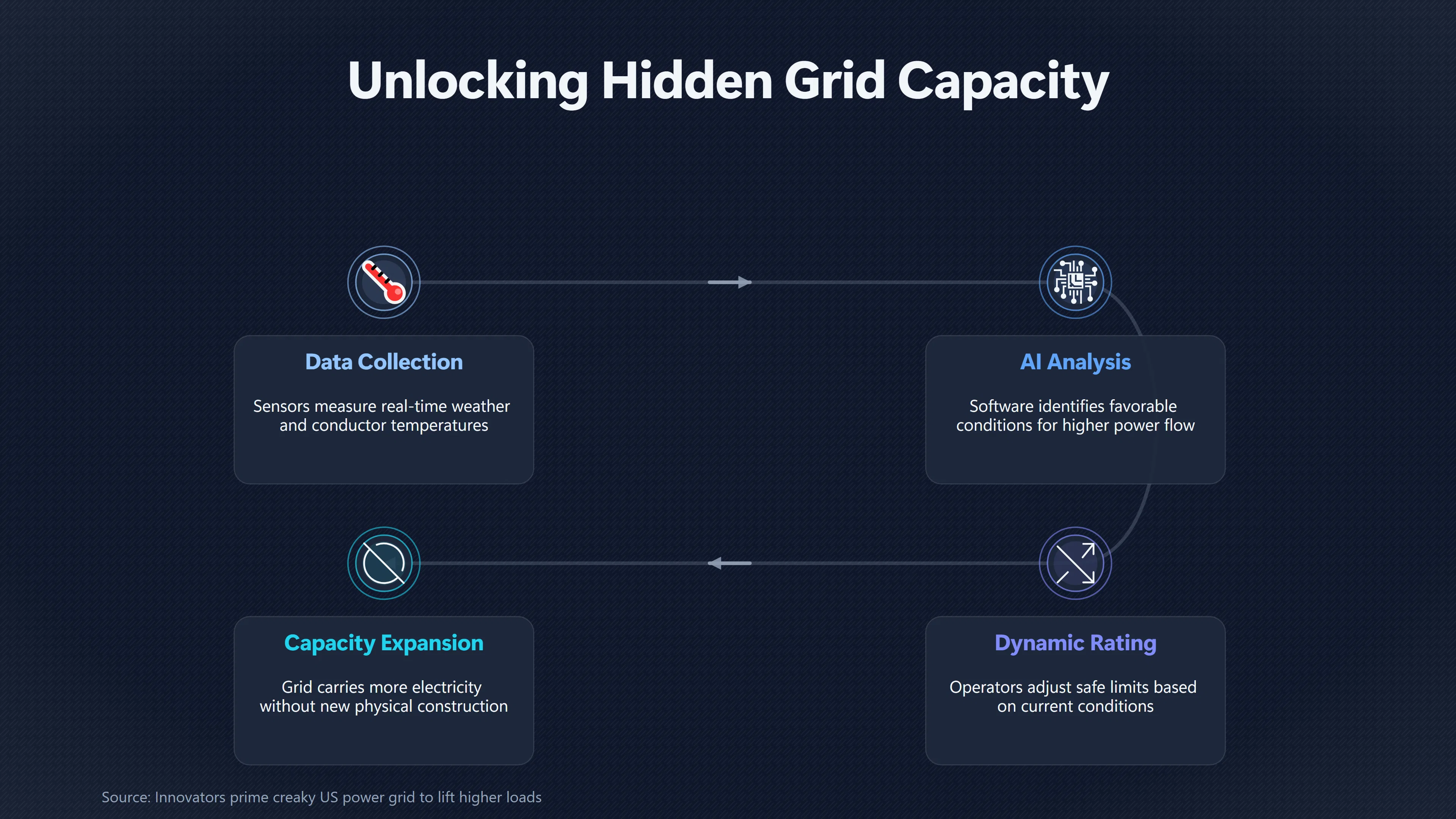
The idea of “hidden capacity” is often misunderstood. It does not mean that utilities have forgotten about large amounts of unused infrastructure. Instead, it refers to operational flexibility that can be unlocked by measuring conditions more accurately and reducing unnecessary safety margins.
For example, a transmission line rated conservatively for a hot, still summer afternoon may safely carry significantly more electricity during a cool, windy day because the wind removes heat from the conductor. AI-assisted weather forecasting and dynamic line ratings allow operators to recognise those favourable conditions rather than assuming the worst all year round. Regulators and system operators increasingly view this as an important way to improve efficiency.[Federal Energy Regulatory Commission]ferc.govFederal Energy Regulatory CommissionFERC Rule to Improve Transmission Line Ratings Will Help Lower Transmission Costs | Federal Energy Re…
However, these gains exist only where conservative assumptions are the binding constraint. Once the real physical capability of equipment has been reached, software has nothing further to optimise.
The Weakest-Link Problem Across Grid Corridors
A transmission corridor is only as capable as its most restrictive component.
Electricity does not travel through a single wire. A transfer path typically includes:
- overhead transmission lines[energy.gov]energy.govGrid-Enhancing Technologies Improve Existing Power Lines | Department of EnergyGrid-Enhancing Technologies Improve Existing Power Lines | Department of Energy
- underground or submarine cables
- transformers
- substations
- switchgear
- protection systems
- voltage-control equipment
Increasing the rating of only one element does not increase the capability of the entire corridor if another component reaches its limit first.
Imagine a motorway where one bridge has only two lanes. Widening every other section to four lanes does not eliminate the traffic jam at the bridge. Power grids behave similarly. A line that can safely carry another 20% of current is of limited value if the receiving transformer is already operating at its thermal limit or if the destination substation cannot handle higher power flows.
This explains why detailed engineering studies examine complete transmission paths rather than individual assets. Grid capacity is determined by the limiting element, not by the strongest one.
Bottlenecks That Dynamic Ratings Cannot Remove
Dynamic line ratings and AI forecasting primarily address uncertainty about overhead conductor temperatures. Many of the most important constraints in modern grids arise elsewhere.
Transformer limits
Large power transformers are among the hardest components to replace. Their thermal capability depends on insulation ageing, internal temperatures and cooling systems rather than simply the weather.
Although dynamic transformer ratings exist for some installations, they cannot overcome the basic thermal and mechanical limits of ageing equipment. Many networks already contain transformers that are decades old and require replacement regardless of improved operational software.[Reuters]reuters.comInnovators prime creaky US power grid to lift higher loadspower grid, with its outdated lines and transformers, faces significant challenges in handling anticipated increases in power supply and…
Substation capacity
Substations contain circuit breakers, busbars and protection equipment designed for specific fault currents and operating conditions.
Even if transmission lines could carry more power, substations may require entirely new bays, breakers or transformers before additional generation or demand can be connected.
These are civil engineering projects, not software updates.
Underground cables
Unlike overhead lines, underground cables dissipate heat poorly because they are surrounded by soil.
Their ratings depend on factors such as soil moisture, burial depth and neighbouring cables. While improved monitoring can refine estimates, underground circuits generally offer much less opportunity for dynamic increases than overhead conductors.
Voltage and stability constraints
Not every bottleneck is thermal.
Large transfers can create voltage instability, oscillations or unacceptable reactive power requirements long before equipment overheats.
These limits depend on the behaviour of the entire network rather than a single transmission line. AI can help operators predict these conditions earlier, but prediction cannot eliminate the underlying electrical physics.
Why Geography Still Demands New Transmission
Another limitation is location.
Hidden capacity can only increase flows where infrastructure already exists. It cannot create entirely new routes between regions.
This matters because renewable resources are often concentrated far from major demand centres:
- offshore wind may be hundreds of kilometres from cities
- desert solar farms require long-distance transmission
- remote hydroelectric resources need new export corridors
- future nuclear plants or industrial clusters may require completely different network configurations
Even perfect forecasting cannot transport electricity across regions that lack sufficient physical connections.
This distinction becomes increasingly important as AI-driven economic growth raises electricity demand. If advanced manufacturing, electrified industry and AI data centres expand faster than transmission networks, existing corridors eventually become genuine physical bottlenecks rather than operational ones.
How Software and Construction Complement Each Other
The debate is sometimes framed incorrectly as a choice between smarter software and building more infrastructure.
In practice, the strongest planning strategies combine both.
AI and grid-enhancing technologies can:[energy.gov]energy.govSource details in endnotes.
- increase utilisation of existing assets
- reduce renewable curtailment
- postpone some upgrades
- improve operational reliability
- shorten connection queues in favourable locations
Meanwhile, new infrastructure provides capabilities software cannot:
- entirely new transmission paths
- larger substations
- higher-capacity transformers
- stronger interregional connections
- improved network resilience through additional routes
The International Energy Agency argues that grid-enhancing technologies can unlock substantial additional hosting capacity with relatively low cost and short lead times, but also emphasises that they complement rather than replace long-term grid expansion. Its estimates show that technologies such as dynamic line ratings, topology optimisation and advanced power-flow control could enable hundreds of gigawatts of additional project connections, yet these gains sit alongside—not instead of—major investment in new transmission.[IEA]iea.orgGrids – Electricity 2026 – Analysis - IEA…

Why This Matters for AI-Enabled Energy Abundance
Within the broader discussion of AI-enabled abundance, hidden grid capacity represents an important but bounded opportunity.
AI forecasting can help reveal operational flexibility that conventional methods leave unused. Better predictions reduce uncertainty, allowing operators to move more electricity safely through existing infrastructure. Faster renewable integration, lower congestion costs and improved asset utilisation all make clean electricity more available in the near term.
But these improvements do not repeal engineering constraints. A civilisation powered by far larger amounts of electricity—for advanced AI systems, widespread electrification, clean industry, desalination, synthetic fuels or future space-related industries—will almost certainly require both smarter operation and far more physical infrastructure.
In other words, AI can help today’s grid behave more intelligently, but it cannot transform a limited network into an unlimited one. Hidden capacity is valuable because it buys time, reduces waste and improves efficiency. It is not a substitute for the long-term investment in transmission corridors, substations and transformers that an energy-abundant future will still demand.
Amazon book picks
Further Reading
Books and field guides related to Where Does Hidden Grid Capacity Run Out?. Use these as the next step if you want deeper reading beyond the article.
The Grid
One of Bill Gates's Favorite Books of 2016 A revelatory look at our national power grid--how it developed, its current flaws, and how it...
How the World Really Works
INSTANT NEW YORK TIMES BESTSELLER “A new masterpiece from one of my favorite authors… [How The World Really Works] is a compelling and hi...
Material World
THE NEW YORK TIMES BOOK REVIEW EDITORS' CHOICE • AN ECONOMIST BEST BOOK OF THE YEAR • Finalist for the Financial Times and Schroders Busi...
The Powerhouse
A Soul of a New Machine for our time—a gripping account of invention, commerce, and duplicity in the age of technology A worldwide race i...
eBay marketplace picks
Marketplace Samples
Live-tested eBay searches with available results related to this page.
Selected frompower grid model oneBay.co.uk.

Endnotes
1.
Source: iea.org
Link:https://www.iea.org/reports/electricity-2026/grids
Source snippet
Grids – Electricity 2026 – Analysis - IEA...
2.
Source: reuters.com
Title: Innovators prime creaky US power grid to lift higher loads
Link:https://www.reuters.com/markets/commodities/innovators-prime-creaky-us-power-grid-lift-higher-loads-maguire-2025-03-18/
Source snippet
power grid, with its outdated lines and transformers, faces significant challenges in handling anticipated increases in power supply and...
3.
Source: iea.org
Link:https://www.iea.org/reports/electricity-2026/executive-summary
Source snippet
Executive summary – Electricity 2026 – Analysis - IEA...
4.
Source: iea.org
Link:https://www.iea.org/data-and-statistics/charts/estimated-global-grid-hosting-capacity-that-can-be-unlocked-through-selected-upgrades-by-voltage-level-2025
5.
Source: iea.org
Link:https://www.iea.org/news/rising-component-prices-and-supply-chain-pressures-are-hindering-the-[development
6.
Source: energy.gov
Link:https://www.energy.gov/oe/articles/grid-enhancing-technologies-research-and-development-reality-0
7.
Source: energy.gov
Link:https://www.energy.gov/oe/articles/grid-enhancing-technologies-research-and-development-reality
8.
Source: iea.org
Link:https://www.iea.org/news/lack-of-ambition-and-attention-risks-making-electricity-grids-the-weak-link-in-clean-energy-transitions
9.
Source: energy.gov
Title: Grid-Enhancing Technologies Improve Existing Power Lines | Department of Energy
Link:https://www.energy.gov/oe/grid-enhancing-technologies-improve-existing-power-lines
10.
Source: iea.org
Link:https://www.iea.org/reports/electricity-grids-and-secure-energy-transitions/executive-summary
11.
Source: ferc.gov
Link:https://www.ferc.gov/news-events/news/ferc-rule-improve-transmission-line-ratings-will-help-lower-transmission-costs
Source snippet
Federal Energy Regulatory CommissionFERC Rule to Improve Transmission Line Ratings Will Help Lower Transmission Costs | Federal Energy Re...
12.
Source: ferc.gov
Link:https://www.ferc.gov/explainer-implementation-dynamic-line-ratings
13.
Source: ferc.gov
Link:https://www.ferc.gov/news-events/news/presentation-e-1-implementation-dynamic-line-ratings
14.
Source: ferc.gov
Link:https://www.ferc.gov/news-events/news/ferc-seeks-comment-potential-dlr-framework-improve-grid-operations-fact-sheet
15.
Source: ferc.gov
Link:https://www.ferc.gov/news-events/news/ferc-opens-inquiry-use-dynamic-line-ratings-promote-grid-efficiency
16.
Source: ferc.gov
Link:https://www.ferc.gov/news-events/news/e-1-commissioner-james-danly-concurrence-regarding-managing-transmission-line
Additional References
17.
Source: enline.energy
Title: Dynamic Line Rating: Is Your Congestion Real?
Link:https://enline.energy/articles/dynamic-line-rating-is-your-congestion-real
Source snippet
DYNAMIC LINE RATING REVEALS 20–40% HIDDEN GRID CAPACITY. IS YOUR CONGESTION REAL OR DRIVEN BY STATIC ASSUMPTIONS? SEE THE PORTUGAL CASE STU...
18.
Source: energypolicy.columbia.edu
Title: Arent, Lawrence Heath & Noah Kaufman •
Link:https://www.energypolicy.columbia.edu/publications/unlocking-transmission-efficiency-through-grid-enhancement-solutions/
Source snippet
Transmission Efficiency through Grid Enhancement Solutions - Center on Global Energy Policy at Columbia University SIPA | CGEPMarch 23, 2...
19.
Source: youtube.com
Title: What Are Dynamic Line Ratings in Grid Modernization?
Link:https://www.youtube.com/watch?v=qaDmZdZ9_DI
Source snippet
How to Increase Transmission Line Capacity Without Building New Lines | HTLS, HVDC & SIL Explained...
20.
Source: youtube.com
Title: Expanding Transmission Capacity with Grid-Enhancing Technologies
Link:https://www.youtube.com/watch?v=H5Sf9CRqFVw
Source snippet
More Power, Same Lines: The AI Revolution in Transmission Infrastructure...
21.
Source: nature.com
Link:https://www.nature.com/articles/s44359-024-00001-5
22.
Source: youtube.com
Title: More Power, Same Lines: The AI Revolution in Transmission Infrastructure
Link:https://www.youtube.com/watch?v=2k4OKwW-J7M
Source snippet
Grid's Hidden Potential Dynamic Line Rating...
23.
Source: nrel.gov
Link:https://www.nrel.gov/news/video/four-ways-to-increase-transmission-text
24.
Source: nrel.gov
Link:https://www.nrel.gov/grid/transmission-planning.html
25.
Source: enline.energy
Title: ‘S GRIDSIGHT DI
Link:https://enline.energy/articles/the-missing-layer-in-grid-modernisation-digital-twin-and-dynamic-line-rating-for-transmission-intelligence
Source snippet
The Missing Layer in Grid Modernization: Digital Twin and Dynamic Line Rating for Transmission IntelligenceApril 20, 2026 — Apr 20, 2026...
Published: April 20, 2026
26.
Source: iso-ne.com
Title: FER C Order No
Link:https://www.iso-ne.com/participate/support/participant-readiness-outlook/ferc-order-no-881-mtlr
Source snippet
881: Managing Transmission Line Ratings (MTLR)July 2, 2026 — FERC ORDER NO. 881: MANAGING TRANSMISSION LINE RATINGS (MTLR) IN THIS SECTIO...
Published: July 2, 2026