Within Eye Exams
Why Same Visit Eye Exams Change Patient Follow Through
Offering an autonomous eye exam during a diabetes appointment can remove the extra bookings and journeys that cause many patients to miss screening.
On this page
- Where conventional referral pathways lose patients
- What the 100% versus 22% trial result reveals
- Why immediate results can improve specialist follow up
Page outline Jump by section
Introduction
Same-visit autonomous eye screening changes diabetic eye care by tackling one of its biggest practical problems: many patients never complete a separate referral for retinal screening. Instead of asking someone to book another appointment at a different clinic weeks or months later, an AI-enabled retinal examination can be performed during the diabetes visit they are already attending. The main benefit is therefore behavioural rather than technological. By removing extra booking steps, additional travel and delays, the care pathway becomes much harder to abandon. Studies show that this can dramatically increase screening completion and improve the chances that people with abnormal findings actually reach an eye specialist for treatment.[PubMed]pubmed.ncbi.nlm.nih.govAutonomous artificial intelligence increases screening and follow-up for diabetic retinopathy in youth: the ACCESS randomized contr…
Within the broader question of how autonomous eye examinations improve screening access, this is an important mechanism. It illustrates how AI can increase the real-world impact of existing medical knowledge by reducing missed referrals rather than by inventing a new therapy. As a modest but concrete example within the wider vision of AI-enabled human flourishing, it shows how intelligent systems may help healthcare reach more people instead of leaving effective interventions unused.
Where conventional referral pathways lose patients
Diabetic retinopathy is often symptomless until vision has already been damaged. For that reason, regular retinal screening is recommended even when patients believe their eyesight is normal.
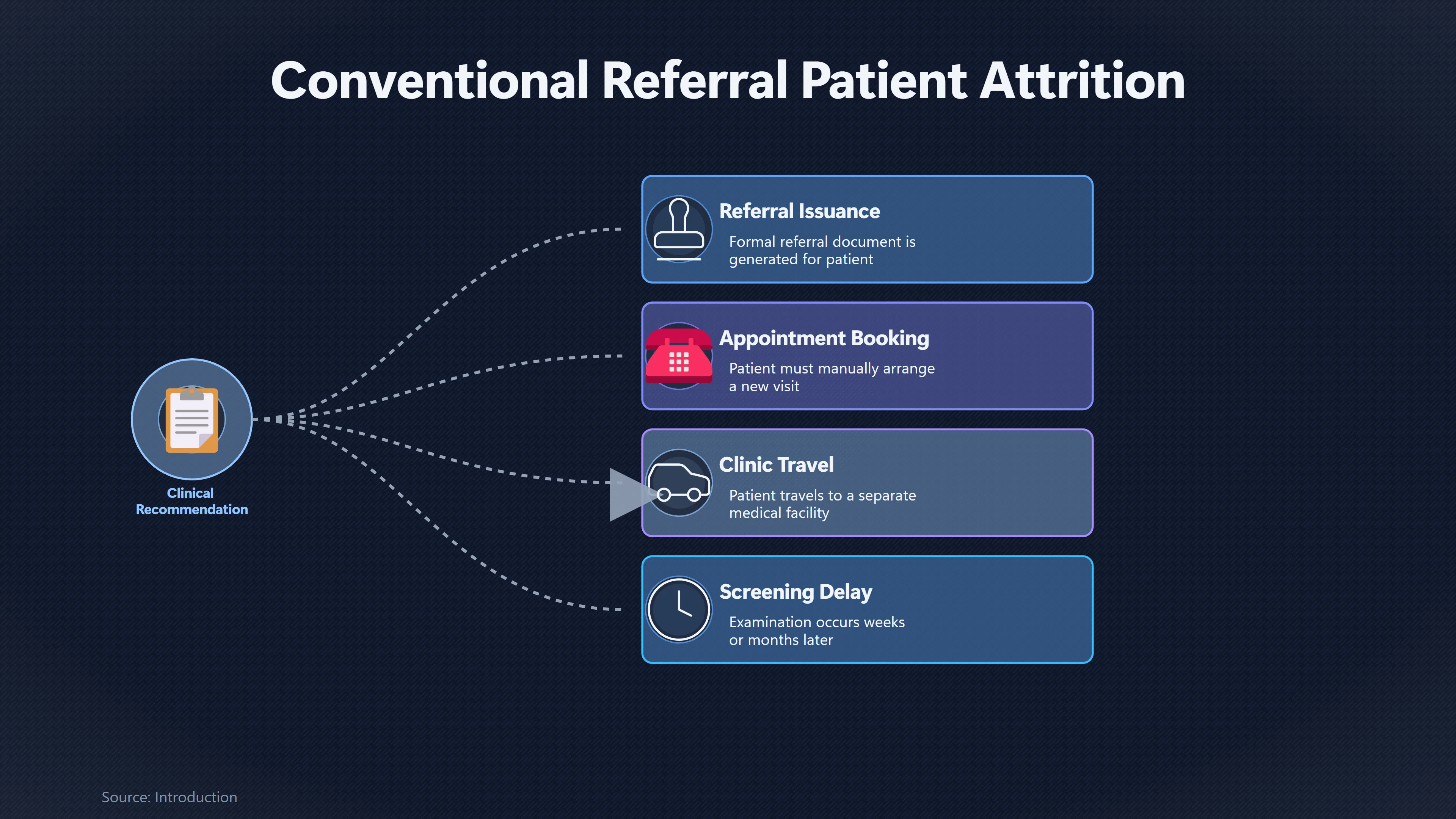
The conventional pathway, however, creates several opportunities for people to fall out of care:
- A diabetes clinician recommends an eye examination.
- A referral is issued.
- The patient must arrange another appointment.
- They travel to a different clinic.
- Screening occurs days, weeks or months later.
- If disease is found, another specialist visit must be arranged.
Every additional stage introduces friction. Patients may forget, postpone the appointment, struggle with transport, lose time from work, need childcare or simply decide the examination feels less urgent because they have no symptoms. Public health researchers consistently identify these practical barriers as a major reason recommended diabetic eye screening rates remain below target in many healthcare systems.[JAMA Network]jamanetwork.comJAMA NetworkPivotal Evaluation of an Artificial Intelligence System for Autonomous Detection of Referrable and Vision-Threatening Diabeti…
Importantly, these losses occur before any discussion about whether the AI is more accurate than a clinician. A highly accurate screening system provides little benefit if patients never reach it.
What the 100% versus 22% trial result reveals
One of the clearest demonstrations comes from the ACCESS randomised controlled trial involving children and young adults with diabetes.
Participants assigned to autonomous AI screening received a retinal examination during their routine diabetes clinic visit. The comparison group received standard referral and education encouraging them to arrange conventional screening elsewhere.
The difference was striking:
- 100% of participants offered same-visit autonomous AI screening completed their diabetic eye examination.
- Only 22% of those relying on the traditional referral pathway completed screening within six months.
- Among patients requiring further ophthalmology assessment after an abnormal result, 64% completed specialist follow-up in the intervention group compared with 22% in the conventional referral group.[nature.com]nature.comal | Nature CommunicationsJanuary 11, 2024…
These findings highlight an important distinction. The intervention did not primarily improve outcomes by detecting disease more accurately than existing practice. Instead, it ensured that screening actually happened.
The study therefore measures something broader than diagnostic performance: it measures completion of care. In many screening programmes, completion is the limiting factor that determines whether patients benefit from early treatment at all.
Why immediate results improve specialist follow-up
Receiving a result before leaving the clinic changes the conversation between clinician and patient.
Rather than saying, “Please arrange an eye appointment,” clinicians can discuss a concrete finding while the patient is still present. If the examination is normal, reassurance is immediate. If potentially significant disease is detected, referral can be organised before the patient leaves.
This creates several advantages:
- the patient understands why referral matters because the result is immediate;
- appointments can often be initiated while the patient is still in the healthcare system;
- fewer patients delay action because the issue feels hypothetical;
- primary care staff can answer questions immediately rather than relying on a future specialist visit.
Behavioural science has long shown that people are more likely to complete actions that require fewer separate decisions. Same-visit retinal screening applies this principle to healthcare by collapsing multiple appointments into one clinical encounter.[PubMed]pubmed.ncbi.nlm.nih.govAutonomous artificial intelligence increases screening and follow-up for diabetic retinopathy in youth: the ACCESS randomized contr…
The referral becomes more targeted, not less important
Autonomous AI does not eliminate ophthalmologists from diabetic eye care.
Instead, it changes who reaches specialist clinics.
Patients with no evidence of referable diabetic retinopathy can usually continue routine surveillance, while those with positive or non-diagnostic examinations are directed towards specialist assessment. This allows ophthalmologists to concentrate on patients most likely to benefit from further investigation or treatment rather than reviewing every normal screening examination.[JAMA Network]jamanetwork.comJAMA NetworkPivotal Evaluation of an Artificial Intelligence System for Autonomous Detection of Referrable and Vision-Threatening Diabeti…
The specialist referral therefore becomes more meaningful. Instead of asking every patient to attend an eye clinic regardless of risk, the pathway focuses attention on those with evidence of disease or images that cannot safely be interpreted.
Early real-world evidence beyond the trial
Randomised trials show what can happen under controlled conditions, but healthcare systems also need evidence that new workflows improve care in everyday practice.
A 2026 study from Johns Hopkins Medicine examined thousands of adults with diabetes after autonomous AI retinal screening was introduced into primary care clinics. The researchers found that AI-assisted screening was associated with improved presentation to specialist eye care among at-risk patients, including better downstream access for African American patients, a group that has historically experienced lower screening attendance and more advanced disease at diagnosis.[nature.com]nature.comtients | npj Digital Medicine…
Although observational studies cannot prove causation as strongly as randomised trials, they suggest that the same mechanism seen in the ACCESS study can continue to operate after deployment in routine clinical practice.
Why this matters for broader AI-enabled healthcare
Same-visit autonomous retinal screening demonstrates an important pattern that extends beyond ophthalmology. The value of medical AI may sometimes lie less in producing a slightly better prediction than in redesigning care so that more people actually receive timely diagnosis.
Within the wider discussion of AI abundance and long-term human flourishing, this is a practical illustration of how intelligent systems can expand access to proven healthcare rather than replacing clinical expertise. Preventing missed referrals preserves vision using treatments that already exist, while freeing specialist time for patients who genuinely need advanced care.
The lesson is broader than diabetic eye disease. If AI can consistently reduce friction between diagnosis, referral and treatment across many conditions, relatively small improvements in patient follow-through could accumulate into substantial gains in population health, especially when combined with equitable access, appropriate clinical oversight and well-designed referral pathways.
Amazon book picks
Further Reading
Books and field guides related to Why Same Visit Eye Exams Change Patient Follow Through. Use these as the next step if you want deeper reading beyond the article.

Deep Medicine: How Artificial Intelligence Can Make Healthcar...
First published 2019. Subjects: Artificial intelligence, Medical informatics, Medical applications, Diagnosis, Data processing.

The Checklist Manifesto: How to Get Things Right
Rating: 3.9/5 from 35 Google Books ratings
First published 2010. Subjects: Listes, Emergency Medicine, Clinical Competence, Qualité, Lists.
The Digital Doctor: Hope, Hype, and Harm at the Dawn of Medic...
The New York Times Science Bestseller from Robert Wachter, Modern Healthcare’s #1 Most Influential Physician-Executive in the US While mo...
Better: A Surgeon's Notes on Performance
The bestselling author of Complications' fascinating examination of how medical professionals strive for better, even in the face of adve...
eBay marketplace picks
Marketplace Samples
Live-tested eBay searches with available results related to this page.
Selected frommedical display model oneBay.co.uk.




Endnotes
1.
Source: nature.com
Link:https://www.nature.com/articles/s41746-026-02460-5
Source snippet
tients | npj Digital Medicine...
2.
Source: nature.com
Link:https://www.nature.com/articles/s41467-023-44676-z
Source snippet
al | Nature CommunicationsJanuary 11, 2024...
Published: January 11, 2024
3.
Source: nature.com
Link:https://www.nature.com/articles/s41746-026-02460-5.pdf
4.
Source: nature.com
Link:https://www.nature.com/articles/s41746
5.
Source: pubmed.ncbi.nlm.nih.gov
Link:https://pubmed.ncbi.nlm.nih.gov/38212308/
Source snippet
Autonomous artificial intelligence increases screening and follow-up for diabetic retinopathy in youth: the ACCESS randomized contr...
6.
Source: jamanetwork.com
Link:https://jamanetwork.com/journals/jamanetworkopen/fullarticle/2786132
Source snippet
JAMA NetworkPivotal Evaluation of an Artificial Intelligence System for Autonomous Detection of Referrable and Vision-Threatening Diabeti...
7.
Source: pubmed.ncbi.nlm.nih.gov
Link:https://pubmed.ncbi.nlm.nih.gov/41781569/
Source snippet
Autonomous AI-assisted diabetic retinopathy screening at primary care is associated with increased presentation to eye care by at r...
8.
Source: pmc.ncbi.nlm.nih.gov
Link:https://pmc.ncbi.nlm.nih.gov/articles/PMC13077085/
Source snippet
2026 Mar 5;9:310. doi: 10.1038/s41746-026-02460-5 AUTONOMOUS AI-ASSISTED DIABETIC RETINOPATHY SCREENING AT PRIMARY CARE IS ASSOCIATED WIT...
9.
Source: pmc.ncbi.nlm.nih.gov
Link:https://pmc.ncbi.nlm.nih.gov/articles/PMC10784572/
10.
Source: pubmed.ncbi.nlm.nih.gov
Link:https://pubmed.ncbi.nlm.nih.gov/38026608/
11.
Source: pubmed.ncbi.nlm.nih.gov
Link:https://pubmed.ncbi.nlm.nih.gov/36469332/
12.
Source: pubmed.ncbi.nlm.nih.gov
Link:https://pubmed.ncbi.nlm.nih.gov/35132211/
13.
Source: pubmed.ncbi.nlm.nih.gov
Link:https://pubmed.ncbi.nlm.nih.gov/32174153/
14.
Source: pubmed.ncbi.nlm.nih.gov
Link:https://pubmed.ncbi.nlm.nih.gov/33146763/
15.
Source: pmc.ncbi.nlm.nih.gov
Link:https://pmc.ncbi.nlm.nih.gov/articles/PMC7716929/
16.
Source: pubmed.ncbi.nlm.nih.gov
Link:https://pubmed.ncbi.nlm.nih.gov/31304320/
Additional References
17.
Source: pure.johnshopkins.edu
Title: Wolf *, Roomasa Channa *,
Link:https://pure.johnshopkins.edu/en/publications/autonomous-ai-assisted-diabetic-retinopathy-screening-at-primary-/
Source snippet
AI-assisted diabetic retinopathy screening at primary care is associated with increased presentation to eye care by at risk patients - Jo...
18.
Source: youtube.com
Title: AI in Ophthalmology: Improving Detection, Workflow and Patient Care
Link:https://www.youtube.com/watch?v=zWfDd1ySWg0
Source snippet
Digi4Care Pilot 1: AI Fundus Camera for Diabetic Retinopathy Screening in Primary Care...
19.
Source: youtube.com
Title: Autonomous AI for Diabetic Retinopathy Screening
Link:https://www.youtube.com/watch?v=AUlv_GmR-KU
Source snippet
LumineticsCore™ Engineered by Digital Diagnostics: Revolutionizing Healthcare with AI...
20.
Source: diabetesjournals.org
Link:https://diabetesjournals.org/diabetes/article/71/Supplement_1/48-OR/145906/48-OR-Barriers-to-Follow-Up-Specialized-Eye-Care
21.
Source: ophth.wisc.edu
Link:https://www.ophth.wisc.edu/blog/2024/01/11/autonomous-artificial-intelligence-increases-screening-and-follow-up-for-diabetic-retinopathy-in-youth-the-access-randomized-control-trial/
22.
Source: youtube.com
Link:https://www.youtube.com/watch?v=FmIDLPeJSjw
Source snippet
Topcon Screen - An Overview...
23.
Source: iro.uiowa.edu
Link:https://iro.uiowa.edu/esploro/outputs/journalArticle/Autonomous-AI-assisted-diabetic-retinopathy-screening-at/9985141867702771
24.
Source: youtube.com
Title: Topcon Screen
Link:https://www.youtube.com/watch?v=bzbSnOcqusc
Source snippet
AI in Ophthalmology: Improving Detection, Workflow and Patient Care...
25.
Source: clinicaltrials.gov
Link:https://clinicaltrials.gov/study/NCT06721351