Within Robotics
Which Construction Jobs Should Robots Do First?
Drones, demolition machines and robotic tools can take over the riskiest stages of roof, bridge and unstable-structure work without replacing an entire trade.
On this page
- Why changing worksites resist full automation
- High risk tasks robots can already take over
- How supervised machines could reshape construction roles
Page outline Jump by section
Introduction
The first construction jobs that robots should take over are not entire trades but the most dangerous tasks performed at height. Falls remain one of the leading causes of fatal injuries in construction, while demolition, roof work, bridge inspection and work on unstable structures expose people to risks that cannot always be eliminated by training or protective equipment alone. Rather than replacing builders, roofers or steelworkers, today’s most useful construction robots remove people from the moments when a mistake is most likely to be fatal. This task-by-task approach fits the broader vision of AI-enabled human flourishing: using increasingly capable machines to reduce avoidable danger while allowing people to focus on supervision, planning, skilled assembly and problem-solving. Whether these gains become widely shared, however, depends on careful deployment, good safety regulation and successful workforce transition rather than automation alone.[HSE]hse.gov.ukWork at height - HSEMarch 11, 2026…
Why changing worksites resist full automation
Construction sites are among the hardest environments for robots. Unlike factories, they change daily. Floors appear and disappear, scaffolding moves, weather alters conditions, and materials are stacked unpredictably. A robot that performs flawlessly in a controlled warehouse may struggle with mud, debris, poor lighting or partially demolished buildings.
Work at height compounds these challenges. Roof structures vary enormously between buildings, bridge repairs often occur alongside live traffic, and demolition can make structures progressively less stable. Robots therefore need reliable perception, localisation and obstacle avoidance while operating safely around human workers.
This explains why the industry has generally adopted specialised machines rather than general-purpose humanoids. Instead of expecting one robot to perform every construction task, companies increasingly deploy different systems for different hazards:
- inspection drones for roofs, bridges and towers;
- remotely operated demolition robots inside unstable structures;
- autonomous or semi-autonomous inspection robots that document changing worksites;
- robotic tools that carry out repetitive or hazardous operations while remaining under human supervision.
This gradual strategy also aligns with established safety principles. Britain’s Health and Safety Executive (HSE) emphasises that the best protection is to avoid exposing workers to height whenever reasonably practicable, before relying on fall-arrest systems. Robots can sometimes eliminate the exposure altogether by allowing inspections or certain operations to occur without a person leaving the ground.[HSE]hse.gov.ukHSEAssessing all work at heightHSEAssessing all work at height
High-risk tasks robots can already take over
The strongest evidence comes from narrowly defined activities where removing the worker from immediate danger produces clear safety benefits.
Roof and façade inspection
Small drones equipped with high-resolution cameras and thermal sensors increasingly inspect roofs, façades, towers and industrial buildings.
Instead of requiring surveyors to climb fragile roofs or erect temporary access equipment simply to assess damage, drones can capture detailed imagery from the ground-controlled flight. AI-assisted image analysis can then highlight cracked tiles, damaged flashing, corrosion or missing components for later human review.
This does not eliminate skilled roofing work, but it reduces the number of times workers must climb onto hazardous surfaces purely for inspection. NIOSH, the occupational safety research agency within the US Centers for Disease Control and Prevention, is studying both the benefits of drone inspection and the new interaction risks that arise when drones operate around construction workers.[cdc.gov]cdc.govOpen source on cdc.gov.
Demolition inside unstable structures
Remote-controlled demolition robots are among the clearest examples of successful hazard reduction.
Compact tracked machines equipped with hydraulic breakers, crushers or shears can dismantle walls, floors and concrete while operators remain outside the immediate collapse zone. Their relatively small size allows them to enter buildings that would be difficult or dangerous for conventional excavators.
These machines are particularly valuable when:
- structures are partially collapsed;
- overhead materials could fall unexpectedly;
- confined spaces prevent safe human working positions;
- vibration or dust creates additional hazards.
Removing the operator from the structure can substantially reduce exposure to falling debris and collapse, although the robots themselves create new crushing hazards if poorly controlled. NIOSH has therefore begun dedicated research into safe human interaction with demolition robots after serious workplace incidents demonstrated that robotic equipment also requires new operating procedures.[cdc.gov]cdc.govOpen source on cdc.gov.
Bridge and elevated infrastructure inspection
Bridge inspection traditionally requires inspectors to work above water, traffic or steep terrain using ropes, access platforms or specialist vehicles.
Increasingly, robots and autonomous inspection platforms are collecting visual data and non-destructive measurements instead. Research systems have combined cameras with ground-penetrating radar, ultrasonic sensors and electrical measurements to map bridge deterioration while reducing human exposure during routine data collection.[arXiv]arxiv.orgAutonomous Robotic System using Non-Destructive Evaluation methods for Bridge Deck InspectionApril 15, 2017…
Commercial deployments remain selective, but the trend is towards allowing inspectors to spend less time physically accessing hazardous locations and more time interpreting digital information.
Hazard mapping before workers enter
Quadruped robots and autonomous mobile platforms are increasingly used to document complex construction sites before crews begin work.
Machines such as Boston Dynamics’ Spot can repeatedly traverse evolving sites to capture imagery, produce three-dimensional models and identify changes that might otherwise require repeated human walkthroughs across unfinished structures. These systems are primarily inspection tools rather than builders, but they can reduce unnecessary exposure to unfinished or hazardous environments while improving situational awareness.[Boston Dynamics]bostondynamics.comBoston Dynamics Construction | Boston DynamicsBoston Dynamics Construction | Boston Dynamics

Robots change the riskiest moments rather than replacing the trade
A common misconception is that construction robotics aims to eliminate entire occupations. Current deployments suggest a different pattern.
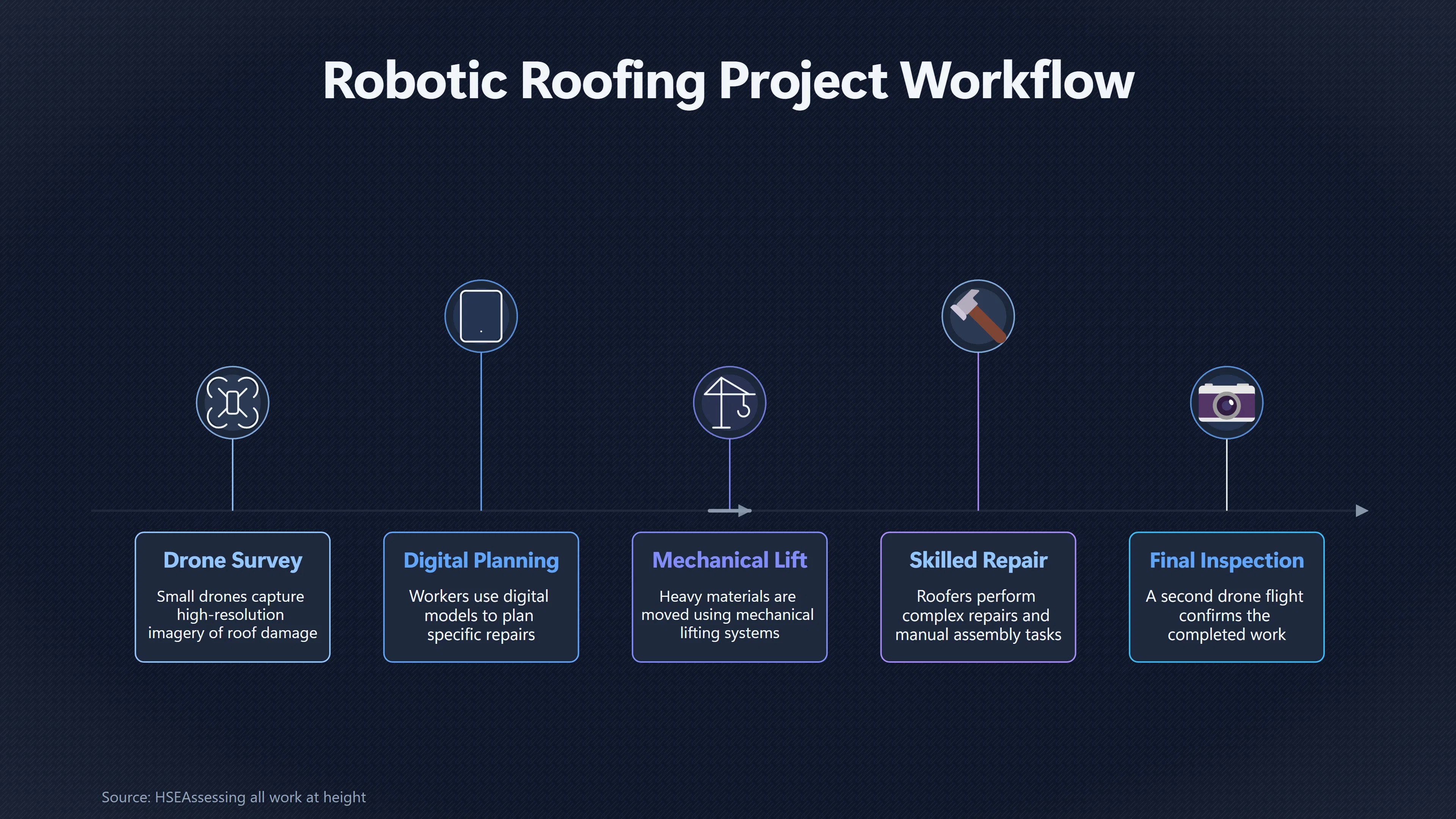
A roofing project illustrates the distinction:
- A drone surveys the roof and identifies damaged areas.
- Workers plan repairs using digital models.
- Materials are lifted mechanically.
- Skilled roofers complete the repair.
- A final drone inspection confirms the finished work.
The robot removes repeated climbing and inspection rather than replacing the judgement required to diagnose unusual defects or perform complex repairs.
The same applies in demolition. Remote-controlled machines perform the dangerous breaking and crushing, while engineers determine demolition sequencing, supervisors monitor structural behaviour and crews manage material separation, transport and recycling.
This division of labour reflects one of the broader themes within AI-enabled abundance: machines increasingly assume predictable physical risk while humans concentrate on tasks requiring judgement, coordination and accountability.
New hazards appear alongside old ones
Construction robots improve safety only if they are integrated carefully.
Robots introduce risks that traditional construction safety procedures were not originally designed to manage, including:
- workers entering a robot’s operating envelope;
- unexpected autonomous movement;
- communication failures during remote operation;
- reduced operator awareness caused by camera-only viewpoints;
- overconfidence in autonomous inspection results.
NIOSH researchers have documented serious injuries involving demolition robots and are studying operator behaviour, control interfaces and human trust in robotic systems to reduce these new forms of risk. Similarly, research into drone-human interaction examines whether aerial robots distract workers performing tasks at height or unintentionally increase fall risk.[cdc.gov]cdc.govOpen source on cdc.gov.
The lesson is not that robots are unsafe, but that replacing one category of hazard often creates another that requires different engineering controls, training and regulation.
How supervised machines could reshape construction roles
The most plausible near-term future is neither fully manual construction nor fully autonomous building sites.
Instead, construction work may become increasingly layered:
- autonomous systems perform routine inspection and data collection;
- remotely operated robots undertake hazardous demolition and breaking;
- AI software analyses imagery to identify defects or monitor progress;
- skilled workers intervene for complex installation, repair, adaptation and quality assurance.
This shift could improve both safety and productivity. Supervisors may increasingly oversee several robotic systems while tradespeople spend less time climbing ladders, entering unstable structures or conducting repetitive inspections.
Whether this ultimately contributes to broader human flourishing depends on more than technology. If productivity gains reduce injuries while supporting higher-quality skilled work, construction could become both safer and more attractive. If, however, automation merely concentrates profits while workers face insecure employment or inadequate retraining, the social benefits become far less certain.
What this means for an AI-enabled future
Construction work at height illustrates an important feature of the wider AI bloom argument. Progress does not require waiting for fully autonomous humanoid builders capable of replacing every craft worker. Meaningful improvements can arrive much earlier through specialised systems that remove people from the most dangerous parts of the job.
Inspection drones, robotic demolition equipment and autonomous site-monitoring systems already demonstrate how AI and robotics can reduce exposure to falls, collapsing structures and unstable environments. These are incremental advances rather than revolutionary replacements, yet they point towards a broader possibility: that increasingly capable machines could steadily separate essential economic activity from unnecessary human danger.
For the long-term vision of human flourishing, that may be the more important transformation. Success is measured not by how many construction jobs disappear, but by how many workers return home safely from jobs that once carried an unacceptably high risk of death or life-changing injury.
Amazon book picks
Further Reading
Books and field guides related to Which Construction Jobs Should Robots Do First?. Use these as the next step if you want deeper reading beyond the article.
The Second Machine Age
A New York Times Bestseller A revolution is under way. In recent years, Google’s autonomous cars have logged thousands of miles on Americ...
The Design of Everyday Things
Even the smartest among us can feel inept as we fail to figure out which light switch or oven burner to turn on, or whether to push, pull...
Robotics: A Very Short Introduction
Robotics is a key technology in the modern world. Robots are a well-established part of manufacturing and warehouse automation, assemblin...
Human Factors in Engineering and Design
First published 1994. Subjects: Engineering, Engineering design.
eBay marketplace picks
Marketplace Samples
Live-tested eBay searches with available results related to this page.
Selected fromconstruction poster oneBay.co.uk.



Endnotes
1.
Source: hse.gov.uk
Link:https://www.hse.gov.uk/construction/faq-height.htm
Source snippet
Work at height - HSEMarch 11, 2026...
Published: March 11, 2026
2.
Source: hse.gov.uk
Title: HSEAssessing all work at height
Link:https://www.hse.gov.uk/construction/safetytopics/assess.htm
3.
Source: cdc.gov
Link:https://www.cdc.gov/niosh/blogs/2024/construction-robotics.html
4.
Source: arxiv.org
Link:https://arxiv.org/abs/1704.04663
Source snippet
Autonomous Robotic System using Non-Destructive Evaluation methods for Bridge Deck InspectionApril 15, 2017...
Published: April 15, 2017
5.
Source: arxiv.org
Title: arXiv [Development]({{ ‘build-rights/’ | relative_url }}) of An Autonomous Bridge Deck Inspection Robotic System
Link:https://arxiv.org/abs/1704.07400
6.
Source: arxiv.org
Title: arXiv Auto Inspect: Towards Long-Term Autonomous Industrial Inspection
Link:https://arxiv.org/abs/2404.12785
7.
Source: arxiv.org
Link:https://arxiv.org/abs/2404.13143
8.
Source: hse.gov.uk
Title: Planning for construction work SITE ORGANI
Link:https://www.hse.gov.uk/construction/safetytopics/
Source snippet
Safety hazards - HSEApril 22, 2026 — SAFETY HAZARDS Includes site organisation, working at height, structural stability, electrical safet...
Published: April 22, 2026
9.
Source: press.hse.gov.uk
Title: * Inspector s
Link:https://press.hse.gov.uk/2025/10/09/contractor-told-to-carry-out-unpaid-work-after-ignoring-hse-action/
Source snippet
told to carry out unpaid work after ignoring HSE action – HSE Media CentreOctober 9, 2025 — CONTRACTOR TOLD TO CARRY OUT UNPAID WORK AFTE...
Published: October 9, 2025
10.
Source: press.hse.gov.uk
Link:https://press.hse.gov.uk/2025/06/12/demolition-firm-fined-after-worker-seriously-injured-in-fall-from-height/
11.
Source: archive.cdc.gov
Link:https://archive.cdc.gov/www_cdc_gov/niosh/enews/enewsv21n10.html
12.
Source: stacks.cdc.gov
Link:https://stacks.cdc.gov/view/cdc/140196
13.
Source: cdc.gov
Title: falls campaign
Link:https://www.cdc.gov/niosh/bulletin/2022/falls-campaign.html
14.
Source: cdc.gov
Link:https://www.cdc.gov/niosh/bulletin/2017/drones.html
15.
Source: hse.gov.uk
Link:https://www.hse.gov.uk/safetybulletins/mast-climbing-work-platforms-mechanical-failure.htm
16.
Source: bostondynamics.com
Title: Boston Dynamics Construction | Boston Dynamics
Link:https://bostondynamics.com/industry/construction/
17.
Source: bostondynamics.com
Title: Boston Dynamics Spot | Boston Dynamics
Link:https://bostondynamics.com/products/spot/
18.
Source: bostondynamics.com
Link:https://bostondynamics.com/case-studies/critical-infrastructure-spot-inspects-hamburg-bridge/
19.
Source: bostondynamics.com
Link:https://bostondynamics.com/solutions/safety/nuclear-decommissioning/
20.
Source: bostondynamics.com
Link:https://bostondynamics.com/solutions/inspection/perimeter/
21.
Source: bostondynamics.com
Link:https://bostondynamics.com/solutions/digital-twin/
22.
Source: bostondynamics.com
Link:https://bostondynamics.com/solutions/inspection/
23.
Source: www-bostondynamics.com
Link:https://www.www-bostondynamics.com/products/spot/
Additional References
24.
Source: youtube.com
Link:https://www.youtube.com/watch?v=5emNhfzWQp8
Source snippet
BMU building maintenance unit high window cleaning machine...
25.
Source: youtube.com
Title: BMU building maintenance unit high window cleaning machine
Link:https://www.youtube.com/watch?v=RA90jN2KSSA
Source snippet
Autonomous Inspection of a Construction Site using the ANYmal Quadruped...
26.
Source: youtube.com
Title: The brand new HUSQVARNA DXR 145 DEMOLITION ROBOT
Link:https://www.youtube.com/watch?v=1PhFZUXr1EA
Source snippet
Gondola/ Suspended Elevated Platform/ Building Maintenance Unit Restraint Socket 吊船插銷碼...
27.
Source: youtube.com
Title: Autonomous Inspection of a Construction Site using the ANYmal Quadruped
Link:https://www.youtube.com/watch?v=Eyl6II_tB3k
Source snippet
Spot Robot Testing at Construction Sites...
28.
Source: robotsdynamic.com
Link:https://www.robotsdynamic.com/solutions/safety/nuclear-decommissioning/
29.
Source: sciencedirect.com
Link:https://www.sciencedirect.com/science/article/pii/S0022437522001475
30.
Source: www-bostondynamics.com
Link:https://www.www-bostondynamics.com/solutions/inspection/thermal/
31.
Source: youtube.com
Title: Spot Robot Testing at Construction Sites
Link:https://www.youtube.com/watch?v=wND9goxDVrY
32.
Source: sciencedirect.com
Title: Construction Robot
Link:https://www.sciencedirect.com/topics/engineering/construction-robot
33.
Source: pmc.ncbi.nlm.nih.gov
Link:https://pmc.ncbi.nlm.nih.gov/articles/PMC9244236/