Within AI Screening
When Finding More DCIS Causes More Harm
AI may detect more ductal carcinoma in situ, but some lesions might never cause harm and can still lead to surgery, radiotherapy or hormone treatment.
On this page
- Why DCIS creates an overdiagnosis dilemma
- How AI changes the number of early lesions found
- Why individual patients cannot know which cancers were harmless
Page outline Jump by section
Introduction
Artificial intelligence can improve mammography by identifying subtle abnormalities that human readers might miss. That is encouraging when the additional findings are aggressive cancers that benefit from earlier treatment. However, one of the most important concerns is whether AI also increases the detection of ductal carcinoma in situ (DCIS) that would never have caused illness during a person’s lifetime. If so, more accurate image recognition can unintentionally increase overdiagnosis: the diagnosis of disease that would never have become clinically important. The result is not simply extra tests, but potentially unnecessary surgery, radiotherapy or hormone treatment for people who would otherwise have remained healthy. The key question is therefore not whether AI finds more DCIS, but whether the extra cases it detects translate into better long-term health outcomes.[Cancer.gov]cancer.govWhat Is Ductal Carcinoma in Situ (DCIS)?NCIDecember 2, 2025…
Why DCIS creates an overdiagnosis dilemma
DCIS describes abnormal cells that are confined within the milk ducts of the breast. Because these cells have not invaded surrounding tissue, DCIS is often described as stage 0 or non-invasive breast disease. Some DCIS lesions eventually develop into invasive breast cancer, but others may remain stable for decades or never progress at all. At present, medicine cannot reliably distinguish every harmless lesion from one that will become dangerous.[Cancer.gov]cancer.govWhat Is Ductal Carcinoma in Situ (DCIS)?NCIDecember 2, 2025…
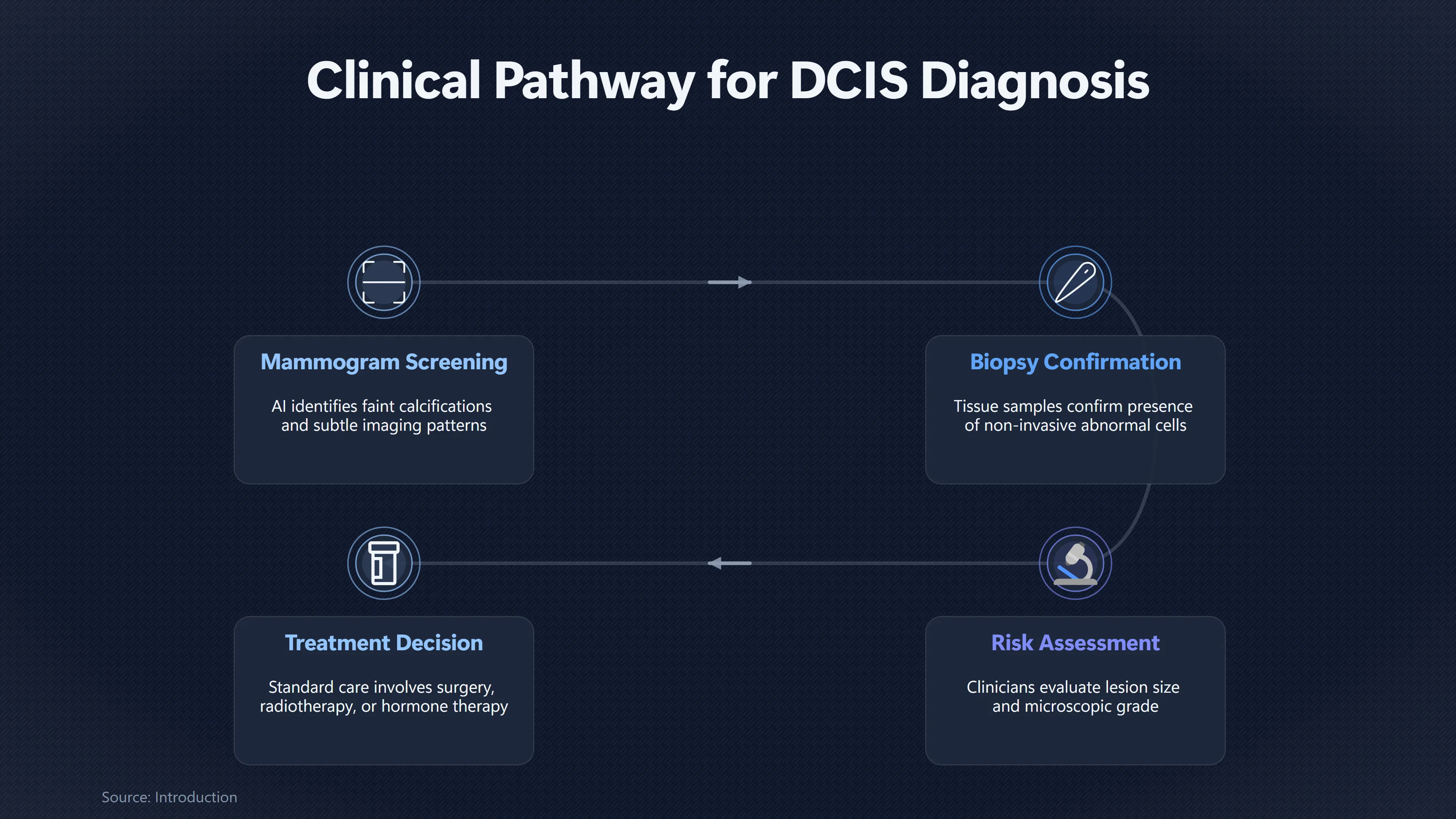
This uncertainty creates a fundamental problem for screening. Once DCIS is identified on a mammogram and confirmed by biopsy, standard care has usually involved treatment rather than observation because clinicians cannot confidently predict which individual patient faces future invasion. As a result, people diagnosed with biologically quiet lesions may receive the same treatments as those whose disease would have progressed.
The distinction between overdiagnosis and overtreatment is important:
- Overdiagnosis means screening found a lesion that would never have caused symptoms or death during the person’s lifetime.
- Overtreatment is the surgery, radiotherapy or drug treatment given because of that diagnosis.
Overdiagnosis is invisible in individual patients. No doctor can say with certainty that a particular person’s DCIS was harmless because treatment prevents knowing what would otherwise have happened. Instead, overdiagnosis can only be estimated across large populations by comparing screened and unscreened groups or through carefully validated disease models.[Cancer.gov]cancer.govScreening Overview (PDQ®Cancer Screening Overview (PDQ®) - NCI…
How AI changes the number of early lesions found
AI systems are designed to detect faint calcifications and subtle imaging patterns associated with early breast abnormalities. That means they may identify DCIS that previous screening methods would have overlooked.
Whether this represents progress depends on which additional lesions are being found.
If AI preferentially detects high-risk DCIS that is likely to become invasive, earlier diagnosis may prevent future cancers. If instead it mainly detects slow-growing lesions that would never have threatened health, the apparent improvement in cancer detection could increase overdiagnosis without improving survival.
This distinction has become one of the most closely watched questions in prospective AI screening trials.
The large Swedish MASAI randomised trial offers reassuring but still incomplete evidence. Investigators reported that AI-supported screening detected more cancers overall while reducing radiologist workload. Importantly, the increase was not driven by a rise in low-grade DCIS, which would have raised greater concerns about overdiagnosis. Roughly half of the additional DCIS detected were high-grade (nuclear grade III), which has a substantially greater likelihood of progressing to invasive disease. The remaining increase consisted mainly of intermediate-grade lesions, where uncertainty remains greater.[DOI]doi.orgScreening performance and characteristics of breast cancer detected in the Mammography Screening with Artificial Intelligence trial (M…
These findings suggest that modern AI systems are not simply uncovering large numbers of obviously harmless abnormalities. Nevertheless, even intermediate-grade DCIS includes lesions that may never become clinically important, so longer follow-up is still required before concluding that every additional diagnosis represents a net health benefit.[DOI]doi.orgScreening performance and characteristics of breast cancer detected in the Mammography Screening with Artificial Intelligence trial (M…
Why individual patients cannot know which cancers were harmless
The greatest challenge is that overdiagnosis cannot usually be recognised at the bedside.
After a biopsy confirms DCIS, clinicians must decide whether to recommend surgery, radiotherapy or hormone therapy using information such as:
- lesion size;
- microscopic grade;
- hormone receptor status;
- imaging appearance;
- patient age and overall health.
These factors help estimate risk but do not provide certainty. Even high-quality pathology cannot reliably identify every lesion that would remain harmless for decades.
Because the alternative—missing an invasive cancer—can have serious consequences, treatment has historically been favoured. This cautious approach protects many patients but inevitably means some undergo procedures they never truly needed.[Cancer.gov]cancer.govWhat Is Ductal Carcinoma in Situ (DCIS)?NCIDecember 2, 2025…
Researchers are attempting to improve this situation through better biological markers, molecular profiling, imaging analysis and AI-based prediction models that estimate which DCIS lesions are most likely to progress. Although these approaches are promising, none has yet become sufficiently accurate to replace current clinical decision-making for most patients.[arXiv]arxiv.orgDeep learning analysis of breast MRIs for prediction of occult invasive disease in ductal carcinoma in situNovember 28, 2017…
What the evidence says about the scale of overdiagnosis
Estimating DCIS overdiagnosis is surprisingly difficult because results depend on how researchers define it and how long patients are followed.
Recent modelling work using a validated simulation of breast screening estimated that approximately one in five DCIS diagnoses in organised biennial screening programmes may represent overdiagnosis from a population perspective. The same study also showed why published estimates vary so widely: changing the definition of overdiagnosis can produce estimates ranging from around 18% to more than 90%, making direct comparisons between studies misleading.[PubMed]pubmed.ncbi.nlm.nih.govOverdiagnosis of ductal carcinoma in situ by grade and definition in population-based screening: A modeling study - PubMed…
This wide range does not mean scientists have no idea what is happening. Rather, it reflects different assumptions about:
- whether later invasive cancers that develop from untreated DCIS should be counted;
- how long women are followed;
- whether estimates are made from an individual’s perspective or across an entire screened population.
The uncertainty itself reinforces why simply counting additional cancers detected by AI is an incomplete measure of success.
Can less treatment reduce the harm?
Recognition of possible overdiagnosis has encouraged interest in active monitoring for carefully selected patients with low-risk DCIS rather than immediate surgery.
Early clinical trial results suggest that, for some women with carefully defined low-risk disease, close surveillance may produce similar short-term outcomes to immediate operation. These studies remain under follow-up, and researchers emphasise that longer-term evidence is needed before practice changes broadly.[reuters.com]reuters.comIn another study, Pfizer's Ibrance significantly extended the time to disease progression in patients with HR- and HER2-positive metastatThe median progression time was increased by 15 months when Ibrance was added to standard treatments. Additionally, a study reported risi…
If future evidence confirms that some forms of DCIS can safely be monitored instead of treated, the balance of benefits and harms from AI-assisted screening could improve. Detecting additional lesions would no longer automatically lead to invasive treatment, reducing the risk that increased sensitivity translates into unnecessary intervention.
Why this matters for AI-enabled healthcare
Within the broader debate about AI and human flourishing, mammography illustrates an important principle: better pattern recognition is valuable only when it improves meaningful outcomes for patients.
AI that finds more high-risk cancers while avoiding unnecessary treatment strengthens the case that advanced intelligence can expand healthy life through earlier and more accurate diagnosis. AI that mainly increases diagnoses of biologically harmless disease would instead create additional physical, psychological and financial burdens.
Current evidence from prospective trials is encouraging because AI-supported mammography appears to increase detection of clinically important cancers without a corresponding surge in low-grade DCIS. Even so, researchers continue to treat overdiagnosis as a central question rather than a solved problem. The long-term value of AI screening will ultimately depend not on how many abnormalities it detects, but on whether those extra diagnoses genuinely prevent illness, reduce deaths and improve patients’ lives.[doi.org]doi.orgScreening performance and characteristics of breast cancer detected in the Mammography Screening with Artificial Intelligence trial (M…
Amazon book picks
Further Reading
Books and field guides related to When Finding More DCIS Causes More Harm. Use these as the next step if you want deeper reading beyond the article.
Overdiagnosed: Making People Sick in the Pursuit of Health
From a nationally recognized expert, an exposé of the worst excesses of our zeal for medical testingGoing against the conventional wisdom...
The Emperor of All Maladies: A Biography of Cancer
A historical assessment of cancer addresses both the courageous battles against the complex disease and the misperceptions and hubris tha...

The Cancer Code: A Revolutionary New Understanding of a Medic...
First published 2020. Subjects: Internal medicine, Diseases.

Ending Medical Reversal: Improving Outcomes, Saving Lives
First published 2015. Subjects: Medical care, Therapeutics, Clinical trials.
eBay marketplace picks
Marketplace Samples
Live-tested eBay searches with available results related to this page.
Selected frombreast cancer pin oneBay.co.uk.



Endnotes
1.
Source: cancer.gov
Title: What Is Ductal Carcinoma in Situ (DCIS)?
Link:https://www.cancer.gov/types/breast/breast-cancer-types/dcis
Source snippet
NCIDecember 2, 2025...
Published: December 2, 2025
2.
Source: cancer.gov
Title: Screening Overview (PDQ®)
Link:https://www.cancer.gov/about-cancer/screening/hp-screening-overview-pdq
Source snippet
Cancer Screening Overview (PDQ®) - NCI...
3.
Source: doi.org
Link:https://doi.org/10.1016/s2589-7500%2824%2900267-x
Source snippet
Screening performance and characteristics of breast cancer detected in the Mammography Screening with Artificial Intelligence trial (M...
4.
Source: arxiv.org
Link:https://arxiv.org/abs/1711.10577
Source snippet
Deep learning analysis of breast MRIs for prediction of occult invasive disease in ductal carcinoma in situNovember 28, 2017...
Published: November 28, 2017
5.
Source: reuters.com
Link:https://www.reuters.com/business/[healthcare
Source snippet
The median progression time was increased by 15 months when Ibrance was added to standard treatments. Additionally, a study reported risi...
6.
Source: cancer.gov
Title: Screening for Breast Cancer
Link:https://www.cancer.gov/types/breast/screening
7.
Source: cancer.gov
Title: Breast Cancer Screening (PDQ®)
Link:https://www.cancer.gov/types/breast/hp/breast-screening-pdq
8.
Source: cancer.gov
Title: Risk of Breast Cancer Death is Low After DCIS Diagnosis
Link:https://www.cancer.gov/news-events/cancer-currents-blog/2015/dcis-low-risk
9.
Source: pmc.ncbi.nlm.nih.gov
Link:https://pmc.ncbi.nlm.nih.gov/articles/PMC12829814/
10.
Source: pubmed.ncbi.nlm.nih.gov
Link:https://pubmed.ncbi.nlm.nih.gov/41082841/
Source snippet
Overdiagnosis of ductal carcinoma in situ by grade and definition in population-based screening: A modeling study - PubMed...
11.
Source: pmc.ncbi.nlm.nih.gov
Link:https://pmc.ncbi.nlm.nih.gov/articles/PMC12547802/
Source snippet
PubMed Central (PMC)Overdiagnosis of ductal carcinoma in situ by grade and definition in population-based screening: A modeling study - PMC...
12.
Source: pmc.ncbi.nlm.nih.gov
Link:https://pmc.ncbi.nlm.nih.gov/articles/PMC10175360/
13.
Source: pmc.ncbi.nlm.nih.gov
Link:https://pmc.ncbi.nlm.nih.gov/articles/PMC8805655/
14.
Source: pmc.ncbi.nlm.nih.gov
Link:https://pmc.ncbi.nlm.nih.gov/articles/PMC8633447/
15.
Source: pmc.ncbi.nlm.nih.gov
Link:https://pmc.ncbi.nlm.nih.gov/articles/PMC4589101/
16.
Source: pubmed.ncbi.nlm.nih.gov
Link:https://pubmed.ncbi.nlm.nih.gov/25948872/
17.
Source: pubmed.ncbi.nlm.nih.gov
Link:https://pubmed.ncbi.nlm.nih.gov/11678555/
18.
Source: ncbi.nlm.nih.gov
Link:https://www.ncbi.nlm.nih.gov/books/NBK22311/
Additional References
19.
Source: time.com
Link:https://time.com/7201610/breast-cancer-dcis-treatment-study/
Source snippet
The study, led by Dr. Shelley Hwang of Duke Cancer Institute, compared outcomes of women who received standard treatment versus those who...
20.
Source: youtube.com
Title: [Early Detection]({{ ‘early-detection/’ | relative_url }}) and Overdiagnosis of Breast Cancer
Link:https://www.youtube.com/watch?v=NH7rPX8qgng
Source snippet
Dr. Christiane Kuhl on the Overdiagnosis of Breast Cancer...
21.
Source: youtube.com
Title: Dr. Christiane Kuhl on the Overdiagnosis of Breast Cancer
Link:https://www.youtube.com/watch?v=EomGoqvl3Q8
Source snippet
DCIS overdiagnosis breast cancer screening Breast Cancer Overdiagnosis KPIX | CBS NEWS BAY AREA...
22.
Source: youtube.com
Title: Breast cancer screening ‘leads to over-diagnosis’
Link:https://www.youtube.com/watch?v=7_zBK2MU-qo
Source snippet
Early Detection and Overdiagnosis of Breast Cancer - MedStar Health Cancer Network...
23.
Source: jamanetwork.com
Link:https://jamanetwork.com/journals/jama/fullarticle/2828218
24.
Source: frontiersin.org
Link:https://www.frontiersin.org/journals/oncology/articles/10.3389/fonc.2026.1870768/full
25.
Source: sciencedirect.com
Link:https://www.sciencedirect.com/science/article/pii/S0960977625006113
26.
Source: dcisunderstood.org
Link:https://dcisunderstood.org/is-dcis-overtreated/
27.
Source: youtube.com
Title: Breast Cancer Overdiagnosis
Link:https://www.youtube.com/watch?v=Kx40-3Br1Ns
Source snippet
Breast cancer screening 'leads to over-diagnosis'...
28.
Source: youtube.com
Title: Overtreatment of Stage 0 Breast Cancer DCIS
Link:https://www.youtube.com/watch?v=0ToUzgdV1xE
Source snippet
Breast Cancer Overdiagnosis...