Within Trusted Access
What Would Make an AI Tutor Trustworthy?
Public certification could test AI tutors for educational quality, source transparency, privacy, accessibility and reliable routes for correcting failures.
On this page
- What certification should test
- Why continuous evaluation is necessary
- Who should audit and enforce the standards
Page outline Jump by section
Introduction
If AI tutors are to become trusted public infrastructure for lifelong learning, they should not simply receive a one-off approval badge. They should meet a continuously monitored certification system that tests educational quality, safety, transparency, privacy, accessibility and accountability throughout their working lives. Unlike a textbook, an AI tutor generates new responses every day, may be updated frequently and can change behaviour as underlying models evolve. A trustworthy certification system therefore needs to evaluate both the organisation running the tutor and the tutor’s real-world performance over time.
This matters well beyond today’s classrooms. If AI is to support broader human flourishing by making high-quality learning available throughout life, people must be able to trust that their tutor helps them learn accurately, protects their interests and can be held accountable when it fails. Certification is not about guaranteeing perfection; it is about creating reliable public confidence through clear standards, independent oversight and continuous improvement rather than marketing claims alone.[unesco.org]unesco.orgguidance generative ai education and researchGuidance for generative AI in education and research | UNESCOSeptember 7, 2023…
What certification should test
A credible certification scheme should examine the complete learning experience rather than only the technical performance of the AI model.
The most important areas include:
- Educational effectiveness. The tutor should demonstrate that it supports genuine learning rather than merely producing answers. Certification should examine whether it encourages reasoning, retrieval practice, reflection and appropriate feedback instead of becoming a shortcut for completing assignments. Educational experts—not only AI engineers—should participate in these evaluations.[oecd.org]oecd.orgopportunities guidelines and guardrails for effective and equitable use of ai in education 2f0862dcOpportunities, guidelines and guardrails for effective and equitable use of AI in education: OECD Digital Education Outlook 2023 | OECDDe…
- Accuracy and source transparency. Users should be able to distinguish established knowledge from uncertainty. The tutor should cite reliable sources where appropriate, indicate confidence levels when evidence is mixed and avoid inventing references. Independent testing should measure factual reliability across different subjects and learner groups.[unesco.org]unesco.orgguidance generative ai education and researchGuidance for generative AI in education and research | UNESCOSeptember 7, 2023…
- Protection of learner data. Educational conversations often reveal sensitive information about ability, interests, disabilities or career ambitions. Certification should verify that personal data are collected only when necessary, securely stored, clearly governed and not quietly repurposed for advertising or unrelated commercial uses without appropriate safeguards.[unesco.org]unesco.orgguidance generative ai education and researchGuidance for generative AI in education and research | UNESCOSeptember 7, 2023…
- Accessibility and inclusion. Trusted tutors should work for learners with disabilities, support multiple languages where possible and avoid systematic bias against particular groups. Testing should include diverse users rather than assuming that one benchmark represents everyone.[unesco.org]unesco.orgguidance generative ai education and researchGuidance for generative AI in education and research | UNESCOSeptember 7, 2023…
- Human oversight. Certification should ensure that users know when to seek a teacher, librarian or other qualified professional. AI tutors should recognise their limits instead of presenting uncertain answers with unwarranted confidence.[unesco.org]unesco.orgguidance generative ai education and researchGuidance for generative AI in education and research | UNESCOSeptember 7, 2023…
- Resilience against misuse. Systems should be evaluated for prompt injection, manipulation, inappropriate content generation and other foreseeable failures. A trustworthy educational assistant should remain dependable even when users deliberately or accidentally push it beyond its intended role.[NIST]nist.govAI Standards | NISTAI Standards | NIST…
Together, these requirements would move certification beyond a narrow software test towards an assessment of whether the tutor genuinely serves learners and the public interest.
Why continuous evaluation is necessary
Traditional educational accreditation often assumes that a textbook or curriculum remains relatively stable for years. AI tutors are different. Their underlying models may be updated weekly or even daily, changing their behaviour without users noticing.
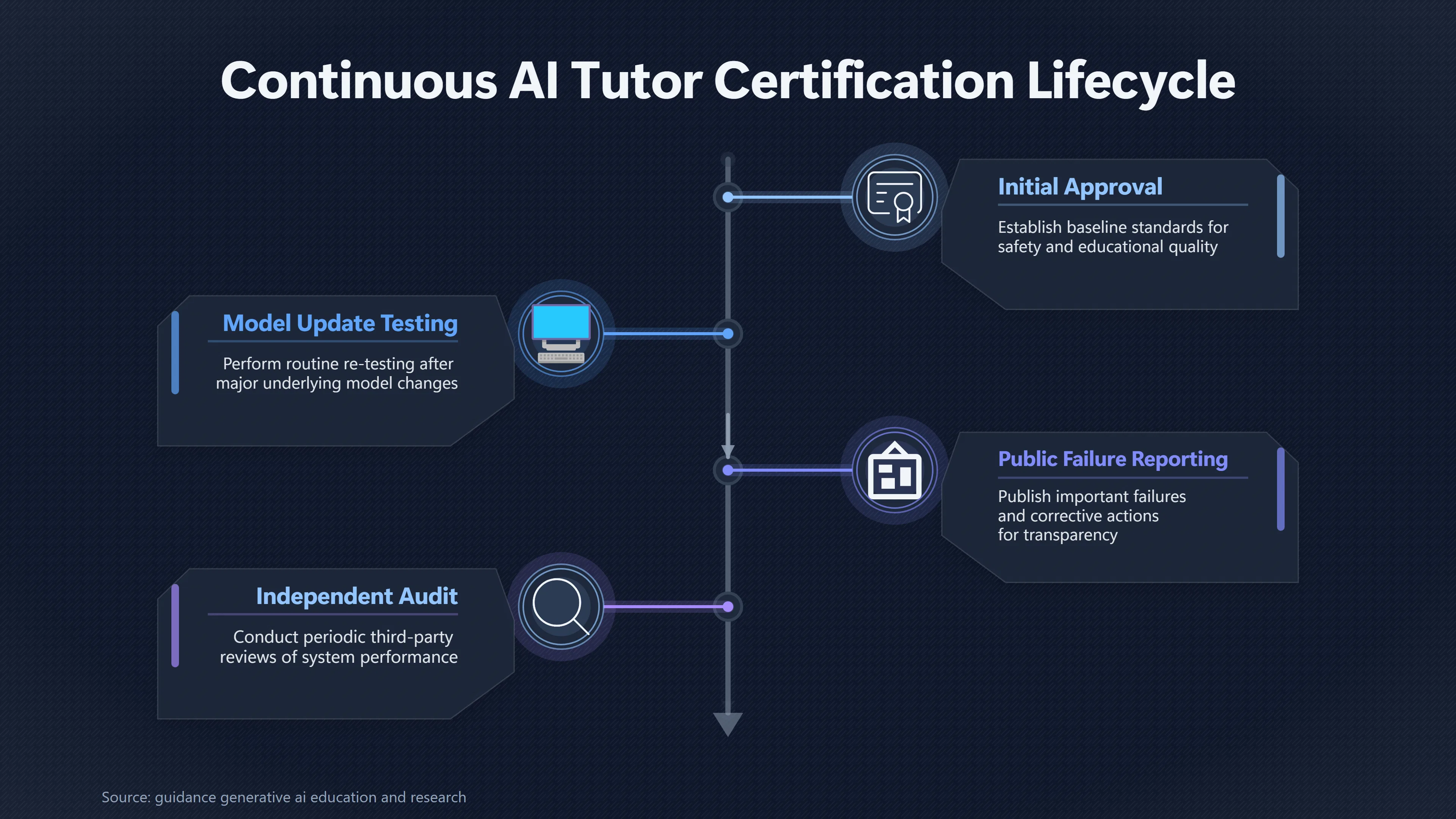
This means certification cannot be a one-time event. Instead, it should resemble aviation safety or pharmaceutical monitoring, combining initial approval with ongoing surveillance.
A continuous system could include:
- routine re-testing after major model updates;
- public reporting of important failures and corrective actions;
- monitoring for changes in accuracy, bias or educational performance;
- mechanisms allowing teachers and learners to report problems;
- periodic independent audits rather than relying solely on company self-assessment.
This lifecycle approach is increasingly reflected in international AI governance frameworks. ISO/IEC 42001, the first international AI management system standard, emphasises continual improvement rather than static compliance. Similarly, the NIST AI Risk Management Framework treats trustworthy AI as an ongoing process of governing, measuring and managing risks instead of a one-off certification exercise.[iso.org]iso.orgISO/IEC 42001:2023 - AI management systemsAugust 23, 1970…
For conversational tutors, continuous evaluation also creates incentives for developers to improve educational quality over time instead of optimising only for product launch.
Who should audit and enforce the standards?
No single organisation is likely to command sufficient public trust on its own.
A stronger model would divide responsibilities among several institutions.
Independent educational experts should assess whether tutoring supports genuine learning rather than superficial task completion.
Technical auditors should evaluate cybersecurity, robustness, privacy protections, testing procedures and model governance.
Accessibility specialists should verify that disabled learners and speakers of different languages are not systematically disadvantaged.
Public regulators should establish minimum legal requirements, particularly where AI tutors are used in schools, universities or publicly funded lifelong learning programmes.
Accredited third-party certification bodies could perform recurring audits in a manner similar to existing certification systems for information security, quality management or medical devices.
This separation reduces conflicts of interest. Developers may perform extensive internal testing, but independent assessment provides greater public confidence that certification reflects genuine performance rather than commercial incentives. UNESCO has similarly argued for regulatory frameworks that protect learners while maintaining human oversight, and recent OECD guidance stresses that accountability for educational decisions must remain clearly assigned to institutions and professionals rather than delegated to AI systems.[unesco.org]unesco.orgguidance generative ai education and researchGuidance for generative AI in education and research | UNESCOSeptember 7, 2023…
Existing standards provide building blocks, not a complete solution
No widely adopted certification exists today that fully certifies an AI tutor’s educational trustworthiness.
However, several international frameworks already provide useful foundations.
ISO/IEC 42001 offers requirements for organisational AI governance, including risk management, documentation and continual improvement. The NIST AI Risk Management Framework provides methods for identifying, measuring and managing trustworthy AI characteristics such as validity, safety, explainability and accountability. UNESCO’s guidance for generative AI in education focuses specifically on educational settings, highlighting learner protection, privacy, transparency and human-centred design. OECD work on AI in education and vocational training similarly emphasises accountability, transparency, inclusiveness and secure data governance.[iso.org]iso.orgISO/IEC 42001:2023 - AI management systemsAugust 23, 1970…
None of these frameworks alone certifies whether an AI tutor is a good teacher. Instead, they suggest that future educational certification should combine governance standards with educational quality assurance and ongoing classroom evidence.
What a public certification mark could mean
A recognisable public certification could eventually function much like food hygiene ratings, energy efficiency labels or accessibility certifications: not a guarantee that every interaction will be flawless, but an easily understood signal that minimum standards have been independently verified.
A certified AI tutor might therefore be expected to publish:
- what subjects and age groups it has been evaluated for;
- how frequently it is re-tested;
- known limitations and confidence boundaries;
- how learner data are handled;
- how users can challenge incorrect or harmful outputs;
- the date of the most recent independent audit.
Making these details public would allow schools, libraries, employers and individual learners to compare systems on more than marketing claims alone.

Why certification matters for lifelong learning
The optimistic vision behind trusted public AI tutors is not simply that everyone will have access to conversational software. It is that reliable educational assistance could become a permanent part of civic infrastructure, helping people learn throughout changing careers, longer lives and rapidly evolving scientific knowledge.
That ambition depends on trust. If learners cannot distinguish between well-governed educational assistants and poorly supervised systems, confidence in AI-supported learning may erode, even where the technology is genuinely beneficial.
Certification therefore serves a broader purpose than consumer protection. It helps create the institutional foundations needed for AI tutors to become dependable public resources that expand access to knowledge while protecting learners’ rights. In the larger vision of AI-enabled human flourishing, trustworthy certification is one of the governance mechanisms that could make abundant, lifelong learning both widely available and worthy of public confidence.
Amazon book picks
Further Reading
Books and field guides related to What Would Make an AI Tutor Trustworthy?. Use these as the next step if you want deeper reading beyond the article.
The Alignment Problem
Finalist for the Los Angeles Times Book Prize A jaw-dropping exploration of everything that goes wrong when we build AI systems and the m...
Human Compatible
A leading artificial intelligence researcher lays out a new approach to AI that will enable people to coexist successfully with increasin...

Weapons of Math Destruction
"A former Wall Street quantitative analyst sounds an alarm on mathematical modeling, a pervasive new force in society that threatens to u...
eBay marketplace picks
Marketplace Samples
Live-tested eBay searches with available results related to this page.
Selected fromrobotics kit oneBay.co.uk.

Endnotes
1.
Source: unesco.org
Title: guidance generative ai education and research
Link:https://www.unesco.org/en/articles/guidance-generative-ai-education-and-research?hub=84636
Source snippet
Guidance for generative AI in education and research | UNESCOSeptember 7, 2023...
Published: September 7, 2023
2.
Source: nist.gov
Title: AI Standards | NIST
Link:https://www.nist.gov/artificial-intelligence/ai-standards
Source snippet
AI Standards | NIST...
3.
Source: oecd.org
Link:https://www.oecd.org/en/publications/2023/12/oecd-digital-education-outlook-2023_c827b81a/full-report/opportunities-guidelines-and-guardrails-for-[effective
Source snippet
Opportunities, guidelines and guardrails for effective and equitable use of AI in education: OECD Digital Education Outlook 2023 | OECDDe...
4.
Source: oecd.org
Link:https://www.oecd.org/en/publications/five-principles-for-the-effective-use-of-ai-in-vocational-education-and-training-[development
Source snippet
June 23, 2026 — FIVE PRINCIPLES FOR THE EFFECTIVE USE OF AI IN VOCATIONAL EDUCATION AND TRAINING DEVELOPMENT Policy brief More info MORE...
Published: June 23, 2026
5.
Source: unesco.org
Title: Recommendation on the Ethics of Artificial Intelligence
Link:https://www.unesco.org/en/legal-affairs/recommendation-ethics-artificial-intelligence?hub=1063
Source snippet
Legal Affairs...
6.
Source: unesco.org
Title: Ethics of Artificial Intelligence
Link:https://www.unesco.org/en/artificial-intelligence/recommendation-ethics?hub=918
Source snippet
AI | UNESCO...
7.
Source: airc.nist.gov
Title: AI Resource Center AI RMF
Link:https://airc.nist.gov/airmf-resources/airmf/
Source snippet
NIST AI Resource CenterAI RMF - AIRC...
8.
Source: iso.org
Link:https://www.iso.org/standard/42001?gad_source=1
Source snippet
ISO/IEC 42001:2023 - AI management systemsAugust 23, 1970...
Published: August 23, 1970
9.
Source: oecd.org
Title: policy considerations 4e3d1028
Link:https://www.oecd.org/en/publications/developing-vocational-education-and-training-with-artificial-intelligence_e9f76b4e-en/full-report/policy-considerations_4e3d1028.html
Source snippet
POLICY CONSIDERATIONS Copy link to 5. Policy considerations ABSTRACT There are barriers and risks associated with the use of artificial i...
10.
Source: oecd.org
Link:https://www.oecd.org/en/publications/2026/02/oecd-due-diligence-guidance-for-responsible-ai_7831bb49/full-report/component-4.html
11.
Source: iso.org
Link:https://www.iso.org/cms/%20render/live/en/sites/isoorg/contents/data/standard/08/12/81230.html?browse=tc
12.
Source: iso.org
Link:https://www.iso.org/cms/%20render/live/en/sites/isoorg/contents/data/standard/08/12/81230.html
Additional References
13.
Source: youtube.com
Title: Ethical AI in Education: Building Transparent Frameworks for the Future
Link:https://www.youtube.com/watch?v=aCcsjR1b87M
Source snippet
AI for Learning Outcomes: Equity, Safety, and System Transformation...
14.
Source: youtube.com
Title: AI for Learning Outcomes: Equity, Safety, and System Transformation
Link:https://www.youtube.com/watch?v=bhGgSYjMpjc
Source snippet
Evaluating AI: What's New and Why the Development Sector Should Care...
15.
Source: youtube.com
Title: Building an AI Tutor with Google Deep Mind
Link:https://www.youtube.com/watch?v=H3ycjuBCJQY
Source snippet
Ethical AI in Education: Building Transparent Frameworks for the Future...
16.
Source: youtube.com
Title: Why AI Matters in Education: UNESCO AI Competency Framework
Link:https://www.youtube.com/watch?v=IygbQoXOepM
Source snippet
Building an AI Tutor with Google DeepMind...
17.
Source: youtube.com
Title: Evaluating AI: What’s New and Why the Development Sector Should Care
Link:https://www.youtube.com/watch?v=1PM2-WgAGBA