Within Tutor vs Chatbot
Can an AI Tutor Understand Why You Are Wrong?
Effective AI tutors respond to the reason behind an error, adjusting hints and difficulty instead of merely supplying the correct answer.
On this page
- From wrong answers to underlying misconceptions
- How hints and difficulty can adapt
- Where learner models can still fail
Page outline Jump by section
Introduction
The difference between an AI tutor and a conversational chatbot is often most obvious when a learner makes a mistake. A general chatbot may simply explain the correct answer or generate another explanation. A purpose-built AI tutor instead tries to answer a more important question: why did the learner make that mistake?
That distinction lies at the heart of personalised education. The most effective AI tutors attempt to identify underlying misconceptions, estimate which concepts the learner has already mastered, and choose feedback that is challenging enough to promote learning without becoming discouraging. Rather than treating every wrong answer as identical, they use models of student understanding to decide whether to offer a hint, ask another question, simplify the task or move on. This ability to diagnose and adapt is one of the main reasons educational researchers continue to distinguish specialised tutoring systems from general conversational AI.[nature.com]nature.comces | Topics | Nature Index…
From wrong answers to underlying misconceptions
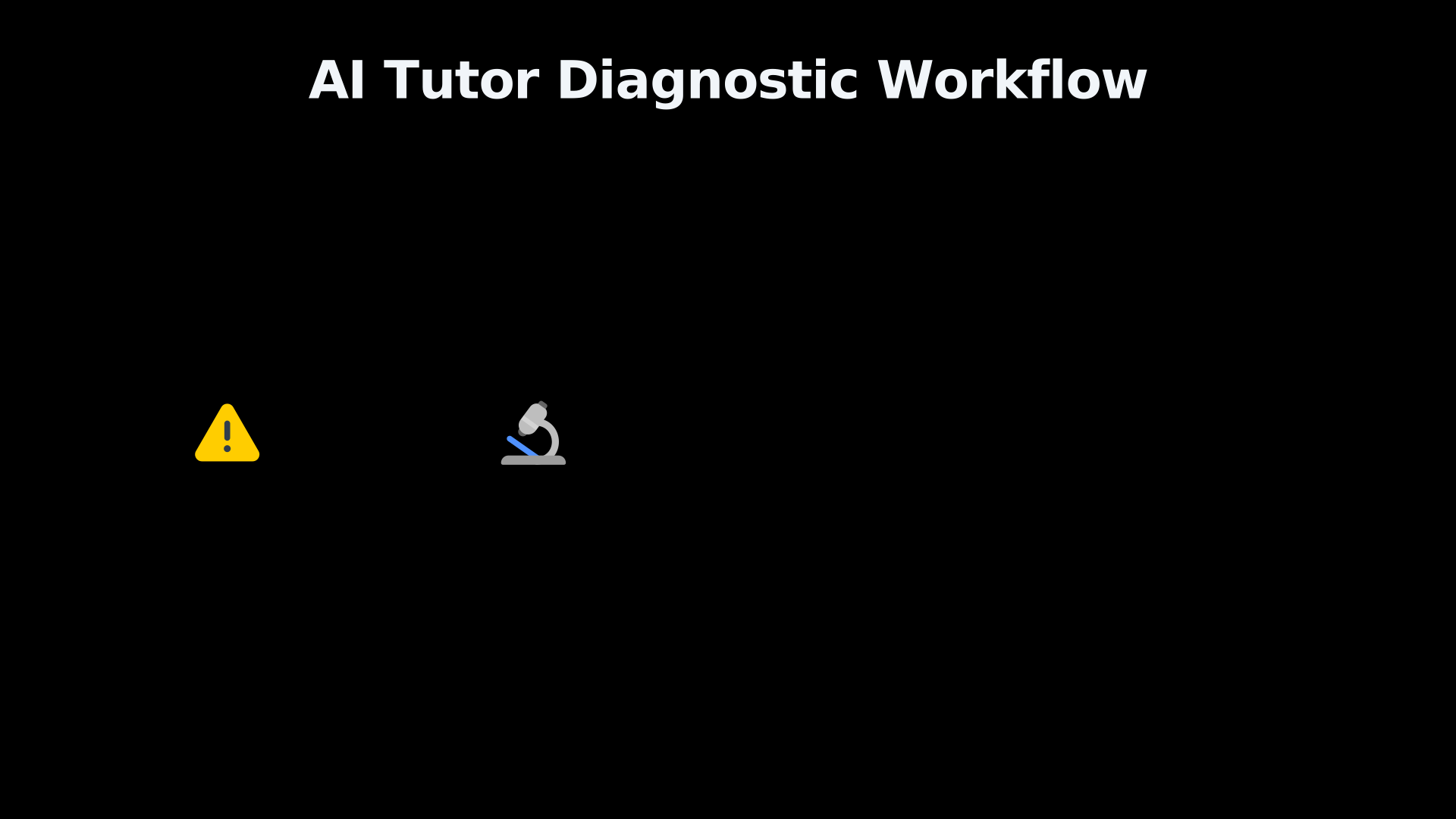
A wrong answer is only the visible symptom of a learning problem. Two students may produce exactly the same incorrect response for completely different reasons.
For example, in algebra, one student may misunderstand the distributive law, while another simply makes an arithmetic slip. In physics, one learner may apply the wrong formula, whereas another understands the formula but misinterprets the question. Giving both students identical feedback wastes an opportunity to teach effectively.
Purpose-built AI tutors therefore try to infer the learner’s hidden understanding rather than merely marking answers right or wrong. Educational researchers refer to this process as student modelling or knowledge tracing. The tutor continuously updates an estimate of which skills have probably been mastered and which remain uncertain as each interaction unfolds.[nature.com]nature.comces | Topics | Nature Index…
Earlier intelligent tutoring systems relied on carefully designed cognitive models that represented common solution paths and frequent misconceptions. Modern systems increasingly combine those ideas with large language models that can interpret free-text explanations, code, mathematical reasoning or natural-language dialogue. Even so, many researchers still argue that explicit learner models remain valuable because they make diagnoses more transparent and easier to evaluate than relying solely on an AI model’s conversational judgement.[sciencedirect.com]sciencedirect.comScienceDirect Cognitive TutorCognitive Tutor - an overview | ScienceDirect Topics…
Looking beyond correctness
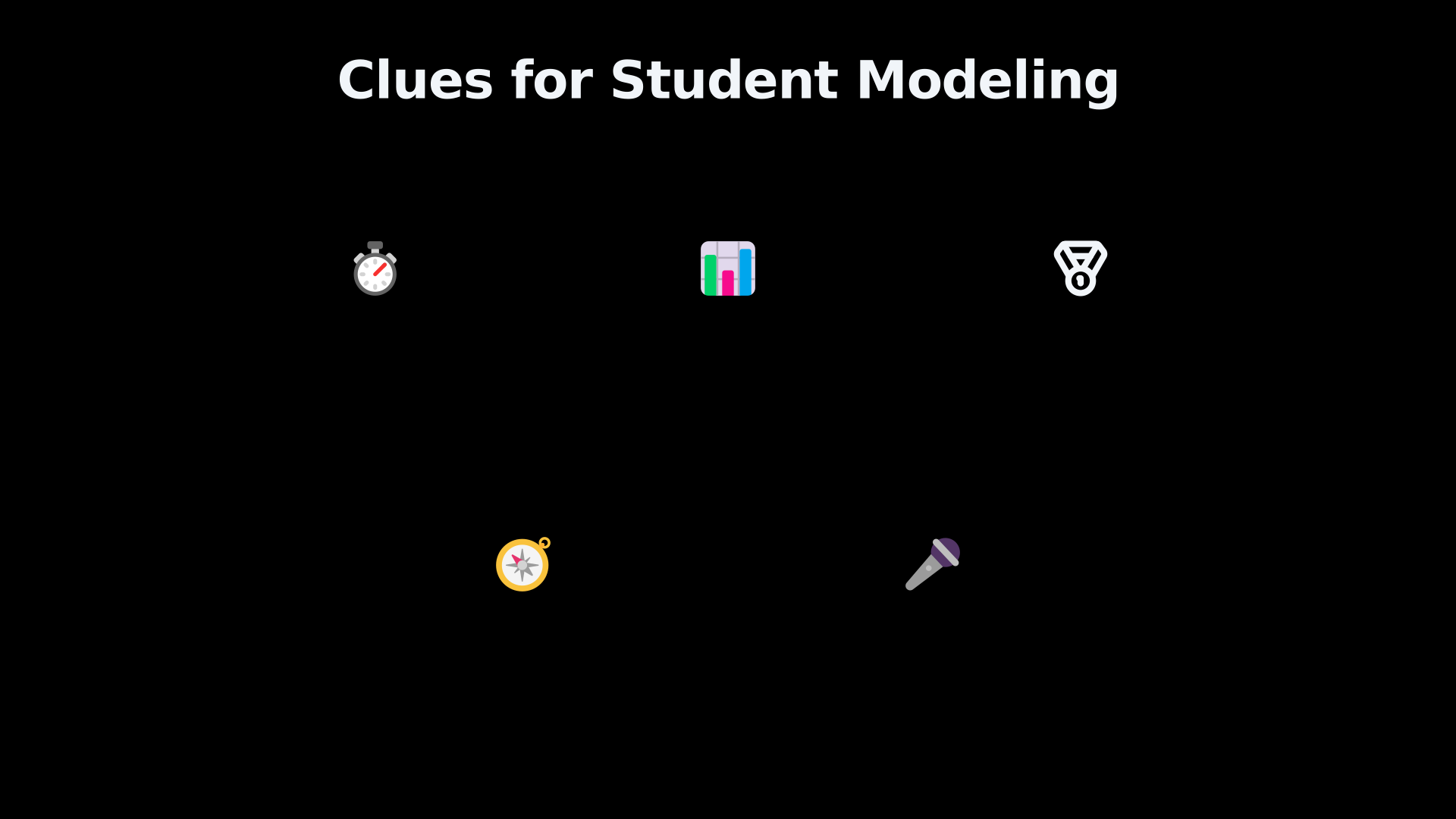
An effective tutor may use several clues before deciding what the learner needs next, including:
- which concept the question was testing;
- patterns across previous mistakes;
- how long the learner took to answer;
- whether confidence or explanations match performance;
- whether errors are becoming more or less consistent over time.
A single wrong answer rarely determines the diagnosis. Instead, the tutor gradually builds evidence about the learner’s understanding across many interactions.[nature.com]nature.comces | Topics | Nature Index…
How hints and difficulty can adapt
Once a tutor has an estimate of the learner’s understanding, it can change its behaviour instead of delivering the same response every time.
A common strategy is graduated scaffolding. Rather than immediately revealing the solution, the tutor offers progressively stronger assistance. The first hint may simply remind the learner of the relevant concept. A second hint may point to the next step. Only after several attempts might the tutor demonstrate the full solution. This preserves what educational psychologists call productive struggle: enough challenge to encourage thinking without leaving the learner completely stuck.[nature.com]nature.comOpen source on nature.com.
Difficulty can also adapt dynamically. If the learner repeatedly succeeds, the tutor introduces more complex problems or combines multiple skills. If repeated misconceptions appear, it may temporarily return to simpler examples or prerequisite concepts before attempting the original task again.
Modern language-model tutors can make these adaptations conversationally. Instead of following fixed decision trees, they can generate new examples, vary explanations, ask diagnostic questions or change analogies to suit an individual learner. However, many educational systems still constrain these responses within carefully designed instructional frameworks to reduce the risk of inconsistent teaching.[nature.com]nature.comOpen source on nature.com.
Why diagnosis matters more than explanation
Research increasingly suggests that effective tutoring depends less on producing impressive explanations than on choosing the right explanation for the learner’s current state.
The 2025 Harvard randomised controlled trial that compared a purpose-built AI tutor with active-learning physics classes illustrates this point. The system was not simply instructed to answer questions well. It was deliberately engineered to guide students through problems sequentially, manage cognitive load, encourage reasoning before revealing answers and keep learners actively engaged with each step. Those design choices reflected decades of educational research rather than conversational ability alone. Students achieved significantly higher learning gains while spending less time on the material, but the study’s central lesson is that instructional design mattered as much as the underlying language model.[nature.com]nature.comOpen source on nature.com.
In other words, diagnosing the learner’s needs is often more valuable than generating the most eloquent explanation.
Where learner models can still fail
Despite impressive progress, AI tutors remain imperfect diagnosticians.
One difficulty is that many systems observe only external behaviour. They can see answers, response times and dialogue, but they cannot directly observe what the learner is thinking. Different misconceptions may produce identical answers, making accurate diagnosis difficult.
Another challenge is overconfidence. Large language models sometimes infer a detailed misconception from limited evidence when several explanations remain plausible. If the diagnosis is wrong, the tutor may provide irrelevant hints or steer the learner away from the real problem.
Knowledge-tracing models also simplify learning into probabilities rather than capturing the full richness of human understanding. Motivation, anxiety, fatigue, guessing and distraction can all influence performance without reflecting genuine mastery. Researchers continue to investigate ways to combine behavioural data, dialogue and interpretable learner models to improve reliability while keeping the reasoning behind diagnoses understandable to teachers.[nature.com]nature.comces | Topics | Nature Index…
Recent research is also exploring systems that explicitly classify common misconceptions from student dialogue before selecting targeted scaffolding, rather than relying solely on generic conversational responses. These approaches aim to make the tutor’s diagnosis more faithful to the specific misunderstanding the learner actually holds.[arXiv]arxiv.orgFrom Explanation to Diagnosis: Next Generation Interactive Video Coach with Misstep AwarenessJune 2, 2026…
Why adaptive diagnosis matters for AI-enabled human flourishing
Within the broader vision of AI expanding educational opportunity, diagnosing mistakes is more important than simply answering questions correctly.
If future AI tutors can reliably identify misconceptions, personalise practice and maintain appropriate levels of challenge, they could help deliver many of the benefits traditionally associated with one-to-one human tutoring at far lower cost and much greater scale. That possibility is significant because personalised tutoring has consistently produced strong educational gains but has historically been too expensive for most learners.
Whether that potential contributes to wider human flourishing depends on more than technical capability. Learner models must be accurate, transparent and fair across different populations. Teachers need visibility into the tutor’s reasoning rather than treating it as a black box. Access must also be broad enough that adaptive tutoring reduces educational inequality instead of reinforcing it.
The mechanism itself, however, is increasingly clear. The educational value of an AI tutor comes not from always knowing the right answer, but from becoming progressively better at understanding why each learner reaches the wrong one, and choosing the next step that helps them learn rather than merely correcting them.[nature.com]nature.comces | Topics | Nature Index…
Amazon book picks
Further Reading
Books and field guides related to Can an AI Tutor Understand Why You Are Wrong?. Use these as the next step if you want deeper reading beyond the article.
How People Learn II: Learners, Contexts, and Cultures
There are many reasons to be curious about the way people learn, and the past several decades have seen an explosion of research that has...
Make It Stick: The Science of Successful Learning
To most of us, learning something "the hard way" implies wasted time and effort. Good teaching, we believe, should be creatively tailored...
Visible Learning
The world’s most powerful research on the practices that improve learning in schools John Hattie’s groundbreaking book is the result of 1...
The Cambridge Handbook of the Learning Sciences
Learning sciences is an interdisciplinary field that studies teaching and learning. The sciences of learning include cognitive science, e...
eBay marketplace picks
Marketplace Samples
Live-tested eBay searches with available results related to this page.
Selected fromrobotics kit oneBay.co.uk.


Endnotes
1.
Source: nature.com
Link:https://www.nature.com/nature-index/topics/l4/knowledge-tracing-in-intelligent-tutoring-systems
Source snippet
ces | Topics | Nature Index...
2.
Source: nature.com
Link:https://www.nature.com/articles/s41598-025-97652-6
3.
Source: doi.org
Link:https://doi.org/10.1109/TLT.2023.3259013
Source snippet
Improving Knowledge Tracing via Considering Two Types of Actual Differences From Exercises and Prior Knowledge...
4.
Source: sciencedirect.com
Title: ScienceDirect Cognitive Tutor
Link:https://www.sciencedirect.com/topics/computer-science/cognitive-tutor
Source snippet
Cognitive Tutor - an overview | ScienceDirect Topics...
5.
Source: arxiv.org
Link:https://arxiv.org/abs/2412.09248
6.
Source: arxiv.org
Link:https://arxiv.org/abs/2606.02970
Source snippet
From Explanation to Diagnosis: Next Generation Interactive Video Coach with Misstep AwarenessJune 2, 2026...
Published: June 2, 2026
7.
Source: arxiv.org
Link:https://arxiv.org/abs/2602.02414
8.
Source: sciencedirect.com
Link:https://www.sciencedirect.com/science/article/pii/S0747563225002754
9.
Source: gse.harvard.edu
Title: fighting misinformation artificial intelligence and maybe cash
Link:https://www.gse.harvard.edu/ideas/news/25/10/fighting-misinformation-artificial-intelligence-and-maybe-cash
10.
Source: news.harvard.edu
Title: what if ai could help students learn not just do assignments for them
Link:https://news.harvard.edu/gazette/story/2025/10/what-if-ai-could-help-students-learn-not-just-do-assignments-for-them/
11.
Source: hks.harvard.edu
Title: learning not cheating ai assistance can enhance rather hinder skill [development]({{ ‘build-rights/’ | relative_url }})
Link:https://www.hks.harvard.edu/publications/learning-not-cheating-ai-assistance-can-enhance-rather-hinder-skill-development
12.
Source: doi.org
Title: Knowledge Tracing: A Survey | ACM Computing Surveys
Link:https://doi.org/10.1145/3569576
13.
Source: hks.harvard.edu
Title: coach not crutch ai assistance can enhance rather hinder skill development
Link:https://www.hks.harvard.edu/publications/coach-not-crutch-ai-assistance-can-enhance-rather-hinder-skill-development
14.
Source: ui.adsabs.harvard.edu
Link:https://ui.adsabs.harvard.edu/abs/2025NatSR..1517458K/abstract
15.
Source: serl.fas.harvard.edu
Link:https://serl.fas.harvard.edu/research
16.
Source: sciencedirect.com
Title: A self-attentive model for tracing knowledge and engagement in parallel
Link:https://www.sciencedirect.com/science/article/abs/pii/S0167865522003464
17.
Source: ischool.berkeley.edu
Link:https://www.ischool.berkeley.edu/research/publications/2010/modeling-individualization-bayesian-networks-implementation-knowledge
Additional References
18.
Source: onlinelibrary.wiley.com
Title: Yet existing models struggle to integrate the multidimensional and heteroge
Link:https://onlinelibrary.wiley.com/doi/10.1155/int/3037960
Source snippet
wiley.comGCKT: Context‐Aware Gating of Heterogeneous Learning Features With Transformer for Cognitive Knowledge Tracing in Intelligent Tu...
19.
Source: youtube.com
Title: What Are Intelligent Tutoring Systems In Classroom AI?
Link:https://www.youtube.com/watch?v=syPEVO34MMA
Source snippet
AI for Personalised Learning & Student Support...
20.
Source: alphaxiv.org
Link:https://www.alphaxiv.org/abs/2505.21517v1
21.
Source: alphaxiv.org
Link:https://www.alphaxiv.org/abs/2602.00070
22.
Source: youtube.com
Title: AI for Personalised Learning & Student Support
Link:https://www.youtube.com/watch?v=1AuDilDXSKQ
Source snippet
OATutor: An Open-source Adaptive Tutoring System...
23.
Source: youtube.com
Title: OATutor: An Open-source Adaptive Tutoring System
Link:https://www.youtube.com/watch?v=dx5P-oiSNIs
Source snippet
Multi-Agent AI Study Coach | Kaggle Capstone...
24.
Source: youtube.com
Title: What Is An Intelligent Tutoring System?
Link:https://www.youtube.com/watch?v=BU2qoJn5Aiw
Source snippet
What Are Intelligent Tutoring Systems In Classroom AI?...
25.
Source: scale.stanford.edu
Link:https://scale.stanford.edu/ai/repository/[ai-tutoring
26.
Source: researchgate.net
Title: 377750156 Twenty five years of Bayesian knowledge tracing a systematic review
Link:https://www.researchgate.net/publication/377750156_Twenty-five_years_of_Bayesian_knowledge_tracing_a_systematic_review
27.
Source: aclanthology.org
Title: Toward In-Context Teaching: Adapting Examples to Students’ Misconceptions
Link:https://aclanthology.org/2024.acl-long.718/