Within A Lab
How A Lab Turned Failure Into Better Experiments
A-Lab's key advance was using failed syntheses to revise recipes instead of merely repeating automated instructions.
On this page
- How the closed experimental loop worked
- What active learning changed after failure
- Why adaptive experimentation matters for discovery
Page outline Jump by section
Introduction
One of Berkeley’s A-Lab’s most important innovations was not that it automated laboratory work, but that it treated unsuccessful experiments as useful information rather than wasted effort. In conventional materials research, a failed synthesis often leads to a scientist manually reviewing the results, revising the recipe and deciding what to try next. A-Lab embedded that reasoning into a closed experimental loop: every unsuccessful attempt became data that the system used to design a better follow-up experiment.[nature.com]nature.comNovember 29, 2023…

Within the wider story of autonomous scientific discovery, this matters because it demonstrates a shift from automation to adaptation. The laboratory did not simply execute a fixed sequence of robotic instructions. It interpreted experimental outcomes, identified when a target material had not formed in sufficient quantity, and altered subsequent experiments accordingly. That ability to learn from failure is one of the key mechanisms that could eventually allow AI-assisted laboratories to accelerate scientific discovery, while also revealing where today’s systems still reach their limits.[nature.com]nature.comNovember 29, 2023…
How the Closed Experimental Loop Worked
A-Lab connected several stages that are often separated in traditional research.
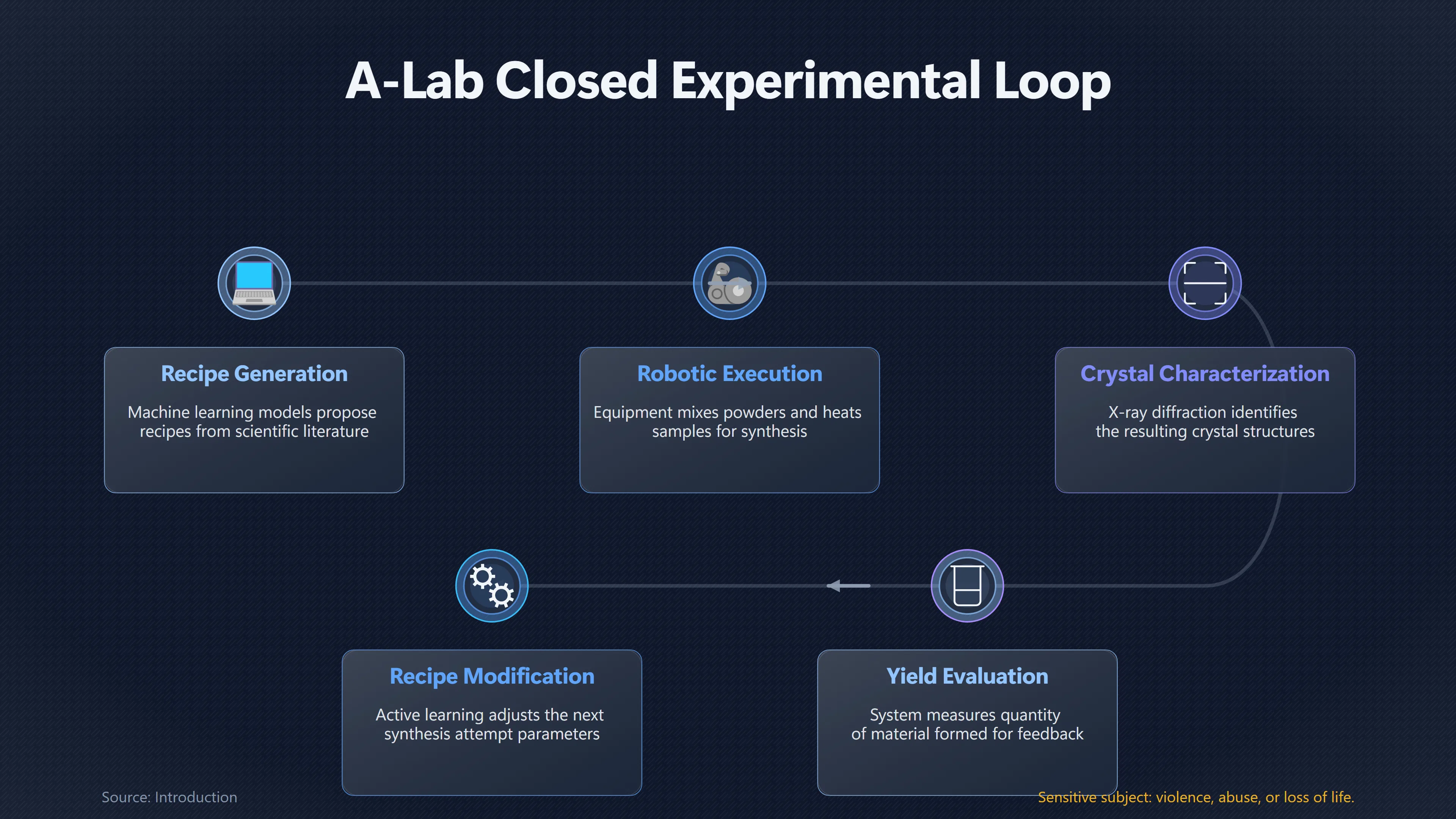
It began with candidate materials predicted to be stable through computational methods. Machine-learning models, trained on synthesis procedures extracted from the scientific literature, proposed several plausible experimental recipes for producing each material. Robotic equipment then measured precursor chemicals, mixed powders, heated samples and characterised the products using X-ray diffraction (XRD), a technique that identifies crystal structures from diffraction patterns.[nature.com]nature.comNovember 29, 2023…
The crucial difference came after characterisation.
Instead of merely recording whether an experiment succeeded, the system evaluated how much of the intended material had actually formed. If the target was not produced in sufficient yield, the experiment was not treated as a dead end. Its outcome became the starting point for selecting the next experiment.
In effect, the laboratory repeatedly cycled through four steps:
- Generate a synthesis recipe from previous scientific knowledge.
- Perform the experiment robotically.
- Analyse the resulting crystal structure automatically.
- Modify the next synthesis recipe using what had just been observed.
This continual feedback transformed laboratory automation into an adaptive research process.[nature.com]nature.comNovember 29, 2023…
What Active Learning Changed After Failure
The adaptive element of A-Lab relied on active learning, a branch of machine learning in which an algorithm deliberately chooses the next experiment expected to provide the most useful information.
Rather than retrying the same recipe, A-Lab switched to an optimisation method known as Autonomous Reaction Route Optimisation with Solid-State Synthesis (ARROWS). This algorithm combined thermodynamic calculations with the experimental evidence collected so far to search for alternative reaction pathways that offered a stronger driving force towards the desired material.[nature.com]nature.comNovember 29, 2023…
Importantly, the system did not ignore earlier scientific knowledge. Its first attempts were guided by synthesis recipes learned from published literature, much as an experienced chemist begins by adapting methods that have worked for chemically similar compounds. Only after these literature-inspired recipes proved insufficient did the active-learning algorithm begin proposing increasingly refined alternatives.[nature.com]nature.comNovember 29, 2023…
This produced a layered decision-making process:
- Historical knowledge suggested sensible starting points.
- Experimental evidence showed whether those ideas actually worked.
- Active learning generated increasingly informed follow-up experiments.
The result was a laboratory that could improve its own search strategy without requiring a researcher to redesign every experiment manually.
Failure Revealed More Than Success
One of the most scientifically valuable outcomes was that the unsuccessful experiments exposed systematic barriers to synthesis rather than merely lowering the headline success rate.
Among the targets that A-Lab could not produce, researchers identified several recurring failure modes:
- slow reaction kinetics, where reactions progressed too slowly under the laboratory’s standard conditions;
- precursor volatility, where important ingredients evaporated during heating;
- product amorphisation, in which materials failed to crystallise into the desired structure;
- limitations in computational predictions, where theoretical calculations suggested stability that proved difficult to realise experimentally.[nature.com]nature.comNovember 29, 2023…
This distinction matters because the failures often reflected genuine physical constraints rather than algorithmic mistakes.
For example, many unsuccessful compounds appeared to require higher temperatures, longer heating periods or intermediate regrinding of powders—standard laboratory techniques that lay outside A-Lab’s automated decision space. When researchers manually applied some of these additional processing steps, several previously unsuccessful targets were successfully synthesised, indicating that the limitation lay in the available experimental actions rather than in the overall concept of adaptive learning.[nature.com]nature.comNovember 29, 2023…
In this sense, failure became a diagnostic tool. Instead of simply recording “did not work”, the system helped identify exactly which parts of the experimental workflow required future improvement.
Why Adaptive Experimentation Matters for Discovery
Scientific discovery rarely follows a straight path. Researchers routinely learn more from an unexpected outcome than from a perfectly predicted one. A-Lab’s contribution was to encode part of that process into software.
The laboratory demonstrated that an AI-guided system could revise experimental plans on the basis of evidence generated only hours earlier, allowing dozens or hundreds of experiments to build on one another without waiting for human redesign between every iteration. Over approximately 17 days of continuous operation, this closed-loop approach enabled hundreds of synthesis experiments while continually refining future attempts.[nature.com]nature.comNovember 29, 2023…
For the broader idea of AI-enabled scientific acceleration, the lesson is not that machines have replaced scientific judgement. Rather, they can compress the repetitive cycle of hypothesis, experiment, analysis and revision that often dominates experimental research.
If future autonomous laboratories expand the range of experimental actions they can perform, incorporate richer physical models and learn across many laboratories simultaneously, they could shorten one of the major bottlenecks between computational prediction and experimental validation. That prospect is relevant to the wider discussion of AI and long-term human flourishing because many advances in energy, batteries, catalysts, electronics and other foundational technologies depend not only on generating ideas but on rapidly discovering which ideas survive contact with physical reality.[nature.com]nature.comNovember 29, 2023…
What A-Lab Still Does Not Prove
It would be a mistake to interpret A-Lab as evidence that autonomous laboratories can independently conduct all scientific research.
The system operated within carefully defined boundaries. Human researchers selected target materials, constrained the available precursor chemicals, designed the overall workflow and interpreted the broader scientific significance of the results. Its active learning improved synthesis recipes within that framework rather than inventing entirely new research programmes.[nature.com]nature.comNovember 29, 2023…
The study also showed that adaptive learning cannot overcome every obstacle. Some failures arose because the underlying physical models were incomplete, while others required experimental capabilities—such as more aggressive processing steps or different precursor choices—that the robotic platform could not yet perform autonomously. These limitations are as informative as the successes because they indicate where future generations of autonomous laboratories will need broader experimental flexibility, better physical modelling and closer integration with human scientific expertise.[nature.com]nature.comNovember 29, 2023…
Amazon book picks
Further Reading
Books and field guides related to How A Lab Turned Failure Into Better Experiments. Use these as the next step if you want deeper reading beyond the article.
Algorithms to Live By
A fascinating exploration of how computer algorithms can be applied to our everyday lives. In this dazzlingly interdisciplinary work, acc...
Reinforcement Learning
Richard Sutton and Andrew Barto provide a clear and simple account of the key ideas and algorithms of reinforcement learning. Their discu...
Deep Learning
Rating: 3.5/5 from 6 Google Books ratings
An introduction to a broad range of topics in deep learning, covering mathematical and conceptual background, deep learning techniques us...
Reinventing Discovery
A pioneer of quantum computing describes how the Internet and powerful new online tools are democratising and accelerating scientific dis...
eBay marketplace picks
Marketplace Samples
Live-tested eBay searches with available results related to this page.
Selected fromrobotics kit oneBay.co.uk.
Endnotes
1.
Source: nature.com
Link:https://www.nature.com/articles/s41586-023-06734-w
Source snippet
November 29, 2023...
Published: November 29, 2023
2.
Source: nature.com
Title: Robot chemist sparks row with claim it created new materials | Nature
Link:https://www.nature.com/articles/d41586-023-03956-w
Source snippet
December 12, 2023 — * NEWS * 12 December 2023 * Update 09 January 2024 ROBOT CHEMIST SPARKS ROW WITH CLAIM IT CREATED NEW MATERIALS Resea...
Published: December 12, 2023
3.
Source: ceder.berkeley.edu
Title: a lab paper published in nature featured in news story
Link:https://ceder.berkeley.edu/news/a-lab-paper-published-in-nature-featured-in-news-story/
4.
Source: nature.com
Title: Autonomous experiments using active learning and AI | Nature Reviews Materials
Link:https://www.nature.com/articles/s41578-023-00588-4
5.
Source: ceder.berkeley.edu
Title: autonomous experimentation for accelerated materials discovery
Link:https://ceder.berkeley.edu/research-areas/autonomous-experimentation-for-accelerated-materials-discovery/
6.
Source: pubs.acs.org
Link:https://pubs.acs.org/doi/10.1021/acsphyschemau.4c00009
Source snippet
American Chemical Society PublicationsA Vision for the Future of Materials Innovation and How to Fast-Track It with Services | ACS Physic...
Additional References
7.
Source: osti.gov
Link:https://www.osti.gov/biblio/2281696
Source snippet
An autonomous laboratory for the accelerated synthesis of novel materials (Journal Article) | OSTI.GOV...
8.
Source: pmc.ncbi.nlm.nih.gov
Link:https://pmc.ncbi.nlm.nih.gov/articles/PMC10700133/
Source snippet
PubMed Central (PMC)An autonomous laboratory for the accelerated synthesis of inorganic materials - PMC...
9.
Source: sciencedirect.com
Link:https://www.sciencedirect.com/org/science/article/pii/S2635098X26001361
Source snippet
The most explicit realization of tightly constrained, validation-centered discovery workflo...
10.
Source: wired.com
Title: Google Deep Mind’s AI Dreamed Up 380,000 New Materials
Link:https://www.wired.com/story/an-ai-dreamed-up-380000-new-materials-the-next-challenge-is-making-them
Source snippet
The Next Challenge Is Making ThemGoogle DeepMind developed an AI program, GNoME, which has predicted 380,000 new stable materials, expand...
11.
Source: youtube.com
Link:https://www.youtube.com/watch?v=7WqOY82KTd4
Source snippet
How [Autonomous Labs]({{ 'autonomous-labs/' | relative_url }}) Will Transform Scientific Research: Ginkgo Bioworks' Jason Kelly...
12.
Source: youtube.com
Title: Autonomous Laboratory for Inorganic Materials Synthesis and Discovery
Link:https://www.youtube.com/watch?v=Z_cBhe5v0Ss
Source snippet
The AI That Discovered 380,000 New Materials | DeepMind GNoME...
13.
Source: youtube.com
Title: Alab OS: Automating Materials Discovery
Link:https://www.youtube.com/watch?v=Xm5cElpRUIs
Source snippet
Autonomous Laboratory for Inorganic Materials Synthesis and Discovery...
14.
Source: escholarship.org
Link:https://escholarship.org/uc/item/4w49b5cb
15.
Source: researchgate.net
Link:https://www.researchgate.net/publication/388723617_Balancing_autonomy_and_expertise_in_autonomous_synthesis_laboratories
16.
Source: researchgate.net
Link:https://www.researchgate.net/publication/376043973_An_autonomous_laboratory_for_the_accelerated_synthesis_of_inorganic_materials