Within Space Expansion
Can moon dust become future homes?
Using lunar resources for construction could reduce dependence on Earth and make long-term settlements more practical.
On this page
- Using lunar materials for infrastructure
- AI support for difficult construction tasks
- The engineering limits of off world building
Page outline Jump by section
Introduction
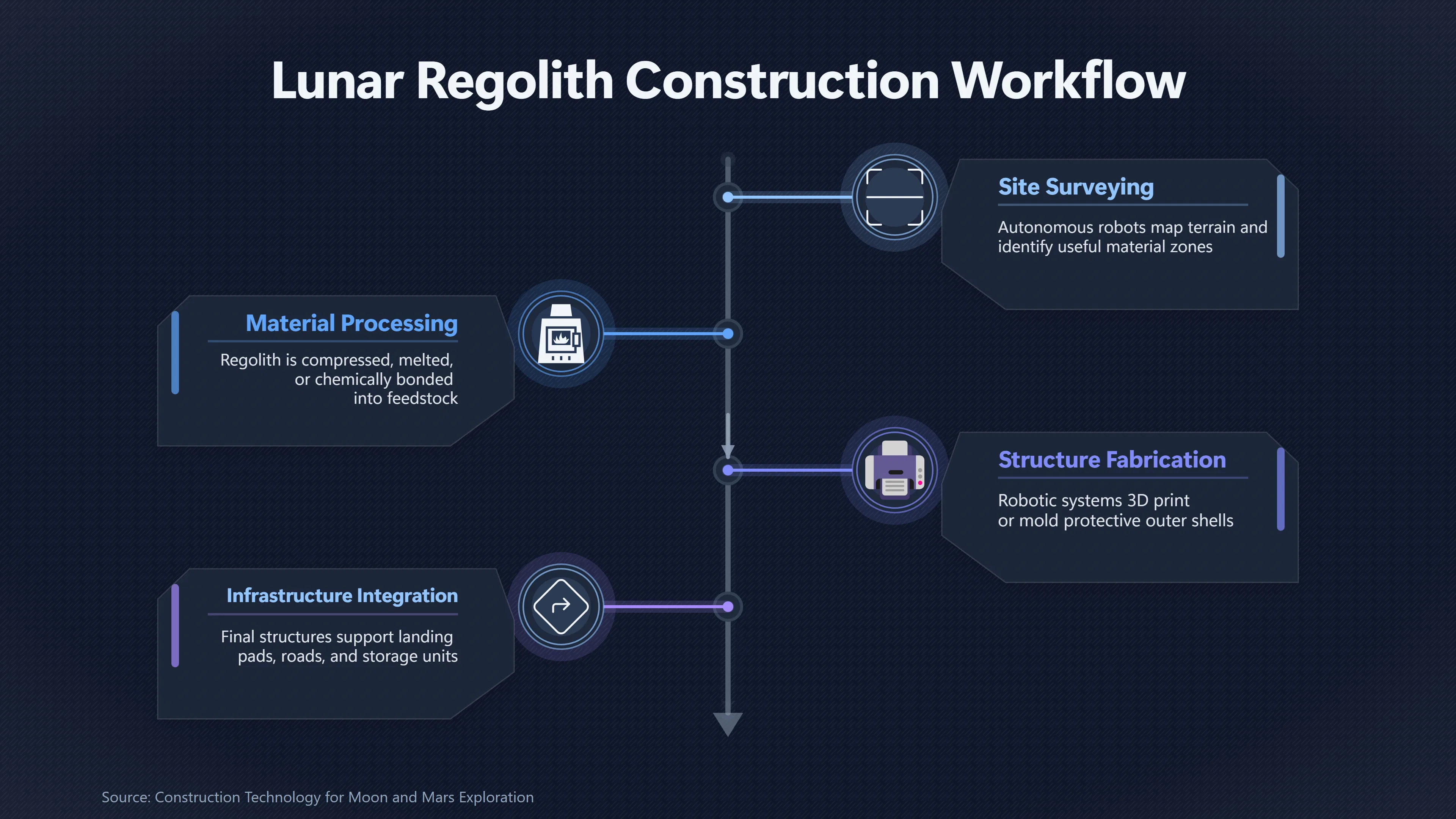
Can moon dust become future homes? Potentially, yes — not by turning loose dust into ready-made houses overnight, but by using lunar soil as the raw material for robotic construction systems that create shelters, landing pads, roads and protective infrastructure. The reason this matters is simple: transporting every building material from Earth is one of the biggest barriers to a permanent lunar presence. Using local resources, known as in-situ resource utilisation (ISRU), could allow future settlements to grow with far less dependence on Earth.[NASA]nasa.govConstruction Technology for Moon and Mars ExplorationConstruction Technology for Moon and Mars ExplorationMay 13, 2025…
For an AI-enabled space settlement future, lunar construction is a practical example of a broader shift: advanced intelligence could help civilisation operate in environments where humans alone cannot easily work. AI would not remove the physics of building on the Moon, but it could help autonomous machines survey terrain, process materials, operate construction equipment and maintain infrastructure in a place where every repair is difficult. The result would not be instant space cities, but a pathway towards more resilient off-world communities.[NASA TechPort]techport.nasa.govTech Port NASA Tech PortNASA TechPortNASA TechPort - ProjectJune 18, 2026…
Using lunar materials for infrastructure
The Moon already contains the basic ingredient future builders need: regolith, the layer of dust and broken rock covering the surface. Unlike Earth soil, lunar regolith is not suitable for farming, but it is a valuable construction feedstock. It can potentially be compressed, melted, chemically bonded or mixed with imported binders to create useful building materials.[European Space Agency]esa.intEuropean Space Agency ESAEuropean Space AgencyESA - Bricks from Moon dustAugust 20, 2018…
The main economic argument is reducing launch mass. A spacecraft can carry only a limited amount of equipment from Earth, and transporting large quantities of concrete, steel or conventional construction materials would be extremely expensive. Instead, a lunar settlement could import specialised machines and small quantities of high-value materials while producing bulk structures locally. NASA identifies local construction materials for habitats, radiation shielding, roads and landing infrastructure as a key capability for sustained lunar exploration.[NASA]nasa.govConstruction Technology for Moon and Mars ExplorationConstruction Technology for Moon and Mars ExplorationMay 13, 2025…
Possible uses for lunar-derived materials include:
- Habitat shielding: Layers of regolith can protect living spaces from radiation, temperature swings and small impacts from space debris.
- Landing pads and roads: Building stable surfaces could reduce the problems caused by rocket exhaust blasting loose dust across equipment and nearby habitats.
- Storage structures and work areas: Larger unpressurised buildings could support industrial activity without requiring every space to function as a sealed spacecraft.
- Thermal systems: Some regolith-based materials may help store or manage heat in the extreme lunar environment. ESA researchers have investigated artificial regolith bricks as potential heat-storage materials for future lunar systems.[European Space Agency]esa.intEuropean Space Agency ESAEuropean Space AgencyESA - Artificial regolith brick in a vacuum chamberJuly 18, 2019…
One important design idea is that lunar construction may not look like Earth construction. Engineers are not necessarily trying to recreate houses with walls, windows and roofs. Early habitats are more likely to combine a pressurised living module brought from Earth with a protective outer structure built from local material.
A concept explored by Foster + Partners with the European Space Agency uses an inflatable habitat covered by a robot-built shell of lunar soil. The outer layer would provide protection while minimising the amount of material launched from Earth.[Foster + Partners]fosterandpartners.comFoster + Partners Lunar Habitation | ProjectsFoster + Partners Lunar Habitation | Projects
AI support for difficult construction tasks
Building on the Moon is not just a materials problem. It is an operations problem. Machines must work in a vacuum, survive extreme temperatures, handle abrasive dust and make decisions when human operators cannot constantly intervene.
AI could become important because lunar construction requires many small decisions under uncertain conditions. A robotic construction system may need to answer questions such as:
- Where is the safest location to build?
- Which areas contain useful material?
- How should excavation equipment move across uneven ground?
- How should multiple robots coordinate without blocking each other?
- When does a damaged machine need repair before continuing work?
Autonomous systems could therefore act less like remote-controlled tools and more like independent industrial teams. Research into lunar robotics has explored autonomous excavation, terrain preparation and coordination between multiple machines. Experimental systems such as CraterGrader focus on enabling robots to map terrain, plan material movement and manipulate lunar-like soil without relying on GPS, which is unavailable on the Moon.[arXiv]arxiv.orgCraterGrader: Autonomous Robotic Terrain Manipulation for Lunar Site Preparation and EarthmovingNovember 3, 2023…
NASA’s Moon-to-Mars Planetary Autonomous Construction Technology (MMPACT) programme is exploring robotic construction approaches using lunar materials. The project targets infrastructure such as habitats, shelters, landing pads, roads and protective barriers, with the aim of developing construction capabilities that can operate directly on another world.[NASA TechPort]techport.nasa.govTech Port NASA Tech PortNASA TechPortNASA TechPort - ProjectJune 18, 2026…
The AI contribution is especially important for scaling. A single astronaut crew can only work limited hours in spacesuits and dangerous conditions. A fleet of autonomous machines could operate before humans arrive, preparing sites and reducing the amount of risky manual labour required.
This changes the economics of settlement. Instead of sending people first and building around them, future missions could send robotic builders first, creating the foundations of a safer human presence.

The engineering limits of off-world building
The idea of lunar construction is promising, but the gap between a successful laboratory demonstration and a working lunar construction industry is large.
The first challenge is the lunar environment itself. The Moon has no atmosphere, extreme temperature changes, high radiation exposure and abrasive dust that can damage mechanical systems. Construction machines must be designed for conditions very different from those on Earth.[European Space Agency]esa.intEuropean Space Agency ESAEuropean Space AgencyESA - Artificial regolith brick in a vacuum chamberJuly 18, 2019…
The second challenge is material processing. Lunar soil is abundant, but turning it into reliable building material requires energy, machinery and quality control. Engineers must ensure that structures built from regolith can withstand pressure, temperature cycles and long-term degradation. Research into regolith-based bricks and composites is advancing, but many techniques remain at the experimental stage.[DOI]doi.orgLow binder content bricks: a regolith-based solution for sustainable surface construction on the Moon | Discover Applied Sciences | Sp…
A third issue is autonomy. AI can improve decision-making, but autonomous construction in space requires extremely reliable systems. A software error or mechanical failure on Earth may cause delays; on the Moon, it could leave equipment stranded millions of kilometres from repair facilities.
There are also questions about how quickly lunar settlements could become genuinely self-sufficient. Local construction reduces dependence on Earth, but early settlements would still need imported electronics, specialised machinery, power systems and life-support equipment. The Moon may become a place where humans manufacture more of what they need, but not an independent civilisation in the near term.
Why lunar construction matters for AI-enabled abundance
Lunar construction is a small but significant example of a larger AI bloom possibility: reducing the importance of physical scarcity by combining intelligence with automation.
On Earth, abundance often depends on overcoming bottlenecks in knowledge, labour and resources. In space, these bottlenecks become extreme. Every kilogram delivered from Earth has a cost, every human task carries risk, and every failure is harder to recover from. AI-assisted construction could help transform an environment that appears barren into one where infrastructure can gradually emerge from local materials.
The significance is not that the Moon will quickly become a second Earth. A more realistic possibility is that AI helps humanity develop the capability to build in places where previous generations could not. That capability could support scientific research, new industries, planetary resilience and eventually a civilisation less limited to one planet.
Lunar habitats made from moon dust would therefore represent more than a construction achievement. They would be an early test of whether intelligent machines can help humanity extend its reach, turning local resources into the foundations of a larger and more resilient future.

Amazon book picks
Further Reading
Books and field guides related to Can moon dust become future homes?. Use these as the next step if you want deeper reading beyond the article.
The Case for Mars
He explains step-by-step how we can use present-day technology to send humans to Mars within ten years; actually produce fuel and oxygen...
A City on Mars
* THE INSTANT NEW YORK TIMES BESTSELLER * Winner of the Hugo Award * Scientific American’s #1 Book for 2023 * Winner of Royal Society's T...

Packing for Mars
Rating: 3.9/5 from 19 Google Books ratings
What happens to you when you can't walk for a year? When you can't have sex? Or smell flowers? What happens if you vomit in your helmet d...
The High Frontier
This expanded third edition features a new preface, introduction, and collection of essays by space researchers.
eBay marketplace picks
Marketplace Samples
Live-tested eBay searches with available results related to this page.
Selected fromlunar model oneBay.co.uk.
Endnotes
1.
Source: nasa.gov
Title: Construction Technology for Moon and Mars Exploration
Link:https://www.nasa.gov/directorates/stmd/nasa-enables-construction-technology-for-moon-and-mars-exploration/
Source snippet
Construction Technology for Moon and Mars ExplorationMay 13, 2025...
Published: May 13, 2025
2.
Source: techport.nasa.gov
Title: Tech Port NASA Tech Port
Link:https://techport.nasa.gov/projects/116319
Source snippet
NASA TechPortNASA TechPort - ProjectJune 18, 2026...
Published: June 18, 2026
3.
Source: esa.int
Title: European Space Agency ESA
Link:https://www.esa.int/Science_Exploration/Human_and_Robotic_Exploration/Exploration/Bricks_from_Moon_dust
Source snippet
European Space AgencyESA - Bricks from Moon dustAugust 20, 2018...
Published: August 20, 2018
4.
Source: esa.int
Title: European Space Agency ESA
Link:https://www.esa.int/ESA_Multimedia/Images/2019/07/Artificial_regolith_brick_in_a_vacuum_chamber
Source snippet
European Space AgencyESA - Artificial regolith brick in a vacuum chamberJuly 18, 2019...
Published: July 18, 2019
5.
Source: esa.int
Title: European Space Agency ESA
Link:https://www.esa.int/Enabling_Support/Preparing_for_the_Future/[Discovery
Source snippet
European Space AgencyESA - Powering the future with lunar soil...
6.
Source: arxiv.org
Link:https://arxiv.org/abs/2311.01697
Source snippet
CraterGrader: Autonomous Robotic Terrain Manipulation for Lunar Site Preparation and EarthmovingNovember 3, 2023...
Published: November 3, 2023
7.
Source: doi.org
Link:https://doi.org/10.1007/s42452-024-05717-4
Source snippet
Low binder content bricks: a regolith-based solution for sustainable surface construction on the Moon | Discover Applied Sciences | Sp...
8.
Source: nasa.gov
Title: Lunar Surface Technology
Link:https://www.nasa.gov/lunar-surface-technology/
Source snippet
July 6, 2026 — Technology Graphic representation of a future lunar infrastructure, where power generation and storage, in‑situ resource u...
Published: July 6, 2026
9.
Source: doi.org
Title: Reza Emami Image M. Rez
Link:https://doi.org/10.3390/aerospace13060492
Source snippet
Lunar Robotic Construction System Using Raw Regolith: System EngineeringMay 24, 2026 — LUNAR ROBOTIC CONSTRUCTION SYSTEM USING RAW REGOLI...
Published: May 24, 2026
10.
Source: ntrs.nasa.gov
Link:https://ntrs.nasa.gov/citations/20260002896
11.
Source: techport.nasa.gov
Link:https://techport.nasa.gov/projects/116272
12.
Source: techport.nasa.gov
Link:https://techport.nasa.gov/projects/154421
13.
Source: techport.nasa.gov
Link:https://techport.nasa.gov/projects/113283
14.
Source: techport.nasa.gov
Link:https://techport.nasa.gov/projects/154545
15.
Source: techport.nasa.gov
Link:https://techport.nasa.gov/projects/125644
16.
Source: ntrs.nasa.gov
Link:https://ntrs.nasa.gov/citations/20250010749
17.
Source: ideas.esa.int
Title: int Open Space Innovation Platform
Link:https://ideas.esa.int/core/servlet/hype/IMT?documentId=e177f1f327a4b1aa970f77bd6a7138c0&documentTableId=6134754942864747243&templateName=&userAction=Browse
18.
Source: science.nasa.gov
Title: leveraging lunar regolith to further space exploration
Link:https://science.nasa.gov/biological-physical/leveraging-lunar-regolith-to-further-space-exploration/
19.
Source: spinoff.nasa.gov
Title: Dust Powered 3D Printing
Link:https://spinoff.nasa.gov/Dust-Powered_3D_Printing
20.
Source: activities.esa.int
Title: int Lunar Robotic Construction with Raw Regolith | Activities Portal
Link:https://activities.esa.int/4000146486
21.
Source: blogs.esa.int
Title: int LEG O bricks from space dust – ESA – Exploration
Link:https://blogs.esa.int/exploration/lego-bricks-from-space-dust/
22.
Source: ideas.esa.int
Title: int Open Space Innovation Platform
Link:https://ideas.esa.int/core/servlet/hype/IMT?documentId=a100eb877b4e088d252f53d6e586ad79&documentTableId=6668269872839545513&templateName=&userAction=Browse
23.
Source: esa.int
Link:https://www.esa.int/ESA_Multimedia/Videos/2023/10/One_small_step_on_the_way_to_lunar_roads/%28lang%29
24.
Source: nasa.gov
Title: Overview: In-Situ Resource Utilization
Link:https://www.nasa.gov/overview-in-situ-resource-utilization/
25.
Source: ntrs.nasa.gov
Link:https://ntrs.nasa.gov/citations/20230008890
26.
Source: nasa.gov
Title: NAS A, ICON Advance Lunar Construction Technology for Moon Missions
Link:https://www.nasa.gov/centers-and-facilities/marshall/nasa-icon-advance-lunar-construction-technology-for-moon-missions/
27.
Source: ntrs.nasa.gov
Link:https://ntrs.nasa.gov/citations/20220013715
28.
Source: ntrs.nasa.gov
Link:https://ntrs.nasa.gov/citations/20210021422
29.
Source: ntrs.nasa.gov
Link:https://ntrs.nasa.gov/citations/20210016390
30.
Source: esa.int
Link:https://www.esa.int/Enabling_Support/Space_Engineering_Technology/CDF/ESA_engineers_assess_Moon_Village_habitat
31.
Source: nasa.gov
Title: NAS A Looks to Advance 3D Printing Construction Systems for the Moon and Mars
Link:https://www.nasa.gov/technology/manufacturing-materials-3-d-printing/nasa-looks-to-advance-3d-printing-construction-systems-for-the-moon-and-mars/
32.
Source: esa.int
Link:https://www.esa.int/ESA_Multimedia/Images/2019/07/Artificial_regolith_brick
33.
Source: esa.int
Link:https://www.esa.int/ESA_Multimedia/Images/2013/02/Lunar_base_made_with_3D_printing
34.
Source: esa.int
Link:https://www.esa.int/ESA_Multimedia/Images/2018/10/3D-printed_lunar_base_design
35.
Source: esa.int
Link:https://www.esa.int/Enabling_Support/Space_Engineering_Technology/Printing_bricks_from_moondust_using_the_Sun_s_heat
36.
Source: ntrs.nasa.gov
Link:https://ntrs.nasa.gov/archive/nasa/casi.ntrs.nasa.gov/20140002630.pdf
37.
Source: esa.int
Link:https://www.esa.int/Enabling_Support/Space_Engineering_Technology/Building_a_lunar_base_with_3D_printing?no_link=1
38.
Source: esa.int
Link:https://www.esa.int/Enabling_Support/Space_Engineering_Technology/Building_a_lunar_base_with_3D_printing
39.
Source: esa.int
Link:https://www.esa.int/ESA_Multimedia/Images/2013/01/Lunar_base_made_with_3D_printing
40.
Source: technology.nasa.gov
Title: KSC TOPS 88
Link:https://technology.nasa.gov/patent/KSC-TOPS-88
41.
Source: ntrs.nasa.gov
Link:https://ntrs.nasa.gov/citations/20205007535
42.
Source: esa.int
Link:https://www.esa.int/ESA_Multimedia/Images/2013/01/3D-printed_lunar_base_design
43.
Source: fosterandpartners.com
Title: Foster + Partners Lunar Habitation | Projects
Link:https://www.fosterandpartners.com/projects/lunar-habitation/
44.
Source: fosterandpartners.com
Title: A Journey to Digital Manufacture | +Plus Journal
Link:https://www.fosterandpartners.com/insights/plus-journal/a-journey-to-digital-manufacture
45.
Source: inhabitat.com
Title: Foster + Partners Unveil Plans for 3D-Printed Moon Base!
Link:https://inhabitat.com/foster-partners-unveil-plans-for-3d-printed-moon-base/
46.
Source: fosterandpartners.com
Title: Working with European Space Agency
Link:https://www.fosterandpartners.com/news/foster-plus-partners-works-with-european-space-agency-to-3d-print-structures-on-the-moon
47.
Source: dexigner.com
Title: Foster + Partners Works with ESA to 3D Print Structures on the Moon
Link:https://www.dexigner.com/news/26202
48.
Source: fosterandpartners.com
Link:https://www.fosterandpartners.com/projects/mars-habitat
Additional References
49.
Source: youtube.com
Title: Why the Moon Could Be a Multibillion-Dollar Business | Bloomberg Primer
Link:https://www.youtube.com/watch?v=hD_7Ti2hNeI
Source snippet
What Is AstroCrete? 'Concrete' Created By Scientists Using Astronauts' Blood, Sweat, Tears For mars...
50.
Source: youtube.com
Link:https://www.youtube.com/watch?v=KyiBLB62yQ4
Source snippet
Regolith 3D Printing: Building Lunar Homes by 2028...
51.
Source: youtube.com
Title: Scientists Are 3D Printing Buildings on the Moon — Using Nothing But Moon Dust
Link:https://www.youtube.com/watch?v=4DMvFmCsWGs
Source snippet
How China Created Fibers Stronger Than Steel on the Moon...
52.
Source: youtube.com
Title: How China Created Fibers Stronger Than Steel on the Moon
Link:https://www.youtube.com/watch?v=DRT2VvQ3Mis
Source snippet
Why the Moon Could Be a Multibillion-Dollar Business | Bloomberg Primer...
53.
Source: researchgate.net
Link:https://www.researchgate.net/publication/349064673_Construction_of_lunar_masonry_habitats_using_laser-processed_bricks
54.
Source: envisioning.com
Link:https://www.envisioning.com/research/substrate/autonomous-regolith-construction
55.
Source: colab.ws
Link:https://colab.ws/articles/10.1016%2Fj.apmt.2024.102456
56.
Source: colab.ws
Link:https://colab.ws/articles/10.1016/j.apmt.2024.102456
57.
Source: envisioning.com
Link:https://www.envisioning.com/research/apogee/lunar-surface-construction-robotics
58.
Source: som.com
Link:https://www.som.com/research/moon-village/