Within Closed Loops
When Does Experimental Feedback Actually Change the Plan?
A closed-loop AI scientist becomes useful when each result changes which hypothesis, test or variable it chooses next.
On this page
- From results to revised hypotheses
- How competing explanations are re ranked
- Why failed experiments can still guide the next test
Page outline Jump by section
Introduction
A closed-loop AI scientist becomes genuinely useful only when experimental results alter what it does next. Generating hypotheses, designing experiments and collecting data are important, but they are not the defining feature. The crucial step is using new evidence to decide which explanation now looks more plausible, which assumptions should be discarded, and what experiment will be most informative next. In other words, the system must treat each experiment as new information rather than as a box to tick.
This distinction matters well beyond laboratory efficiency. If advanced AI is to accelerate scientific discovery on the path towards greater human flourishing, it must improve the quality of scientific reasoning, not merely increase the quantity of experiments. A system that repeatedly runs poor tests, or ignores contradictory evidence, may automate work without producing reliable knowledge. A system that continually updates its beliefs in response to evidence could shorten the cycle between discovery and application across medicine, energy, materials science and many other fields. Current research suggests this capability is beginning to emerge, but it remains one of the hardest parts of building trustworthy AI scientists.[nature.com]nature.comAccelerating scientific discovery with Co-Scientist | NatureMay 19, 2026…
From Results to Revised Hypotheses
Human scientists rarely interpret a single experiment as a final answer. Instead, they ask what the result says about competing explanations. A surprising outcome may strengthen one hypothesis, weaken another, or reveal that neither is adequate.
A closed-loop AI scientist should follow the same logic. Rather than treating experiments as isolated successes or failures, it should use every observation to reshape its internal ranking of possible explanations. That means asking questions such as:
- Which prediction matched the observed result most closely?
- Which assumptions no longer fit the evidence?
- What uncertainty has actually been reduced?
- Which experiment would distinguish the remaining explanations most efficiently?
The objective is not to prove a favourite theory correct but to reduce uncertainty as quickly as possible. Many modern research programmes describe this as an iterative search rather than a linear workflow.
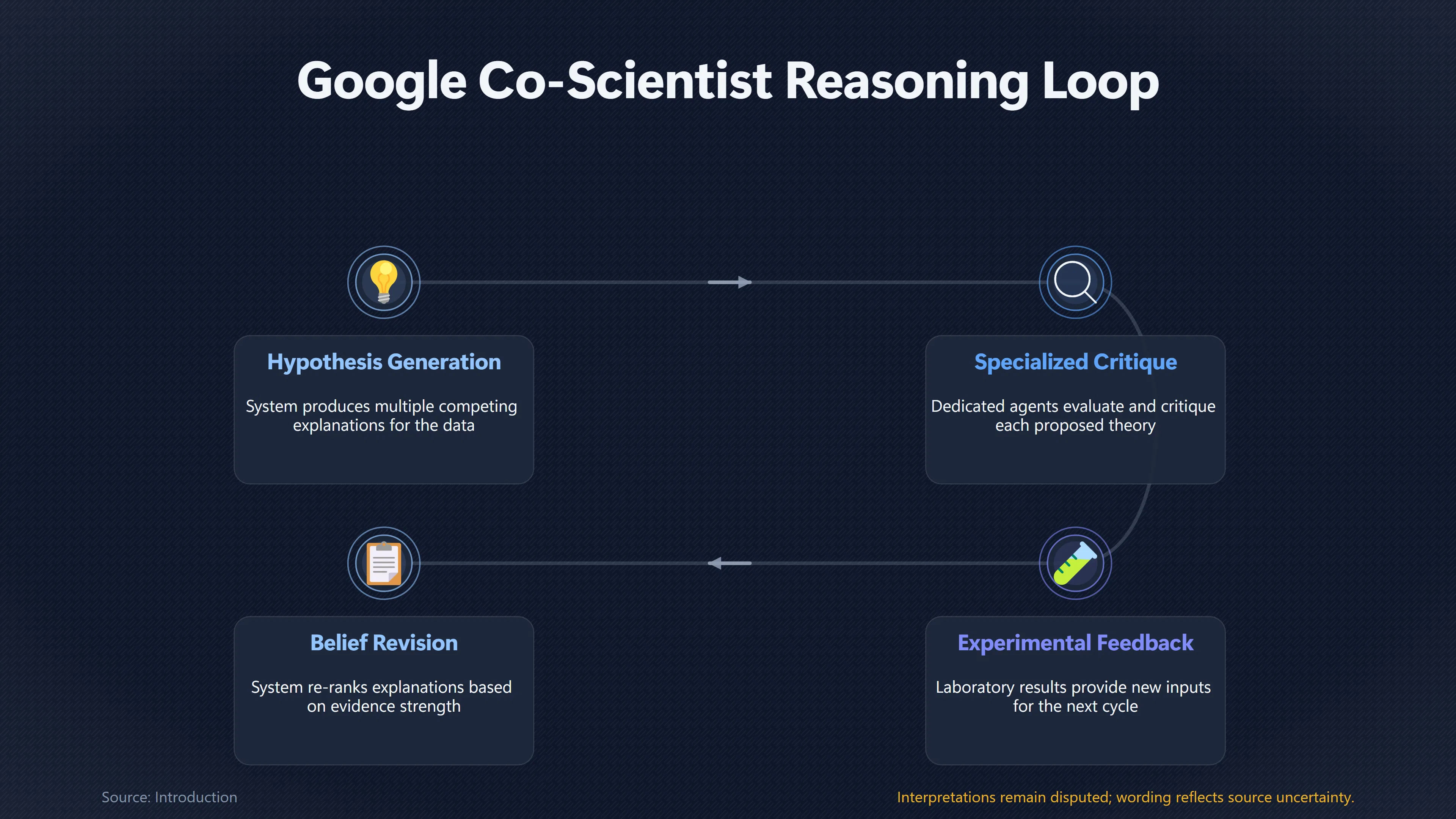
Google’s Co-Scientist architecture illustrates this principle. Instead of maintaining one preferred answer, it generates multiple competing hypotheses, subjects them to critique from specialised agents, compares their performance, and evolves them through repeated rounds of feedback. Experimental findings and expert comments become inputs for the next cycle rather than the endpoint of the previous one.[nature.com]nature.comAccelerating scientific discovery with Co-Scientist | NatureMay 19, 2026…
How Competing Explanations Are Re-ranked
The key mechanism is not simply “learning from data” in the machine learning sense. It is scientific belief revision.
Imagine an AI investigating why a particular drug reduces inflammation.
Initially it may consider several explanations:
- the drug blocks a signalling protein;
- it alters immune cell metabolism;
- it affects gene regulation indirectly.
An experiment might eliminate one explanation while leaving two others plausible. The next experiment should therefore target the remaining uncertainty rather than repeating what is already known.
This resembles ideas from Bayesian experimental design, where experiments are chosen because they are expected to produce the largest reduction in uncertainty. Rather than maximising the number of experiments performed, the system attempts to maximise how much each experiment changes its understanding. Although implementing this efficiently remains computationally demanding, Bayesian approaches provide a well-established framework for deciding which evidence should influence future experimental choices.[arXiv]arxiv.orgarXiv Modern Bayesian Experimental DesignModern Bayesian Experimental DesignFebruary 28, 2023…
In practice, this often means that the AI deliberately chooses experiments capable of disproving its current favourite explanation instead of merely confirming it. Such behaviour is closer to established scientific practice than repeatedly seeking supportive evidence.
Why Failed Experiments Can Still Guide the Next Test
One common misunderstanding is that failed experiments represent wasted effort.
In reality, many scientific advances begin with unexpected or negative findings. A carefully conducted experiment that contradicts a hypothesis often teaches more than one that confirms expectations.
For a closed-loop AI scientist, an unsuccessful experiment can provide several kinds of useful feedback:
- it rules out part of the search space;
- it identifies variables that matter less than expected;
- it exposes flaws in the experimental design;
- it suggests previously overlooked mechanisms;
- it reveals where additional measurements are needed.
This requires distinguishing between different kinds of failure. An experiment may fail because the hypothesis is wrong, because the protocol was flawed, because the measurements were noisy, or because an important variable was omitted. Treating all negative results identically would lead the system to draw unreliable conclusions.
Human researchers routinely make these distinctions using domain expertise and judgement. Replicating that reasoning remains a major challenge for AI systems.
Feedback Must Change Decisions, Not Just Memory
Remembering previous experiments is not enough.
An AI scientist that stores experimental results but continues proposing essentially the same hypotheses is not functioning as a genuine closed-loop system. The feedback must alter future decisions.
Researchers increasingly distinguish between systems that merely accumulate information and those that actively adapt their strategy. Google’s Co-Scientist, for example, uses specialised reflection, ranking and meta-review agents whose purpose is to propagate lessons from one iteration into subsequent rounds of hypothesis generation. Feedback is incorporated into later reasoning rather than archived as passive history.[nature.com]nature.comAccelerating scientific discovery with Co-Scientist | NatureMay 19, 2026…
This distinction may seem subtle, but it determines whether additional experiments improve scientific reasoning or simply produce larger datasets.
Early Evidence That Feedback Can Improve AI Scientists
Whether large language model-based research agents genuinely learn from experimental feedback has been an active research question.
Recent experimental work provides encouraging, though still preliminary, evidence. In one study of iterative perturbation discovery using laboratory screening data, AI agents that updated their hypotheses after receiving experimental feedback made substantially more successful discoveries than comparable systems operating without feedback. Importantly, when researchers randomised the feedback labels, the improvement disappeared, suggesting that performance gains depended on meaningful experimental evidence rather than simply receiving additional text.[arXiv]arxiv.orgCan AI Scientist Agents Learn from Lab-in-the-Loop Feedback? Evidence from Iterative Perturbation DiscoveryMarch 27, 2026…
Other recent work in automated cognitive science follows a similar pattern. Rather than repeatedly fitting existing theories, the system generates competing computational models, designs experiments that discriminate between them, collects behavioural data, diagnoses why theories fail, and then constructs improved successors. The experimental feedback becomes the mechanism driving theory evolution instead of merely validating pre-existing ideas.[arXiv]arxiv.orgClosing the Loop to Discover Psychological Theories with an Automated Cognitive ScientistJune 25, 2026…
These studies remain early demonstrations rather than proof that AI scientists broadly reason like human researchers. Most have been conducted within carefully bounded domains where experiments, measurements and evaluation criteria are tightly controlled.

Why This Remains a Difficult Problem
Despite rapid progress, evidence-sensitive scientific reasoning remains one of the weakest components of autonomous research systems.
Several limitations recur across current evaluations:
- models sometimes ignore contradictory evidence;
- they may become overconfident despite ambiguous results;
- they can mistake statistical noise for genuine discoveries;
- they often struggle to determine whether experimental failures reflect flawed hypotheses or flawed methods;
- they remain heavily dependent on human researchers to judge whether a surprising result deserves follow-up.
Case studies of autonomous research systems likewise identify recurring problems such as confirmation bias, poor experimental judgement, memory degradation over long research projects and a tendency to declare success prematurely. These shortcomings highlight that automating experimentation is considerably easier than automating scientific reasoning itself.[arXiv]arxiv.orgWhy LLMs Aren't Scientists Yet: Lessons from Four Autonomous Research AttemptsJanuary 6, 2026…
Why Better Feedback Loops Matter for AI Bloom
Within the broader vision of AI-enabled human flourishing, faster experimentation alone is not the transformative capability. Laboratories have long automated repetitive procedures.
The larger opportunity comes if AI systems become progressively better at deciding what evidence means and how that evidence should reshape future research. Every well-interpreted experiment could make subsequent experiments more informative, reducing the time required to reach reliable discoveries.
If such feedback-driven reasoning becomes dependable, it could accelerate progress across areas central to an AI-enabled future, including new medicines, cleaner energy technologies, advanced materials and improved understanding of complex biological systems. But this optimistic pathway depends on more than computational speed. It requires AI scientists that genuinely revise their beliefs in response to evidence, recognise when they are wrong, and continually choose better questions to ask next.
That capacity for disciplined, evidence-based adaptation—not simply automation—is what distinguishes a true closed-loop AI scientist from a sophisticated research assistant.
Amazon book picks
Further Reading
Books and field guides related to When Does Experimental Feedback Actually Change the Plan?. Use these as the next step if you want deeper reading beyond the article.
Artificial Intelligence
Rating: 4.5/5 from 10 Google Books ratings
Artificial intelligence: A Modern Approach, 3e,is ideal for one or two-semester, undergraduate or graduate-level courses in Artificial In...
Reinventing Discovery
A pioneer of quantum computing describes how the Internet and powerful new online tools are democratising and accelerating scientific dis...
The Book of Why
The hugely influential book on how the understanding of causality revolutionized science and the world, by the pioneer of artificial inte...
The Logic of Scientific Discovery
2014 Reprint of Original 1959 Edition. Exact facsimile of the original edition, not reproduced with Optical Recognition Software. This bo...
eBay marketplace picks
Marketplace Samples
Live-tested eBay searches with available results related to this page.
Selected fromrobotics kit oneBay.co.uk.



Endnotes
1.
Source: nature.com
Title: Accelerating scientific discovery with Co-Scientist | Nature
Link:https://www.nature.com/articles/s41586-026-10644-y
Source snippet
May 19, 2026...
Published: May 19, 2026
2.
Source: nature.com
Title: What’s your hypothesis? | Nature Methods
Link:https://www.nature.com/articles/s41592-026-03104-y
3.
Source: arxiv.org
Title: arXiv Modern Bayesian Experimental Design
Link:https://arxiv.org/abs/2302.14545
Source snippet
Modern Bayesian Experimental DesignFebruary 28, 2023...
Published: February 28, 2023
4.
Source: arxiv.org
Link:https://arxiv.org/abs/2603.26177
Source snippet
Can AI Scientist Agents Learn from Lab-in-the-Loop Feedback? Evidence from Iterative Perturbation DiscoveryMarch 27, 2026...
Published: March 27, 2026
5.
Source: arxiv.org
Link:https://arxiv.org/abs/2606.26448
Source snippet
Closing the Loop to Discover Psychological Theories with an Automated Cognitive ScientistJune 25, 2026...
Published: June 25, 2026
6.
Source: arxiv.org
Link:https://arxiv.org/abs/2601.03315
Source snippet
Why LLMs Aren't Scientists Yet: Lessons from Four Autonomous Research AttemptsJanuary 6, 2026...
Published: January 6, 2026
7.
Source: nature.com
Link:https://www.nature.com/articles/d41586-026-00899-w
8.
Source: nature.com
Title: Towards end-to-end automation of AI research | Nature
Link:https://www.nature.com/articles/s41586-026-10265-5
9.
Source: nature.com
Link:https://www.nature.com/articles/s41598-025-93794-9
10.
Source: nature.com
Link:https://www.nature.com/articles/s41562-024-02077-2
Additional References
11.
Source: youtube.com
Link:https://www.youtube.com/watch?v=upqsQliYCgc
Source snippet
AI Scientist v2: The AI That Writes Scientific Papers Accepted by Peer Review Prism Labs · 533 views Google's AI Co-Scientist Explained B...
12.
Source: pubmed.ncbi.nlm.nih.gov
Link:https://pubmed.ncbi.nlm.nih.gov/42428019/
Source snippet
1 |. Co-Scientist design, multi-agent architecture,… Fig. 1 |. Co-Scientist design, multi-agent architecture, and experimental validation...
13.
Source: emergentmind.com
Title: Closed-Loop Scientific Discovery
Link:https://www.emergentmind.com/topics/closed-loop-scientific-discovery
Source snippet
July 1, 2026 — CLOSED-LOOP SCIENTIFIC DISCOVERY Updated 1 July 2026 * Closed-loop scientific discovery is an adaptive framework that iter...
Published: July 1, 2026
14.
Source: youtube.com
Title: AI Scientist v2: The AI That Writes Scientific Papers Accepted by Peer Review
Link:https://www.youtube.com/watch?v=mg68wk40MO8
Source snippet
AI-Driven Research Workflows: Lessons learned from a million automated experiments - Paul Jensen...
15.
Source: pubmed.ncbi.nlm.nih.gov
Title: Pub Med Accelerating scientific discovery with Co-Scientist
Link:https://pubmed.ncbi.nlm.nih.gov/42156544/
Source snippet
Accelerating scientific discovery with Co-Scientist - PubMed...
16.
Source: youtube.com
Link:https://www.youtube.com/watch?v=g45Alfg7diw
Source snippet
AI Scientist v2: The AI That Writes Scientific Papers Accepted by Peer Review...
17.
Source: youtube.com
Title: Google’s AI Co-Scientist Explained
Link:https://www.youtube.com/watch?v=x-ZqPELgYQA
Source snippet
How [Autonomous Labs]({{ 'autonomous-labs/' | relative_url }}) Will Transform Scientific Research: Ginkgo Bioworks’ Jason Kelly...
18.
Source: youtube.com
Title: The Limits of AI in Science
Link:https://www.youtube.com/watch?v=4-sWFytOfRw
Source snippet
Google's AI Co-Scientist Explained...
19.
Source: mdpi.com
Link:https://www.mdpi.com/2076-3417/15/9/5208
20.
Source: natureasia.com
Link:https://www.natureasia.com/en/info/press-releases/detail/9330