Within Robotics
Can Robots Make Nuclear Clean Up Safer?
Remote machines at Sellafield show how robotics can remove workers from radiation while tackling complex waste that buildings were never designed to handle.
On this page
- Why Sellafield is unusually difficult to decommission
- How remote machines inspect and handle radioactive material
- Where human judgement and robotic capability still fall short
Page outline Jump by section
Introduction
Sellafield is one of the clearest real-world demonstrations of why advanced robotics matters for the future of dangerous work. The site contains ageing nuclear facilities, radioactive waste, contaminated buildings and storage ponds that were never designed to be emptied or dismantled using modern engineering methods. In some areas, radiation levels or contamination make prolonged human access impossible or highly restricted. Robots therefore do more than improve efficiency: they allow work that would otherwise expose people to unacceptable risks.[GOV.UK]GOV.UKSellafield robots leading an evolution in nuclear decommissioningSellafield robots leading an evolution in nuclear decommissioning
Within the broader discussion of AI-enabled human flourishing, Sellafield represents an important proof of principle rather than a futuristic promise. Remote-controlled machines, increasingly supported by autonomous navigation, computer vision, digital mapping and AI-assisted inspection, show how technology can separate essential work from direct human exposure to life-threatening environments. The lesson extends well beyond nuclear decommissioning. If machines can reliably undertake some of the world’s most hazardous physical tasks, they may gradually reduce dangerous labour across many industries while allowing people to focus on supervision, judgement and higher-value problem solving.
Why Sellafield Is Unusually Difficult to Decommission
Sellafield, on the Cumbrian coast, accumulated decades of nuclear infrastructure during Britain’s early weapons and civilian nuclear programmes. Many facilities date from the 1950s and 1960s, when long-term decommissioning received far less attention than production. Engineers today often confront buildings whose exact internal condition is only partially documented, with radioactive sludge, damaged equipment, corroded structures and legacy waste stored inside ageing facilities.[UK National Nuclear Laboratory]uknnl.comUK National Nuclear Laboratory Decommissioning at SellafieldUK National Nuclear LaboratoryDecommissioning at Sellafield - United Kingdom National Nuclear Laboratory…
Unlike constructing a new industrial plant, decommissioning frequently begins with uncertainty. Engineers must first discover what remains inside a building before deciding how to remove it safely. Radiation can interfere with electronics, access routes may be narrow, lighting poor, and debris unpredictable. Human workers often cannot simply enter, inspect and adapt as they would on a conventional demolition site.
This combination of uncertainty and hazard makes Sellafield an unusually demanding robotics testbed. Success depends not only on rugged machines but on reliable sensing, remote operation, careful planning and continuous verification.
How Remote Machines Inspect and Handle Radioactive Material
Rather than relying on one universal robot, Sellafield increasingly employs specialised machines designed for particular environments and tasks.
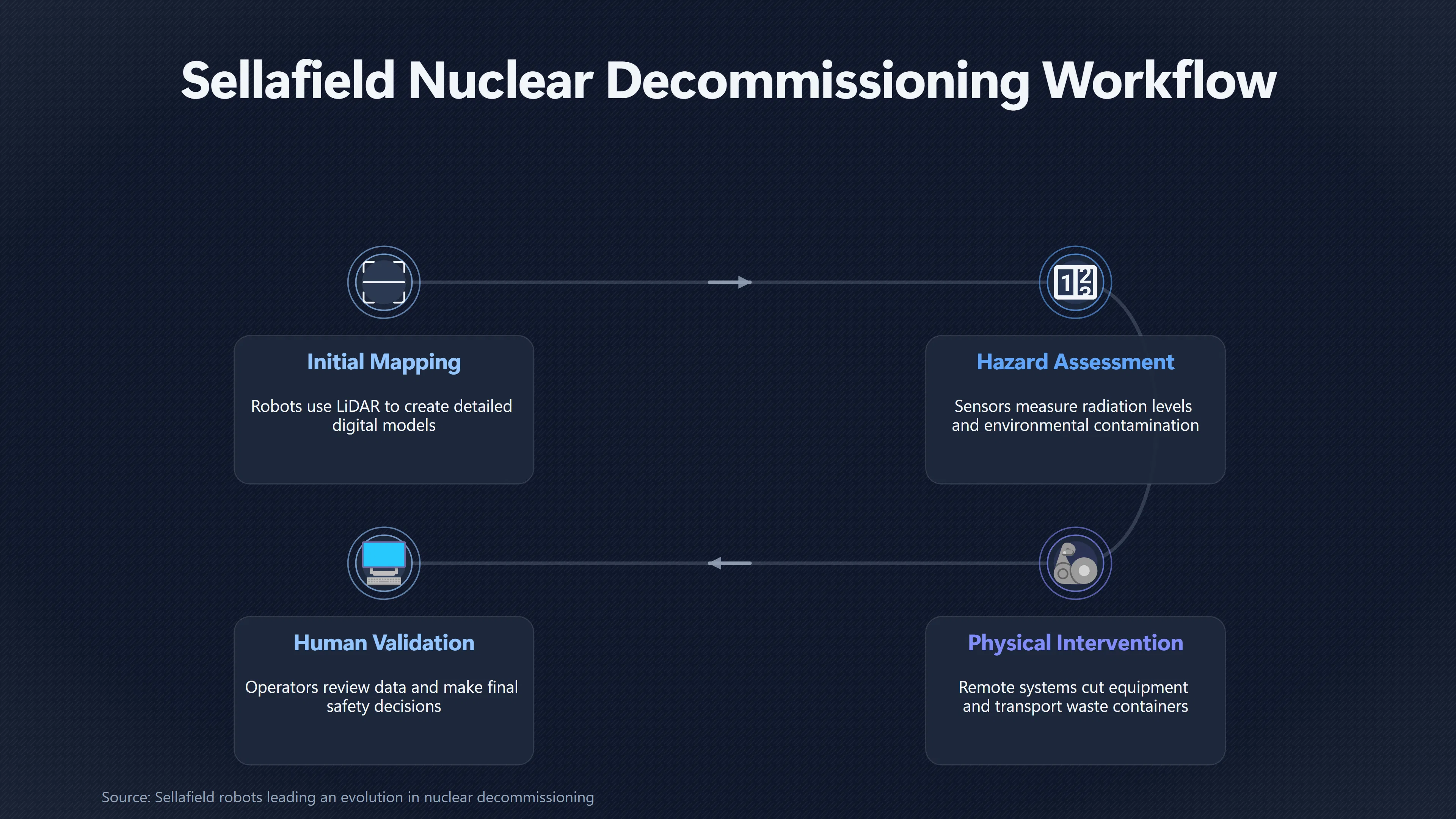
Inspection robots typically perform the first stage of work. Equipped with cameras, LiDAR (laser-based three-dimensional mapping), radiation detectors and environmental sensors, they enter hazardous areas to create detailed digital models before humans commit to more invasive operations. This allows engineers to understand obstacles, measure contamination and plan retrieval work while remaining behind shielding. Sellafield engineers demonstrated one of the first uses of LiDAR mounted on a remotely operated vehicle inside a high-radiation environment, enabling accurate three-dimensional mapping without sending personnel inside.[GOV.UK]GOV.UKSellafield robots leading an evolution in nuclear decommissioningSellafield robots leading an evolution in nuclear decommissioning
Once conditions are understood, remotely operated systems undertake increasingly complex physical tasks, including:
- surveying contaminated rooms;
- measuring radiation levels;
- collecting environmental samples;
- cutting contaminated equipment;
- manipulating tools with robotic arms;
- transporting waste containers;
- sorting radioactive debris for packaging.
Many operations combine human decision-making with robotic execution. Operators remain in protected control rooms, viewing multiple camera feeds while controlling robotic arms, tracked vehicles or mobile inspection platforms with high precision.[UK National Nuclear Laboratory]uknnl.comUK National Nuclear Laboratory Decommissioning at SellafieldUK National Nuclear LaboratoryDecommissioning at Sellafield - United Kingdom National Nuclear Laboratory…
The objective is not full autonomy but safe separation between people and radiation.
From Robot Dogs to Custom Nuclear Machines
One of Sellafield’s most visible innovations has been the deployment of quadrupedal “robot dogs”. Adapted from commercially available walking robots, these systems carry specialist nuclear payloads including gamma and alpha radiation detectors, LiDAR scanners, high-resolution cameras and environmental sensors. Their ability to climb stairs, traverse uneven ground and repeatedly inspect hazardous areas makes them well suited to facilities that are awkward for wheeled vehicles.[GOV.UK]GOV.UKHow are robot dogs helping clean up Sellafield?Case study - GOV.UKJanuary 29, 2026…
Recent deployments have shown these platforms carrying out:
- repeated inspection routes;
- radiological characterisation;
- three-dimensional mapping;
- photographic documentation;
- environmental monitoring;
- contamination swabbing using newly developed robotic tools.[GOV.UK]GOV.UKNew robot swabbing technology trialled for the first time at SellafieldNew robot swabbing technology trialled for the first time at Sellafield
Sellafield has also demonstrated secure teleoperation of these robots from outside the licensed nuclear site, showing that future inspections may increasingly be performed from dedicated remote operations centres rather than directly beside hazardous facilities.[GOV.UK]GOV.UKSellafield Ltd and Atkins Réalis reach new robotics milestoneSellafield Ltd and AtkinsRéalis reach new robotics milestone - GOV.UK…
Alongside these mobile robots, engineers continue to develop bespoke systems for individual challenges, including remotely operated demolition machines, glovebox manipulators, robotic laser-cutting systems and reconfigurable inspection robots capable of squeezing through access ports as small as 150 millimetres before expanding inside confined spaces.[uknnl.com]uknnl.comUK National Nuclear Laboratory Decommissioning at SellafieldUK National Nuclear LaboratoryDecommissioning at Sellafield - United Kingdom National Nuclear Laboratory…
AI’s Role Is Growing, But Human Expertise Remains Central
Despite frequent discussion of artificial intelligence, today’s nuclear robots remain heavily supervised by skilled operators.
AI contributes mainly by assisting rather than replacing people. Computer vision can identify equipment, autonomous navigation can help avoid obstacles, mapping software can merge sensor data into detailed digital twins, and inspection algorithms can highlight changes that deserve human attention. These capabilities reduce operator workload and improve consistency without eliminating human oversight.[RAICo]raico.orgRobotics and Artificial Intelligence Collaboration | RAICoRobotics and Artificial Intelligence Collaboration | RAICoMarch 4, 2024…
This reflects the realities of nuclear decommissioning. Small mistakes may have expensive or dangerous consequences. Equipment failures must be anticipated, safety cases demonstrated to regulators and every significant operation carefully validated.
For the foreseeable future, Sellafield’s model is best described as supervised robotics rather than autonomous clean-up.

Where Human Judgement and Robotic Capability Still Fall Short
Robotics has transformed many tasks, but important limitations remain.
Radiation gradually damages electronics, cameras and sensors, reducing equipment life in the harshest environments. Unexpected debris can jam manipulators. Communication links may be unreliable inside heavily shielded structures. Dust, water and corrosion create additional engineering challenges.[arXiv]arxiv.orgarXiv Towards Robotically Supported Decommissioning of Nuclear SitesarXiv Towards Robotically Supported Decommissioning of Nuclear Sites
Many facilities also present unique problems because they were never designed with robotic access in mind. Engineers often have to invent new tools for a single building rather than deploy standard commercial equipment.
Human expertise therefore remains indispensable in several areas:
- interpreting incomplete historical records;
- planning retrieval strategies;
- responding when equipment behaves unexpectedly;
- validating safety decisions;
- maintaining and repairing robotic systems;
- deciding when remote work should give way to carefully controlled human intervention.
Ironically, successful robotics often increases the importance of expert human judgement by allowing people to concentrate on planning and decision-making instead of hazardous manual labour.
Why Sellafield Matters Beyond Nuclear Decommissioning
Sellafield is sometimes viewed as a niche engineering challenge, yet its broader significance is considerable.
The site demonstrates that robots become most valuable not where labour is merely expensive, but where human presence itself is the principal hazard. Lessons developed there increasingly influence other sectors involving dangerous inspection and remote intervention, including chemical processing, offshore infrastructure, mining, disaster response and future fusion energy facilities. The Robotics and Artificial Intelligence Collaboration (RAICo), bringing together Sellafield Ltd, the Nuclear Decommissioning Authority, the UK Atomic Energy Authority, the University of Manchester and AWE, was established specifically to accelerate this transfer of technology across the nuclear sector.[RAICo]raico.orgRobotics and Artificial Intelligence Collaboration | RAICoRobotics and Artificial Intelligence Collaboration | RAICoMarch 4, 2024…
Within the wider vision of AI abundance and long-term human flourishing, Sellafield provides evidence that advanced robotics can achieve something more fundamental than labour productivity. Every inspection completed remotely, every contaminated sample collected without human exposure and every hazardous building characterised by machines instead of workers illustrates a future in which technology increasingly removes people from environments that threaten their health or lives.
The achievement is not that robots have eliminated dangerous work altogether. It is that they have begun to change which risks society asks humans to bear. In that sense, Sellafield offers one of today’s strongest practical examples of how AI-assisted robotics can contribute to the gradual end of some of the most hazardous forms of labour while preserving the central role of human expertise, accountability and judgement.
Amazon book picks
Further Reading
Books and field guides related to Can Robots Make Nuclear Clean Up Safer?. Use these as the next step if you want deeper reading beyond the article.
Robotics: Modelling, Planning and Control
Based on the successful Modelling and Control of Robot Manipulators by Sciavicco and Siciliano (Springer, 2000), Robotics provides the ba...
Introduction to Autonomous Mobile Robots
The second edition of a comprehensive introduction to all aspects of mobile robotics, from algorithms to mechanisms. Mobile robots range...
Nuclear Power: A Very Short Introduction
Following the increasing cost of fossil fuels and concerns about the security of their future supply. However, the term 'nuclear power' c...
eBay marketplace picks
Marketplace Samples
Live-tested eBay searches with available results related to this page.
Selected fromrobot dog model oneBay.co.uk.



Endnotes
1.
Source: GOV.UK
Title: Sellafield robots leading an evolution in nuclear decommissioning
Link:https://www.gov.uk/government/news/sellafield-robots-leading-an-evolution-in-nuclear-decommissioning
2.
Source: GOV.UK
Title: How are robot dogs helping clean up Sellafield?
Link:https://www.gov.uk/government/case-studies/how-are-robot-dogs-helping-clean-up-sellafield
Source snippet
Case study - GOV.UKJanuary 29, 2026...
Published: January 29, 2026
3.
Source: GOV.UK
Title: Sellafield Ltd and Atkins Réalis reach new robotics milestone
Link:https://www.gov.uk/government/news/sellafield-ltd-and-atkinsrealis-reach-new-robotics-milestone
Source snippet
Sellafield Ltd and AtkinsRéalis reach new robotics milestone - GOV.UK...
4.
Source: GOV.UK
Title: New robot swabbing technology trialled for the first time at Sellafield
Link:https://www.gov.uk/government/news/new-robot-swabbing-technology-trialled-for-the-first-time-at-sellafield
5.
Source: arxiv.org
Title: arXiv MIRRAX: A Reconfigurable Robot for Limited Access Environments
Link:https://arxiv.org/abs/2203.00337
6.
Source: GOV.UK
Link:https://www.gov.uk/government/news/rrobo-world-first-demonstrates-the-future-of-nuclear-clean-up-is-in-safe-hands
Source snippet
RrOBO: World first demonstrates the future of nuclear clean-up is in safe hands - GOV.UK...
7.
Source: raico.org
Title: Robotics and Artificial Intelligence Collaboration | RAICo
Link:https://raico.org/
Source snippet
Robotics and Artificial Intelligence Collaboration | RAICoMarch 4, 2024...
Published: March 4, 2024
8.
Source: arxiv.org
Title: arXiv Autonomous Systems’ Safety Cases for use in UK Nuclear Environments
Link:https://arxiv.org/abs/2310.02344
9.
Source: arxiv.org
Title: arXiv Towards Robotically Supported Decommissioning of Nuclear Sites
Link:https://arxiv.org/abs/1705.06401
10.
Source: raico.org
Link:https://raico.org/about/
11.
Source: GOV.UK
Title: www.gov.uk Innovative robotics trialled to tackle nuclear waste challenges
Link:https://www.gov.uk/government/news/innovative-robotics-trialled-to-tackle-nuclear-waste-challenges
12.
Source: raico.org
Title: New robot swabbing technology trialled for the first time at Sellafield
Link:https://raico.org/new-robot-swabbing-technology-
13.
Source: raico.org
Link:https://raico.org/robotic-platform-completes-successful-trials-at-europes-most-complex-nuclear-site/
14.
Source: raico.org
Title: Quadruped deployed in reactor bioshield as part of dismantling project
Link:https://raico.org/quadruped-deployed-in-reactor-bioshield-as-part-of-dismantling-project/
15.
Source: uknnl.com
Title: UK National Nuclear Laboratory Decommissioning at Sellafield
Link:https://uknnl.com/customer-solutions/case-studies/decommissioning-at-sellafield/
Source snippet
UK National Nuclear LaboratoryDecommissioning at Sellafield - United Kingdom National Nuclear Laboratory...
Additional References
16.
Source: wired.com
Link:https://www.wired.com/story/inside-sellafield-nuclear-waste-decommissioning
Source snippet
The site, operational since the early 1950s, faces significant cleanup challenges, costs £1.9 billion annually to run, and clean-up effor...
17.
Source: youtube.com
Title: Laser Snake2
Link:https://www.youtube.com/watch?v=hqOfRhJsaEQ
Source snippet
Robotic Arm Operates Inside Active Nuclear Glovebox | World-First Demonstration at Sellafield...
18.
Source: youtube.com
Link:https://www.youtube.com/watch?v=56xnHhAthl0
Source snippet
The £120 Billion Cleanup of the World's Most Dangerous Site...
19.
Source: youtube.com
Title: The Robots Built to Clean Up Our Nuclear Mess
Link:https://www.youtube.com/watch?v=7i4j1iNh5bY
Source snippet
MIRRAX 150 - UoM Robotics - Reconfigurable Nuclear Decommissioning Robot...
20.
Source: youtube.com
Title: The £120 Billion Cleanup of the World’s Most Dangerous Site
Link:https://www.youtube.com/watch?v=RmJQg4UqDyY
Source snippet
The Robots Built to Clean Up Our Nuclear Mess...
21.
Source: youtube.com
Title: MIRRAX 150
Link:https://www.youtube.com/watch?v=YKIwPEfwVWk