Within Labour Share
Which Workers Face the Biggest AI Pressure
Research on occupational exposure shows that AI affects different workers unevenly, with many jobs transformed rather than fully replaced.
On this page
- Occupations with high AI exposure
- Evidence on transformation versus replacement
- Why skills and job design matter
Page outline Jump by section
Introduction
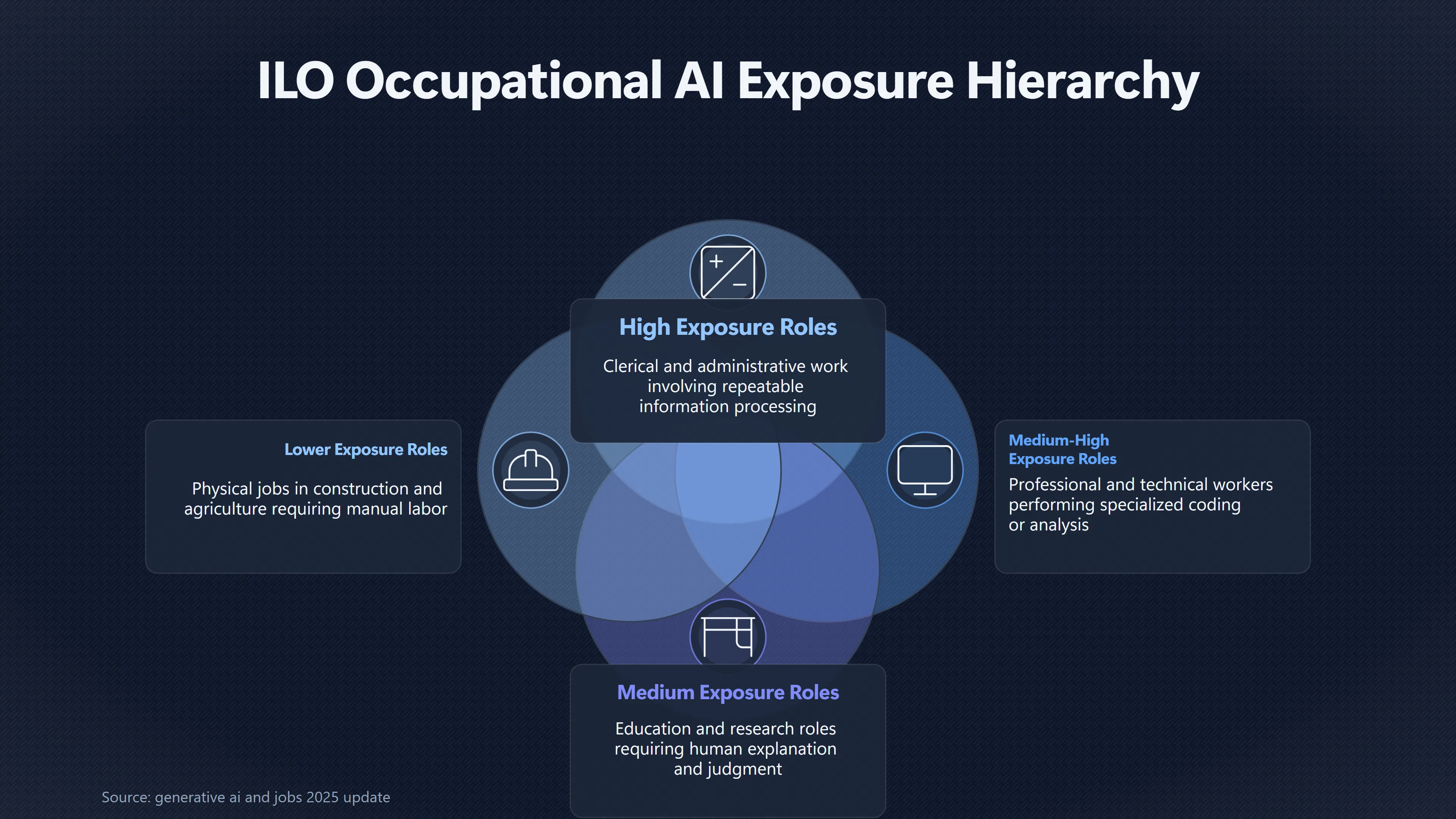
AI exposure across occupations is not the same as job replacement. The strongest evidence so far suggests that artificial intelligence is most likely to reshape many jobs by taking over some tasks, changing workflows and altering the balance between human judgement and machine assistance. The workers facing the greatest immediate exposure are often not those doing physical labour, but people whose jobs involve producing, processing or communicating information: administrative staff, clerical workers, analysts, legal workers, programmers, financial professionals and other highly digitised occupations.[International Labour Organization]ilo.orggenerative ai and jobs 2025 updateInternational Labour OrganizationGenerative AI and jobs: A 2025 update | International Labour OrganizationMay 20, 2025…
This evidence matters for the wider question of AI and labour’s share of income. If AI systems become powerful enough to perform a larger portion of economically valuable tasks, the distribution of gains will depend partly on which occupations are affected, how quickly firms adopt new systems, whether workers gain new skills, and who owns the technology. Occupational exposure research does not predict a single future, but it shows where economic pressure and opportunities are most likely to appear first.[International Labour Organization]ilo.orgInternational Labour OrganizationGenerative AI and Jobs: A Refined Global Index of Occupational Exposure | International Labour Organizat…
Which workers face the biggest AI pressure
Information-heavy jobs are the most exposed
Modern AI systems are strongest at tasks involving language, pattern recognition, classification, summarisation, drafting, information retrieval and routine analysis. This means exposure is concentrated in occupations where a large share of daily work already happens through computers and structured information systems.
The International Labour Organization’s (ILO) 2025 global assessment found that around one in four workers worldwide are in occupations with some degree of exposure to generative AI. However, only a small minority fall into the highest exposure category, because most jobs contain important tasks that still require human judgement, responsibility, interaction or physical presence.[International Labour Organization]ilo.orggenerative ai and jobs 2025 updateInternational Labour OrganizationGenerative AI and jobs: A 2025 update | International Labour OrganizationMay 20, 2025…
The occupations with the highest exposure are typically:
- Clerical and administrative workers — including data-entry roles, administrative assistants, bookkeeping clerks and secretarial work. These jobs contain many repeatable information-processing tasks that language models can increasingly assist with or automate.[International Labour Organization]ilo.orgOpen source on ilo.org.
- Professional and technical workers — including programmers, financial analysts, legal professionals and some research roles. Exposure has expanded here as AI systems have become better at specialised text, coding and analytical tasks.[International Labour Organization]ilo.orgOpen source on ilo.org.
- Media and communication roles — where writing, editing, translation, image generation and content production tasks are increasingly supported by AI tools.[International Labour Organization]ilo.orggenerative ai and jobs 2025 updateInternational Labour OrganizationGenerative AI and jobs: A 2025 update | International Labour OrganizationMay 20, 2025…
A notable finding from early occupational exposure studies is that the most exposed jobs are not necessarily the lowest-skilled jobs. Earlier research on large language models found significant exposure among occupations such as legal services, investment-related roles and higher education teaching, because these jobs involve extensive language and knowledge work.[arXiv]arxiv.orgHow will Language Modelers like ChatGPT Affect Occupations and Industries?March 2, 2023…
Exposure does not mean replacement
The central distinction in AI labour research is between exposure and displacement. Exposure measures how much of a job’s task bundle could potentially be affected by AI. It does not show that the occupation will disappear.
A solicitor, for example, may use AI to search documents, draft first versions of contracts or summarise case material while still spending significant time on negotiation, judgement, client relationships and legal responsibility. A doctor may use AI to review information or support diagnosis while retaining responsibility for decisions and patient care.
The ILO’s research emphasises this difference: the evidence points more strongly towards transformation than a simple “job apocalypse”. Many occupations combine tasks that AI can perform with tasks where human involvement remains essential.[International Labour Organization]ilo.orgOpen source on ilo.org.
This is why exposure studies usually analyse occupations at the task level. A job is not a single activity; it is a bundle of activities. The same occupation can contain:
- tasks that AI can automate;
- tasks where AI increases worker productivity;
- tasks where human skills remain central;
- entirely new tasks created by adopting AI systems.
The economic effect depends on which of these categories becomes dominant.
The evidence map: who is most and least exposed
AI exposure varies because occupations differ in how much they rely on information processing, social interaction, physical work and judgement.
Occupation typeTypical AI exposureWhyAdministrative and clerical workHighMany structured documents, records and communication tasksFinance and business analysisHigh to mediumLarge amounts of data processing and reportingSoftware developmentMedium to highCoding assistance is improving rapidly, but system design and responsibility remain importantEducation and researchMediumAI can support writing, analysis and teaching, but human explanation and judgement matterHealthcare professionalsMediumAI can assist with information tasks, but care decisions involve trust and responsibilityConstruction, agriculture and many physical jobsLower for language AIPhysical environments remain difficult for software-only systems
The OECD’s AI exposure research similarly finds that current AI capabilities are closest to occupations involving routine information processing and codifiable tasks, while remaining further away from roles requiring complex social understanding, physical interaction and contextual judgement.[oecd.org]oecd.orgthe oecd ai exposure measure 489cfd42The OECD AI exposure measure | OECDMay 26, 2026…
However, lower exposure to generative AI does not necessarily mean permanent protection. Physical occupations may eventually be affected by robotics, machine vision and embodied AI systems. The automation pathway differs: software AI mainly affects information tasks, while robotics targets physical tasks.
Why job design matters more than job titles
Occupational exposure scores can be misleading if they are treated as predictions about entire careers. Two people with the same job title may experience very different effects depending on how their workplace uses AI.
A customer service worker might be replaced in a highly automated call-centre model, while another customer service worker using AI assistance might handle more complex cases and become more productive. A programmer using AI coding tools may complete routine work faster but spend more time on architecture, testing and problem-solving.
This means the key question is often not “Will AI replace this occupation?” but:
- Which tasks will move from humans to machines?
- Which new tasks will humans perform?
- Who captures the productivity gains?
- Do workers gain bargaining power from higher productivity, or lose it because fewer workers are needed?
The same technology can produce very different outcomes depending on workplace organisation and economic incentives.
What the evidence means for labour’s future share
Occupational exposure evidence strengthens the case that AI’s economic effects will arrive unevenly. Workers whose jobs contain many automatable information tasks may face pressure even if their occupations continue to exist. The adjustment may appear through slower hiring, fewer entry-level opportunities, changing skill requirements or weaker bargaining power rather than immediate unemployment.
This matters for the AI abundance debate because a future of greater productivity does not automatically guarantee broad prosperity. If AI increases the output produced by each worker while shifting more value towards owners of AI systems, software and computing infrastructure, labour’s share of income could decline even as the economy grows.
At the same time, exposure can also represent opportunity. If AI becomes a tool that amplifies workers rather than replacing them, occupations may become more productive, creative and accessible. The outcome will depend not only on what AI can do, but on decisions about education, ownership, workplace design and how the gains from technological progress are distributed.
The evidence gap: measuring a moving target
AI exposure studies are valuable, but they have limits. They often estimate potential capability rather than actual adoption. A task that an AI model can theoretically perform may remain human work because of regulation, trust, cost, errors or organisational constraints.
Researchers are therefore moving towards more detailed measures that combine occupational tasks, workplace evidence and observed AI use. The ILO’s updated index, for example, combines task-level analysis with expert input and worker-related evidence rather than relying only on broad occupation categories.[International Labour Organization]ilo.orgInternational Labour OrganizationGenerative AI and Jobs: A Refined Global Index of Occupational Exposure | International Labour Organizat…
The picture emerging from current evidence is neither mass replacement nor no disruption. AI is most likely to create a period of uneven transition: some workers gain powerful new tools, some tasks disappear, some roles are redesigned, and some groups face greater pressure than others. Understanding those differences is essential for judging whether AI contributes to wider human flourishing or mainly increases the returns to those who control the technology.

Amazon book picks
Further Reading
Books and field guides related to Which Workers Face the Biggest AI Pressure. Use these as the next step if you want deeper reading beyond the article.
AI Superpowers
THE NEW YORK TIMES, USA TODAY, AND WALL STREET JOURNAL BESTSELLER "Kai-Fu Lee believes China will be the next tech-innovation superpower...
Working with AI
Two management and technology experts show that AI is not a job destroyer, exploring worker-AI collaboration in real-world work settings....
The Second Machine Age
A New York Times Bestseller. A “fascinating” (Thomas L. Friedman, New York Times) look at how digital technology is transforming our work...
The Future of the Professions
This book predicts the decline of today's professions and introduces the people and systems that will replace them. In an internet-enhanc...
eBay marketplace picks
Marketplace Samples
Live-tested eBay searches with available results related to this page.
Selected fromrobotics kit oneBay.co.uk.




Endnotes
1.
Source: ilo.org
Title: generative ai and jobs 2025 update
Link:https://www.ilo.org/publications/generative-ai-and-jobs-2025-update
Source snippet
International Labour OrganizationGenerative AI and jobs: A 2025 update | International Labour OrganizationMay 20, 2025...
Published: May 20, 2025
2.
Source: ilo.org
Link:https://www.ilo.org/resource/article/generative-ai-work-what-it-means-jobs-europe-and-beyond
3.
Source: ilo.org
Link:https://www.ilo.org/publications/generative-ai-and-jobs-refined-global-index-occupational-exposure
Source snippet
International Labour OrganizationGenerative AI and Jobs: A Refined Global Index of Occupational Exposure | International Labour Organizat...
4.
Source: oecd.org
Title: A I and work | OECD
Link:https://www.oecd.org/en/topics/sub-issues/ai-and-work.html
5.
Source: arxiv.org
Link:https://arxiv.org/abs/2303.01157
Source snippet
How will Language Modelers like ChatGPT Affect Occupations and Industries?March 2, 2023...
Published: March 2, 2023
6.
Source: ilo.org
Link:https://www.ilo.org/resource/article/how-might-generative-ai-impact-different-occupations
7.
Source: oecd.org
Title: the oecd ai exposure measure 489cfd42
Link:https://www.oecd.org/en/publications/2026/05/the-oecd-ai-exposure-measure_489cfd42.html
Source snippet
The OECD AI exposure measure | OECDMay 26, 2026...
Published: May 26, 2026
8.
Source: oecd.org
Title: component 6
Link:https://www.oecd.org/en/publications/skills-in-the-ai-age_972bd15e-en/full-report/component-6.html
Source snippet
AI has a transformative impact on businesses, work and digital societies: Skills in the AI age | OECDJuly 8, 2026 — JOBS WITH GREATEST EX...
Published: July 8, 2026
9.
Source: ilo.org
Link:https://www.ilo.org/resource/news/new-ilo-data-confirm-women-face-higher-workplace-risks-generative-ai-men
10.
Source: live.ilo.org
Title: workers exposure ai across [development]({{ ‘build-rights/’ | relative_url }}) stages 2025 11 27
Link:https://live.ilo.org/event/workers-exposure-ai-across-development-stages
11.
Source: ilo.org
Link:https://www.ilo.org/resource/news/one-four-jobs-risk-being-transformed-genai-new-ilo%E2%80%93nask-global-index-shows
12.
Source: ilo.org
Link:https://www.ilo.org/it/resource/news/intelligenza-artificiale-generativa-e-lavoro-un-indice-globale
13.
Source: oecd.org
Title: component 7
Link:https://www.oecd.org/en/publications/job-creation-and-local-economic-development-2024_83325127-en/full-report/component-7.html
14.
Source: oecd.org
Link:https://www.oecd.org/en/publications/artificial-intelligence-and-the-changing-demand-for-skills-in-the-labour-market_88684e36-en.html
15.
Source: oecd.org
Title: artificial intelligence and jobs no signs of slowing labour demand yet 5aebe670
Link:https://www.oecd.org/en/publications/oecd-employment-outlook-2023_08785bba-en/full-report/artificial-intelligence-and-jobs-no-signs-of-slowing-labour-demand-yet_5aebe670.html
16.
Source: oecd.org
Title: artificial intelligence job quality and inclusiveness a713d0ad
Link:https://www.oecd.org/en/publications/oecd-employment-outlook-2023_08785bba-en/full-report/artificial-intelligence-job-quality-and-inclusiveness_a713d0ad.html
17.
Source: oecd.org
Link:https://www.oecd.org/en/publications/what-skills-and-abilities-can-automation-technologies-replicate-and-what-does-it-mean-for-workers_646aad77-en.html
18.
Source: researchrepository.ilo.org
Title: Generative AI and jobs a 2025
Link:https://researchrepository.ilo.org/esploro/outputs/encyclopediaEntry/Generative-AI-and-jobs-a-2025/995653517302676
19.
Source: researchrepository.ilo.org
Title: Generative AI and jobs a refined
Link:https://researchrepository.ilo.org/esploro/outputs/encyclopediaEntry/Generative-AI-and-jobs-a-refined/995653520102676
20.
Source: researchrepository.ilo.org
Title: encyclopedia Entry
Link:https://researchrepository.ilo.org/esploro/outputs/encyclopediaEntry/995653520102676
21.
Source: oecd.ai
Title: The Future of Work
Link:https://oecd.ai/en/working-group-future-of-work
22.
Source: doi.org
Link:https://doi.org/10.48550/arXiv.2303.10130
Additional References
23.
Source: data.london.gov.uk
Link:https://data.london.gov.uk/blog/londons-workforce-exposure-to-generative-artificial-intelligence
Source snippet
2. 3. Blog 4. 5. London’s workforce exposure to generative artificial intelligence London’s workforce exposure to generati...
24.
Source: youtube.com
Link:https://www.youtube.com/watch?v=-cg5U2M2wwI
Source snippet
Workers' exposure to AI across development stages...
25.
Source: youtube.com
Title: Will AI change our jobs? What the evidence says about the future of work
Link:https://www.youtube.com/watch?v=IPUTBOUJuUo
Source snippet
Is AI really taking our jobs? The future of work explained I LSE Research...
26.
Source: youtube.com
Title: How is generative AI reshaping gender inequalities at work?
Link:https://www.youtube.com/watch?v=m1K_rFVVsm0
Source snippet
Will AI change our jobs? What the evidence says about the future of work...
27.
Source: youtube.com
Title: Workers’ exposure to AI across development stages
Link:https://www.youtube.com/watch?v=AXqSQsUA4Hw
Source snippet
How is generative AI reshaping gender inequalities at work?...
28.
Source: oecd-ilibrary.org
Link:https://www.oecd-ilibrary.org/en/about/projects/artificial-intelligence-and-future-of-skills.html
29.
Source: knowledge4policy.ec.europa.eu
Link:https://knowledge4policy.ec.europa.eu/news/jrc-methodology-assesses-which-occupations-face-greatest-disruption-uptake-ai_en
30.
Source: oecd-ilibrary.org
Link:https://www.oecd-ilibrary.org/en/publications/how-is-ai-changing-the-way-workers-perform-their-jobs-and-the-skills-they-require_8dc62c72-en.html
31.
Source: pewresearch.org
Title: Which US workers are exposed to AI in their jobs? | Pew Research Center
Link:https://www.pewresearch.org/social-trends/2023/07/26/which-u-s-workers-are-more-exposed-to-ai-on-their-jobs/
32.
Source: collaborate.princeton.edu
Title: occupational industry and geographic exposure to artificial intel
Link:https://collaborate.princeton.edu/en/publications/occupational-industry-and-geographic-exposure-to-artificial-intel/