Within AI Coordination
Can AI Power Become More Distributed?
Public-interest AI infrastructure could help smaller countries and researchers use advanced systems without depending entirely on a few powerful organisations.
On this page
- Why access matters beyond ownership
- Public and shared AI infrastructure
- Avoiding new dependency on AI powers
Page outline Jump by section
Introduction
A future where AI helps humanity flourish will depend not only on how powerful AI systems become, but on who can use them. Distributed AI infrastructure means building the computing capacity, networks, public services, open tools and shared institutions that allow more countries, researchers, businesses and communities to access advanced AI without relying entirely on a small group of technology providers.
This matters because AI could become a form of global cognitive infrastructure: supporting scientific discovery, healthcare, education, public administration and economic development. But if access to the most capable systems depends on a handful of companies or countries, the benefits of an AI-enabled human bloom could be unevenly distributed. The central challenge is not simply creating more AI capacity, but creating systems where capability is widely available, trustworthy and sustainable.
Why access matters beyond ownership
Advanced AI is increasingly shaped by physical infrastructure. Training and running large models requires specialised chips, data centres, energy supplies and high-speed networks. This creates a risk that the future benefits of AI could follow the pattern of other strategic technologies, where a small number of actors control essential resources. Research on the political geography of AI infrastructure highlights that leading cloud providers already account for a large share of global computing capacity, meaning access to AI increasingly depends on infrastructure ownership as well as software innovation.[Oxford Internet Institute]oii.ox.ac.ukOxford Internet Institute OII | The political geography of AI infrastructureOxford Internet Institute OII | The political geography of AI infrastructure
For countries without major technology industries, this creates a difficult position. They may be able to adopt AI applications but have limited influence over the systems underneath them: where data is processed, which models are available, how prices are set and whether services remain accessible during geopolitical disputes. This is why debates around “AI sovereignty” increasingly focus not only on owning models, but on having meaningful control over compute, networks and deployment choices.[SSRN]papers.ssrn.comAI Compute Sovereignty: Infrastructure Control Across Territories, Cloud Providers, and Accelerators by Zoe Jay Hawkins, Vili Lehdonv…
Distributed infrastructure does not mean every country needs to build its own frontier AI laboratory. A more realistic goal is broader access to useful AI capabilities. A small research institute, hospital system or public agency may not need to train the largest possible model, but it may need affordable access to advanced models, secure computing environments and the ability to adapt systems for local needs.
This distinction is important for the AI bloom vision. The optimistic case for AI is not based only on a few organisations creating extraordinary systems. It depends on those systems becoming tools that expand human capability across societies: helping scientists in smaller institutions, supporting teachers in under-resourced regions and giving more people access to expert-level assistance.
Public and shared AI infrastructure
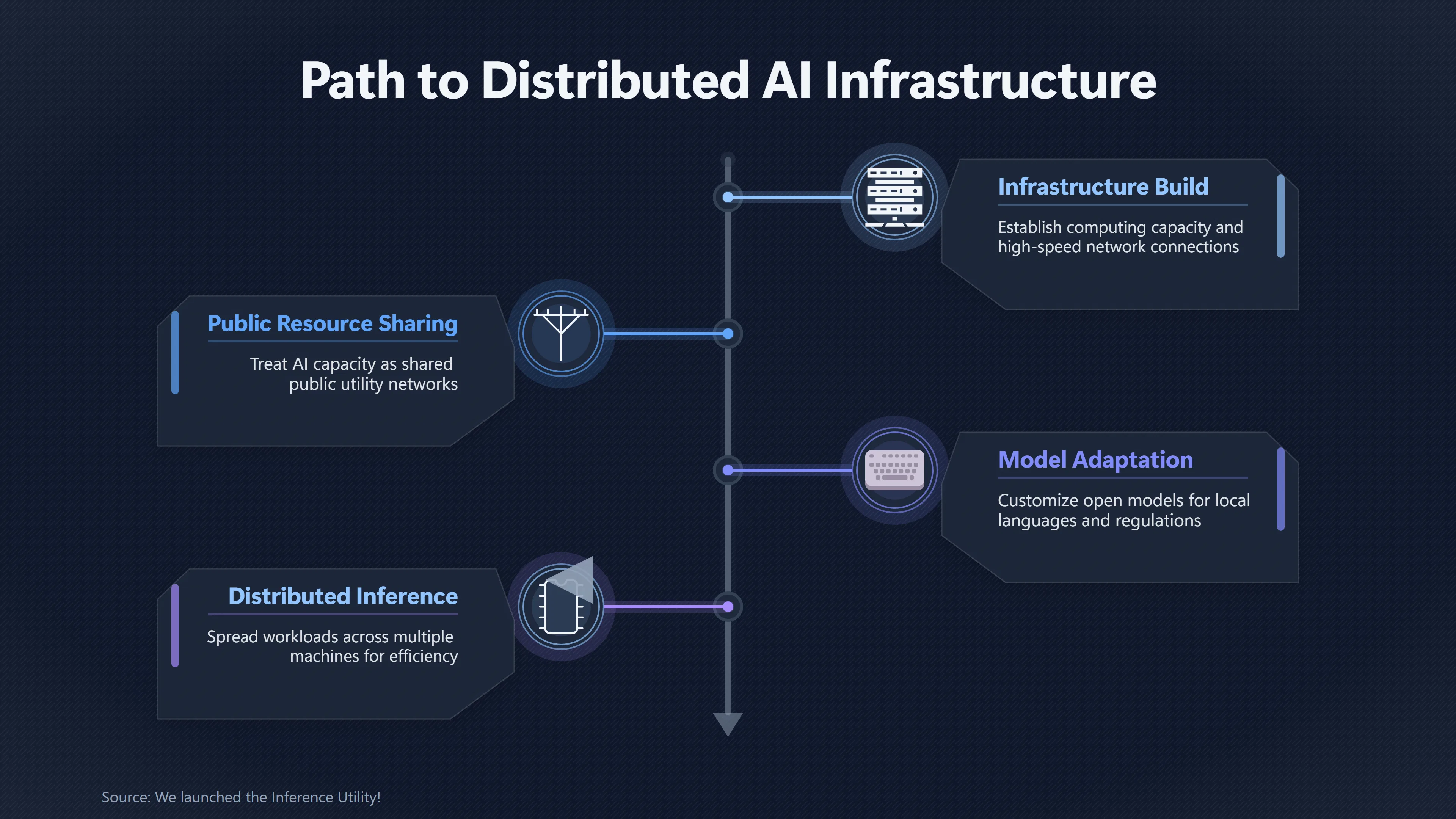
One approach is to treat some AI capacity as a shared public resource rather than purely a commercial service. Public AI infrastructure could include national or regional computing facilities, shared research platforms, open model repositories, publicly funded datasets and international partnerships that allow smaller actors to participate.
The idea resembles earlier forms of public infrastructure. Electricity networks, universities, scientific databases and communications systems created broad economic benefits because access was not limited only to the organisations wealthy enough to build them privately. AI infrastructure could follow a similar path if societies choose to invest in shared capacity.
Some initiatives are already exploring this direction. Public AI projects have proposed shared access points for public and sovereign AI models, allowing users to interact with models developed by public institutions while using open-source deployment systems.[publicai.co]publicai.coWe launched the Inference Utility!September 2, 2025… Meanwhile, discussions around shared infrastructure argue that collaborative approaches could help countries develop AI capabilities without each attempting to recreate the entire technology stack independently.[World Economic Forum]weforum.orgWorld Economic ForumHow shared infrastructure can enable sovereign AI | World Economic ForumFebruary 16, 2026…
Distributed infrastructure can also take technical forms. AI services increasingly rely on distributed computing, where workloads are spread across multiple machines rather than running on a single computer. This can improve efficiency and allow organisations to combine computing resources across locations. Modern AI deployment frameworks are already built around distributing inference — the process of running trained models to produce answers — across multiple computing devices.[NVIDIA]nvidia.comScale and Serve Generative AI | NVIDIA DynamoScale and Serve Generative AI | NVIDIA Dynamo…
However, “distributed” does not automatically mean “democratic”. A network can still be controlled by a small number of companies if those companies own the key hardware, cloud platforms or operating systems. Genuine distribution requires attention to ownership, governance and access rules, not just technical architecture.
The case for open models and local adaptation
Open and openly available AI models are one possible route towards wider access. Unlike closed systems that can only be used through a company-controlled service, open models can often be downloaded, adapted and deployed by others. This can allow governments, universities and companies to customise systems for local languages, regulations and cultural contexts.
The appeal is particularly strong for organisations that need greater control over sensitive information. Public agencies, healthcare providers and researchers may prefer systems that can be inspected or operated in their own environments rather than sending data to external providers.
Recent debates around open-weight models — systems where model parameters are available for others to use — show both the promise and limitations of this approach. Open models can reduce dependence on a single provider and encourage wider experimentation, but they do not remove the need for expensive computing infrastructure, technical expertise and security measures.[Reuters]reuters.comWhile closed models offer convenience, performance, and service guarantees, they come with higher costs and restrictions. Open-weight mod…
This creates a key distinction: access to a model is not the same as access to AI capability. A university may be able to obtain an open model but still lack the computing resources to run it at scale. A developing country may have skilled researchers but insufficient energy infrastructure or connectivity. Distributed AI therefore requires investment across the whole ecosystem, not just releasing software.
Avoiding new dependency on AI powers
The strongest argument for distributed AI infrastructure is also a warning against a new form of dependency. If essential AI services are concentrated among a small number of foreign companies or governments, countries may gain access without gaining resilience.
This does not mean every nation should pursue complete technological independence. Building every component of the AI supply chain — from advanced chips to frontier models — is extremely difficult and expensive. Even wealthy regions face challenges in developing independent capacity. The European Union, for example, has discussed large-scale investment in AI infrastructure partly because of concerns about dependence on external providers.[AP News]apnews.comThe European Commission aims to attract an additional €20 billion ($22.8 billion) in private investment. These gigafactories are planned…
A more practical goal is strategic flexibility: having enough local capability, partnerships and alternatives that societies are not completely dependent on one source. This could include regional computing centres, international research collaborations, open technical standards and shared safety frameworks.
For smaller countries, cooperation may be especially important. Several nations pooling resources may achieve more than each attempting to build isolated national systems. Shared infrastructure could allow participation in advanced AI development while spreading costs and technical expertise.

The limits of infrastructure as a solution
Distributed AI infrastructure faces serious obstacles. The first is cost. Large-scale AI computing requires expensive hardware, reliable electricity and specialised engineering skills. Building more widely distributed systems may improve access, but it does not eliminate the underlying scarcity of advanced chips and energy.
Environmental constraints are another challenge. Data centres require significant electricity and cooling resources, meaning AI expansion must be balanced with sustainability goals. Research on sovereign AI infrastructure highlights that energy availability, cooling capacity and network constraints increasingly shape where AI systems can realistically operate.[arXiv]arxiv.orgarXiv AI Infrastructure SovereigntyAI Infrastructure SovereigntyFebruary 11, 2026…
There are also governance questions. Public infrastructure can become inefficient, politicised or poorly maintained if institutions lack expertise and accountability. Open systems can improve transparency, but they can also create challenges around security, misuse and responsibility.
The goal, therefore, is not simply to decentralise everything. Some highly capable AI systems may continue to require large-scale facilities. The challenge is designing a layered ecosystem where frontier research, shared infrastructure and local deployment reinforce one another.
A more distributed path towards AI-enabled flourishing
For AI to contribute to a broader human bloom, capability must become more than a product available to those with the greatest financial or geopolitical power. It must become a resource that expands human potential across regions and generations.
Distributed AI infrastructure is one possible bridge between technological progress and broad human benefit. It could help smaller countries participate in scientific research, allow communities to build locally relevant applications and reduce the risk that advanced intelligence becomes a permanent advantage held by a narrow group.
The deeper question is not whether AI will become powerful. That is increasingly likely. The question is whether advanced intelligence becomes a shared foundation for human flourishing or another source of concentrated power. The answer will depend on choices about infrastructure, openness, cooperation and governance made before AI becomes too central to civilisation to redesign easily.
Amazon book picks
Further Reading
Books and field guides related to Can AI Power Become More Distributed?. Use these as the next step if you want deeper reading beyond the article.
The Age of A. I.
An A.I. that learned to play chess discovered moves that no human champion would have conceived of. Driverlesscars edge forward at red li...
The Coming Wave
"We are approaching a critical threshold in the history of our species. Everything is about to change. Soon you will live surrounded by A...
AI Superpowers
THE NEW YORK TIMES, USA TODAY, AND WALL STREET JOURNAL BESTSELLER "Kai-Fu Lee believes China will be the next tech-innovation superpower...
Chip War
***Winner of the 2022 Financial Times Business Book of the Year Award*** ***Selected as one of Barack Obama's Favourite Books of 2023***...
eBay marketplace picks
Marketplace Samples
Live-tested eBay searches with available results related to this page.
Selected fromAI robot kit oneBay.co.uk.
Current eBay listing
AI Vision Kit for VinciBot Coding Robot with a 180° Flip Camera


Current eBay listing
Programmable AI Robot Kit for Kids 12+ STEM Coding Set with Camera
Endnotes
1.
Source: papers.ssrn.com
Link:https://papers.ssrn.com/sol3/Delivery.cfm/5312977.pdf?abstractid=5312977&mirid=1
Source snippet
AI Compute Sovereignty: Infrastructure Control Across Territories, Cloud Providers, and Accelerators by Zoe Jay Hawkins, Vili Lehdonv...
2.
Source: publicai.co
Title: We launched the Inference Utility!
Link:https://publicai.co/stories/utility
Source snippet
September 2, 2025...
Published: September 2, 2025
3.
Source: nvidia.com
Title: Scale and Serve Generative AI | NVIDIA Dynamo
Link:https://www.nvidia.com/en-gb/ai/dynamo/
Source snippet
Scale and Serve Generative AI | NVIDIA Dynamo...
4.
Source: reuters.com
Link:https://www.reuters.com/commentary/breakingviews/open-source-ai-is-imperfect-hedge-against-us-clout-2026-07-29/
Source snippet
While closed models offer convenience, performance, and service guarantees, they come with higher costs and restrictions. Open-weight mod...
5.
Source: arxiv.org
Title: arXiv AI Infrastructure Sovereignty
Link:https://arxiv.org/abs/2602.10900
Source snippet
AI Infrastructure SovereigntyFebruary 11, 2026...
Published: February 11, 2026
6.
Source: arxiv.org
Link:https://arxiv.org/abs/2604.09705
7.
Source: papers.ssrn.com
Link:https://papers.ssrn.com/sol3/papers.cfm?abstract_id=5312977
8.
Source: papers.ssrn.com
Link:https://papers.ssrn.com/sol3/papers.cfm?abstract_id=6415119
9.
Source: oii.ox.ac.uk
Title: Oxford Internet Institute OII | The political geography of AI infrastructure
Link:https://www.oii.ox.ac.uk/research/projects/the-political-geography-of-ai-infrastructure/
10.
Source: weforum.org
Link:https://www.weforum.org/stories/artificial-intelligence/shared-infrastructure-ai-sovereignty/
Source snippet
World Economic ForumHow shared infrastructure can enable sovereign AI | World Economic ForumFebruary 16, 2026...
Published: February 16, 2026
11.
Source: apnews.com
Link:https://apnews.com/article/88b83cd517a4d47c115605e636d0b3e4
Source snippet
The European Commission aims to attract an additional €20 billion ($22.8 billion) in private investment. These gigafactories are planned...
12.
Source: oracle.com
Link:https://www.oracle.com/artificial-intelligence/sovereign-ai/
Additional References
13.
Source: youtube.com
Link:https://www.youtube.com/watch?v=OwBasKP8XSU
Source snippet
Ep.016 - Sovereign AI and Compliance: Infrastructure as a Regulatory Decision...
14.
Source: youtube.com
Link:https://www.youtube.com/watch?v=Q85kSPP3GFc
Source snippet
The Global Compute Race: Who Controls it? The Other Supply Chain Issue #aicompute #geopolitics...
15.
Source: youtube.com
Title: How Nebius Is Building a Globally Scalable AI Infrastructure Platform
Link:https://www.youtube.com/watch?v=V7Z_Z7D8TTE
Source snippet
AI Sovereignty for Business and Society: Project Tapestry, Open Source AI & Data Governance...
16.
Source: youtube.com
Title: Distributed AI Infrastructure: Running [AI Workloads]({{ ‘flexible-workloads/’ | relative_url }}) Anywhere with AWS
Link:https://www.youtube.com/watch?v=i9MN2HlTkFM
Source snippet
How Nebius Is Building a Globally Scalable AI Infrastructure Platform...
17.
Source: oecd.org
Link:https://www.oecd.org/en/publications/a-blueprint-for-building-national-compute-capacity-for-artificial-intelligence_876367e3-en.html
18.
Source: soverstack.io
Title: Sovereign cloud
Link:https://soverstack.io/en
Source snippet
Notify me soverstack open source · self-hosted SOVEREIGN CLOUD.FOR EVERYONE_.. → For startups, SMEs, and enterprises. Self-hosted infrast...
19.
Source: dispersed.com
Link:https://www.dispersed.com/
20.
Source: graniteinfra.ai
Link:https://www.graniteinfra.ai/
21.
Source: o-cloud.io
Link:https://www.o-cloud.io/
22.
Source: usenix.org
Link:https://www.usenix.org/conference/osdi26/presentation/yao