Within Verification
Can AI Be Trusted to Check AI?
AI reviewers, citation checks and formal verification can reduce some errors, but high-stakes approval still depends on trusted evidence and accountable
On this page
- How automated reviewers and citation checks work
- Where formal verification and retrieval help most
- Why human approval remains difficult to remove
Page outline Jump by section
Introduction
As AI systems become able to generate reports, software, legal drafts and scientific summaries at extraordinary speed, the next constraint is no longer producing work but deciding what can be trusted. That raises an obvious question: can AI itself perform much of the checking?
The answer is partly, but not completely. AI reviewers can already eliminate many routine errors, verify citations against source documents, detect inconsistencies, compare outputs with policies and identify work that deserves closer inspection. These capabilities can substantially reduce the verification bottleneck, especially when the goal is to filter large volumes of material. However, today’s evidence suggests that AI reviewers remain unreliable as the final authority in high-stakes settings. They inherit many of the same weaknesses as the systems they evaluate, including hallucinations, bias and occasional failures on unusual cases. Instead of replacing human judgement, the strongest implementations combine automated review with accountable human approval.
How automated reviewers and citation checks work
An AI reviewer is not simply another chatbot. It is usually a specialised system whose task is to evaluate rather than generate. Instead of asking, “Write this report”, the prompt becomes, “Check whether every factual claim is supported”, “Compare this contract with company policy”, or “Verify that every citation matches the original document.”
Several complementary techniques are increasingly used together:
- Citation verification, where the reviewer confirms that quoted passages actually appear in the cited source.
- Retrieval-based checking, where claims are compared with trusted databases or internal documentation rather than relying solely on the model’s memory.
- Rule-based validation, which checks measurable requirements such as formatting rules, numerical consistency or regulatory constraints.
- Cross-model review, where one AI evaluates another’s output to identify disagreements.
- Confidence scoring and triage, which routes uncertain or high-risk cases to human experts instead of approving them automatically.
These systems aim to reduce the amount of human attention spent on obvious mistakes, allowing experts to concentrate on genuinely difficult decisions.
A useful way to think about this is quality control in manufacturing. Automated inspection can reject products with visible defects far faster than humans, but unusual failures or safety-critical products often still require experienced inspectors.
Where retrieval and formal verification help most
Not every verification task depends on human judgement. Some questions have objective answers that computers can test directly.
Retrieval reduces unsupported claims
Retrieval-augmented generation (RAG) connects an AI system to trusted external information instead of relying only on its training data. A reviewer can therefore compare generated statements against company documents, regulations, scientific papers or technical manuals.
Grounding responses in external evidence substantially reduces many hallucinations and makes citations traceable to original sources. Major AI developers increasingly rely on this approach for enterprise and professional applications because it improves factual reliability compared with unaided language generation.[ft.com]ft.comStrategies also include allowing AI systems access to internal databases for context-specific accuracy. However, grounding models introdu…
However, retrieval is only as reliable as the sources being searched. If the underlying documents are outdated, incomplete or compromised, the reviewer may confidently validate incorrect information.
Formal verification provides mathematical guarantees
Some verification problems can move beyond probability altogether.
Formal verification converts requirements into mathematical statements and proves whether software or logical systems satisfy them. This approach has long been used in areas such as hardware design and safety-critical software.
Recent research explores combining language models with formal methods so that AI translates human requirements into machine-verifiable specifications while mathematical solvers perform the actual proof. Rather than asking another language model whether code appears correct, the system attempts to demonstrate that specific properties always hold.[arXiv]arxiv.orgarXiv Formal Judge: A Neuro-Symbolic Paradigm for Agentic OversightFormalJudge: A Neuro-Symbolic Paradigm for Agentic OversightFebruary 11, 2026…
This approach is particularly attractive where correctness can be precisely defined, such as:
- software security properties;
- protocol compliance;
- mathematical reasoning;
- logical consistency between stated constraints.
Its limitation is equally important: many real-world decisions cannot be expressed as precise mathematical rules. Questions involving ethics, clinical judgement, legal interpretation or organisational priorities remain only partly formalisable.
Why AI reviewers still make important mistakes
The idea of “AI checking AI” sounds reassuring, but it creates a difficult statistical problem. If both systems rely on similar reasoning processes, they may repeat or overlook the same errors.
Research on “LLM-as-a-judge”—using one large language model to evaluate another—shows encouraging performance on many routine evaluation tasks but also identifies persistent weaknesses.
Common failure modes include:
- accepting plausible but incorrect reasoning;
- overlooking fabricated citations;
- displaying systematic scoring biases;
- favouring fluent answers over correct ones;
- producing inconsistent judgements across repeated evaluations.
Studies have found that both human and AI judges exhibit measurable biases under different experimental conditions, suggesting that automated review cannot simply inherit human authority by imitation.[arXiv]arxiv.orgarXiv Humans or LLMs as the Judge? A Study on Judgement BiasesHumans or LLMs as the Judge? A Study on Judgement BiasesFebruary 16, 2024…
Other work has shown that automated reviewers often fail to detect faulty scientific reasoning even when deliberate logical flaws are inserted into research papers, highlighting the difference between recognising polished writing and recognising valid argumentation.[ACL Anthology]aclanthology.orgACL AnthologyAutomatic Reviewers Fail to Detect Faulty Reasoning in Research Papers: A New Counterfactual Evaluation Framework - ACL Anth…
In financial document evaluation, researchers have also demonstrated substantial false-acceptance rates, where AI judges incorrectly approve wrong answers despite having access to supporting material. The problem becomes especially severe for numerical thresholds, exact calculations and structured reasoning tasks.[SSRN]papers.ssrn.comWhen the Judge is Wrong: Measuring LLM-as-Judge Reliability Against Graph-Verified Ground Truth in Financial Documents by Agus Sudjia…
These findings reinforce an important distinction: evaluating language quality is easier than verifying objective correctness.
Why human approval remains difficult to remove
Verification is not merely a technical exercise. It also determines responsibility.
When a clinician signs a discharge summary, a solicitor approves a contract or an engineer certifies a bridge design, they are not only checking factual accuracy. They are accepting professional and legal accountability.
Several aspects remain difficult to automate completely.
Context beyond available evidence. Humans often know organisational history, informal practices or exceptional circumstances that never appear in the documents an AI reviews.
Value judgements. Decisions frequently require balancing competing objectives rather than finding one objectively correct answer. A regulator, for example, may need to weigh legal risk, commercial urgency and public interest simultaneously.
Responsibility for consequences. Organisations usually require a named individual who can explain and defend why an important decision was made. Current AI systems cannot bear legal or professional liability.
For these reasons, high-stakes review increasingly resembles a layered process rather than full automation.

The most promising implementation: layered verification
The strongest evidence does not support replacing human reviewers with AI. It supports redesigning review so that different forms of verification reinforce one another.
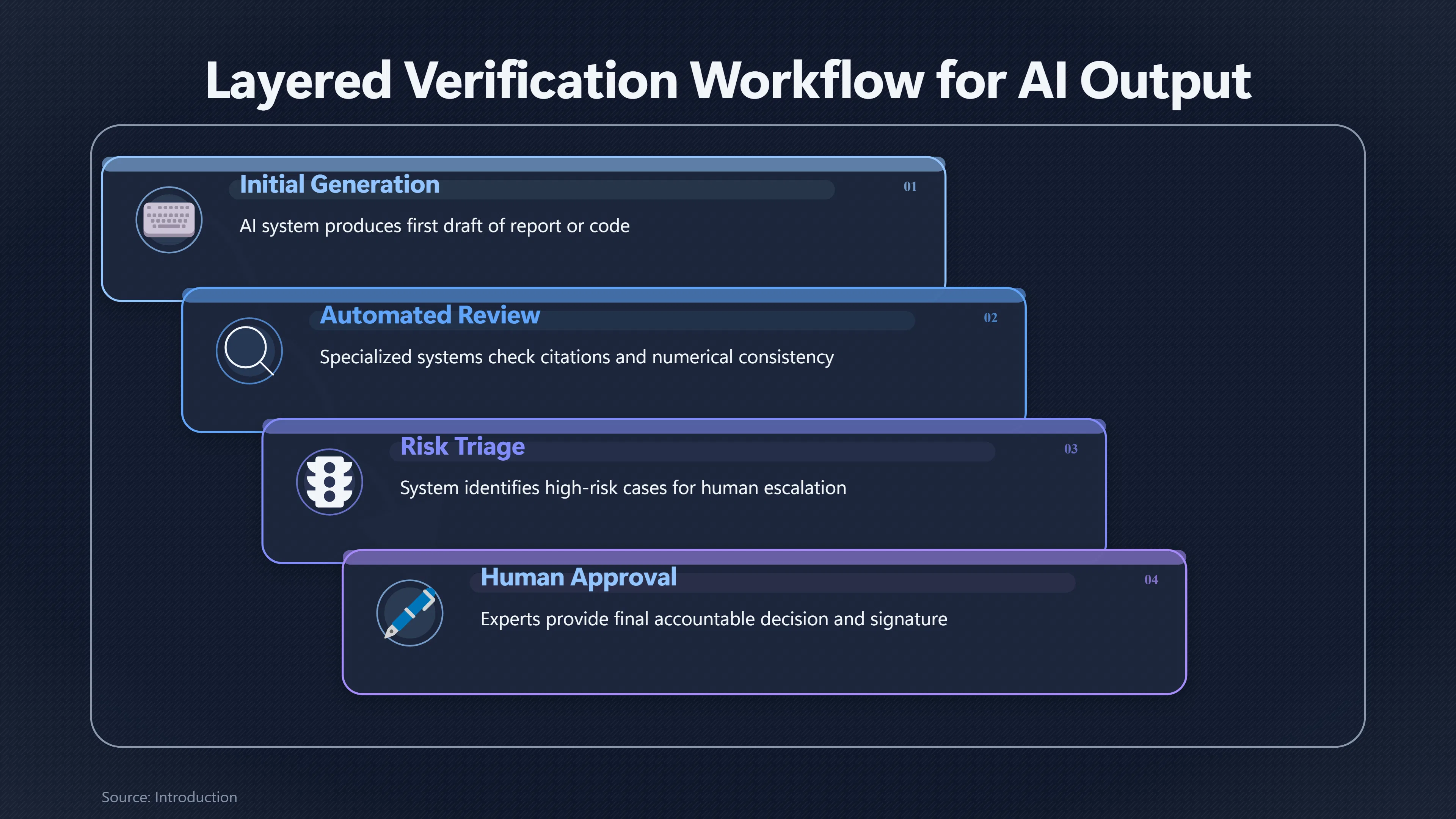
A practical workflow often looks like this:
- AI generates an initial draft.
- Automated reviewers check citations, numerical consistency, formatting, policy compliance and retrieval-grounded factual claims.
- Cases that pass straightforward checks continue automatically.
- Outputs with uncertainty, conflicting evidence or elevated risk are escalated to human specialists.
- Humans make the final accountable decision where consequences justify the additional cost.
Research on software engineering reflects this trend. Rather than treating AI judgement as a replacement for established evaluation methods, developers increasingly combine automated judges with structured human review to improve scalability without abandoning reliability.[Google Research]research.googleOpen source on research.google.
Emerging statistical work similarly argues that AI judges are often most valuable as assistants that reduce the amount of human review required, not as substitutes that eliminate it altogether. Human evaluation can then be concentrated where automated confidence is weakest or the consequences of error are greatest.[arXiv]arxiv.orgAugmenting Human Evaluation with LLM Judges: How Many Human Reviews Do You Need?May 8, 2026…
What this means for AI abundance and human flourishing
Within the broader vision of AI-driven abundance, automated reviewers matter because they determine whether rapidly expanding intellectual production becomes genuinely useful rather than overwhelming.
If verification remains entirely dependent on scarce experts, much of AI’s productive capacity could sit behind approval queues. If automated review becomes substantially more reliable, scientific papers, software, engineering designs, medical documentation and regulatory analysis could all move through validation far more quickly.
Yet current evidence suggests that this will not come from a single breakthrough in “AI judging AI”. Instead, progress is likely to depend on combining multiple approaches:
- retrieval grounded in trusted evidence;[ijarcs.info]ijarcs.infoSource details in endnotes.
- formal verification where mathematical guarantees are possible;
- specialised automated reviewers for routine checks;
- transparent audit trails;
- accountable human oversight for consequential decisions.
The verification bottleneck is therefore unlikely to disappear entirely. It is more likely to change shape. AI reviewers can automate much of the repetitive checking that currently consumes expert time, allowing scarce human judgement to focus on ambiguous, novel and high-consequence decisions. If that balance can be achieved, verification itself becomes more scalable, making it more plausible that advances in AI generation translate into broader scientific progress, safer deployment and, ultimately, a more flourishing long-term future rather than simply an abundance of unverified output.
Amazon book picks
Further Reading
Books and field guides related to Can AI Be Trusted to Check AI?. Use these as the next step if you want deeper reading beyond the article.
The Alignment Problem: Machine Learning and Human Values
Finalist for the Los Angeles Times Book Prize A jaw-dropping exploration of everything that goes wrong when we build AI systems and the m...
Human Compatible: Artificial Intelligence and the Problem of...
A leading artificial intelligence researcher lays out a new approach to AI that will enable people to coexist successfully with increasin...
Artificial Intelligence: A Guide for Thinking Humans
“After reading Mitchell’s guide, you’ll know what you don’t know and what other people don’t know, even though they claim to know it. And...
The Coming Wave: Technology, Power, and the Twenty-first Cent...
NEW YORK TIMES BESTSELLER • An urgent warning of the unprecedented risks that AI and other fast-developing technologies pose to global or...
eBay marketplace picks
Marketplace Samples
Live-tested eBay searches with available results related to this page.
Selected fromtechnology poster oneBay.co.uk.




Endnotes
1.
Source: ft.com
Link:https://www.ft.com/content/7a4e7eae-f004-486a-987f-4a2e4dbd34fb
Source snippet
Strategies also include allowing AI systems access to internal databases for context-specific accuracy. However, grounding models introdu...
2.
Source: arxiv.org
Title: arXiv Formal Judge: A Neuro-Symbolic Paradigm for Agentic Oversight
Link:https://arxiv.org/abs/2602.11136
Source snippet
FormalJudge: A Neuro-Symbolic Paradigm for Agentic OversightFebruary 11, 2026...
Published: February 11, 2026
3.
Source: arxiv.org
Title: arXiv Humans or LLMs as the Judge? A Study on Judgement Biases
Link:https://arxiv.org/abs/2402.10669
Source snippet
Humans or LLMs as the Judge? A Study on Judgement BiasesFebruary 16, 2024...
Published: February 16, 2024
4.
Source: papers.ssrn.com
Link:https://papers.ssrn.com/sol3/papers.cfm?abstract_id=6482162
Source snippet
When the Judge is Wrong: Measuring LLM-as-Judge Reliability Against Graph-Verified Ground Truth in Financial Documents by Agus Sudjia...
5.
Source: arxiv.org
Link:https://arxiv.org/abs/2605.16354
Source snippet
Augmenting Human Evaluation with LLM Judges: How Many Human Reviews Do You Need?May 8, 2026...
Published: May 8, 2026
6.
Source: papers.ssrn.com
Link:https://papers.ssrn.com/sol3/Delivery.cfm/6482162.pdf?abstractid=6482162&mirid=1
7.
Source: aclanthology.org
Link:https://aclanthology.org/2026.tacl-1.22/
Source snippet
ACL AnthologyAutomatic Reviewers Fail to Detect Faulty Reasoning in Research Papers: A New Counterfactual Evaluation Framework - ACL Anth...
8.
Source: research.google
Link:https://research.google/pubs/towards-a-human-in-the-loop-framework-for-reliable-patch-evaluation-using-an-llm-as-a-judge/
9.
Source: aclanthology.org
Title: Peer Check: Enhancing LLM-Generated Academic Reviews Towards Human-Level Quality
Link:https://aclanthology.org/2026.findings-acl.1170/
10.
Source: aclanthology.org
Title: Claim Verification in the Age of Large Language Models: A Survey
Link:https://aclanthology.org/2026.acl-srw.2/
11.
Source: aclanthology.org
Title: Review Eval: An Evaluation Framework for AI-Generated Reviews
Link:https://aclanthology.org/2025.findings-emnlp.1120/
12.
Source: aclanthology.org
Link:https://aclanthology.org/2024.findings-emnlp.607/
Additional References
13.
Source: ai-infrastructure.net
Title: LL M-as-a-judge reliability and validity
Link:https://ai-infrastructure.net/llm-judge-reliability/
Source snippet
LLM-as-a-judge reliability and validity - AI Infrastructure Knowledge BaseJuly 11, 2026 — AI Infrastructure Knowledge Base LLM-as-a-judge...
Published: July 11, 2026
14.
Source: youtube.com
Title: LLM as a Judge: Evaluating AI with AI for Hallucination Detection & Beyond
Link:https://www.youtube.com/watch?v=wYibF4aezZ4
Source snippet
How to Verify Legal Citations & Avoid AI Hallucination (Veracity Demo)...
15.
Source: pmc.ncbi.nlm.nih.gov
Title: Pub Med Central (PMC)A survey on LLM-as-a-judge
Link:https://pmc.ncbi.nlm.nih.gov/articles/PMC13237853/
Source snippet
PubMed Central (PMC)A survey on LLM-as-a-judge - PMC...
16.
Source: youtube.com
Title: How to Verify Legal Citations & Avoid AI Hallucination (Veracity Demo)
Link:https://www.youtube.com/watch?v=PxFZiEwdOXw
Source snippet
AI guardrails for Salesforce [development]({{ 'build-rights/' | relative_url }}): How to scale AI safely...
17.
Source: youtube.com
Link:https://www.youtube.com/watch?v=B2oLNixFoo8
Source snippet
LLM as a Judge: Evaluating AI with AI for Hallucination Detection & Beyond...
18.
Source: researchgate.net
Link:https://www.researchgate.net/publication/397509649_Judicial_Hallucination_Investigating_and_Understanding_the_Unreliability_of_LLM-as-a-Judge
19.
Source: ijarcs.info
Link:https://www.ijarcs.info/index.php/Ijarcs/article/view/7341
20.
Source: openreview.net
Link:https://openreview.net/forum?id=TKmxf2oSSR
21.
Source: openreview.net
Link:https://openreview.net/forum?id=oRBjSQFDva
22.
Source: justintime.ai
Link:https://justintime.ai/publication/judge/