Within Local Power Strain
Who Pays to Power Massive AI Data Centres?
Regulators must decide whether data-centre developers, utilities or ordinary customers should fund the grid expansion required by huge AI loads.
On this page
- Why new AI loads trigger billion pound grid investments
- How tariffs and cost sharing models divide the bill
- Which rules can protect existing electricity customers
Page outline Jump by section
Introduction
As AI data centres grow larger, the question is no longer simply whether enough electricity can be generated. Increasingly, the difficult policy decision is who should pay for the new substations, transformers and transmission lines needed to connect facilities that may each require as much electricity as a medium-sized town. That decision matters because the costs can fall on very different groups: the technology companies building AI infrastructure, regulated utilities, ordinary electricity customers, taxpayers or some combination of all four.

This debate sits at the heart of the broader question of AI-enabled human flourishing. If AI is to accelerate science, medicine and economic productivity, it will need major physical infrastructure. But if households and existing businesses end up subsidising a handful of profitable AI developers, public support for that expansion could weaken. Conversely, making every developer pay the full cost of long-lived grid upgrades could slow investment in infrastructure that ultimately benefits many future users. The challenge for regulators is therefore to design rules that encourage beneficial investment while protecting existing customers from unfair costs.
Why new AI loads trigger billion-pound grid investments
Many industrial customers can connect to existing electricity networks with relatively modest upgrades. Hyperscale AI data centres are different. Individual facilities increasingly request connections measured in hundreds of megawatts, while proposed AI campuses may seek more than one gigawatt of capacity.
Meeting these requests often requires investments well beyond the data centre’s own boundary, including:
- new high-voltage transmission lines;
- additional substations;
- larger transformers;
- reinforcement of local distribution networks;
- control systems to maintain grid stability.
These assets usually last for decades and can later serve other customers. That creates the central cost-allocation problem: should the first company requesting the upgrade bear the entire expense, or should some costs be shared because the infrastructure becomes part of the public network?
The International Energy Agency has identified transmission constraints and slow grid expansion as major barriers to connecting both new electricity generation and rapidly growing electricity demand, including data centres. It argues that modernising grids is becoming as important as building new power generation.[IEA]iea.orgGrids – Electricity 2026 – Analysis - IEA…
The three main approaches to paying for upgrades
Different countries divide these costs in different ways, but most debates revolve around three broad models.
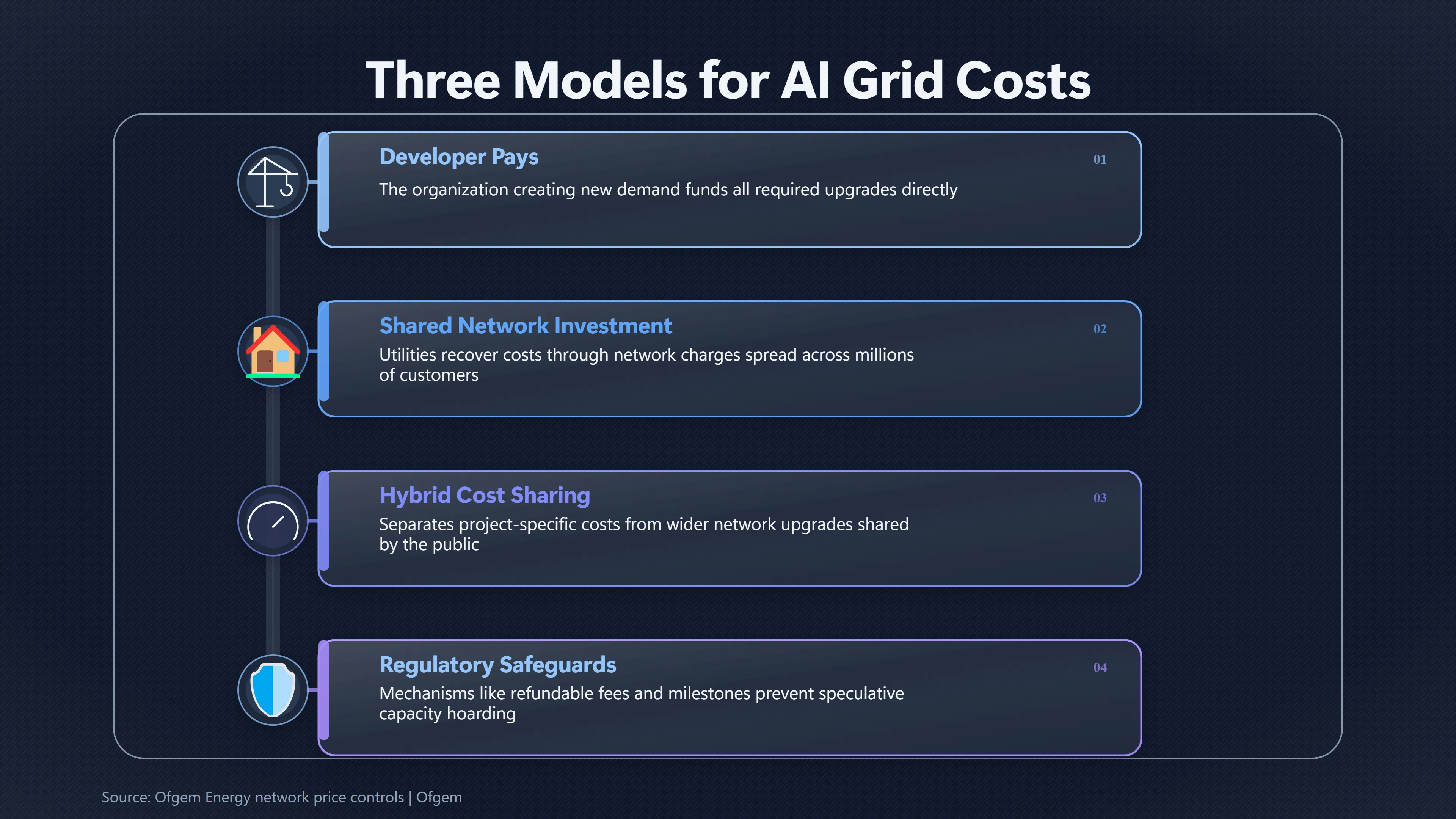
The developer-pays principle
Under the strictest approach, the organisation creating the new demand pays for all upgrades directly required by its project.
Supporters argue this reflects the “cost causer pays” principle. If an AI company creates the need for a new transformer or transmission line, its shareholders rather than existing electricity customers should finance that investment.
Advantages include:
- protecting household electricity bills;
- encouraging companies to choose locations with spare grid capacity;
- discouraging speculative applications for oversized connections;[itpro.com]itpro.comThis move comes as contracted demand surged from 41 GW to 125 GW between November 2024 and June 2025, with many applications tied to proj…
- giving investors clearer price signals about infrastructure costs.
The downside is that the first large customer can end up funding assets that later benefit many other users. That may discourage investment in regions where upgrades are especially expensive.
Shared network investment
A second approach treats major grid expansion as part of the regulated electricity network.
Utilities recover investment through network charges spread across millions of customers over decades. Because upgraded infrastructure often serves future homes, businesses and renewable energy projects as well as the original data centre, regulators may conclude that wider cost sharing is justified.
This model reflects how many traditional transmission projects have historically been financed. Ofgem’s network price-control system, for example, allows regulated network companies to recover approved investments while requiring them to demonstrate value for consumers.[Ofgem]ofgem.gov.ukOfgem Energy network price controls | OfgemOfgem Energy network price controls | Ofgem
The criticism is straightforward: if AI companies receive most of the immediate commercial benefit while everyone contributes through higher network charges, ordinary consumers may effectively subsidise private technology investment.
Hybrid cost sharing
Many regulators increasingly favour hybrid systems.
These attempt to separate:
- project-specific costs, paid by the developer;
- wider network upgrades, whose costs are shared because future customers also benefit.
Although determining where one category ends and the other begins can be technically difficult, hybrid models seek to avoid both extreme outcomes: complete public subsidy or excessive private charges that discourage socially valuable investment.
How tariffs and cost-sharing models divide the bill
The practical mechanisms used to recover costs matter as much as the underlying principle.
Utilities can charge:
- upfront connection fees;[itpro.com]itpro.comThis move comes as contracted demand surged from 41 GW to 125 GW between November 2024 and June 2025, with many applications tied to proj… * ongoing network tariffs;[acer.europa.eu]acer.europa.euSource details in endnotes.
- capacity reservation charges;
- demand charges linked to peak usage;
- special contracts for exceptionally large loads.
Increasingly, regulators are also trying to ensure that companies requesting very large connections demonstrate they genuinely intend to build.
In Britain, rapid growth in proposed AI data-centre connections has prompted Ofgem to consult on refundable commitment fees and stricter project milestones. The proposal aims to prevent speculative developers from reserving scarce network capacity for projects that never materialise, while allowing serious investors to proceed more quickly.[Reuters]reuters.comThis move seeks to free up limited network capacity by deterring speculative applicants. Ofgem's proposal includes introducing a financia…
Similar concerns have emerged in the United States. The Federal Energy Regulatory Commission (FERC) has been reviewing how tariffs should treat very large new electricity users, including AI data centres, with particular attention to protecting existing consumers while speeding connections for genuine projects.[Federal Energy Regulatory Commission]ferc.govOpen source on ferc.gov.
Why ordinary electricity customers worry
The public concern is not simply that AI uses electricity. It is that regulated utility spending can eventually appear in household bills.
If utilities invest billions in transmission and distribution infrastructure and regulators permit those costs to be recovered through network charges, households and small businesses may contribute even if they never directly benefit from AI services.
Whether that outcome is fair depends on several questions:
- Will the upgraded network later serve many other users?
- Does AI-driven economic growth increase tax revenues and wages enough to offset higher electricity costs?
- Are technology companies already paying sufficiently through tariffs and taxes?
- Would the upgrades have been needed eventually even without AI?
These questions rarely have simple yes-or-no answers, which explains why cost allocation has become one of the most contentious aspects of AI infrastructure policy.
Which rules best protect existing electricity customers?
Experience across electricity markets suggests that no single rule solves every problem. Instead, regulators increasingly combine several safeguards.
The strongest approaches typically include:
- Developer contributions for direct connection assets. Companies should generally fund infrastructure built solely for their own projects.
- Evidence before reserving capacity. Financial deposits, planning milestones and proof of site control discourage speculative queueing that delays genuine developments. Britain’s recent proposals reflect this direction.[Reuters]reuters.comThis move seeks to free up limited network capacity by deterring speculative applicants. Ofgem's proposal includes introducing a financia…
- Transparent cost allocation. Regulators should clearly distinguish upgrades benefiting one customer from investments creating broader public value.
- Long-term network planning. Rather than expanding the grid project by project, coordinated planning can identify infrastructure likely to serve multiple future users, reducing overall costs.
- Flexible demand where possible. Some AI workloads can shift in time or temporarily reduce consumption during periods of grid stress. Better demand flexibility may reduce the scale of expensive network reinforcement required. The IEA identifies grid-enhancing technologies and operational flexibility as important tools for easing connection bottlenecks without always building entirely new transmission lines.[IEA]iea.orgGrids – Electricity 2026 – Analysis - IEA…
The wider AI bloom perspective
Within the broader vision of AI helping humanity flourish, this debate illustrates an important principle: abundance is not created by software alone. Digital intelligence still depends on physical infrastructure whose costs and benefits must be distributed fairly.
If AI accelerates scientific discovery, healthcare, education and economic productivity over coming decades, grid expansion may prove to be a worthwhile long-term investment. Transmission lines, substations and transformers built for today’s AI facilities could eventually support cleaner industry, electrified transport, advanced manufacturing and future communities as well.
However, that optimistic outcome is not automatic. Poorly designed cost-sharing rules could transfer private investment risks onto ordinary households, creating political resistance and slowing infrastructure development. Equally, requiring every early AI developer to finance the full cost of infrastructure that later benefits millions could delay investments with broad social value.
The central governance challenge is therefore not choosing between public and private funding in absolute terms. It is designing regulatory frameworks that follow a simple principle: companies should pay for the costs they uniquely create, society should invest in infrastructure that creates enduring public value, and existing electricity customers should not become an open-ended subsidy for the AI economy.
Amazon book picks
Further Reading
Books and field guides related to Who Pays to Power Massive AI Data Centres?. Use these as the next step if you want deeper reading beyond the article.

Electrify: An Optimist's Playbook for Our Clean Energy Future
First published 2021. Subjects: Environmental engineering, Energy Production & Extraction, Economics, Science & Math, Public Affairs & Po...
Energy and Civilization: A History
A comprehensive account of how energy has shaped society throughout history, from pre-agricultural foraging societies through today's fos...
The Grid: The Fraying Wires Between Americans and Our Energy...
One of Bill Gates's Favorite Books of 2016 A revelatory look at our national power grid--how it developed, its current flaws, and how it...
How the World Really Works
INSTANT NEW YORK TIMES BESTSELLER “A new masterpiece from one of my favorite authors… [How The World Really Works] is a compelling and hi...
eBay marketplace picks
Marketplace Samples
Live-tested eBay searches with available results related to this page.
Selected fromserver rack model oneBay.co.uk.

![Listing image for Dell PowerEdge R730xd 16LFF+2SFF Server /IndigoVision NVR-AS 4000/32GB RAM [16D]](/assets/images/marketplace-covers/18895e58d071ea980a50.jpg)

Endnotes
1.
Source: iea.org
Link:https://www.iea.org/reports/electricity-2026/grids
Source snippet
Grids – Electricity 2026 – Analysis - IEA...
2.
Source: reuters.com
Link:https://www.reuters.com/business/energy/uks-ofgem-proposes-grid-connection-fee-deter-speculative-data-centre-projects-2026-07-29/
Source snippet
This move seeks to free up limited network capacity by deterring speculative applicants. Ofgem's proposal includes introducing a financia...
3.
Source: ferc.gov
Link:https://www.ferc.gov/news-events/news/ferc-launches-aggressive-targeted-action-speed-large-load-integration
4.
Source: ferc.gov
Link:https://ferc.gov/news-events/news/ferc-orders-action-co-location-issues-related-data-centers-running-ai
Source snippet
Federal Energy Regulatory CommissionFERC Orders Action on Co-Location Issues Related to Data Centers Running AI | Federal Energy Regulato...
5.
Source: ferc.gov
Link:https://www.ferc.gov/news-events/news/fact-sheet-ferc-takes-action-supercharge-americas-grid-efficiency-reliability-and
6.
Source: ferc.gov
Link:https://ferc.gov/news-events/news/fact-sheet-ferc-directs-nations-largest-grid-operator-create-new-rules-embrace
7.
Source: ferc.gov
Link:https://www.ferc.gov/news-events/news/e-1-commissioner-rosners-concurrence-pjm-co-location
8.
Source: ferc.gov
Link:https://www.ferc.gov/explainer-transmission-planning-and-cost-allocation-final-rule
9.
Source: ferc.gov
Link:https://www.ferc.gov/explainer-interconnection-final-rule
10.
Source: iea.org
Link:https://www.iea.org/reports/key-questions-on-energy-and-ai/executive-summary?_bhlid=10646f272364cf3af59c0fa8f3886b1cfe01e627
11.
Source: ofgem.gov.uk
Title: Ofgem Energy network price controls | Ofgem
Link:https://www.ofgem.gov.uk/energy-regulation/how-we-regulate/energy-network-price-controls
12.
Source: ofgem.gov.uk
Link:https://www.ofgem.gov.uk/publications/clarification-treatment-service-upgrades-existing-distribution-connections-single-occupancy-premises
13.
Source: itpro.com
Link:https://www.itpro.com/infrastructure/data-centres/ofgem-mulls-fees-for-data-center-grid-connection-requests
Source snippet
This move comes as contracted demand surged from 41 GW to 125 GW between November 2024 and June 2025, with many applications tied to proj...
Published: November 2024
14.
Source: theguardian.com
Link:https://www.theguardian.com/uk-news/2026/jul/29/datacentre-projects-fees-grid-access-connection-queue-ofgem
Source snippet
With 315 datacentres in the queue demanding 73GW—nearly 30GW above the country's peak demand—Ofgem aims to discourage speculative project...
15.
Source: ofgem.gov.uk
Title: Connect update: demand connections reform | Ofgem
Link:https://www.ofgem.gov.uk/cy/policy/connect-update-demand-connections-reform
16.
Source: ofgem.gov.uk
Title: ofgem sets rules 2028 2033 grid investment meet growing electricity demand
Link:https://www.ofgem.gov.uk/press-release/ofgem-sets-rules-2028-2033-grid-investment-meet-growing-electricity-demand
17.
Source: wired-gov.net
Link:https://www.wired-gov.net/wg/news.nsf/articles/Ofgem%2Bsets%2Bout%2Bmajor%2Breform%2Bpackage%2Bin%2Bnext%2Bstep%2Bto%2Baccelerate%2Bgrid%2Bconnections%2B08122025150500
18.
Source: ofgem.gov.uk
Link:https://www.ofgem.gov.uk/cy/press-release/ofgem-approves-initial-ps24-billion-operate-and-maintain-critical-gas-networks-and-upgrade-britains-electricity-supergrid
19.
Source: ofgem.gov.uk
Link:https://www.ofgem.gov.uk/cy/press-release/plan-connecting-new-hinkley-point-power-station-grid-could-save-consumers-over-ps100m
20.
Source: ofgem.gov.uk
Title: Targeted Charging Review: Minded to decision and draft impact assessment | Ofgem
Link:https://www.ofgem.gov.uk/consultation/targeted-charging-review-minded-decision-and-draft-impact-assessment
21.
Source: ofgem.gov.uk
Title: Smart use of grid capacity and spreading costs fairly | Ofgem
Link:https://www.ofgem.gov.uk/blog/smart-use-grid-capacity-and-spreading-costs-fairly
22.
Source: GOV.UK
Title: www.gov.uk Electricity network delivery and access
Link:https://www.gov.uk/guidance/electricity-network-delivery-and-access/
Additional References
23.
Source: eur-lex.europa.eu
Title: Rising electricity demand, the increasing electrification of end u
Link:https://eur-lex.europa.eu/legal-content/MT/ALL/?uri=CELEX%3A52026PC0600
Source snippet
europa.euEUR-Lex - 52026PC0600 - IT - EUR-LexJuly 17, 2026 — The European electricity network is the most interconnected in the world and...
Published: July 17, 2026
24.
Source: youtube.com
Title: Data center power crisis: who pays for AI’s energy? | Interchange Recharged
Link:https://www.youtube.com/watch?v=ynC1uSOvSHs
Source snippet
How AI Data Centers are Quietly Raising your Electricity Bill...
25.
Source: youtube.com
Title: How AI Data Centers are Quietly Raising your Electricity Bill
Link:https://www.youtube.com/watch?v=CpLpRJqCG7g
Source snippet
Data centers vs the grid: who pays the bill? | Interchange Recharged...
26.
Source: youtube.com
Title: Data centers vs the grid: who pays the bill? | Interchange Recharged
Link:https://www.youtube.com/watch?v=h__XWNwLaH0
Source snippet
Can Data Centers Actually Lower Your Electric Bill?...
27.
Source: neso.energy
Link:https://www.neso.energy/industry-information/charging/connection-charges
28.
Source: thegridreport.news
Link:https://thegridreport.news/data-center-grid-costs/
29.
Source: utilitydive.com
Link:https://www.utilitydive.com/news/firstenergy-ferc-data-center-transmission-interconnection/822333/
30.
Source: neso.energy
Link:https://www.neso.energy/industry-information/charging/charges-using-great-britains-electricity-system
31.
Source: acer.europa.eu
Link:https://www.acer.europa.eu/news/acer-launches-new-tool-improve-transparency-european-electricity-network-tariffs
32.
Source: op.europa.eu
Link:https://op.europa.eu/en/publication-detail/-/publication/8ee0f230-91ca-11eb-b85c-01aa75ed71a1/language-en