Within AI Bloom
Who Gets the Wealth of an Automated Economy?
If machines replace much paid labour, ownership, taxation and public institutions will decide whether abundance is broad or narrowly captured.
On this page
- Why labour's share could fall
- Ownership, income and universal access
- Preventing monopoly, surveillance and political capture
Page outline Jump by section
Introduction
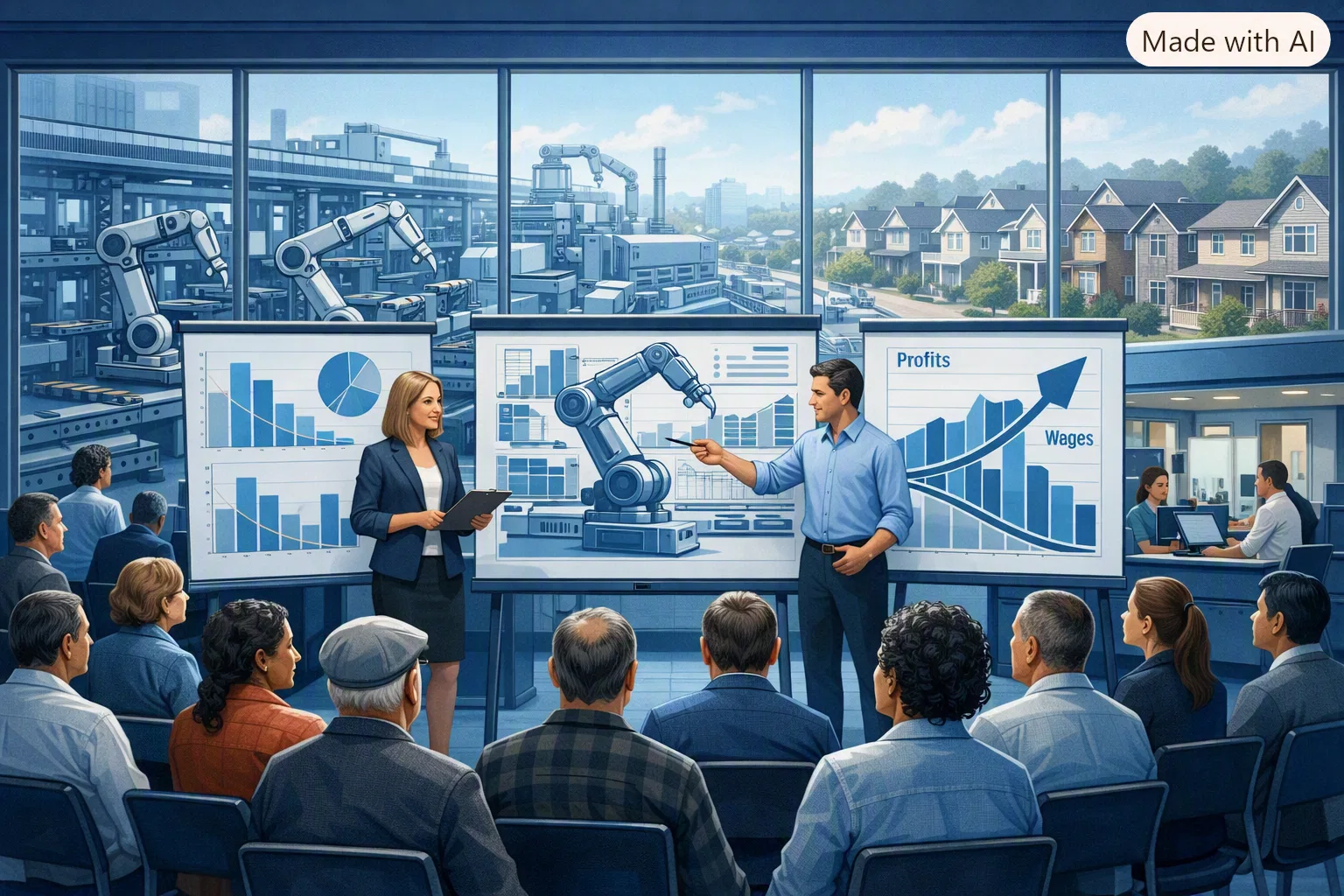
An automated economy does not distribute its gains automatically. If advanced AI and robotics make goods and services dramatically cheaper while replacing much paid labour, the decisive question becomes: who owns the machines, models, data centres, intellectual property and firms that receive the new income? A society can become vastly more productive while many people lose bargaining power, security and control over their lives.
The optimistic AI-bloom case therefore depends on political economy as much as technical capability. Broad prosperity could come through higher wages, shorter working hours, cheaper essentials, stronger public services, social dividends and widespread ownership of productive assets. Narrow prosperity could instead mean extraordinary returns for a small group of shareholders, cloud providers and technology firms, with everyone else dependent on insecure work, tightly controlled platforms or public transfers.
The central policy challenge is not to prevent abundance, but to build institutions that turn productive abundance into universal access, economic independence and democratic power.
Why labour’s share could fall
Most households obtain income chiefly by selling their labour. Companies and wealthy households receive more of their income through ownership: shares, businesses, property, patents and other assets. This arrangement becomes unstable if machines can perform an ever-growing share of economically valuable tasks.
Research on transformative AI shows why the issue could become unusually severe. In economic models where machines can substitute for human workers across nearly all tasks, output may grow extremely quickly while labour’s share of total income falls towards zero. Wages need not literally collapse: scarce human abilities might remain valuable, and rapid growth could raise wages even as capital receives a larger percentage of a much bigger economy. Yet total wages could still become small relative to profits, leaving owners with most of the gains and much of the effective power.[National Bureau of Economic Research]nber.orgUnder almost any stan-dard assumptions, what follows is a radical acceleration to growth and decline in the labor share. 2.1 Growth and l…
This is not a forecast that mass technological unemployment is imminent. The International Labour Organization’s 2025 assessment found that one in four workers worldwide was in an occupation with some exposure to generative AI, but only 3.3 per cent of global employment was in its highest exposure category. Because most occupations contain tasks requiring continued human involvement, the ILO judged job transformation more likely than complete replacement at today’s capability level.[International Labour Organization]ilo.orgInternational Labour OrganizationGenerative AI and Jobs: A Refined Global Index of Occupational Exposure | International Labour Organizat…
Even gradual automation, however, can change the distribution of income before it eliminates many jobs. Firms may reduce entry-level hiring, weaken workers’ negotiating position, outsource remaining tasks or use AI to monitor and intensify work. Exposure also differs from opportunity: IMF analysis suggests that higher earners are often better placed to use AI as a complement, while people with less education may find it harder to move from vulnerable jobs into expanding ones. Capital owners gain through higher profits and asset values even when displaced workers cannot make a comparable transition.[IMF eLibrary]elibrary.imf.orgThe gains in productivity, if strong, could result in higher growth and higher incomes for most workers. Owing to capital deepeni…
The effect will depend partly on what kind of AI businesses choose to build. Systems designed to extend nurses, electricians, teachers, technicians and small firms can raise the productivity and value of human work. Systems designed mainly to reproduce existing jobs with fewer workers transfer more activity from labour to capital. Economists advocating “pro-worker AI” argue that this direction is shaped by research incentives, procurement, taxation and workplace organisation rather than by technological inevitability.[brookings.edu]brookings.eduBuilding pro-worker AI | Brookings* 5 min read… * Full report… Capital-augmenting technologies make machines (e.g., algorithms, processes, innovations) better, cheap…

Ownership decides who receives abundance
Cheaper products are one way productivity gains reach the public. If AI sharply reduces the cost of legal advice, tutoring, diagnosis, manufacturing or administration, people may enjoy higher living standards even without matching wage rises. But falling prices alone are unlikely to settle the distribution problem.
Some essentials cannot be reproduced at negligible cost. Housing, land, energy networks, minerals, physical infrastructure and desirable locations remain scarce. If household income becomes less reliable while ownership of these assets stays concentrated, people may gain abundant digital services yet struggle to secure a home, energy, care or political independence. An economy can therefore appear technologically post-scarcity while retaining acute scarcity in the goods that determine everyday security.
Ownership also affects decision-making. The owner of an AI system can determine its permitted uses, price, access conditions, data practices and whose interests it serves. Where models depend on concentrated supplies of advanced chips, cloud computing and finance, control may rest not only with model developers but with the infrastructure firms behind them. The US Federal Trade Commission found that major cloud–AI partnerships included equity stakes, revenue rights, cloud-spending commitments, preferential access and, in some cases, consultation or control rights. These arrangements may support costly development, but they can also bind emerging AI firms to incumbent platforms.[ftc.gov]ftc.govFor these reasons, the agency’s 6(b) study sought to understand the motivations and impacts of these partnerships on cloud compu…
The OECD describes AI infrastructure markets as complex and often highly concentrated, particularly around accelerator chips and cloud resources. The UK Competition and Markets Authority has likewise warned that firms with strong positions in compute, data, talent, platforms and customer access may be able to shape several layers of the foundation-model market at once.[oecd.org]oecd.orgcomponent 4component 4
That concentration matters far beyond consumer prices. A handful of companies controlling general-purpose AI could influence which industries prosper, which workers are monitored, which research is prioritised and which institutions become technologically dependent. The question “who owns AI?” is therefore partly about wealth, but also about who controls an infrastructure that may mediate education, employment, public administration and access to knowledge.
Income without dependence on a job
If paid employment provides a declining share of national income, governments may need to strengthen other routes by which people obtain purchasing power. No single mechanism is sufficient, and the balance should change as the scale of automation becomes clearer.
Stronger social insurance is the most immediate option. Unemployment protection, wage insurance, portable benefits and transition support can prevent a technological shock from becoming a personal catastrophe. These policies are more targeted than universal payments, although they can leave people navigating complex eligibility rules and may be poorly suited to a world of persistent underemployment rather than temporary job loss.
A guaranteed minimum income or universal basic income would separate a basic level of economic security from employment. This could give people greater freedom to care, study, create, volunteer or refuse abusive work. In a highly automated economy, it could also maintain demand for the goods machines produce. Yet the level and funding matter. A modest payment may reduce hardship without providing genuine independence; a generous payment could require substantial new revenue. IMF scenario work treats broad income support, including UBI-type systems, as increasingly relevant under extreme automation, while cautioning that poorly designed capital taxes can reduce investment and output.[IMF eLibrary]elibrary.imf.orgOpen source on imf.org.
Universal basic services offer a different route. Instead of giving households enough cash to purchase everything privately, government can guarantee healthcare, education, transport, connectivity, housing support and access to AI-enabled public services. This directly converts productivity into capabilities that people can use regardless of income. It can also reduce the amount of cash required for a decent life. The weakness is that badly governed public provision can become rigid, rationed or paternalistic; abundance requires quality, choice and accountability, not merely nominal entitlement.
Shorter working hours can share productivity gains through time rather than only money. If output per hour rises, societies can choose a shorter standard week, longer leave or flexible work across the life course. This preserves a role for employment while making paid labour less dominant in human life. It works best where workers have sufficient bargaining power to prevent reduced hours from simply meaning reduced income.
The durable solution will probably combine these channels. Cash protects choice, services secure essentials, social insurance covers disruption, and reduced working time distributes leisure. Their common purpose is to ensure that loss of market demand for a person’s labour does not mean loss of social membership.
From redistribution to broad ownership
Transfers distribute income after firms have earned it. Broader asset ownership changes who receives the returns in the first place.
One option is a social wealth fund: a publicly or collectively owned portfolio holding shares in companies and other productive assets. Its returns can finance public services or be paid as a citizen dividend. Rather than taxing every future AI profit after it appears, society gradually acquires a direct claim on the expanding capital base.
Such funds can be built through ordinary public investment, taxes paid partly in equity, levies on exceptional profits, public stakes in firms receiving major subsidies, or returns from publicly financed research and infrastructure. Governments already take substantial technological risk by funding universities, energy systems, basic science, defence research and workforce education. Equity or revenue-sharing arrangements can allow the public to share in commercially successful outcomes without requiring the state to manage each company.
A related idea is universal basic capital: giving every citizen a diversified financial endowment or an interest in a national investment fund. Unlike a basic income, which is a continuing payment, basic capital gives people an ownership stake and potentially a voice in how wealth is invested. Recent policy analysis has highlighted citizen funds and structured equity-sharing as ways to distribute AI-era gains more directly than relying solely on wages or retrospective taxation.[brookings.edu]brookings.eduA I growth acceleration versus distributional fairness | BrookingsA I growth acceleration versus distributional fairness | Brookings
Worker ownership can operate at firm level. Profit-sharing, employee share ownership, pension-fund stakes and cooperative structures can ensure that employees benefit when AI raises productivity. These mechanisms are not substitutes for wages or labour rights: workers should not bear excessive risk by holding both their job and savings in one company. Diversified ownership and collective funds are safer than merely paying bonuses in employer stock.
Public ownership may be particularly appropriate for parts of AI infrastructure that have utility-like characteristics. Public or nonprofit compute facilities, shared research clouds and open technical resources can widen access for universities, small firms and public-interest projects. They also prevent every school, hospital or local authority from becoming permanently dependent on a small number of foreign providers. The case is not that governments should operate all AI, but that public capacity can preserve competition, bargaining power and strategic choice.
Taxing the gains without blocking useful automation
Tax systems were largely designed for economies in which human work generated much of the taxable income. If labour’s share falls, governments that depend heavily on payroll and income taxes may face rising demands for support alongside a shrinking traditional tax base.
A blunt “robot tax” sounds intuitive but is hard to define. Software rarely replaces one worker in a clean one-for-one exchange; it may automate some tasks, complement others and create new services. Taxing each machine could discourage beneficial equipment, including systems that make jobs safer or workers more productive. IMF analysis therefore favours strengthening taxation of capital income and excess returns rather than trying to identify and tax individual robots.[IMF]imf.orgFiscal Policy Can Help Broaden the Gains of AI to HumanityFiscal Policy Can Help Broaden the Gains of AI to Humanity
The starting point is to remove tax biases that make replacing workers artificially attractive. In many systems, payroll taxes and other labour charges raise the cost of employing a person, while investment receives accelerated deductions or preferential treatment. OECD work notes that when effective taxes on labour exceed those on capital, the tax system can encourage more automation than underlying productivity alone would justify.[oecd.org]oecd.orgcomponent 7component 7
Possible revenue sources include:
- more consistent taxation of dividends, capital gains and inherited wealth;[imf.org]imf.orgFiscal Policy Can Help Broaden the Gains of AI to HumanityFiscal Policy Can Help Broaden the Gains of AI to Humanity
- corporate tax rules that capture profits where economic activity and users are located;
- taxes on monopoly rents and exceptional profits rather than normal investment returns;
- land and property taxation, because scarce assets may absorb part of the AI dividend;
- consumption taxes combined with rebates or universal payments to protect poorer households;
- public returns on subsidies, procurement, data access and publicly funded innovation.
Each involves trade-offs. Capital and intellectual property can cross borders, governments can compete to attract investment, and excessive taxation may slow productive deployment. Coordination between countries is therefore important. The goal is not to confiscate the reward for innovation but to prevent a situation in which society finances infrastructure, education and research while private owners retain nearly all the upside.
Tax collection itself may also improve with AI. The OECD reports that most member-country tax administrations already use AI or related tools in some form, offering scope to detect evasion, improve compliance and administer more complex systems. These uses require transparency and appeal rights, particularly when automated assessments affect people with limited resources to challenge the state.[oecd.org]oecd.orgai in tax administration 30724e43ai in tax administration 30724e43
Preventing monopoly and political capture
Redistribution becomes harder when the companies being taxed possess enough market and political power to shape the rules. Competition policy is therefore part of distribution policy.
AI markets may naturally reward scale. Larger firms can afford more compute, attract scarce specialists, gather usage data and distribute services through existing platforms. Customers may find it costly to move models, data or applications between cloud providers. Partnerships can spread risk and accelerate development, but they may also give infrastructure incumbents privileged access to emerging competitors. Competition authorities in the UK, United States and European Union have consequently focused on cloud contracts, strategic investments, chips, data access and routes to market.[ftc.gov]ftc.govOpen source on ftc.gov.
Effective intervention does not necessarily mean breaking up every large AI company. It can include interoperability requirements, limits on restrictive cloud contracts, scrutiny of acquisitions and exclusive partnerships, access to essential infrastructure, transparent pricing and rules preventing a platform from favouring its own model unfairly. Public procurement can strengthen smaller suppliers by demanding portability and open standards rather than locking government into a single proprietary ecosystem.
Political capture is a broader danger. Extremely wealthy AI owners could use lobbying, media influence, campaign finance, control of information systems or promises of national technological leadership to weaken oversight. Governments may in turn rely on a small number of firms for defence, administration and critical infrastructure, making regulation more difficult. A flourishing economy therefore needs independent regulators with technical expertise, disclosure of lobbying and public contracts, strong conflict-of-interest rules and institutions capable of evaluating corporate claims without relying entirely on the companies concerned.
International concentration adds another layer. Countries that own advanced models, chips and cloud infrastructure could collect a disproportionate share of global income, while poorer states remain consumers paying rents abroad. The ILO finds that present exposure to generative AI is higher in richer economies, but lower-income countries may also have less infrastructure and institutional capacity to capture complementary gains. Access to affordable compute, technical education, open research and competitive digital markets will matter if AI is to narrow rather than widen global inequality.[International Labour Organization]ilo.orgInternational Labour OrganizationGenerative AI and Jobs: A Refined Global Index of Occupational Exposure | International Labour Organizat…
Surveillance is not a fair price for productivity
Ownership determines not only who earns the profits but how work is governed. AI can help allocate tasks, detect hazards and reduce administrative burdens. It can also measure keystrokes, rank workers, predict behaviour, set demanding targets and automate hiring or dismissal decisions.
An OECD survey of more than 6,000 firms across six countries found algorithmic management already widespread in most of them. Managers often believed it improved decisions, but reported concerns about unclear accountability, difficulty understanding system logic and inadequate protection of worker health. The OECD found that consultation with workers can improve acceptance and help identify risks.[oecd.org]oecd.orgOpen source on oecd.org.
The International Labour Organization similarly warns that digital monitoring and algorithmic management can cause work intensification and psychosocial harm. It recommends involving workers and their representatives in the design, operation and monitoring of workplace systems rather than presenting AI as a finished managerial tool that employees must accept.[International Labour Organization]ilo.orgOpen source on ilo.org.
Practical safeguards include prior impact assessments, limits on intrusive monitoring, an explanation when automated systems materially affect employment, human review and appeal, collective bargaining over deployment, and protection against retaliation for challenging an algorithmic decision. Workers should also have a claim on productivity gains generated from their knowledge and work processes, especially where systems are trained on employee-created materials or detailed records of how they perform their jobs.
Without such rights, “abundance” may mean that people produce more while experiencing less autonomy. Human flourishing requires that AI reduce drudgery without turning the remaining workplace into a system of continuous observation and control.
What a broadly shared AI dividend requires
No government can know precisely how quickly automation will progress. Acting as though mass displacement is certain could waste resources or obstruct valuable technology; waiting until labour income has collapsed would leave institutions trying to rebuild social legitimacy during a crisis.
A credible approach is adaptive. Near-term policy should strengthen competition, labour rights, transition support, public AI capacity and the taxation of capital income. Governments can establish social wealth funds and public stakes before AI profits become overwhelmingly concentrated. They can also prepare income and service systems that scale automatically when unemployment, wage shares or regional disruption cross defined thresholds.
The most important indicators are not simply model benchmarks or headline investment. Policymakers should track labour’s share of income, median wages, working hours, job quality, wealth concentration, market concentration, household access to essential services and the proportion of productivity gains reaching workers and consumers. These measures reveal whether AI is actually broadening human capability or merely increasing the value of scarce assets.
The deeper principle is straightforward: people should benefit from advanced AI not only as consumers who receive cheaper outputs, or as displaced workers who receive compensation, but as citizens with enforceable rights and a meaningful stake in the productive system. An AI economy can support an extraordinary human future only if its gains expand freedom and security across society. Ownership, taxation, public provision, competition and democratic control are the mechanisms that decide whether technological abundance becomes shared flourishing or concentrated power.
Amazon book picks
Further Reading
Books and field guides related to Who Gets the Wealth of an Automated Economy?. Use these as the next step if you want deeper reading beyond the article.
Power and Progress: Our Thousand-Year Struggle Over Technolog...
A bold reinterpretation of economics and history revealing why technology does not inevitably lead to shared prosperity, and how we must...
The Second Machine Age: Work, Progress, and Prosperity in a T...
The big stories -- The skills of the new machines : technology races ahead -- Moore's law and the second half of the chessboard -- The di...
Life 3.0: Being Human in the Age of Artificial Intelligence
'This is the most important conversation of our time, and Tegmark's thought-provoking book will help you join it' Stephen Hawking THE INT...
The Age of Surveillance Capitalism: The Fight for a Human Fut...
An exposé of the unprecedented form of power called “surveillance capitalism,” and the quest by powerful corporations to predict and cont...
eBay marketplace picks
Marketplace Samples
Live-tested eBay searches with available results related to this page.
Selected fromrobotics model oneBay.co.uk.


Endnotes
1.
Source: ilo.org
Link:https://www.ilo.org/publications/generative-ai-and-jobs-refined-global-index-occupational-exposure
Source snippet
International Labour OrganizationGenerative AI and Jobs: A Refined Global Index of Occupational Exposure | International Labour Organizat...
2.
Source: elibrary.imf.org
Link:https://www.elibrary.imf.org/downloadpdf/view/journals/006/2024/001/article-A001-en.pdf
Source snippet
The gains in productivity, if strong, could result in higher growth and higher incomes for most workers. Owing to capital deepeni...
3.
Source: imf.org
Link:https://www.imf.org/-/media/Files/OAP/oap-home/2024/AISDNPPTMarch14.ashx
Source snippet
ISCO stands for International Standard Classification of Occupations. AEs = advanced economics; EMs = emerging markets; LICs = low-income...
4.
Source: brookings.edu
Title: Building pro-worker AI | Brookings
Link:https://www.brookings.edu/articles/building-pro-worker-ai/
Source snippet
* 5 min read... * Full report... Capital-augmenting technologies make machines (e.g., algorithms, processes, innovations) better, cheap...
5.
Source: ftc.gov
Link:https://www.ftc.gov/system/files/ftc_gov/pdf/p246201_aipartnerships6breport_redacted_0.pdf
Source snippet
For these reasons, the agency’s 6(b) study sought to understand the motivations and impacts of these partnerships on cloud compu...
6.
Source: oecd.org
Title: component 4
Link:https://www.oecd.org/en/publications/competition-in-artificial-intelligence-infrastructure_623d1874-en/full-report/component-4.html
7.
Source: GOV.UK
Title: CM A outlines growing concerns in markets for AI Foundation Models
Link:https://www.gov.uk/government/news/cma-outlines-growing-concerns-in-markets-for-ai-foundation-models
8.
Source: elibrary.imf.org
Link:https://www.elibrary.imf.org/view/journals/068/2026/002/article-A001-en.xml
9.
Source: elibrary.imf.org
Title: article A001 en.xml
Link:https://www.elibrary.imf.org/abstract/journals/001/2025/068/article-A001-en.xml
10.
Source: brookings.edu
Title: A I growth acceleration versus distributional fairness | Brookings
Link:https://www.brookings.edu/articles/ai-growth-acceleration-versus-distributional-fairness/
11.
Source: imf.org
Title: Fiscal Policy Can Help Broaden the Gains of AI to Humanity
Link:https://www.imf.org/en/Blogs/Articles/2024/06/17/fiscal-policy-can-help-broaden-the-gains-of-ai-to-humanity
12.
Source: oecd.org
Title: component 7
Link:https://www.oecd.org/en/publications/megatrends-and-the-future-of-social-protection_6c9202e8-en/full-report/component-7.html
13.
Source: oecd.org
Title: ai in tax administration 30724e43
Link:https://www.oecd.org/en/publications/governing-with-artificial-intelligence_795de142-en/full-report/ai-in-tax-administration_30724e43.html
14.
Source: ftc.gov
Link:https://www.ftc.gov/news-events/news/press-releases/2025/01/ftc-issues-staff-report-ai-partnerships-investments-study
15.
Source: GOV.UK
Link:https://www.gov.uk/government/publications/joint-statement-on-competition-in-generative-ai-foundation-models-and-ai-products
16.
Source: oecd.org
Link:https://www.oecd.org/en/publications/how-widespread-is-algorithmic-management-in-workplaces_cda7a114-en/full-report.html
17.
Source: oecd.org
Link:https://www.oecd.org/en/publications/algorithmic-management-in-the-workplace_287c13c4-en.html
18.
Source: ilo.org
Link:https://www.ilo.org/sites/default/files/2025-04/ILO_Safeday25_Report_EN_r8%2B%281%29.pdf
19.
Source: ilo.org
Link:https://www.ilo.org/sites/default/files/2025-04/ILO_Safeday25_Report_r8%2B%282%29%20FULL%20%281%29.pdf
20.
Source: oecd.org
Title: recent policy developments on ai in the labour market c0ffced7 en
Link:https://www.oecd.org/en/publications/recent-policy-developments-on-ai-in-the-labour-market_c0ffced7-en.html
21.
Source: oecd.org
Title: full report
Link:https://www.oecd.org/en/publications/skills-in-the-ai-age_972bd15e-en/full-report.html
22.
Source: GOV.UK
Title: cloud challenge book 2026
Link:https://www.gov.uk/government/publications/cloud-challenge-book-2026/cloud-challenge-book-2026
23.
Source: GOV.UK
Title: cloud challenge book 2026
Link:https://www.gov.uk/government/publications/cloud-challenge-book-2026
24.
Source: brookings.edu
Link:https://www.brookings.edu/articles/ai-workforce-policy-framework/
25.
Source: GOV.UK
Title: annual report on concurrency for 2026
Link:https://www.gov.uk/government/publications/annual-report-on-concurrency-2026/annual-report-on-concurrency-for-2026
26.
Source: ilo.org
Link:https://www.ilo.org/publications/impact-genai-jobs-productivity-and-work-organization-review-empirical
27.
Source: ilo.org
Link:https://www.ilo.org/fr/resource/actualites/ai-driven-intrusive-surveillance-and-loss-autonomy-work-linked-psychosocial
28.
Source: ilo.org
Link:https://www.ilo.org/resource/news/ai-driven-intrusive-surveillance-and-loss-autonomy-work-linked-psychosocial
29.
Source: ilo.org
Link:https://www.ilo.org/resource/news/new-ilo%E2%80%93world-bank-paper-highlights-uneven-global-impact-generative-ai-jobs
30.
Source: brookings.edu
Link:https://www.brookings.edu/articles/how-the-u-s-can-maintain-its-edge-in-ai-without-leaving-workers-behind/
31.
Source: brookings.edu
Link:https://www.brookings.edu/articles/future-tax-policy-a-public-finance-framework-for-the-age-of-ai/
32.
Source: oecd.org
Title: budget and workforce d4c1cec8
Link:https://www.oecd.org/en/publications/2025/11/tax-administration-2025_6360fad8/full-report/budget-and-workforce_d4c1cec8.html
33.
Source: brookings.edu
Title: Boom or bust: How to protect ratepayers from the AI bubble | Brookings
Link:https://www.brookings.edu/articles/boom-or-bust-how-to-protect-ratepayers-from-the-ai-bubble/
34.
Source: brookings.edu
Link:https://www.brookings.edu/articles/fairer-holistic-fiscal-systems-gender-equality-tools/
35.
Source: oecd.org
Link:https://www.oecd.org/en/publications/governing-with-artificial-intelligence_795de142-en/full-report/executive-summary_d73d7ed7.html
36.
Source: brookings.edu
Title: The moral dimension of AI for work and workers | Brookings
Link:https://www.brookings.edu/articles/the-moral-dimension-of-ai-for-work-and-workers/
37.
Source: ftc.gov
Link:https://www.ftc.gov/policy/advocacy-research/tech-at-ftc/2025/01/behind-ftcs-6b-report-large-ai-partnerships-investments
38.
Source: oecd.org
Title: united kingdom c3d387b8 en
Link:https://www.oecd.org/en/publications/job-creation-and-local-economic-development-2024-country-notes_ad2806c1-en/united-kingdom_c3d387b8-en.html
39.
Source: elibrary.imf.org
Title: article A001 en.xml
Link:https://www.elibrary.imf.org/view/journals/001/2024/199/article-A001-en.xml
40.
Source: imf.org
Title: Broadening the Gains from Generative AI: The Role of Fiscal Policies
Link:https://www.imf.org/en/publications/staff-discussion-notes/issues/2024/06/11/broadening-the-gains-from-generative-ai-the-role-of-fiscal-policies-549639
41.
Source: imf.org
Title: Broadening the Gains from Generative AI: The Role of Fiscal Policies
Link:https://www.imf.org/en/publications/staff-discussion-notes/issues/2024/06/11/broadening-the-gains-from-generative-ai-the-role-of-fiscal-policies-549639?cid=sm-com-tw-SDNEA2024002
42.
Source: GOV.UK
Title: www.gov.uk CM A AI strategic update
Link:https://www.gov.uk/government/publications/cma-ai-strategic-update/cma-ai-strategic-update
43.
Source: GOV.UK
Title: www.gov.uk A I Foundation Models: Update paper
Link:https://www.gov.uk/government/publications/ai-foundation-models-update-paper
44.
Source: oecd.org
Title: using ai in the workplace 73d417f9 en
Link:https://www.oecd.org/en/publications/using-ai-in-the-workplace_73d417f9-en.html
45.
Source: elibrary.imf.org
Title: article A001 en.xml
Link:https://www.elibrary.imf.org/view/journals/006/2024/001/article-A001-en.xml
46.
Source: elibrary.imf.org
Title: article A000 en.xml
Link:https://www.elibrary.imf.org/view/journals/006/2024/001/article-A000-en.xml
47.
Source: imf.org
Title: Automation and Welfare: The Role of Bequests and Education
Link:https://www.imf.org/en/publications/wp/issues/2024/01/12/automation-and-welfare-the-role-of-bequests-and-education-543706
48.
Source: GOV.UK
Title: www.gov.uk Cloud services market investigation
Link:https://www.gov.uk/cma-cases/cloud-services-market-investigation
49.
Source: GOV.UK
Title: www.gov.uk CM A launches market investigation into cloud services
Link:https://www.gov.uk/government/news/cma-launches-market-investigation-into-cloud-services
50.
Source: GOV.UK
Title: www.gov.uk A I Foundation Models: Initial report
Link:https://www.gov.uk/government/publications/ai-foundation-models-initial-report
51.
Source: GOV.UK
Link:https://www.gov.uk/government/news/proposed-principles-to-guide-competitive-ai-markets-and-protect-consumers
52.
Source: brookings.edu
Title: How AI-powered software development may affect labor markets | Brookings
Link:https://www.brookings.edu/articles/how-ai-powered-software-development-may-affect-labor-markets/
53.
Source: GOV.UK
Title: www.gov.uk A I Foundation Models: initial review
Link:https://www.gov.uk/cma-cases/ai-foundation-models-initial-review
54.
Source: one.oecd.org
Link:https://one.oecd.org/document/DELSA/ELSA/WD/SEM%282023%297/en/pdf
55.
Source: imf.org
Title: Sharing the Gains of Automation: The Role of Fiscal Policy
Link:https://www.imf.org/en/Blogs/Articles/2021/11/18/sharing-the-gains-of-automation-the-role-of-fiscal-policy
56.
Source: imf.org
Link:https://www.imf.org/en/publications/wp/issues/2021/07/16/for-the-benefit-of-all-fiscal-policies-and-equity-efficiency-trade-offs-in-the-age-of-462133
57.
Source: elibrary.imf.org
Title: 001.2021.issue 187 en.xml
Link:https://www.elibrary.imf.org/view/journals/001/2021/187/001.2021.issue-187-en.xml
58.
Source: elibrary.imf.org
Title: article A001 en.xml
Link:https://www.elibrary.imf.org/view/journals/001/2021/187/article-A001-en.xml
59.
Source: oecd.org
Title: assessment and recommendations 980e99fa
Link:https://www.oecd.org/en/publications/future-proofing-adult-learning-in-london-united-kingdom_c546014a-en/full-report/assessment-and-recommendations_980e99fa.html
60.
Source: oecd.org
Link:https://www.oecd.org/en/publications/future-proofing-adult-learning-in-london-united-kingdom_c546014a-en/full-report/preparing-london-for-the-impact-of-automation-and-technological-change_a2451ae0.html
61.
Source: brookings.edu
Title: How a VAT could tax the rich and pay for universal basic income | Brookings
Link:https://www.brookings.edu/articles/how-a-vat-could-tax-the-rich-and-pay-for-universal-basic-income/
62.
Source: brookings.edu
Link:https://www.brookings.edu/articles/a-new-fiscal-policy-for-a-world-of-accelerated-change-and-artificial-intelligence/
63.
Source: imf.org
Title: fiscal monitor october 2017 tackling inequality 45124
Link:https://www.imf.org/en/publications/fm/issues/2019/09/27/fiscal-monitor-october-2017-tackling-inequality-45124
Published: october 2017
64.
Source: oecd.org
Link:https://www.oecd.org/en/publications/artificial-intelligence-and-competitive-dynamics-in-downstream-markets_ccf0624a-en/full-report.html
65.
Source: oecd.org
Link:https://www.oecd.org/en/publications/competition-in-artificial-intelligence-infrastructure_623d1874-en/full-report.html
66.
Source: oecd.org
Link:https://www.oecd.org/en/publications/artificial-intelligence-markets_d531d73f-en/full-report.html
67.
Source: one.oecd.org
Link:https://one.oecd.org/document/DAF/COMP/M%282025%292/ANN4/FINAL/en/pdf
68.
Source: one.oecd.org
Link:https://one.oecd.org/document/DAF/COMP/M%282025%293/ANN2/FINAL/en/pdf
69.
Source: oecd.org
Link:https://www.oecd.org/en/publications/artificial-intelligence-and-competitive-dynamics-in-downstream-markets_ccf0624a-en/full-report/component-7.html
70.
Source: one.oecd.org
Link:https://one.oecd.org/document/DAF/COMP/GF/WD%282025%2954/en/pdf
71.
Source: oecd.org
Link:https://www.oecd.org/en/publications/competition-in-the-age-of-ai_6f88a1ea-en.html
72.
Source: one.oecd.org
Link:https://one.oecd.org/document/DAF/COMP/GF%282025%294/en/pdf
73.
Source: oecd.org
Link:https://www.oecd.org/en/publications/competition-in-artificial-intelligence-infrastructure_623d1874-en/full-report/component-3.html
74.
Source: oecd.org
Link:https://www.oecd.org/en/publications/competition-in-artificial-intelligence-infrastructure_623d1874-en/full-report/component-6.html
75.
Source: oecd.org
Link:https://www.oecd.org/en/topics/sub-issues/personal-and-property-taxes.html
76.
Source: oecd.org
Link:https://www.oecd.org/en/topics/ai-and-work.html
77.
Source: oecd.org
Link:https://www.oecd.org/en/publications/using-artificial-intelligence-in-the-workplace_840a2d9f-en.html
78.
Source: oecd.org
Link:https://www.oecd.org/en/publications/how-widespread-is-algorithmic-management-in-workplaces_cda7a114-en.html
79.
Source: oecd.org
Link:https://www.oecd.org/en/publications/oecd-employment-outlook-2023_08785bba-en/full-report/social-dialogue-and-collective-bargaining-in-the-age-of-artificial-intelligence_5828691a.html
80.
Source: oecd.org
Link:https://www.oecd.org/en/publications/the-impact-of-ai-on-the-workplace-main-findings-from-the-oecd-ai-surveys-of-employers-and-workers_ea0a0fe1-en.html
81.
Source: oecd.org
Link:https://www.oecd.org/en/publications/the-impact-of-ai-on-the-workplace-evidence-from-oecd-case-studies-of-ai-implementation_2247ce58-en.html
82.
Source: oecd.org
Link:https://www.oecd.org/en/publications/compendium-of-best-practices-for-a-human-centered-development-and-use-of-artificial-intelligence-in-the-world-of-work_inmx2843.html
83.
Source: oecd.org
Link:https://www.oecd.org/en/publications/exploring-win-win-outcomes-of-algorithmic-management_84b59397-en.html
84.
Source: elibrary.imf.org
Link:https://www.elibrary.imf.org/downloadpdf/view/journals/006/2024/001/006.2024.issue-001-en.pdf
85.
Source: imf.org
Link:https://www.imf.org/-/media/files/publications/sdn/2024/english/sdnea2024001.pdf
86.
Source: imf.org
Link:https://www.imf.org/-/media/Files/News/Seminars/2024/12th-statistical-forum/p2sessioniinov20marina-tavaresgenaiartificial-intelligence-and-the-future-of-work.ashx
87.
Source: cef.imf.org
Title: 2024 05 07 Webinar on Gen AI Artificial Intelligence Slides
Link:https://www.cef.imf.org/content/dam/CEF-IMF/CEF-IMF-NewSite/3-News/1-CEFNewsandEvents/3-SeminarsWebinarsandHigh-levelEvents/2024-05-07%20-%20Webinar%20on%20Gen-AI%20Artificial%20Intelligence%20Slides.pdf
88.
Source: elibrary.imf.org
Title: article A001 en
Link:https://www.elibrary.imf.org/downloadpdf/view/journals/001/2025/068/article-A001-en.pdf
89.
Source: ilo.org
Title: generative ai and jobs 2025 update
Link:https://www.ilo.org/publications/generative-ai-and-jobs-2025-update
90.
Source: ilo.org
Link:https://www.ilo.org/sites/default/files/2026-06/Research%20Brief_The%20impact%20of%20GenAi%20on%20jobs%20and%20work%20organization%20a%20review%20of%20empirical%20evidence.pdf
91.
Source: ilo.org
Title: Research brief GenAI 2025 Update
Link:https://www.ilo.org/sites/default/files/2025-05/Research%20brief_GenAI%202025%20Update.pdf
92.
Source: ilo.org
Link:https://www.ilo.org/publications/artificial-intelligence-adoption-and-its-impact-jobs
93.
Source: ilo.org
Title: Research brief FINAL 15May2025 21.05.25 1
Link:https://www.ilo.org/sites/default/files/2025-05/Research%20brief_FINAL_15May2025_21.05.25_1.pdf
94.
Source: ilo.org
Title: Gen AI and Jobs Policy Brief ILO
Link:https://www.ilo.org/sites/default/files/2024-08/GenAI%20and%20Jobs_Policy%20Brief_ILO.pdf
95.
Source: ilo.org
Link:https://www.ilo.org/sites/default/files/2025-05/WP140_web.pdf
96.
Source: ilo.org
Link:https://www.ilo.org/resource/news/one-four-jobs-risk-being-transformed-genai-new-ilo%E2%80%93nask-global-index-shows
97.
Source: ilo.org
Link:https://www.ilo.org/sites/default/files/2026-05/ILC114-I%28B%29-EN.pdf
98.
Source: labordoc.ilo.org
Link:https://labordoc.ilo.org/[discovery
99.
Source: ilo.org
Link:https://www.ilo.org/sites/default/files/2025-04/ILO_Safeday25_Report_EN_r8%20%281%29_compressed_0.pdf
100.
Source: ilo.org
Link:https://www.ilo.org/sites/default/files/wcmsp5/groups/public/%40ed_norm/%40relconf/documents/meetingdocument/wcms_918066.pdf
101.
Source: ilo.org
Link:https://www.ilo.org/publications/revolutionizing-health-and-safety-role-ai-and-digitalization-work
102.
Source: ilo.org
Link:https://www.ilo.org/resource/news/ai-and-digitalization-are-transforming-safety-and-health-work
103.
Source: ilo.org
Link:https://www.ilo.org/sites/default/files/2025-07/wp144_web.pdf
104.
Source: ilo.org
Title: Safeday Report CN
Link:https://www.ilo.org/sites/default/files/2025-04/ILOSafedayReport%20CN.pdf
105.
Source: researchrepository.ilo.org
Title: Revolutionizing health and safety the role
Link:https://researchrepository.ilo.org/esploro/outputs/report/Revolutionizing-health-and-safety-the-role/995649731702676
106.
Source: ftc.gov
Link:https://www.ftc.gov/system/files/ftc_gov/pdf/p246201_aipartnerships6breport_redacted.pdf?_bhlid=7b9c00847453fab2f3c26f0192b87e3443705adf
107.
Source: ftc.gov
Link:https://www.ftc.gov/system/files/ftc_gov/pdf/p246201_aipartnerships6breport_redacted_0.pdf?page=33
108.
Source: ftc.gov
Link:https://www.ftc.gov/reports/ftc-staff-report-ai-partnerships-investments-6b-study
109.
Source: ftc.gov
Link:https://www.ftc.gov/policy/reports/commission-staff-reports
110.
Source: ftc.gov
Link:https://www.ftc.gov/policy/reports/terms/1374
111.
Source: ftc.gov
Title: tech at ftc
Link:https://www.ftc.gov/policy/advocacy-research/tech-at-ftc/2025/01
112.
Source: search.ftc.gov
Title: ferguson ai 6b statement
Link:https://search.ftc.gov/system/files/ftc_gov/pdf/ferguson-ai-6b-statement.pdf
113.
Source: ftc.gov
Link:https://www.ftc.gov/bureau-competition?field_mission_tid=All&page=1&type=All
114.
Source: ftc.gov
Link:https://www.ftc.gov/system/files/ftc_gov/pdf/ai-accomplishments-1.17.25.pdf
115.
Source: brookings.edu
Title: A New Contract with the Middle Class
Link:https://www.brookings.edu/articles/a-new-contract-with-the-middle-class-money/
116.
Source: nber.org
Link:https://www.nber.org/system/files/working_papers/w31815/w31815.pdf
Source snippet
Under almost any stan-dard assumptions, what follows is a radical acceleration to growth and decline in the labor share. 2.1 Growth and l...
117.
Source: competition-policy.ec.europa.eu
Link:https://competition-policy.ec.europa.eu/document/download/c86d461f-062e-4dde-a662-15228d6ca385_nl
118.
Source: competition-policy.ec.europa.eu
Link:https://competition-policy.ec.europa.eu/document/download/79948846-4605-4c3a-94a6-044e344acc33_en?filename=20240723_competition_in_generative_AI_joint_statement_COMP-CMA-DOJ-FTC.pdf&prefLang=fr
119.
Source: competition-policy.ec.europa.eu
Link:https://competition-policy.ec.europa.eu/about/news/joint-statement-competition-generative-ai-foundation-models-and-ai-products-2024-07-23_en
120.
Source: competition-policy.ec.europa.eu
Link:https://competition-policy.ec.europa.eu/document/download/2c70a4f4-2db4-4ed7-aae9-6c005fdcc58e_en?filename=20240628_Competition_in_Virtual_Worlds_and_Generative_AI_conference_programme.pdf&prefLang=sk
121.
Source: competition-policy.ec.europa.eu
Title: eu Virtual Worlds and Generative AI
Link:https://competition-policy.ec.europa.eu/about/reaching-out/virtual-worlds-and-generative-ai_en
122.
Source: competition-policy.ec.europa.eu
Link:https://competition-policy.ec.europa.eu/document/download/2c70a4f4-2db4-4ed7-aae9-6c005fdcc58e_en?filename=20240628_Competition_in_Virtual_Worlds_and_Generative_AI_conference_programme.pdf&prefLang=sl
123.
Source: competition-policy.ec.europa.eu
Link:https://competition-policy.ec.europa.eu/document/download/c86d461f-062e-4dde-a662-15228d6ca385_es
124.
Source: competition-policy.ec.europa.eu
Link:https://competition-policy.ec.europa.eu/document/download/c86d461f-062e-4dde-a662-15228d6ca385_pt
125.
Source: competition-policy.ec.europa.eu
Link:https://competition-policy.ec.europa.eu/document/download/a2ad82d7-2ecf-4c74-bd00-7d751546c514_en?filename=annual-competition-report_2024_report_part2_swd_en.pdf&prefLang=nl
126.
Source: competition-policy.ec.europa.eu
Link:https://competition-policy.ec.europa.eu/system/files/2024-01/20240109_call-for-contributions_virtual-worlds_and_generative-AI.pdf
127.
Source: competition-policy.ec.europa.eu
Title: eu Competition policy briefs
Link:https://competition-policy.ec.europa.eu/publications/competition-policy-briefs_en
128.
Source: competition-policy.ec.europa.eu
Link:https://competition-policy.ec.europa.eu/document/download/ec142ef0-e72b-4483-a253-c35ea722cd3e_en?filename=2024_at_a_glance.pdf
129.
Source: nber.org
Link:https://www.nber.org/system/files/working_papers/w31815/revisions/w31815.rev0.pdf
130.
Source: nber.org
Link:https://www.nber.org/system/files/working_papers/w31815/revisions/w31815.rev2.pdf
131.
Source: nber.org
Link:https://www.nber.org/system/files/working_papers/w31815/revisions/w31815.rev1.pdf
132.
Source: nber.org
Link:https://www.nber.org/papers/w31815
133.
Source: nber.org
Link:https://www.nber.org/papers/w35437
134.
Source: nber.org
Link:https://www.nber.org/system/files/working_papers/w34423/w34423.pdf
135.
Source: nber.org
Link:https://www.nber.org/papers/w34423
Additional References
136.
Source: arxiv.org
Link:https://arxiv.org/html/2601.06343v1
137.
Source: arxiv.org
Link:https://arxiv.org/pdf/2601.06343v1
138.
Source: youtube.com
Title: AI & Inequality | Daron Acemoglu: Big Tech poses risks as AI reshapes society
Link:https://www.youtube.com/watch?v=FLzgjCAXoks
Source snippet
The AI Investment Boom: When Will It Pay Off?...
139.
Source: youtube.com
Title: AI Will Break Capitalism — And No One Is Ready
Link:https://www.youtube.com/watch?v=HQjwc_svP0Q
Source snippet
AI & Inequality | Daron Acemoglu: Big Tech poses risks as AI reshapes society...
140.
Source: arxiv.org
Title: arXiv Resolving the automation paradox: falling labor share, rising wages
Link:https://arxiv.org/abs/2601.06343
141.
Source: youtube.com
Title: The AI Investment Boom: When Will It Pay Off?
Link:https://www.youtube.com/watch?v=JamplHhXONU
Source snippet
A Primer on the Economics of AI from Justin Wolfers...
142.
Source: jvi.org
Link:https://www.jvi.org/fileadmin/jvi_files/News/2024/24WR04_Mar25/SLIDES_JVI_Webinar_24WR04_Artificial_Intelligence_Implications_for_the_Future_of_Work.pdf
143.
Source: economics.mit.edu
Title: Resolving the Automation Paradox Falling Labor Share, Rising Wages
Link:https://economics.mit.edu/sites/default/files/2026-03/Resolving%20the%20Automation%20Paradox%20-%20Falling%20Labor%20Share%2C%20Rising%20Wages.pdf
144.
Source: youtube.com
Title: A Primer on the Economics of AI from Justin Wolfers
Link:https://www.youtube.com/watch?v=pdEgLS5XIQU
145.
Source: shapingwork.mit.edu
Title: Autor Kausik January 2026
Link:https://shapingwork.mit.edu/wp-content/uploads/2026/03/Autor-Kausik-January-2026.pdf
Published: January 2026