Within Rentosertib
What Did Rentosertib's Human Trial Really Prove?
The 12-week trial showed acceptable early safety and a promising lung-function signal, but it did not establish lasting clinical benefit.
On this page
- How the 71 patient trial was designed
- What the safety and lung function results showed
- Why the findings support more testing, not routine treatment
Page outline Jump by section
Introduction
Rentosertib’s phase 2a study is often described as a landmark for AI-designed drugs, but the trial itself made a much narrower claim. It did not show that the drug is an effective treatment for idiopathic pulmonary fibrosis (IPF), nor did it prove that AI has transformed drug development. Instead, it demonstrated that an AI-discovered drug candidate could pass through preclinical development into a properly conducted randomised clinical trial, where it showed an acceptable early safety profile and a promising signal that lung function might improve rather than decline over a short period. Those findings justified larger studies, but they fell well short of establishing lasting clinical benefit.[nature.com]nature.comJune 3, 2025…
Within the broader discussion of AI-enabled scientific acceleration, this distinction matters. The trial provides evidence that AI-generated hypotheses can survive rigorous human testing, but it also illustrates that conventional clinical trials—not computer models—remain the decisive test of whether a medicine works.
How the 71-patient trial was designed
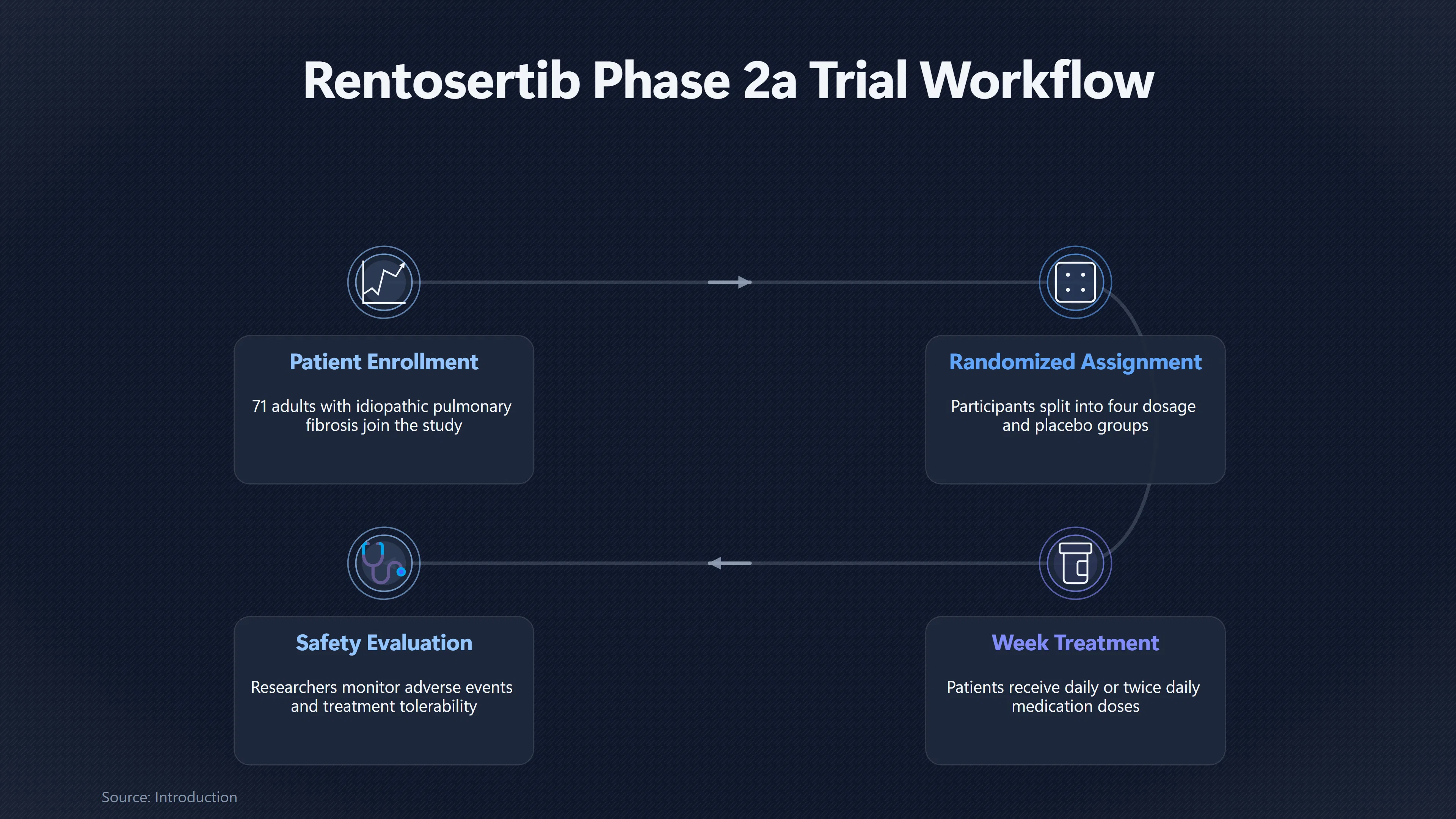
The study was a multicentre, double-blind, randomised, placebo-controlled phase 2a trial involving 71 adults with idiopathic pulmonary fibrosis, a progressive disease in which scarring gradually reduces lung capacity. Participants were randomly assigned to one of four groups:
- 30 mg once daily (18 patients)
- 30 mg twice daily (18 patients)
- 60 mg once daily (18 patients)
- Placebo (17 patients)
Treatment lasted 12 weeks, making this an early proof-of-concept study rather than a definitive assessment of long-term disease progression. The principal objective was safety and tolerability, while measures of lung function and other clinical outcomes were secondary endpoints intended to identify encouraging signals rather than provide conclusive proof of effectiveness.[nature.com]nature.comJune 3, 2025…
That design reflects the normal purpose of a phase 2a trial. Researchers first need to establish that patients can receive the medicine safely before investing in much larger and more expensive studies lasting many months or years.
What the safety results showed
The primary endpoint was achieved. The proportion of patients experiencing at least one treatment-emergent adverse event was broadly similar between the rentosertib groups and the placebo group:
- 72.2% with 30 mg once daily
- 83.3% with 30 mg twice daily
- 83.3% with 60 mg once daily
- 70.6% with placebo
These percentages may appear high, but patients with IPF often experience adverse events during clinical trials regardless of treatment. The important comparison was whether the experimental drug produced substantially worse outcomes than placebo, which it did not on the primary endpoint.[nature.com]nature.comJune 3, 2025…
Researchers nevertheless identified issues that deserve careful monitoring in future studies. Treatment discontinuations were most commonly associated with liver toxicity or diarrhoea, reminding readers that “well tolerated” in clinical research does not mean free of side effects. Instead, it means that the overall balance of risks was considered acceptable for continued investigation in a serious disease with limited treatment options.[nature.com]nature.comJune 3, 2025…
What the lung-function results actually showed
The most widely discussed finding concerned forced vital capacity (FVC), the standard measure of how much air a person can forcibly exhale after taking a deep breath. In IPF, FVC typically declines over time as lung scarring progresses.
After 12 weeks:
- Patients receiving 60 mg once daily showed an average increase of about 98 ml in FVC.
- The placebo group showed an average decline of about 20 ml over the same period.
The lower-dose groups showed smaller effects, with the highest dose producing the clearest improvement.[nature.com]nature.comJune 3, 2025…
This was an encouraging finding because stabilising—or even temporarily improving—lung function is difficult in IPF. However, several important limitations prevent this result from being interpreted as proof that rentosertib slows disease progression.
First, the study involved only 71 patients, so estimates of treatment effect remain uncertain. Second, the observation period lasted just 12 weeks, whereas IPF is a chronic disease that progresses over years. Third, FVC is a useful surrogate measurement, but patients ultimately care about outcomes such as slower long-term decline, fewer hospitalisations, better quality of life and longer survival. The trial was not designed or powered to answer those questions.[nature.com]nature.comJune 3, 2025…
Why the findings support more testing, not routine treatment
The investigators themselves drew a cautious conclusion. Rather than claiming that rentosertib had been proven effective, they argued that the combination of acceptable safety and encouraging lung-function signals warrants larger, longer clinical trials.[nature.com]nature.comJune 3, 2025…
That distinction is fundamental in drug development.
A promising phase 2a study can still be followed by disappointing phase 3 results for many reasons, including:
- early benefits disappearing over longer follow-up;
- side effects becoming more apparent with prolonged treatment;
- apparent treatment effects shrinking in larger populations; or
- improvements in surrogate measures failing to translate into meaningful patient outcomes.
Historically, many drug candidates with encouraging early data have failed in later-stage trials, regardless of whether they were discovered using conventional methods or artificial intelligence. The rentosertib investigators explicitly acknowledge that AI-designed medicines have not yet demonstrated higher success rates in late-stage development than conventional drug candidates.[nature.com]nature.comJune 3, 2025…
What the trial means for AI-designed drugs
The phase 2a trial answers one question much more convincingly than another.
It provides credible evidence that an AI-assisted discovery process can identify both a novel biological target and a candidate drug that survives laboratory testing, regulatory review and randomised evaluation in human patients. That is a meaningful milestone because many AI drug-discovery claims never progress beyond computer models or preclinical experiments.[nature.com]nature.comJune 3, 2025…
At the same time, the study does not demonstrate that AI can reliably produce medicines that outperform conventionally discovered drugs, nor does it show that AI has shortened the difficult clinical testing process. Human trials remain the bottleneck because biology, safety and clinical benefit cannot be established through computation alone.
Within the broader idea of AI accelerating scientific progress, rentosertib therefore serves as an early proof that AI-generated discoveries can enter serious clinical development—not as proof that AI has already solved drug discovery or guaranteed better treatments.
The key takeaway
The strongest conclusion from rentosertib’s phase 2a trial is deliberately modest. The study showed that an AI-discovered medicine could be tested in people, demonstrated an acceptable early safety profile, and produced a promising signal of improved lung function over 12 weeks in patients with idiopathic pulmonary fibrosis.[nature.com]nature.comJune 3, 2025…
What it did not show is equally important. It did not establish durable clinical benefit, prove that patients live longer or feel better, or justify routine clinical use. The trial represents an encouraging step in the long process of drug development—a reason to conduct larger and longer studies, rather than a final verdict on either rentosertib or the broader promise of AI-designed medicines.[nature.com]nature.comJune 3, 2025…
Amazon book picks
Further Reading
Books and field guides related to What Did Rentosertib's Human Trial Really Prove?. Use these as the next step if you want deeper reading beyond the article.
The Drug Hunters: The Improbable Quest to Discover New Medicines
The surprising, behind-the-scenes story of how our medicines are discovered, told by a veteran drug hunter. The search to find medicines...
The Billion Dollar Molecule: One Company's Quest for the Perf...
First published 1994. Subjects: Pharmaceutical biotechnology, Pharmaceutical industry, United States, Vertex Pharmaceuticals Incorporated...
The Emperor of All Maladies: A Biography of Cancer
A historical assessment of cancer addresses both the courageous battles against the complex disease and the misperceptions and hubris tha...

Deep Medicine: How Artificial Intelligence Can Make Healthcar...
First published 2019. Subjects: Artificial intelligence, Medical informatics, Medical applications, Diagnosis, Data processing.
eBay marketplace picks
Marketplace Samples
Live-tested eBay searches with available results related to this page.
Selected frommolecule model oneBay.co.uk.


Endnotes
1.
Source: nature.com
Link:https://www.nature.com/articles/s41591-025-03743-2
Source snippet
June 3, 2025...
Published: June 3, 2025
2.
Source: nature.com
Link:https://www.nature.com/articles/s41591-025-03928-9
Additional References
3.
Source: pubmed.ncbi.nlm.nih.gov
Link:https://pubmed.ncbi.nlm.nih.gov/40461817/
Source snippet
A generative AI-discovered TNIK inhibitor for idiopathic pulmonary fibrosis: a randomized phase 2a trial - PubMed...
4.
Source: publications.ersnet.org
Link:https://publications.ersnet.org/highwire_display/entity_view/node/708745/full
Source snippet
ERS PublicationsRentosertib, a generative AI-discovered TNIK inhibitor improves lung function in IPF patients | European Respiratory Society...
5.
Source: sciencearena.org
Link:https://www.sciencearena.org/en/news/pulmonary-fibrosis-ai-developed-drug-shows-promising-early-results/
Source snippet
June 17, 2026 — 17.06.2026 Artificial Intelligence PULMONARY FIBROSIS: AI-DEVELOPED DRUG SHOWS PROMISING EARLY RESULTS Clinical trial ind...
Published: June 17, 2026
6.
Source: doi.org
Link:https://doi.org/10.1038/s41591-025-03743-2
Source snippet
A generative AI-discovered TNIK inhibitor for idiopathic pulmonary fibrosis: a randomized phase 2a trial | Nature Medicine...
7.
Source: readingtheevidence.org
Title: The First AI-Designed Drug Reached Phase 2a: What the Trial Actually Showed | Dr
Link:https://readingtheevidence.org/articles/first-ai-designed-drug-phase-2a-readout/
Source snippet
Damon TojjarApril 27, 2026 — THE FIRST AI-DESIGNED DRUG REACHED PHASE 2A: WHAT THE TRIAL ACTUALLY SHOWED By Dr. Damon Tojjar27 April 2026...
Published: April 27, 2026
8.
Source: intuitionlabs.ai
Title: IN S018_055 Phase IIa Results: First AI-Designed Drug | Intuition Labs
Link:https://intuitionlabs.ai/articles/ins018-055-phase-2a-results-ai-designed-drug
Source snippet
INS018_055 Phase IIa Results: First AI-Designed Drug | IntuitionLabsApril 19, 2026 — INS018_055 PHASE IIA RESULTS: FIRST AI-DESIGNED DRUG...
Published: April 19, 2026
9.
Source: youtube.com
Link:https://www.youtube.com/watch?v=lLuEl3icc1M
Source snippet
China's INSANE AI Discovered a Drug in 48 Hours — America Spent Years Chasing It...
10.
Source: youtube.com
Title: The AI that discovered a real drug in 30 months (that Big Pharma noticed)
Link:https://www.youtube.com/watch?v=wMEXLz_OOOw
Source snippet
Alex Zhavoronkov: Beating Aging, Designing Drugs and Betting on China | Frameshifts Episode #12...
11.
Source: fibrosis-inflammation.com
Title: GENESIS-IPF Ph2a FVC +
Link:https://www.fibrosis-inflammation.com/en/insights/drug_rentosertib_tnik
Source snippet
Rentosertib (TNIK Inhibitor): First AI-Discovered IPF Drug | Accelerate Your Fibrosis ResearchMay 5, 2026 —...
Published: May 5, 2026
12.
Source: communities.springernature.com
Title: ai meets ipf taking an ai designed drug from target discovery to phase iia
Link:https://communities.springernature.com/posts/ai-meets-ipf-taking-an-ai-designed-drug-from-target-discovery-to-phase-iia