Within Distribution
Can Wages Keep Up With Machine Owned Growth?
AI can raise total output while shifting a growing share of income from workers to the owners of capital.
On this page
- How near total task substitution changes income flows
- Why wages can rise while labour still loses power
- Which workers and occupations face the greatest pressure
Page outline Jump by section
Introduction
An AI-driven economy can become far richer while leaving many workers with a smaller claim on that new wealth. This is the central concern behind a falling labour share of income: the proportion of national income paid as wages, salaries and other compensation to workers rather than to the owners of businesses, machines, software and intellectual property.
This distinction matters because most households still depend primarily on wages. If advanced AI and robotics perform an increasing share of economically valuable work, more income may flow to the owners of productive assets instead. Even if average wages continue to rise in absolute terms because the economy grows rapidly, workers can still lose influence, bargaining power and long-term security if profits grow much faster than pay. Understanding this mechanism is essential to judging whether AI could produce genuine human flourishing or an economy where abundance exists but ownership is concentrated.
How near-total task substitution changes income flows
The key mechanism is not simply “robots replacing jobs”. It is the gradual transfer of productive tasks from people to capital.
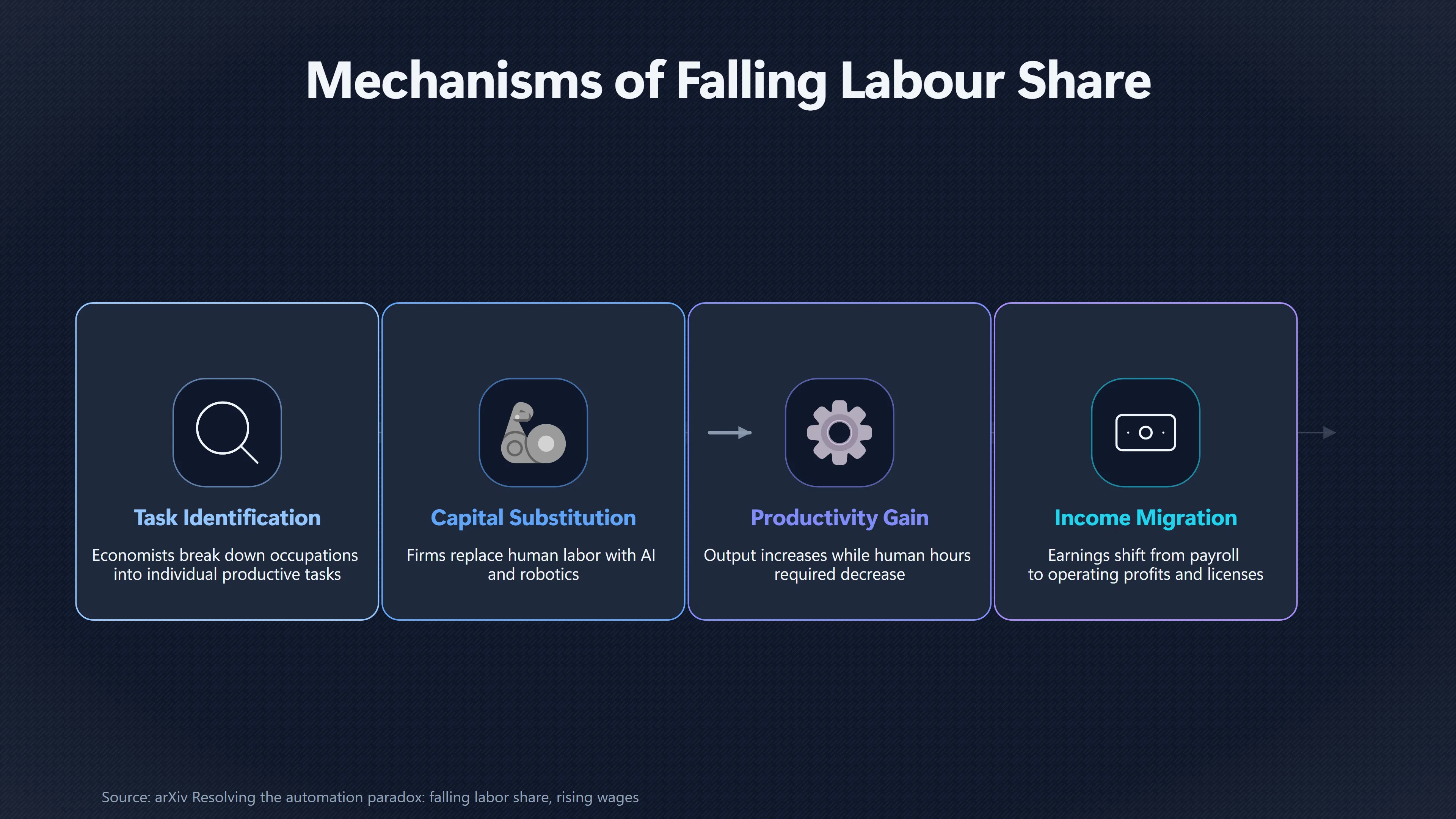
Economists increasingly analyse production as a collection of individual tasks rather than whole occupations. When AI or robotics become capable of performing tasks that humans previously carried out, firms can substitute capital for labour. The immediate effect is higher productivity. The distributional effect is that income generated by those tasks increasingly accrues to whoever owns the technology rather than to employees. This “task-based” framework has become one of the leading ways economists study automation and labour markets.[National Bureau of Economic Research]nber.orgOpen source on nber.org.
In today’s economy, most occupations combine many different activities. A solicitor researches cases, interviews clients, negotiates settlements and appears in court. A nurse records observations, comforts patients, administers medication and makes clinical judgements. Current AI usually automates only some of these activities. As systems improve, however, they may perform a growing fraction of economically valuable tasks within many occupations.
If enough tasks migrate to machines, firms require fewer hours of human labour to produce the same output. Income that previously appeared on payroll increasingly appears as operating profits, returns to shareholders, software licensing income or payments for computing infrastructure.
The mechanism does not require mass unemployment. Even modest reductions in hiring, fewer entry-level opportunities, greater use of contractors, or smaller workforces managing larger automated systems can gradually shift national income towards capital.
Why wages can rise while labour still loses power
A common misunderstanding is that a falling labour share automatically means workers become poorer.
The two ideas are different.
Imagine an economy producing £100 of output, with £60 paid as wages and £40 as profits. Labour’s share is therefore 60%.
Now suppose AI doubles total output to £200. Wages rise to £80, but profits rise to £120.
Workers are earning more than before (£80 instead of £60), yet labour’s share has fallen to 40%. Capital owners receive most of the additional wealth.
This distinction explains why economists sometimes argue that automation can simultaneously:
- increase productivity;
- increase average wages;[nber.org]nber.orgSource details in endnotes.
- reduce labour’s share of income; and
- increase wealth inequality.
Recent theoretical work reinforces this point. Under some economic conditions, further automation can raise real wages while still reducing labour’s share because overall output expands even faster than labour income. The political and social challenge is therefore not simply whether wages rise, but whether workers continue to receive a meaningful share of an increasingly productive economy.[arXiv]arxiv.orgarXiv Resolving the automation paradox: falling labor share, rising wagesResolving the automation paradox: falling labor share, rising wagesJanuary 9, 2026…
For households that rely almost entirely on employment income, relative shares matter because savings, home ownership and investment returns remain concentrated among wealthier groups. If profits increasingly drive income growth, ownership becomes more important than work as the route to prosperity.
Which workers and occupations face the greatest pressure
Evidence so far does not suggest that AI is eliminating most jobs outright. Instead, exposure varies considerably across occupations and tasks.
The International Labour Organization estimates that around one quarter of workers globally are employed in occupations with some degree of exposure to generative AI. However, only a much smaller proportion of employment falls into categories where automation could become highly significant. For most occupations, AI is expected to transform work rather than eliminate it entirely.[International Labour Organization]ilo.orggenerative ai and jobs 2025 updateInternational Labour OrganizationGenerative AI and jobs: A 2025 update | International Labour OrganizationMay 20, 2025…
Pressure is likely to be greatest where work involves large volumes of structured information processing, routine documentation or standardised communication. Administrative support, clerical work, bookkeeping, customer service and some professional support roles often contain many tasks that current AI systems already perform effectively.
Highly educated workers are not automatically protected. IMF research finds that advanced economies have greater occupational exposure because larger shares of their workforce perform cognitive work suitable for AI assistance. Higher-income professionals often occupy roles with both high exposure and high potential for productivity gains, meaning outcomes depend heavily on whether AI complements or substitutes for their expertise.[IMF]imf.orgLabor Market Exposure to AI: Cross-country Differences and Distributional ImplicationsOctober 4, 2023…
The distinction between substitution and augmentation is crucial:
- Augmentation allows workers to complete more valuable work with AI assistance.
- Substitution removes human involvement from tasks altogether.
Two occupations with similar technical exposure may therefore experience very different economic outcomes depending on how organisations redesign work.

Bargaining power changes before employment disappears
Labour’s share can decline even if unemployment remains relatively low.
Employers gain bargaining power whenever workers become easier to replace or when AI reduces the scarcity of particular skills.
This can appear through several channels:
- slower wage growth despite rising productivity;
- reduced hiring for junior roles;
- greater use of temporary or freelance contracts;
- increased workplace monitoring through AI systems;
- more standardised workflows that reduce worker discretion.
These changes may weaken employees’ negotiating position long before technology completely replaces anyone.
Recent research examining how firms adopt generative AI suggests that organisations adjust both by redesigning existing jobs and by changing where they hire, with early evidence that senior and junior positions experience these adjustments differently. Rather than a sudden collapse in employment, labour markets may undergo gradual organisational restructuring.[arXiv]arxiv.orgarXiv Generative AI and the Reorganization of Labor DemandGenerative AI and the Reorganization of Labor DemandMay 22, 2026…
This gradual process helps explain why labour’s share can drift downward over many years instead of collapsing suddenly.
Why technology does not determine the outcome
Automation does not mechanically reduce labour’s share forever.
The same task-based framework identifies an important countervailing force: the creation of entirely new human tasks.
Historically, technological change has both displaced existing work and generated new occupations, industries and forms of expertise. Automation lowers labour demand in some tasks, but innovation can also create new activities where humans retain comparative advantages. These “reinstatement effects” can increase labour demand and raise labour’s share again if enough new work emerges.[National Bureau of Economic Research]nber.orgOpen source on nber.org.
Whether AI follows this historical pattern remains uncertain.
Optimists argue that AI will create entirely new industries, scientific fields, creative professions and service sectors that are difficult to predict today. Pessimists argue that sufficiently capable AI could automate many of those new tasks as well, making the historical adjustment mechanism weaker than during previous technological revolutions.
The answer depends less on AI alone than on the interaction between technological progress, entrepreneurship, education and institutional adaptation.

Why the design of AI matters
Not all AI systems affect labour’s share in the same way.
Researchers increasingly distinguish between AI designed primarily to replace workers and AI designed to make workers substantially more productive.
A nurse equipped with excellent diagnostic assistance may care for more patients while remaining central to healthcare delivery. An electrician using AI-generated wiring plans may complete more complex projects. A teacher using personalised tutoring software may spend more time on mentoring and less on routine administration.
In these cases, AI raises the productivity of labour rather than replacing it.
By contrast, systems developed mainly to reproduce existing work with minimal human involvement transfer productive activity directly towards capital ownership.
This is why economists such as Daron Acemoglu have argued for “pro-worker AI”: technologies that expand human capability instead of maximising labour substitution. The direction of innovation is influenced by research funding, tax systems, procurement choices, workplace organisation and competition policy, not by technological capability alone.[The Atlantic]theatlantic.comThe Atlantic Automation Led to Economic MiseryAI Doesn't Have To.3 days ago — Over the past four decades, digital automation has increased productivity but also deepened economic ineq…
What this means for an AI-enabled future
For the broader vision of AI-enabled abundance, the labour share question is fundamentally about access rather than productivity.
An economy where AI produces extraordinary wealth but directs most new income towards owners of computing infrastructure, algorithms and intellectual property could still generate cheap goods and impressive scientific advances. Yet households that rely mainly on wages might experience declining economic independence even as society becomes richer overall.
Conversely, if AI primarily complements workers, creates valuable new human roles and is paired with broader ownership of productive capital, rising productivity could strengthen rather than weaken labour’s position.
The future therefore depends not only on how capable AI becomes, but also on how economic institutions distribute the returns from that capability. A flourishing AI economy requires more than abundant production. It also requires mechanisms that allow ordinary people to participate meaningfully in the income generated by increasingly intelligent machines.
Amazon book picks
Further Reading
Books and field guides related to Can Wages Keep Up With Machine Owned Growth?. Use these as the next step if you want deeper reading beyond the article.
Power and Progress
A bold reinterpretation of economics and history revealing why technology does not inevitably lead to shared prosperity, and how we must...
A World Without Work
NOMINATED FOR THE FT & McKINSEY BUSINESS BOOK OF THE YEAR AWARDS 2020 'A path-breaking, thought-provoking and in-depth study of how new t...
The Second Machine Age
A New York Times Bestseller. A “fascinating” (Thomas L. Friedman, New York Times) look at how digital technology is transforming our work...
The Age of Em
Robots may one day rule the world, but what is a robot-ruled Earth like? Many think the first truly smart robots will be brain emulations...
eBay marketplace picks
Marketplace Samples
Live-tested eBay searches with available results related to this page.
Selected fromrobot model oneBay.co.uk.




Endnotes
1.
Source: arxiv.org
Title: arXiv Resolving the automation paradox: falling labor share, rising wages
Link:https://arxiv.org/abs/2601.06343
Source snippet
Resolving the automation paradox: falling labor share, rising wagesJanuary 9, 2026...
Published: January 9, 2026
2.
Source: imf.org
Link:https://www.imf.org/en/publications/wp/issues/2023/10/04/labor-market-exposure-to-ai-cross-country-differences-and-distributional-implications-539656
Source snippet
Labor Market Exposure to AI: Cross-country Differences and Distributional ImplicationsOctober 4, 2023...
Published: October 4, 2023
3.
Source: arxiv.org
Title: arXiv Generative AI and the Reorganization of Labor Demand
Link:https://arxiv.org/abs/2605.23159
Source snippet
Generative AI and the Reorganization of Labor DemandMay 22, 2026...
Published: May 22, 2026
4.
Source: imf.org
Title: Aggregate Gains from AI and Their [Distribution]({{ ‘distribution/’ | relative_url }}): Global Evidence from Usage Data
Link:https://www.imf.org/en/publications/wp/issues/2026/07/10/aggregate-gains-from-ai-and-their-distribution-global-evidence-from-usage-data-577586
Source snippet
July 10, 2026 — AGGREGATE GAINS FROM AI AND THEIR DISTRIBUTION: GLOBAL EVIDENCE FROM USAGE DATA ByRachel Yuting Fan, Ha Minh Nguyen July...
Published: July 10, 2026
5.
Source: elibrary.imf.org
Title: article A001 en.xml
Link:https://www.elibrary.imf.org/view/journals/001/2023/216/article-A001-en.xml
6.
Source: nber.org
Link:https://www.nber.org/papers/w25684
7.
Source: ilo.org
Title: generative ai and jobs 2025 update
Link:https://www.ilo.org/publications/generative-ai-and-jobs-2025-update
Source snippet
International Labour OrganizationGenerative AI and jobs: A 2025 update | International Labour OrganizationMay 20, 2025...
Published: May 20, 2025
8.
Source: ilo.org
Link:https://www.ilo.org/resource/other/what-possible-effect-generative-ai-employment
9.
Source: theatlantic.com
Title: The Atlantic Automation Led to Economic Misery
Link:https://www.theatlantic.com/ideas/2026/07/ai-automation-productivity-workers/688083/
Source snippet
AI Doesn't Have To.3 days ago — Over the past four decades, digital automation has increased productivity but also deepened economic ineq...
10.
Source: ilo.org
Title: Disruption without dividend?
Link:https://www.ilo.org/publications/disruption-without-dividend-how-digital-divide-and-task-differences-split
11.
Source: ilo.org
Link:https://www.ilo.org/publications/gen-ai-occupational-segregation-and-gender-equality-world-work
12.
Source: ilo.org
Link:https://www.ilo.org/resource/news/new-ilo-data-confirm-women-face-higher-workplace-risks-generative-ai-men
13.
Source: ilo.org
Link:https://www.ilo.org/resource/article/how-might-generative-ai-impact-different-occupations
14.
Source: ilo.org
Link:https://www.ilo.org/resource/news/one-four-jobs-risk-being-transformed-genai-new-ilo%E2%80%93nask-global-index-shows
15.
Source: nber.org
Link:https://www.nber.org/papers/w32190
16.
Source: nber.org
Link:https://www.nber.org/papers/w24196
17.
Source: nber.org
Link:https://www.nber.org/papers/w22252
18.
Source: researchrepository.ilo.org
Title: Generative AI and jobs a 2025
Link:https://researchrepository.ilo.org/esploro/outputs/encyclopediaEntry/Generative-AI-and-jobs-a-2025/995653517302676
19.
Source: nber.org
Link:https://www.nber.org/papers/w24871
20.
Source: nber.org
Link:https://www.nber.org/papers/w24321
21.
Source: nber.org
Link:https://www.nber.org/books-and-chapters/economics-artificial-intelligence-agenda/artificial-intelligence-automation-and-work
22.
Source: nber.org
Link:https://www.nber.org/papers/w34994
23.
Source: nber.org
Link:https://www.nber.org/papers/w34854
24.
Source: nber.org
Link:https://www.nber.org/papers/w26658
Additional References
25.
Source: data.london.gov.uk
Link:https://data.london.gov.uk/blog/londons-workforce-exposure-to-generative-artificial-intelligence
Source snippet
2. 3. Blog 4. 5. London’s workforce exposure to generative artificial intelligence London’s workforce exposure to generati...
26.
Source: youtube.com
Title: Artificial Intelligence and Its Impact on Labor-Intensive Economic Sectors
Link:https://www.youtube.com/watch?v=vE0g9qPTJro
Source snippet
Andrew Yang: Universal [Basic Income]({{ 'basic-income/' | relative_url }}) to Offset Job Losses Due to Automation...
27.
Source: youtube.com
Link:https://www.youtube.com/watch?v=6osZMY7Gfz0
Source snippet
If AI Replaces Workers, What Happens to Capitalism?...
28.
Source: youtube.com
Title: The Future of Work: AI, Automation, and Human Potential
Link:https://www.youtube.com/watch?v=mnAlseMLkUI
Source snippet
Daron Acemoglu on Automation and the Inappropriateness of 21st century technology...
29.
Source: brookings.edu
Link:https://www.brookings.edu/articles/is-automation-labor-displacing-productivity-growth-employment-and-the-labor-share/
30.
Source: brookings.edu
Link:https://www.brookings.edu/articles/will-robots-make-job-training-and-workers-obsolete-workforce-development-in-an-automating-labor-market/
31.
Source: brookings.edu
Title: Understanding the impact of automation on workers, jobs, and wages | Brookings
Link:https://www.brookings.edu/articles/understanding-the-impact-of-automation-on-workers-jobs-and-wages/
32.
Source: brookings.edu
Title: Generative AI, the American worker, and the future of work | Brookings
Link:https://www.brookings.edu/articles/generative-ai-the-american-worker-and-the-future-of-work/
33.
Source: aeaweb.org
Title: Not a Typical Firm: Capital–Labor Substitution and Firms’ Labor Shares
Link:https://www.aeaweb.org/articles?id=10.1257%2Fmac.20230325
34.
Source: benton.org
Title: Building pro-worker AI | Benton Institute for Broadband & Society
Link:https://www.benton.org/headlines/building-pro-worker-ai