Within Active Learning
How One Experiment Chooses the Next
In a closed-loop laboratory, robots run an AI-selected experiment and feed the result straight back into the model for the next decision.
On this page
- The closed loop cycle from prediction to measurement
- How robotic laboratories learn from failed experiments
- Practical limits from equipment, materials and safety
Page outline Jump by section
Introduction
An autonomous laboratory does more than automate repetitive tasks. It links artificial intelligence, robotic equipment and scientific instruments into a closed loop in which every experimental result immediately influences what happens next. Instead of waiting days or weeks for researchers to analyse data and design follow-up work, the laboratory can measure an outcome, update its model of the problem and select the next experiment while the equipment is still available. This is the practical implementation of active learning: using each new piece of evidence to make the next experiment more informative than the last. If such systems become reliable across many scientific fields, they could help accelerate discovery in areas such as clean energy, advanced materials and medicine, making scientific progress itself faster rather than simply automating individual laboratory tasks.[nature.com]nature.comJanuary 30, 2023…
The Closed-Loop Cycle from Prediction to Measurement
A conventional research project often follows a slow rhythm. Scientists plan a batch of experiments, carry them out, analyse the results, discuss what happened and only then decide what to try next. Even highly automated equipment may sit idle while people interpret data.
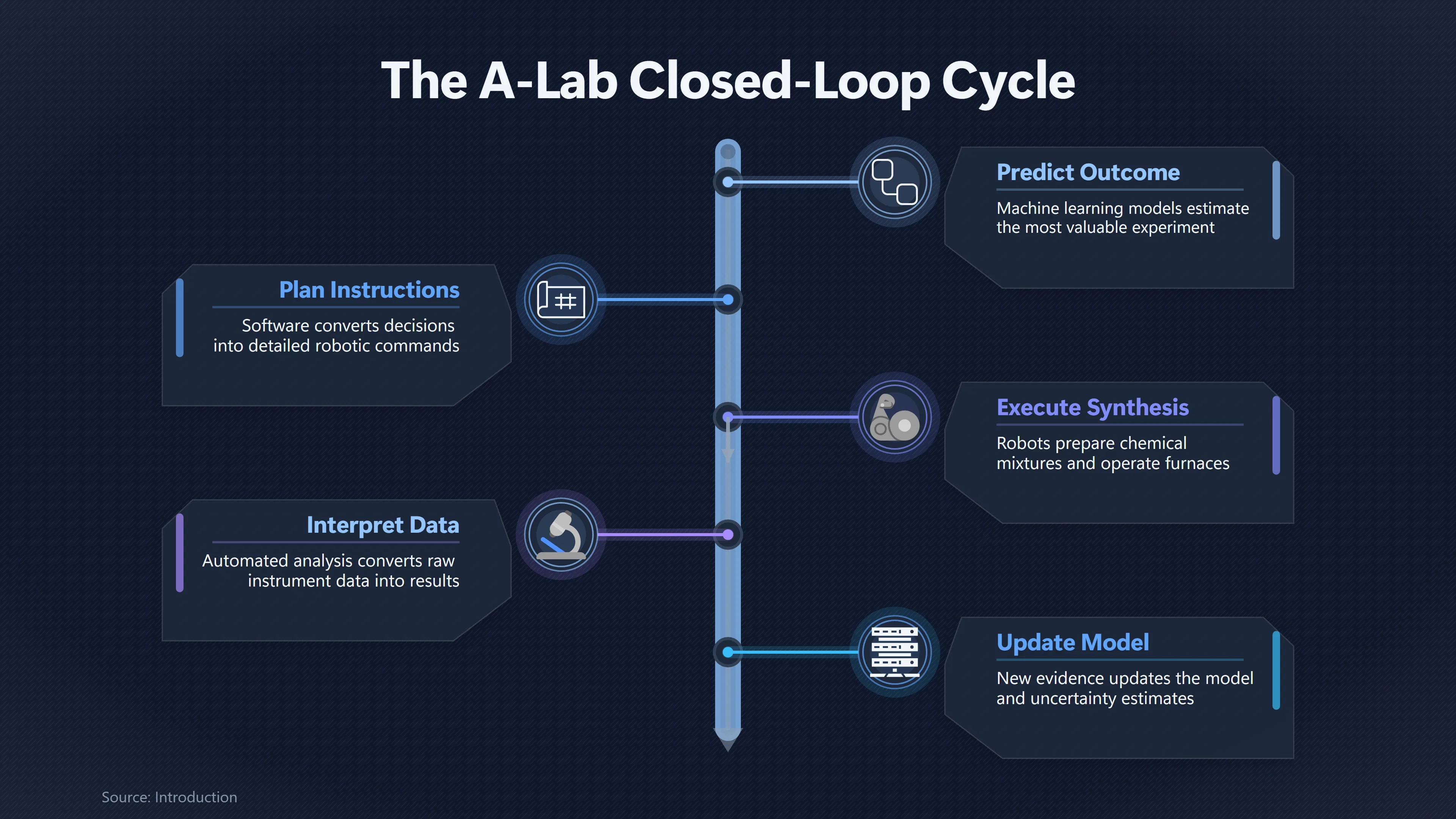
A closed-loop laboratory compresses these stages into a continuous cycle:
- Predict. A machine-learning model estimates which experiment is likely to be most valuable.
- Plan. Software converts that decision into detailed instructions for robotic equipment.
- Execute. Robots prepare samples, run reactions or measurements and collect observations.
- Interpret. Automated analysis converts raw instrument data into scientifically useful results.
- Update. The new evidence is added to the model, changing both its predictions and its uncertainty.
- Choose again. The system immediately selects the next experiment.
Because every iteration changes the model, the research strategy evolves continuously rather than following a fixed experimental schedule.[nature.com]nature.comOpen source on nature.com.
The important point is that the laboratory is not simply repeating predefined procedures. It is adapting its behaviour in response to evidence. In that sense, the laboratory becomes an experimental decision-making system rather than only an automated factory for producing data.
Why Immediate Feedback Matters
Many scientific searches involve enormous spaces of possible experiments. Whether researchers are adjusting catalyst compositions, battery chemistries or synthesis temperatures, only a tiny fraction of possibilities can ever be tested.
Immediate feedback improves this search in several ways.
- It avoids spending resources on experimental directions that already appear unpromising.
- It identifies unexpected successes early enough to investigate them while the campaign is still running.
- It allows uncertainty estimates to change after every measurement instead of after an entire batch.
- It concentrates expensive laboratory time where each experiment is expected to add the most knowledge.
The benefit is often not that individual experiments become faster. Instead, the overall research campaign becomes more efficient because fewer experiments are effectively wasted. This distinction is central to the promise of autonomous laboratories within the broader idea of AI-driven scientific acceleration.[NIST]nist.govfly closed loop materials discovery bayesian active learningOn-the-fly closed-loop materials discovery via Bayesian active learning | NISTNovember 24, 2020…
How Robotic Laboratories Learn from Failed Experiments
Perhaps the most important feature of autonomous laboratories is that unsuccessful experiments are treated as valuable information rather than discarded mistakes.
Human researchers naturally learn from failure, but this learning can be informal and difficult to quantify. Closed-loop systems instead record every unsuccessful attempt in a structured form that immediately updates the predictive model.
For example, if a synthesis produces the wrong crystal phase, lower-than-expected yield or an unstable compound, the laboratory does not merely log the failure. The result changes the estimated relationships between materials, processing conditions and outcomes. The next recommendation therefore avoids repeating identical failures while exploring nearby alternatives that remain plausible.
The developers of the A-Lab autonomous materials platform explicitly describe this philosophy as helping researchers “fail smarter”. Rather than seeing failed syntheses as dead ends, the system analyses why they failed and proposes modified reaction pathways with better thermodynamic prospects. During a 17-day autonomous campaign, active learning repeatedly redesigned synthesis recipes after unsuccessful attempts, improving yields for several target materials that initially failed entirely.[nature.com]nature.comOpen source on nature.com.
This illustrates a subtle but important difference from ordinary automation. A robot following fixed instructions simply repeats mistakes efficiently. An autonomous laboratory changes its future behaviour because mistakes become new training data.
A Real Example: Materials Discovery in the A-Lab
One of the clearest demonstrations of a closed-loop laboratory comes from the A-Lab autonomous materials synthesis platform.
The system combines several components:
- computational predictions of promising new materials,
- machine learning trained on previous synthesis literature,
- robotic preparation of chemical mixtures,
- automated furnace operation,
- robotic transfer between instruments,
- X-ray diffraction measurements,
- machine-learning interpretation of those measurements, and
- active learning that redesigns future synthesis recipes.
Rather than stopping after one unsuccessful synthesis, the platform analyses the measured phases, estimates why the target compound failed to form and proposes a revised experiment. These improved recipes are then executed automatically, creating another feedback cycle.
During continuous operation over 17 days, the laboratory carried out hundreds of experiments and successfully synthesised 36 previously selected inorganic compounds. Equally important, analysis of unsuccessful targets revealed weaknesses in both synthesis procedures and computational assumptions, providing information for improving future decision-making algorithms.[nature.com]nature.comOpen source on nature.com.
This demonstrates that autonomous laboratories are not replacing scientific reasoning. They are embedding parts of that reasoning into an iterative experimental workflow.
Practical Limits from Equipment, Materials and Safety
Although the idea of a self-driving laboratory can sound general, today’s autonomous systems remain specialised.
Most successful demonstrations focus on tightly defined scientific problems with carefully chosen equipment and well-characterised workflows. They perform best when:
- experiments can be standardised,
- measurements are automatically interpretable,
- robotic manipulation is reliable,
- safety constraints are well understood, and
- the search space is large enough for active learning to provide measurable advantages.
Many areas of laboratory science do not yet satisfy these conditions. Biological systems may behave unpredictably, chemical reactions may require delicate manual judgement, and some instruments still cannot be fully automated. Complex multi-stage procedures also introduce opportunities for robotic failure that are uncommon in computational simulations.[nature.com]nature.comJanuary 30, 2023…
Safety adds another constraint. Autonomous decision-making does not mean unrestricted experimentation. Chemical compatibility, operating temperatures, hazardous materials, equipment limits and regulatory requirements all restrict which experiments the AI is permitted to propose. In practice, these constraints become part of the optimisation problem itself, preventing the system from selecting experiments that would be physically unsafe or experimentally infeasible.[nature.com]nature.comJuly 8, 2026…
Why Human Scientists Still Matter
Autonomous laboratories reduce the amount of routine experimental planning, but they do not eliminate the need for human researchers.
People continue to define the scientific objectives, determine which questions are worth pursuing, design the overall research campaign, validate unexpected findings and judge whether the AI’s assumptions remain appropriate.
Current systems are particularly strong at optimisation within narrow domains. They are much less capable of recognising when the scientific question itself should change, when a surprising observation suggests an entirely new hypothesis, or when broader theoretical insight is needed.
Researchers increasingly describe these laboratories as systems for human-AI collaboration rather than replacements for scientists. AI handles repetitive optimisation across thousands of possible experiments, while people contribute domain knowledge, creativity and critical evaluation.[nature.com]nature.comJanuary 30, 2023…
Why Closed-Loop Laboratories Matter for AI Bloom
Within the wider vision of AI-enabled human flourishing, autonomous laboratories are significant because they aim to accelerate the production of reliable scientific knowledge rather than merely automate existing work.
If every experiment improves the choice of the next one, research programmes in areas such as batteries, catalysts, carbon capture, semiconductors, advanced manufacturing or drug discovery may require fewer experiments to reach useful discoveries. Even modest improvements in experimental efficiency could compound across thousands of laboratories over many years.
That does not guarantee a future of scientific abundance. Progress still depends on physical equipment, funding, skilled researchers, reproducible data and responsible governance. Many fields remain difficult to automate, and today’s autonomous laboratories are highly specialised rather than general-purpose scientific agents.[nature.com]nature.comJanuary 30, 2023…
Nevertheless, the closed-loop principle—where each measurement immediately informs the next decision—offers a concrete example of how advances in AI can amplify the pace of discovery itself. Rather than simply making individual experiments cheaper or faster, autonomous laboratories seek to make every experiment more informative than the one before, potentially accelerating the long-term accumulation of scientific knowledge on which broader visions of AI-enabled abundance ultimately depend.[nature.com]nature.comOpen source on nature.com.

Amazon book picks
Further Reading
Books and field guides related to How One Experiment Chooses the Next. Use these as the next step if you want deeper reading beyond the article.
Deep Learning
Rating: 3.5/5 from 6 Google Books ratings
An introduction to a broad range of topics in deep learning, covering mathematical and conceptual background, deep learning techniques us...
Reinventing Discovery
A pioneer of quantum computing describes how the Internet and powerful new online tools are democratising and accelerating scientific dis...
The Elements of Statistical Learning
Rating: 4.5/5 from 13 Google Books ratings
This book describes the important ideas in a common conceptual framework. While the approach is statistical, the emphasis is on concepts...
Artificial Intelligence: A Modern Approach
Rating: 4.5/5 from 10 Google Books ratings
Artificial intelligence: A Modern Approach, 3e,is ideal for one or two-semester, undergraduate or graduate-level courses in Artificial In...
eBay marketplace picks
Marketplace Samples
Live-tested eBay searches with available results related to this page.
Selected fromrobot laboratory model oneBay.co.uk.



Endnotes
1.
Source: nature.com
Link:https://www.nature.com/articles/s44160-022-00231-0
Source snippet
January 30, 2023...
Published: January 30, 2023
2.
Source: nature.com
Link:https://www.nature.com/articles/s41586-023-06734-w
3.
Source: nature.com
Link:https://www.nature.com/articles/s41467-020-19597-w
4.
Source: nist.gov
Title: fly closed loop materials discovery bayesian active learning
Link:https://www.nist.gov/publications/fly-closed-loop-materials-discovery-bayesian-active-learning
Source snippet
On-the-fly closed-loop materials discovery via Bayesian active learning | NISTNovember 24, 2020...
Published: November 24, 2020
5.
Source: nature.com
Link:https://www.nature.com/articles/s43246-026-01219-5
Source snippet
July 8, 2026...
Published: July 8, 2026
6.
Source: ft.com
Link:https://www.ft.com/content/684a5f85-6061-45aa-a00a-beb9a7241c74
Source snippet
While Cooper focuses on scalable industrial integration, Cronin develops specialized, bespoke solutions—both approaches contributing uniq...
Additional References
7.
Source: axios.com
Link:https://www.axios.com/2024/08/09/ai-self-driving-science-labs-research
Source snippet
These labs autonomously conduct experiments in a closed-loop system, learning from outcomes to refine future experimentation. The goal is...
8.
Source: youtube.com
Title: Kebotix | Autonomous self-driving labs and AI: Energy Materials
Link:https://www.youtube.com/watch?v=DgLCI-vCpmY
Source snippet
Closed loop autonomous laboratory robotic materials discovery If You Can’t Measure It, You Can’t Improve It | Materials Discovery Rigaku...
9.
Source: youtube.com
Title: Gerbrand Ceder: Autonomous Laboratories and AI-Driven Materials Discovery
Link:https://www.youtube.com/watch?v=gTZgbAgQkqc
Source snippet
Kebotix | Autonomous self-driving labs and AI: Energy Materials...
10.
Source: youtube.com
Title: Material Abundance: Radical AI’s Closed-Loop Lab Automates Scientific Discovery
Link:https://www.youtube.com/watch?v=395Aa3otZe8
Source snippet
Inside the Lab Where Robots Run Their Own Experiments...
11.
Source: youtube.com
Title: Accelerated Materials Discovery Through Self-Driving Labs
Link:https://www.youtube.com/watch?v=UAKI1TBDsWI
Source snippet
Gerbrand Ceder: Autonomous Laboratories and AI-Driven Materials Discovery...
12.
Source: youtube.com
Title: Inside the Lab Where Robots Run Their Own Experiments
Link:https://www.youtube.com/watch?v=L1UgdoP2aeg
Source snippet
Accelerated Materials Discovery Through Self-Driving Labs...