Within Smarter Grids
Can Better Forecasts Stop Wasting Clean Power?
More accurate forecasts of demand, wind and solar output can shrink reserve margins, ease congestion and reduce wasted renewable electricity.
On this page
- Why forecast errors force operators to hold capacity back
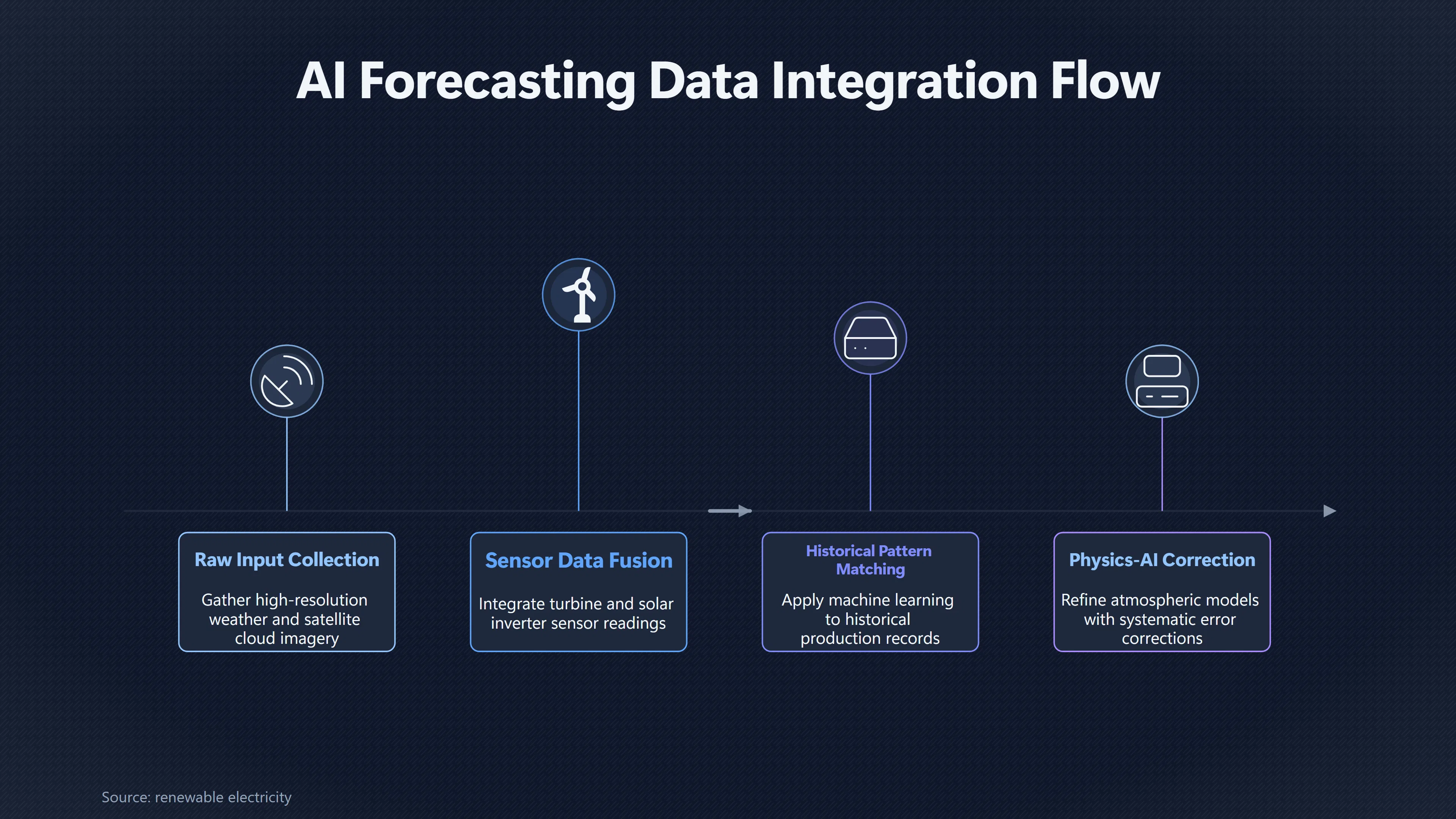
- How AI combines weather, sensor and market data
- What studies show about curtailment, cost and emissions
Page outline Jump by section
Introduction
Better forecasts cannot eliminate renewable curtailment, but they can reduce a surprising share of it. When grid operators are less certain about tomorrow’s electricity demand or the output from wind and solar farms, they compensate by holding extra reserve capacity, limiting power flows and curtailing renewable generation earlier than may ultimately prove necessary. More accurate forecasts shrink that uncertainty, allowing operators to make fuller use of existing networks while maintaining reliability.
Within the broader story of AI forecasting and the hidden capacity of power grids, forecasting is one of the fastest improvements available because it often requires better software and data rather than entirely new physical infrastructure. It is not a substitute for transmission expansion, storage or demand flexibility, but evidence increasingly shows that improved forecasting can reduce unnecessary curtailment, lower operating costs and cut emissions by helping more clean electricity reach consumers.[iea.org]iea.orgrenewable electricityRenewable electricity – Renewables 2025 – Analysis - IEA…
Why Forecast Errors Force Operators to Hold Capacity Back
Electricity systems must balance supply and demand every second. Unlike many other commodities, large-scale electricity cannot simply be stored everywhere until it is needed. Grid operators therefore rely on forecasts to decide:
- how much electricity consumers will use;
- how much wind and solar generation will actually materialise;
- which generators should be committed hours ahead;
- how much reserve capacity should remain available if forecasts prove wrong; and
- whether transmission corridors are likely to become congested.
Forecast errors create operational risk. If a wind farm is expected to generate 800 megawatts but delivers only 500 MW, other generators must respond rapidly. Conversely, if wind or solar output exceeds expectations while demand is lower than forecast, transmission lines or local networks may become overloaded, forcing operators to curtail renewable output even though the energy itself is essentially free.
The larger the uncertainty, the larger the safety margin operators must maintain. Better forecasting therefore creates value not by changing the weather, but by reducing the amount of capacity that has to remain unused “just in case”. This is particularly important in systems with large shares of weather-dependent generation.[iea.org]iea.orgHarnessing Variable Renewables – AnalysisHarnessing Variable Renewables – Analysis - IEAMay 23, 2011…
How AI Combines Weather, Sensor and Market Data
Traditional forecasting relied heavily on numerical weather prediction models and statistical techniques. Modern AI systems instead combine multiple information streams that would be difficult for conventional methods to integrate efficiently.
Typical inputs include:
- high-resolution weather forecasts;
- satellite cloud imagery;
- radar observations;
- turbine and solar inverter sensor data;
- historical production records;
- electricity demand patterns;[iea.org]iea.orgManaging the Seasonal Variability of Electricity Demand and Supply – AnalysisManaging the Seasonal Variability of Electricity Demand and Supply – Analysis
- transmission constraints;
- wholesale market prices; and[reuters.com]reuters.comand Europe is leading to an increase in negative wholesale electricity prices, signaling both challenges and investment opportunities. Co…
- operational measurements from substations and network equipment.
Machine learning models are particularly useful because they can identify complex relationships between weather conditions and actual power production. Rather than relying only on forecast wind speed or solar irradiance, they learn how individual wind farms or solar arrays respond to local terrain, seasonal conditions, maintenance outages and equipment characteristics.
Many systems now combine physics-based weather models with machine learning corrections. The physics captures atmospheric behaviour, while AI learns systematic forecasting errors from historical observations and continually updates predictions as new data arrive.
Forecasts also operate across multiple time horizons. Minute-by-minute forecasts support battery dispatch, hourly forecasts improve market scheduling, while day-ahead forecasts determine which generators are committed before electricity markets open. Improvements at each horizon reduce different forms of operational uncertainty.[nrel.gov]research-hub.nrel.govResearch HubQuantifying the Economic and Grid Reliability Impacts of Improved Wind Power Forecasting - National Laboratory of the Rockies…
Why Better Forecasts Can Reduce Curtailment
The connection between forecasting and curtailment is indirect but powerful.
Imagine a region expecting strong afternoon solar production. If operators lack confidence in the forecast, they may commit additional conventional generation and reserve transmission capacity as insurance. When the afternoon turns out sunnier than expected, there may be insufficient network flexibility to accommodate all available solar power, forcing some installations to reduce output.
More accurate forecasts change several operational decisions simultaneously:
- Lower reserve requirements. Less uncertainty means fewer generators need to remain idle but ready to start.
- Improved unit commitment. Conventional plants can be scheduled more efficiently, reducing unnecessary minimum generation levels that crowd out renewables.
- Better congestion management. Operators gain earlier warning of overloaded transmission corridors and can adjust dispatch before emergency actions become necessary.
- Smarter battery scheduling. Storage systems can charge before renewable peaks and discharge later, absorbing electricity that might otherwise be curtailed.
- Improved demand response. Large electricity users can shift consumption towards periods of expected renewable surplus if forecasts arrive early enough.
Each individual improvement may appear modest. Together they reduce the operational uncertainty that frequently leads to avoidable renewable curtailment.[nrel.gov]research-hub.nrel.govResearch HubQuantifying the Economic and Grid Reliability Impacts of Improved Wind Power Forecasting - National Laboratory of the Rockies…
What the Research Shows
Although the exact benefits vary between electricity systems, a consistent pattern appears across the research literature: better forecasting reduces both operating costs and renewable curtailment.
Researchers at the National Renewable Energy Laboratory (NREL) modelled improved wind forecasting across power systems representing several major US electricity markets. They found that more accurate forecasts reduced wind curtailment, lowered production costs and maintained or improved system reliability. The gains arose because operators could make better commitment and dispatch decisions across multiple timescales.[Research Hub]research-hub.nrel.govResearch HubQuantifying the Economic and Grid Reliability Impacts of Improved Wind Power Forecasting - National Laboratory of the Rockies…
Other researchers have focused directly on predicting curtailment itself. Studies using several years of operational data from the California Independent System Operator (CAISO) demonstrated that machine-learning models can successfully forecast periods when wind and solar curtailment are likely, allowing operators and market participants to prepare more effective responses.[sciencedirect.com]sciencedirect.comScienceDirect…
Research into congestion forecasting similarly shows that improved short-term renewable forecasts allow transmission bottlenecks to be identified earlier, reducing unnecessary wind curtailment while supporting more efficient network planning.[Ewha Womans University]pure.ewha.ac.krEwha Womans UniversityA Probabilistic Estimation of Transmission Congestion for Mitigating Wind Power Curtailments - Ewha Womans University…
The International Energy Agency reaches a broader systems conclusion. As countries increase the share of wind and solar generation, reducing curtailment increasingly depends on combining accurate forecasting with flexibility measures such as stronger transmission, storage, demand response and coordinated system planning. Forecasting alone is valuable, but its largest benefits appear when integrated with other flexibility tools.[IEA]iea.orgrenewable electricityRenewable electricity – Renewables 2025 – Analysis - IEA…
Forecasting Does Not Remove the Need for New Infrastructure
It is easy to overstate what forecasting can achieve.
If a transmission corridor is physically full, a better prediction does not create extra wires. If a region produces several times more solar electricity than local demand during midday, forecasting alone cannot absorb the excess energy.
Persistent curtailment often reflects structural bottlenecks:
- insufficient transmission capacity;
- inadequate storage;
- inflexible conventional generation;
- slow demand response;
- market rules that discourage flexibility; or
- geographical mismatches between renewable resources and electricity demand.
Recent international experience illustrates this distinction. Countries with rapidly growing solar and wind generation have seen curtailment increase where transmission investment has lagged behind renewable deployment. Better operational forecasting helps operators use existing infrastructure more efficiently, but long-term reductions in curtailment still require expanding grids and increasing flexibility across the wider electricity system.[iea.org]iea.orgrenewable electricityRenewable electricity – Renewables 2025 – Analysis - IEA…

Why This Matters for AI and Human Flourishing
Forecasting is an example of AI creating value through better coordination rather than spectacular scientific breakthroughs. The underlying electricity network already exists, as do many renewable generators. What AI often contributes is the ability to reduce uncertainty sufficiently that more of the existing system can be used safely.
That matters because clean electricity underpins many of the wider ambitions associated with an AI-enabled future. Electrified transport, heat pumps, advanced manufacturing, desalination, hydrogen production and energy-intensive computing all benefit when renewable electricity is used rather than wasted.
The broader AI bloom perspective is therefore not that forecasting alone creates abundance. Instead, it demonstrates a recurring pattern: intelligence can substitute for some forms of physical scarcity. By extracting more useful work from infrastructure that already exists, better forecasting makes renewable energy systems more productive while buying time for the larger investments in transmission, storage and flexible demand that a deeply electrified future will still require.
Amazon book picks
Further Reading
Books and field guides related to Can Better Forecasts Stop Wasting Clean Power?. Use these as the next step if you want deeper reading beyond the article.
The Grid
One of Bill Gates's Favorite Books of 2016 A revelatory look at our national power grid--how it developed, its current flaws, and how it...
How the World Really Works
INSTANT NEW YORK TIMES BESTSELLER “A new masterpiece from one of my favorite authors… [How The World Really Works] is a compelling and hi...
The Future Is Faster Than You Think
From the New York Times bestselling authors of Abundance and Bold comes a practical playbook for technological convergence in our modern...
Clean Disruption
The industrial age of energy and transportation will be over by 2030. Maybe before. Exponentially improving technologies such as solar, e...
eBay marketplace picks
Marketplace Samples
Live-tested eBay searches with available results related to this page.
Selected fromscience wall art oneBay.co.uk.




Endnotes
1.
Source: iea.org
Title: renewable electricity
Link:https://www.iea.org/reports/renewables-2025/renewable-electricity
Source snippet
Renewable electricity – Renewables 2025 – Analysis - IEA...
2.
Source: research-hub.nrel.gov
Link:https://research-hub.nrel.gov/en/publications/quantifying-the-economic-and-grid-reliability-impacts-of-improved-4/
Source snippet
Research HubQuantifying the Economic and Grid Reliability Impacts of Improved Wind Power Forecasting - National Laboratory of the Rockies...
3.
Source: iea.org
Link:https://www.iea.org/reports/electricity-2026/flexibility
Source snippet
Flexibility – Electricity 2026 – Analysis - IEA...
4.
Source: iea.org
Title: Harnessing Variable Renewables – Analysis
Link:https://www.iea.org/reports/harnessing-variable-renewables
Source snippet
Harnessing Variable Renewables – Analysis - IEAMay 23, 2011...
Published: May 23, 2011
5.
Source: sciencedirect.com
Link:https://www.sciencedirect.com/science/article/pii/S0196890421010682
Source snippet
ScienceDirect...
6.
Source: iea.org
Title: Managing the Seasonal Variability of Electricity Demand and Supply – Analysis
Link:https://www.iea.org/reports/managing-the-seasonal-variability-of-electricity-demand-and-supply
7.
Source: nrel.gov
Title: the curtailment paradox in a high solar future
Link:https://www.nrel.gov/news/detail/program/2021/the-curtailment-paradox-in-a-high-solar-future
8.
Source: research-hub.nrel.gov
Title: short term load forecast error distributions and implications for 4
Link:https://research-hub.nrel.gov/en/publications/short-term-load-forecast-error-distributions-and-implications-for-4/
9.
Source: iea.org
Link:https://www.iea.org/reports/empowering-variable-renewables-options-for-flexible-electricity-systems
10.
Source: iea.org
Title: key trends to watch
Link:https://www.iea.org/reports/renewables-2020/key-trends-to-watch
11.
Source: iea.org
Link:https://www.iea.org/reports/renewable-energy-market-update-june-2023/will-more-wind-and-solar-pv-capacity-lead-to-more-generation-curtailment
12.
Source: iea.org
Link:https://www.iea.org/reports/scaling-up-demand-flexibility/executive-summary
13.
Source: iea.org
Link:https://www.iea.org/reports/introduction-to-system-integration-of-renewables?mode=overview
14.
Source: sciencedirect.com
Link:https://www.sciencedirect.com/science/article/pii/S0378779625011046?dgcid=rss_sd_all
15.
Source: sciencedirect.com
Link:https://www.sciencedirect.com/science/article/pii/S0960148115001135
16.
Source: pure.ewha.ac.kr
Link:https://pure.ewha.ac.kr/en/publications/a-probabilistic-estimation-of-transmission-congestion-for-mitigat/
Source snippet
Ewha Womans UniversityA Probabilistic Estimation of Transmission Congestion for Mitigating Wind Power Curtailments - Ewha Womans University...
17.
Source: ft.com
Link:https://www.ft.com/content/7939a2e2-5344-4afd-8c43-98df11d4cb18
Source snippet
In 2024, nearly 10% of Britain's wind energy and 30% of Northern Ireland's were curtailed, while Germany and France also saw significant...
18.
Source: reuters.com
Link:https://www.reuters.com/business/energy/investor-view-negative-power-prices-expose-market-opportunity–reeii-2026-07-27/
Source snippet
and Europe is leading to an increase in negative wholesale electricity prices, signaling both challenges and investment opportunities. Co...
19.
Source: research-hub.nlr.gov
Title: wind and solar energy curtailment a review of international exper
Link:https://research-hub.nlr.gov/en/publications/wind-and-solar-energy-curtailment-a-review-of-international-exper/
Additional References
20.
Source: arxiv.org
Link:https://arxiv.org/abs/2504.16100
Source snippet
Towards Accurate Forecasting of Renewable Energy: Building Datasets and Benchmarking Machine Learning Models for Solar and Wind Pow...
21.
Source: youtube.com
Title: Grid’s Hidden Potential [Dynamic Line]({{ ‘dynamic-ratings/’ | relative_url }}) Rating
Link:https://www.youtube.com/watch?v=jzAHUYIXo5U
Source snippet
This selection of videos is relevant because they explore grid integration frameworks, forecasting challenges, and grid-enhancing technol...
22.
Source: amperon.co
Title: This white paper o
Link:https://www.amperon.co/ebooks/mitigating-curtailment-risk-with-smarter-wind-and-solar-forecasting
Source snippet
Mitigating Curtailment Risk with Smarter Wind and Solar ForecastingJuly 8, 2026 — Report Pdf MITIGATING CURTAILMENT RISK with Smarter Win...
Published: July 8, 2026
23.
Source: nature.com
Link:https://www.nature.com/articles/s44406-026-00036-6
24.
Source: youtube.com
Title: Phase 4 of Renewable Energy Integration Explained
Link:https://www.youtube.com/watch?v=5aCZkcoSnOI
Source snippet
Grid Enhancing Technologies | Zhang & Selker | Smart Grid Seminar...
25.
Source: oecd.org
Title: managing seasonal and interannual variability of renewables 093f609e en
Link:https://www.oecd.org/en/publications/managing-seasonal-and-interannual-variability-of-renewables_093f609e-en.html
26.
Source: irena.org
Link:https://www.irena.org/Publications/2026/Jan/Flexibility-for-a-secure-and-affordable-power-sector-transformation
27.
Source: vbn.aau.dk
Link:https://vbn.aau.dk/en/publications/artificial-intelligence-based-prediction-and-analysis-of-the-over/
28.
Source: research.ed.ac.uk
Link:https://www.research.ed.ac.uk/en/publications/opportunities-for-reducing-curtailment-of-wind-energy-in-the-futu/
29.
Source: youtube.com
Title: Phase 2 of Renewable Energy Integration Explained
Link:https://www.youtube.com/watch?v=AsFF4C39hSk
Source snippet
Phase 3 of Renewable Energy Integration Explained...