Within Long Future
Can AI help civilisation repair itself?
AI could make critical systems more resilient by predicting failures, improving planning and helping communities recover from disasters.
On this page
- Predicting failures in essential systems
- AI for disaster planning and recovery
- Limits of automated resilience
Page outline Jump by section
Introduction
Could AI help civilisation repair itself after disasters? The answer is increasingly yes, but not because AI can make societies immune to earthquakes, floods, fires or infrastructure failures. Its more realistic contribution is to help civilisation become more aware of its own weaknesses: detecting when bridges, power networks, water systems or transport links are approaching failure, forecasting where disasters will strike, and helping decision-makers act before damage becomes irreversible.
For an AI-enabled civilisation, this matters because resilience is a foundation for long-term flourishing. A society that can maintain essential systems through shocks has more capacity to invest in science, health, creativity and future expansion. AI infrastructure prediction is therefore not a separate convenience technology; it is part of a broader attempt to build a civilisation that can learn from changing conditions and recover faster. Research and international disaster-risk organisations increasingly frame AI as a tool for improving prediction, early warning and coordination, while stressing that human institutions, reliable data and public trust remain essential.[UNDRR]undrr.orgleveraging ai enhance multi hazard early warning systemsLeveraging AI to enhance multi-hazard early warning systems | UNDRRJuly 7, 2026…
Predicting failures in essential systems
Modern civilisation depends on infrastructure that is difficult to monitor completely. Electricity grids contain millions of components, transport networks span vast areas, and water systems often include ageing assets hidden underground. Traditional maintenance frequently follows fixed schedules: inspect equipment after a certain number of years or repair it after failure. AI enables a different approach: predicting which parts are most likely to fail and when intervention is most valuable.
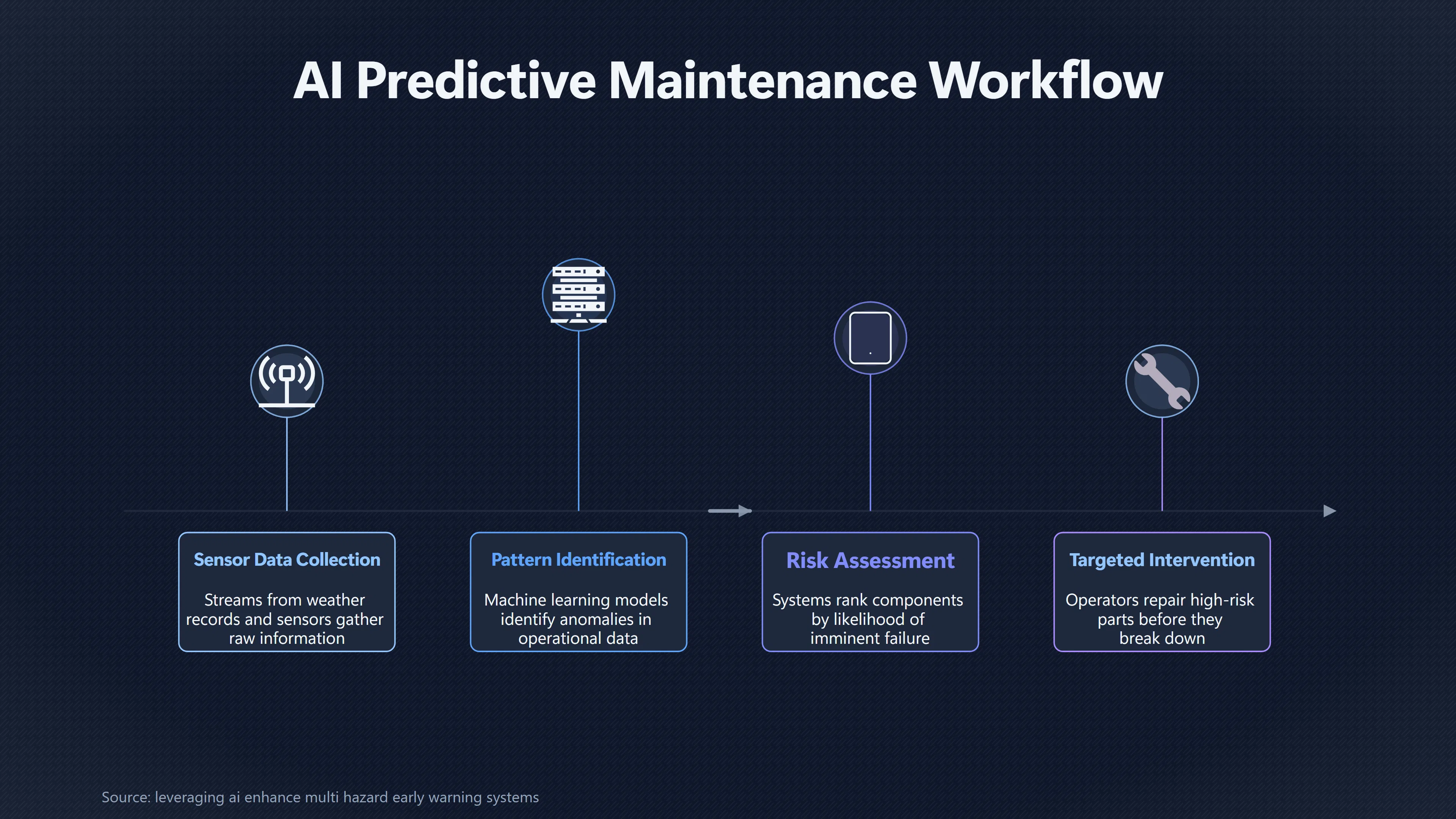
This approach is often called predictive maintenance. Machine-learning systems analyse streams of information from sensors, weather records, inspection reports and operational data to identify patterns that humans may miss. Instead of asking “Has this component failed?”, operators can ask “Which components are becoming risky, and what should be repaired first?”[arXiv]arxiv.orgPredictive Maintenance – Bridging Artificial Intelligence and IoTMarch 20, 2021…
Power grids are one of the clearest examples because failures can cascade. A damaged transformer, overloaded line or vulnerable substation can create outages affecting hospitals, communications, heating and industry. Recent research using graph neural networks — AI models designed to understand relationships between connected systems — has shown how grid data can be used to identify higher-risk substations and support maintenance planning. One study using seven years of data from 347 substations demonstrated that AI-based models could identify risk groups and support decisions about inspections and grid strengthening.[PubMed]pubmed.ncbi.nlm.nih.govPub Med Multilayer GNN for predictive maintenance and clustering in power gridsMultilayer GNN for predictive maintenance and clustering in power grids - PubMedSeptember 3, 2025…
The long-term promise is not simply fewer repairs. It is infrastructure that becomes more adaptive. A future electricity network could continuously learn from weather conditions, demand changes and equipment behaviour, helping utilities decide where to reinforce the system before extreme events cause widespread disruption.
From isolated repairs to intelligent infrastructure networks
The largest shift may come from moving beyond individual assets towards understanding whole systems. A bridge, railway line or power station rarely fails in isolation. Its importance depends on what connects to it: nearby roads, alternative routes, emergency services and economic activity.
AI can help create what engineers call digital twins: computer models that represent real-world systems and update as new information arrives. A digital twin of a city or infrastructure network could combine sensor data, satellite observations, weather forecasts and engineering models to explore possible failures before they happen.
For example, AI-assisted bridge monitoring systems can analyse images, vibration data and environmental conditions to detect damage and estimate future deterioration. Reviews of recent research on AI for bridge resilience highlight improvements in structural monitoring, damage detection and prediction under hazards such as earthquakes, floods and extreme weather.[ScienceDirect]sciencedirect.comArtificial intelligence for bridge resilience under extreme conditions: in-depth analysis and future priorities - ScienceDirect…
The significance for civilisational resilience is that infrastructure could become less like a collection of static objects and more like a living system with continuous feedback. In biological systems, resilience comes from sensing problems early and repairing damage before collapse. AI offers a technological version of that principle.
AI for disaster planning and recovery
Prediction is only valuable if it changes decisions. The next stage of AI-enabled resilience is helping governments, emergency services and communities prepare for disasters and recover afterwards.
Early warning systems are a major area of development. AI can analyse weather observations, satellite imagery, river levels, land conditions and historical events to improve forecasts and identify vulnerable areas. The United Nations Office for Disaster Risk Reduction (UNDRR), together with partner organisations, has highlighted AI’s potential across disaster-warning systems while emphasising that effective deployment requires strong observation networks, governance and human oversight.[UNDRR]undrr.orgleveraging ai enhance multi hazard early warning systemsLeveraging AI to enhance multi-hazard early warning systems | UNDRRJuly 7, 2026…
Flood prediction illustrates both the opportunity and the limits. AI models can improve forecasts by learning complex relationships between rainfall, terrain, rivers and previous flood events. But a better prediction does not automatically prevent damage. Communities still need protective infrastructure, evacuation plans, reliable communication and the ability to act on warnings. Recent reporting on AI-enhanced flood forecasting has emphasised that improved predictions must be matched by practical preparedness.[Reuters]reuters.comAI enhances flood warnings but cannot erase risk of disasterAI has improved weather predictions by analyzing historical data cost-effectively, but challenges remain in using this information effect…
After disasters occur, AI can also accelerate assessment. Satellite images and aerial data can be analysed to estimate damaged buildings, blocked roads and affected regions. This can help emergency teams decide where to send resources first. Research into AI agents and large language models for disaster-resilient infrastructure suggests future systems could support tasks such as damage assessment, simulation, planning and decision support by combining different sources of information.[ScienceDirect]sciencedirect.comOpen source on sciencedirect.com.
Wildfire management is another emerging example. AI systems can combine satellite imagery, weather conditions and landscape information to identify changing fire risks and support response planning. Newer approaches explore digital replicas of fire environments where AI systems can test possible interventions and help coordinate resources.[arXiv]arxiv.orgOpen source on arxiv.org.
Why AI resilience matters for humanity’s long future
The deeper AI bloom argument is not that every disaster can be eliminated. Civilisation will remain exposed to natural hazards, technical failures and human mistakes. The more realistic possibility is that advanced intelligence could gradually increase civilisation’s ability to detect, absorb and recover from shocks.
A resilient civilisation has several advantages:
- More continuity: critical services such as energy, water, healthcare and communications can recover faster.
- Better planning: societies can invest in prevention rather than repeatedly paying for repair.
- Faster learning: every disaster can become additional data for improving future decisions.
- Greater long-term capacity: fewer resources are consumed rebuilding avoidable damage, leaving more capacity for scientific progress and human development.
In this sense, AI infrastructure prediction is part of a larger transition from reactive civilisation to anticipatory civilisation. Instead of waiting for systems to break and then responding, societies could increasingly identify weaknesses before they become crises.
However, this future depends on careful implementation. AI does not replace engineers, emergency workers or public institutions. It depends on accurate data, accountable decision-making and systems designed around human needs. UNDRR’s work on AI and disaster risk reduction repeatedly highlights that technology must be combined with governance, inclusion and local knowledge rather than treated as an automatic solution.[UNDRR]undrr.orgleveraging ai enhance multi hazard early warning systemsLeveraging AI to enhance multi-hazard early warning systems | UNDRRJuly 7, 2026…
Limits of automated resilience
Prediction is not the same as prevention
The biggest misunderstanding about AI resilience is the idea that better prediction creates complete control. It does not.
Some disasters are inherently difficult to forecast. Earthquakes remain a major example: while AI can help analyse seismic data and improve preparedness, it cannot currently provide reliable long-term predictions of exactly when and where major earthquakes will occur.
Even when forecasts are accurate, societies may fail to respond. Warnings can be ignored, resources may be unevenly distributed, and poorer communities may lack the infrastructure needed to benefit from advanced systems. A technologically advanced warning system cannot compensate for weak institutions or insufficient investment.
The risks of depending on intelligent systems
AI itself creates new resilience challenges. Critical infrastructure may become more dependent on software, networks and data systems. A failure, cyberattack or flawed model could introduce new vulnerabilities.
Safety-critical infrastructure therefore requires a different standard from ordinary AI applications. Human oversight, independent testing and clear responsibility remain necessary. Research on autonomous AI in critical infrastructure warns that systems can struggle with unusual crisis situations that differ from their training data, supporting the case for bounded autonomy rather than uncontrolled automation.[arXiv]arxiv.orgOpen source on arxiv.org.
There is also a question of access. Wealthy regions may adopt sophisticated AI monitoring systems first, while vulnerable communities continue to face basic infrastructure gaps. A future in which AI strengthens civilisation broadly will require making resilience tools affordable, interoperable and available beyond the richest countries.

A civilisation that learns before it breaks
AI infrastructure prediction represents one of the more grounded pathways towards a more resilient future. It does not depend on science-fiction assumptions about perfect automation. The basic mechanism is already visible: more sensors, better models, faster analysis and improved decision support.
The larger possibility is that AI could help civilisation develop something like a collective nervous system — continuously sensing risks, identifying weaknesses and supporting repair before failures become catastrophic. That would not create an invulnerable civilisation, but it could create one that is more adaptive, more efficient and better able to preserve the long future of human flourishing.
Amazon book picks
Further Reading
Books and field guides related to Can AI help civilisation repair itself?. Use these as the next step if you want deeper reading beyond the article.
Enlightenment Now
Rating: 4.5/5 from 6 Google Books ratings
INSTANT NEW YORK TIMES BESTSELLER A NEW YORK TIMES NOTABLE BOOK OF 2018 ONE OF THE ECONOMIST'S BOOKS OF THE YEAR "My new favorite book of...
The Fifth Risk: Undoing Democracy
'Will set your hair on end' Telegraph, Top 50 Books of the Year 'I forgot to breathe while reading The Fifth Risk' Michael Hofmann, TLS,...
How Infrastructure Works: Inside the Systems That Shape Our W...
NAMED A BEST BOOK OF 2023 BY PUBLISHERS WEEKLY "Revelatory, superbly written, and pulsing with wisdom and humanity, How Infrastructure Wo...
The Smart Enough City: Putting Technology in Its Place to Rec...
Why technology is not an end in itself, and how cities can be "smart enough," using technology to promote democracy and equity. Smart cit...
eBay marketplace picks
Marketplace Samples
Live-tested eBay searches with available results related to this page.
Selected fromcity model oneBay.co.uk.



Endnotes
1.
Source: undrr.org
Title: leveraging ai enhance multi hazard early warning systems
Link:https://www.undrr.org/publication/documents-and-publications/leveraging-ai-enhance-multi-hazard-early-warning-systems
Source snippet
Leveraging AI to enhance multi-hazard early warning systems | UNDRRJuly 7, 2026...
Published: July 7, 2026
2.
Source: undrr.org
Title: Special report on the use of technology for disaster risk reduction | UNDRR
Link:https://www.undrr.org/publication/documents-and-publications/special-report-use-technology-disaster-risk-reduction
Source snippet
Special report on the use of technology for disaster risk reduction | UNDRR...
3.
Source: arxiv.org
Link:https://arxiv.org/abs/2103.11148
Source snippet
Predictive Maintenance -- Bridging Artificial Intelligence and IoTMarch 20, 2021...
Published: March 20, 2021
4.
Source: sciencedirect.com
Link:https://www.sciencedirect.com/science/article/pii/S2590123026009928
Source snippet
Artificial intelligence for bridge resilience under extreme conditions: in-depth analysis and future priorities - ScienceDirect...
5.
Source: reuters.com
Title: AI enhances flood warnings but cannot erase risk of disaster
Link:https://www.reuters.com/technology/artificial-intelligence/ai-enhances-flood-warnings-cannot-erase-risk-disaster-2024-10-15/
Source snippet
AI has improved weather predictions by analyzing historical data cost-effectively, but challenges remain in using this information effect...
6.
Source: sciencedirect.com
Link:https://www.sciencedirect.com/science/article/pii/S0951832026003133
7.
Source: arxiv.org
Link:https://arxiv.org/abs/2602.08949
8.
Source: globalplatform.undrr.org
Link:https://globalplatform.undrr.org/2025/quick/93127
9.
Source: arxiv.org
Link:https://arxiv.org/abs/2603.15885
10.
Source: sciencedirect.com
Title: Computational intelligence and automation for resilient bridge infrastructure
Link:https://www.sciencedirect.com/science/article/pii/S2666691X26000254
11.
Source: undrr.org
Title: we can and must harness power ai tackle complexity disaster risk
Link:https://www.undrr.org/news/we-can-and-must-harness-power-ai-tackle-complexity-disaster-risk
12.
Source: sciencedirect.com
Title: Multilayer GNN for predictive maintenance and clustering in power grids
Link:https://www.sciencedirect.com/science/article/pii/S2589004225017511
13.
Source: mcr2030.undrr.org
Title: drr ai masterclass
Link:https://mcr2030.undrr.org/event/drr-ai-masterclass
14.
Source: globalplatform.undrr.org
Link:https://globalplatform.undrr.org/2025/news/first-global-early-warnings-all-multi-stakeholder-forum-launches-call-accelerate-universal
15.
Source: sciencedirect.com
Link:https://www.sciencedirect.com/science/article/pii/S1874548223000598
16.
Source: undrr.org
Title: UNDR R
Link:https://www.undrr.org/?lang=en&page=1
17.
Source: undrr.org
Title: UNDR R
Link:https://www.undrr.org/?dur=1
18.
Source: sciencedirect.com
Link:https://www.sciencedirect.com/science/article/abs/pii/S0951832026003133
19.
Source: sciencedirect.com
Link:https://www.sciencedirect.com/science/article/pii/S0951832026002401
20.
Source: sciencedirect.com
Link:https://www.sciencedirect.com/science/article/pii/B9780443455735000136
21.
Source: sciencedirect.com
Link:https://www.sciencedirect.com/science/chapter/bookseries/pii/S0065245826000422
22.
Source: pubmed.ncbi.nlm.nih.gov
Title: Pub Med Multilayer GNN for predictive maintenance and clustering in power grids
Link:https://pubmed.ncbi.nlm.nih.gov/41098774/
Source snippet
Multilayer GNN for predictive maintenance and clustering in power grids - PubMedSeptember 3, 2025...
Published: September 3, 2025
23.
Source: pmc.ncbi.nlm.nih.gov
Link:https://pmc.ncbi.nlm.nih.gov/articles/PMC12519140/
Source snippet
PubMed Central (PMC)Multilayer GNN for predictive maintenance and clustering in power grids - PMC...
24.
Source: GOV.UK
Title: www.gov.uk Digital Twin (official)
Link:https://www.gov.uk/government/publications/digital-twin-definition/digital-twin-official
25.
Source: GOV.UK
Link:https://www.gov.uk/government/case-studies/asset-resilience-emergency-planning-and-response-the-national-digital-twin-programme-ndtp
26.
Source: disasters.nasa.gov
Link:https://disasters.nasa.gov/what-we-do/disasters/floods
27.
Source: appliedsciences.nasa.gov
Link:https://appliedsciences.nasa.gov/what-we-do/disasters/floods
28.
Source: disasters.nasa.gov
Link:https://disasters.nasa.gov/what-we-do/disasters/fires
29.
Source: appliedsciences.nasa.gov
Link:https://appliedsciences.nasa.gov/what-we-do/disasters/floods?page=0
Additional References
30.
Source: youtube.com
Title: Can AI help us survive disasters? | UNDRR
Link:https://www.youtube.com/watch?v=gKl0y9bOZYU
Source snippet
examines how predictive artificial intelligence and advanced risk tools help societies anticipate hazards, protect infrastructure, and im...
31.
Source: youtube.com
Title: Predictive Maintenance with AI: Safeguarding Critical Modern Infrastructure
Link:https://www.youtube.com/watch?v=z80ZnifIVVo
Source snippet
How AI Is Transforming Disaster Relief And Emergency Response | Tech It Out...
32.
Source: youtube.com
Title: How AI Is Transforming Disaster Relief And Emergency Response | Tech It Out
Link:https://www.youtube.com/watch?v=yxjVFJzpWHY
Source snippet
AI for infrastructure resilience | Deloitte Global...
33.
Source: youtube.com
Title: AI Predictive Maintenance: The Future of Smart Maintenance
Link:https://www.youtube.com/watch?v=IQG8NXQ_4UA
Source snippet
Predictive Maintenance with AI: Safeguarding Critical Modern Infrastructure...
34.
Source: pnnl.gov
Link:https://www.pnnl.gov/projects/rapid-analytics-disaster-response
35.
Source: science.nasa.gov
Link:https://science.nasa.gov/science-research/science-enabling-technology/nasa-wildfire-digital-twin-pioneers-new-ai-models-and-streaming-data-techniques-for-forecasting-fire-and-smoke/
36.
Source: worldbank.org
Link:https://www.worldbank.org/en/news/press-release/2019/06/19/42-trillion-can-be-saved-by-investing-in-more-resilient-infrastructure-new-world-bank-report-finds
37.
Source: itu.int
Link:https://www.itu.int/en/ITU-D/Emergency-Telecommunications/Pages/AI-Sub-Group-EW4All-.aspx
38.
Source: mdpi.com
Link:https://www.mdpi.com/2071-1050/17/20/8992
39.
Source: doi.org
Link:https://doi.org/10.1016/j.rineng.2026.109791