Within Income Security
Can AI wealth fund basic income?
Universal basic income could provide a stable cash floor as AI changes work, but funding and ownership of automated wealth remain major questions.
On this page
- Why cash floors matter when jobs change
- Funding questions in an automated economy
- Choice, freedom and limits of UBI
Page outline Jump by section
Introduction
Universal basic income (UBI) is one proposed answer to a central question of an AI-enabled economy: if advanced AI creates enormous wealth while reducing the role of human labour in producing that wealth, how should everyone share in the gains? The strongest case for UBI is not simply that AI will eliminate jobs, but that a future of abundant production could still produce insecurity if ownership and income flows remain concentrated. A regular cash floor could give people greater freedom to adapt, learn, care for others, create, or pursue meaningful work while automation expands economic capacity.
However, AI wealth does not automatically become public wealth. The difficult question is not only whether AI can generate enough value to support basic income, but who owns the systems creating that value, how governments capture part of the gains, and whether redistribution can happen without weakening innovation. UBI could become one part of a broader social contract for an AI-abundant future, but it is not a guaranteed bridge to human flourishing on its own.[International Labour Organization]ilo.orgInternational Labour OrganizationWhy Universal Basic Income is not the answer to the impact of AI on the labour market | International La…
Why cash floors matter when jobs change
A universal basic income provides regular payments to individuals without requiring employment, job searching or proof of hardship. Its appeal in the AI era comes from separating basic economic security from having a traditional wage-paying job.
In today’s economy, wages perform two functions at once: they reward work and distribute purchasing power. If increasingly capable AI systems and robots generate a larger share of production, those two functions could begin to separate. A society could become much richer while many people experience weaker bargaining power or less stable employment. Economic models of automation have highlighted a risk that technological gains may flow disproportionately towards owners of capital rather than workers, increasing wealth inequality even as productivity rises.[Bank of England]bankofengland.co.ukOpen source on bankofengland.co.uk.
This is the core argument behind AI-linked basic income proposals: if machines become major producers of economic value, humans should not depend only on selling labour to receive a share of that prosperity.
A cash floor could provide several forms of security:
- Time to adapt: People could retrain, study, start businesses or move into new industries without facing immediate financial collapse.
- Greater freedom of choice: Workers may be better able to reject unsafe or degrading jobs and negotiate better conditions.
- Support for unpaid contributions: Caring for children, elderly relatives, communities or creative projects could become easier when survival depends less entirely on employment.
- Economic stability during disruption: If automation changes some industries faster than new opportunities emerge, basic income could reduce sudden shocks.
Evidence from cash-transfer experiments suggests that unconditional payments often improve recipients’ ability to manage everyday needs rather than causing the dramatic withdrawal from work sometimes predicted by critics. OpenResearch’s large US unconditional cash study found that recipients used additional money mainly on necessities such as food, rent and transport, while reporting greater financial resilience. It also found some reduction in employment-related measures, showing that the effects are real but not a simple story of either “free money creates dependence” or “cash has no trade-offs”.[OpenResearch]openresearchlab.orgOpen Research Key Findings: Spending | Findings | Open ResearchOpenResearchKey Findings: Spending | Findings | OpenResearchJuly 21, 2024…
UBI therefore addresses one specific problem: how people maintain agency when income becomes less tied to traditional employment. It does not by itself solve housing shortages, healthcare access, education gaps or unequal ownership of productive assets.
Funding questions in an automated economy
The biggest challenge for AI-funded basic income is not the idea of sending money. It is the question of where the money comes from.
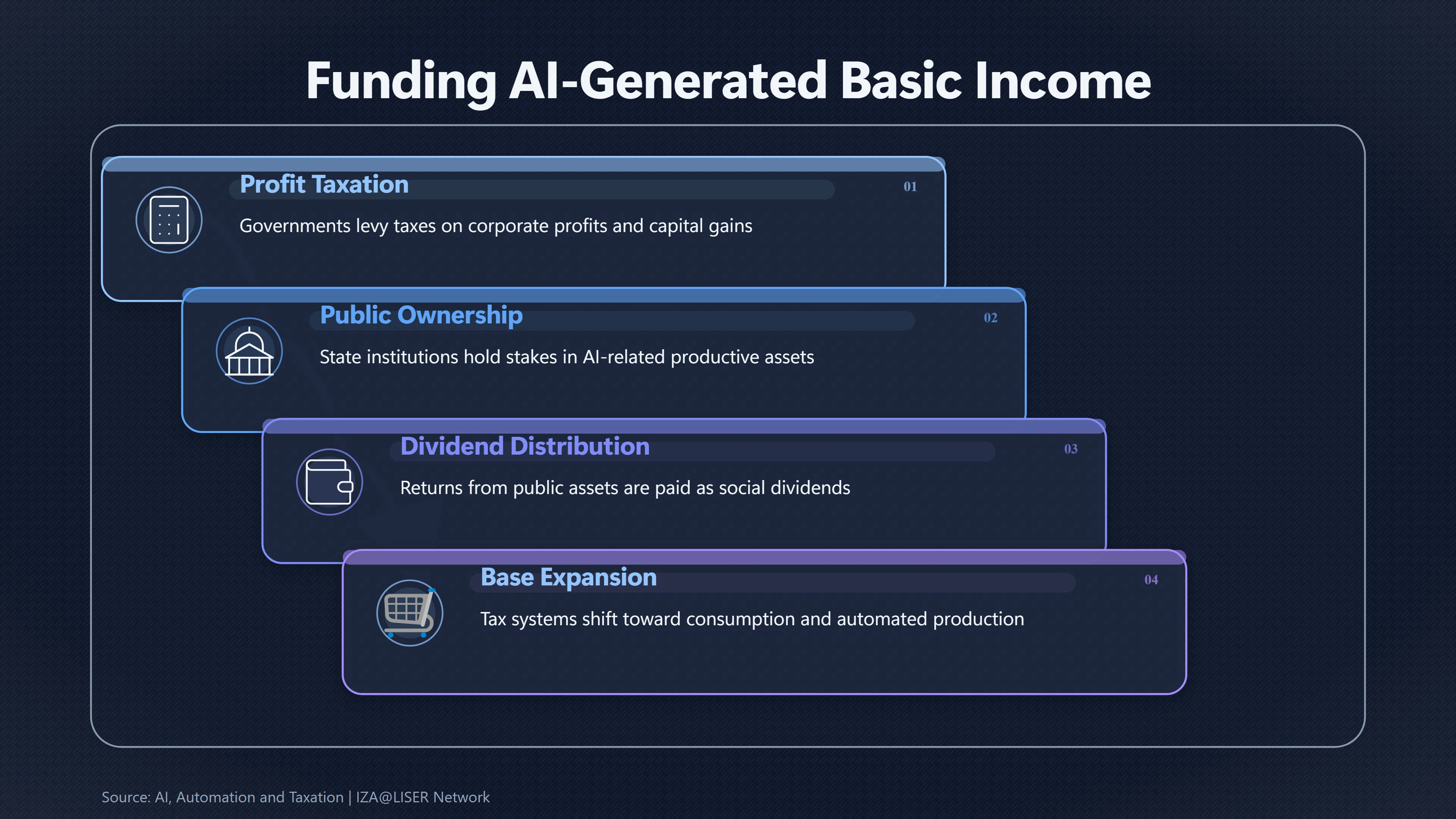
A future with powerful AI could create several possible revenue sources:
Taxing AI-generated profits
If AI systems produce large profits for companies, governments could increase taxes on corporate profits, capital gains or economic rents — the excess returns created when firms have exceptional market power.
This approach follows the logic that AI is not only another productivity tool but a new form of productive capital. If ownership of AI infrastructure becomes concentrated among a small number of firms, taxation could act as a mechanism for sharing part of those gains more widely. Research on automation and taxation has examined how tax systems may need to adapt when technological progress shifts income away from labour and towards capital.[IZA]iza.orgAI, Automation and Taxation | IZA@LISER NetworkAI, Automation and Taxation | IZA@LISER Network…
The difficulty is practical. Companies can relocate, profits can be difficult to measure across borders, and poorly designed taxes could reduce investment or slow useful innovation.
Public ownership or shared AI dividends
Another proposal is that society could own part of the infrastructure that produces AI wealth. Instead of only taxing private AI companies, governments or public institutions could hold stakes in AI-related assets and distribute returns as a social dividend.
This idea resembles existing sovereign wealth funds, where public ownership of valuable assets creates long-term income streams. In an AI-abundant future, supporters argue that access to productive technology itself could become a form of shared inheritance.
The challenge is governance. Public ownership requires institutions capable of managing assets transparently and avoiding political capture.
Broadening the tax base
AI may also require a rethink of existing tax systems. Many welfare states rely heavily on income earned through employment. If labour becomes a smaller share of economic output, governments may need to rely more on taxes linked to consumption, wealth, capital income or automated production.
The International Labour Organization argues that AI’s labour-market effects require careful consideration of social protection systems rather than assuming a single policy response will solve the transition.[International Labour Organization]ilo.orgInternational Labour OrganizationWhy Universal Basic Income is not the answer to the impact of AI on the labour market | International La…
A key point is that AI abundance and UBI are not automatically connected. A highly productive AI economy could still leave many people insecure if ownership remains concentrated and institutions fail to distribute gains.
The evidence from basic income experiments
Current experiments cannot prove what would happen in a world with superintelligent AI or extremely high automation. They mostly test a narrower question: what happens when people receive unconditional cash?
Results so far challenge some common assumptions.
The Finnish basic income experiment, which provided payments to unemployed participants, found improvements in wellbeing and some health-related outcomes, although effects varied and were not a complete solution to broader social problems.[sciencedirect.com]sciencedirect.comScienceDirect…
The OpenResearch unconditional cash study in the United States provided $1,000 per month for three years to low-income participants. Researchers found that recipients used the money primarily for basic needs and gained more flexibility in managing their lives. Employment effects were relatively modest rather than showing either a collapse in work or no change at all.[OpenResearch]openresearchlab.orgOpen Research Findings: Unconditional Cash Study | Open ResearchOpen Research Findings: Unconditional Cash Study | Open Research
These findings matter for AI debates because they suggest that income security can increase personal choice. But they also show the limits of cash alone. A payment can reduce financial stress; it cannot by itself create affordable housing, improve healthcare systems or guarantee that people share in ownership of advanced technology.
Choice, freedom and limits of UBI
The strongest argument for UBI in an AI bloom scenario is philosophical as much as economic. If technology eventually reduces the amount of necessary human labour, the goal would not simply be keeping people comfortable while machines work. The deeper possibility is expanding human freedom.
A society with abundant AI could give people more opportunities to learn, create, explore, care and contribute in ways that are not measured by conventional employment. A basic income could become a foundation that allows more people to participate in that future.
But critics raise several important objections.
Will UBI be affordable?
A meaningful income floor for an entire population would require substantial public resources. The optimistic case depends on AI creating large productivity gains that governments can capture.
Will it reduce motivation?
Evidence from existing pilots does not show a simple collapse of work incentives, but large permanent programmes could produce different effects from small experiments.[The Experiment Society]experimentsociety.orgOpen source on experimentsociety.org.
Could it hide deeper inequality?
A basic payment may provide security while leaving ownership of AI systems, data and infrastructure concentrated. Some argue that the future debate should focus not only on distributing income but also on distributing productive power.
Could prices rise?
If additional income increases demand without expanding supply, some benefits could be absorbed by higher prices, especially in constrained sectors such as housing.
For these reasons, many researchers and policymakers view UBI as one possible tool within a wider system that could include stronger public services, education, healthcare, competition policy and broader access to technology.[oecd.org]oecd.orgai and the future of social protection in oecd countries 7b245f7e enAI and the future of social protection in OECD countries | OECDJune 30, 2025…

Can AI wealth create a broader human future?
The long-term AI bloom vision depends on more than making people richer. It depends on whether technological abundance translates into greater human capability and freedom.
If advanced AI accelerates scientific discovery, lowers the cost of essential goods, improves healthcare and automates dangerous work, then societies may face a historic opportunity: separating human wellbeing from the need for constant economic scarcity.
UBI could help manage that transition by ensuring that people have a stake in a more automated economy. But the decisive question is institutional: whether AI wealth becomes a private windfall for a small group or a shared foundation for wider human flourishing.
A successful AI-era social contract would likely require both sides of the equation: extraordinary increases in productive capacity and deliberate choices about ownership, distribution and democratic control. AI may make abundance possible, but institutions will determine who gets to experience it.
Amazon book picks
Further Reading
Books and field guides related to Can AI wealth fund basic income?. Use these as the next step if you want deeper reading beyond the article.
The war on normal people
First published 2018. Subjects: Guaranteed annual income, Government policy, Economic conditions, Social aspects, Poverty.
Basic Income
Would it be possible to provide people with a basic income as a right? The idea has a long history. This book draws on two pilot schemes...
Give People Money
A New York Times Book Review Editors' Choice Shortlisted for the 2018 FT & McKinsey Business Book of the Year Award A brilliantly reporte...
eBay marketplace picks
Marketplace Samples
Live-tested eBay searches with available results related to this page.
Selected fromAI future poster oneBay.co.uk.




Endnotes
1.
Source: iza.org
Title: AI, Automation and Taxation | IZA@LISER Network
Link:https://www.iza.org/en/publications/pp/212/ai-automation-and-taxation
Source snippet
AI, Automation and Taxation | IZA@LISER Network...
2.
Source: sciencedirect.com
Link:https://www.sciencedirect.com/science/article/pii/S0047272725001781
Source snippet
ScienceDirect...
3.
Source: oecd.org
Title: ai and the future of social protection in oecd countries 7b245f7e en
Link:https://www.oecd.org/en/publications/ai-and-the-future-of-social-protection-in-oecd-countries_7b245f7e-en.html
Source snippet
AI and the future of social protection in OECD countries | OECDJune 30, 2025...
Published: June 30, 2025
4.
Source: sciencedirect.com
Title: From means-tested programs to Universal Basic Income
Link:https://www.sciencedirect.com/science/article/abs/pii/S0304393226000759
Source snippet
The role of endogenous participation in transfer programs - ScienceDirectSeptember 1, 2026 — JOURNAL OF MONETARY ECONOMICS Volume 162, Se...
Published: September 1, 2026
5.
Source: oecd.org
Title: [effective]({{ ‘tutor-design/’ | relative_url }}) use of ai in social security e639350c
Link:https://www.oecd.org/en/publications/harnessing-artificial-intelligence-in-social-security_b52405c1-en/full-report/effective-use-of-ai-in-social-security_e639350c.html
6.
Source: oecd.ai
Title: A I and the future of social protection in OECD countries
Link:https://oecd.ai/en/ai-publications/ai-and-the-future-of-social-protection-in-oecd-countries
7.
Source: oecd.org
Title: megatrends and the future of social protection 6c9202e8 en
Link:https://www.oecd.org/en/publications/megatrends-and-the-future-of-social-protection_6c9202e8-en.html
8.
Source: oecd.org
Title: full report
Link:https://www.oecd.org/en/publications/megatrends-and-the-future-of-social-protection_6c9202e8-en/full-report.html
9.
Source: oecd.org
Title: component 4
Link:https://www.oecd.org/en/publications/modernising-access-to-social-protection_af31746d-en/full-report/component-4.html
10.
Source: oecd.org
Title: mechanics of replacing benefits systems with a basic income ec38a279 en
Link:https://www.oecd.org/en/publications/mechanics-of-replacing-benefits-systems-with-a-basic-income_ec38a279-en.html
11.
Source: oecd.org
Link:https://www.oecd.org/en/about/projects/ai-and-the-future-of-social-protection.html
12.
Source: oecd.org
Link:https://www.oecd.org/en/topics/future-of-social-protection.html
13.
Source: sciencedirect.com
Title: Workers’ incentives and the optimal taxation of AI
Link:https://www.sciencedirect.com/science/article/pii/S0165176526002569
14.
Source: iza.org
Link:https://www.iza.org/publications/dp/17682
15.
Source: ilo.org
Link:https://www.ilo.org/publications/why-universal-basic-income-not-answer-impact-ai-labour-market
Source snippet
International Labour OrganizationWhy Universal Basic Income is not the answer to the impact of AI on the labour market | International La...
16.
Source: bankofengland.co.uk
Link:https://www.bankofengland.co.uk/working-paper/2021/uneven-growth-automations-impact-on-income-and-wealth-inequality
17.
Source: openresearchlab.org
Title: Open Research Key Findings: Spending | Findings | Open Research
Link:https://www.openresearchlab.org/findings/key-findings-spending
Source snippet
OpenResearchKey Findings: Spending | Findings | OpenResearchJuly 21, 2024...
Published: July 21, 2024
18.
Source: openresearchlab.org
Title: Open Research Findings: Unconditional Cash Study | Open Research
Link:https://www.openresearchlab.org/findings/project/unconditional-cash-study
19.
Source: openresearchlab.org
Title: Open Research Unconditional Cash Study | Open Research
Link:https://www.openresearchlab.org/projects/unconditional-cash-study
20.
Source: experimentsociety.org
Link:https://www.experimentsociety.org/evidence/guaranteed-income
21.
Source: basicincome.org
Link:https://basicincome.org/news/2024/10/openresearch-unconditional-cash-study-research-insights-and-early-learnings/
22.
Source: openresearchlab.org
Title: Key Findings: Health | Findings | Open Research
Link:https://www.openresearchlab.org/findings/how-does-unconditional-cash-affect-health-2
23.
Source: openresearchlab.org
Link:https://www.openresearchlab.org/findings/key-findings-the-impact-of-the-cash-on-attitudes-towards-work
24.
Source: tietotarjotin.fi
Title: Basic income experiment | Kela’s Info Tray
Link:https://tietotarjotin.fi/en/information-package/158070/basic-income-experiment
25.
Source: openresearchlab.org
Link:https://www.openresearchlab.org/findings
26.
Source: openresearchlab.org
Link:https://www.openresearchlab.org/projects/unconditional-cash-study/documentation
27.
Source: researchrepository.ilo.org
Title: Why UBI is not the answer
Link:https://researchrepository.ilo.org/esploro/outputs/encyclopediaEntry/Why-UBI-is-not-the-answer/995700568802676
28.
Source: basicincome.org
Link:https://basicincome.org/topic/pilots/
29.
Source: experimentsociety.org
Link:https://www.experimentsociety.org/registry/stockton-seed
Additional References
30.
Source: youtube.com
Title: UBI for Compute? Sam Altman’s Insights at Harvard
Link:https://www.youtube.com/watch?v=svigSXQWo-M
Source snippet
Universal Basic Wealth: The Hidden Plan for AI and Crypto provides an in-depth look at how advanced artificial intelligence could shift e...
31.
Source: youtube.com
Link:https://www.youtube.com/watch?v=iJViRM8RClg
Source snippet
UBI for Compute? Sam Altman's Insights at Harvard...
32.
Source: nature.com
Link:https://www.nature.com/articles/s41599-020-00676-8
33.
Source: youtube.com
Title: Universal Basic Wealth: The Hidden Plan for AI and Crypto
Link:https://www.youtube.com/watch?v=pNAcB5lyIXA
Source snippet
If AI Takes All Jobs, Who Will Buy Everything?...
34.
Source: researchgate.net
Link:https://www.researchgate.net/publication/395135368_Universal_Basic_Income_in_the_Age_of_Artificial_Intelligence_Redistributing_AI-Generated_Profits_for_a_Sustainable_Future
35.
Source: worldbank.org
Link:https://www.worldbank.org/en/topic/socialprotection/publication/exploring-universal-basic-income-a-guide-to-navigating-concepts-evidence-and-practices
36.
Source: basicincome.org
Link:https://basicincome.org/topic/kenya/
37.
Source: cambridge.org
Link:https://www.cambridge.org/core/journals/macroeconomic-dynamics/article/negative-income-tax-and-universal-basic-income-in-the-eyes-of-aiyagari/00FEC4C9D02026504E18270ABF9ED82D
38.
Source: nber.org
Link:https://www.nber.org/papers/w32784
39.
Source: nber.org
Link:https://www.nber.org/papers/w32779