Within Education
Can A General Chatbot Really Replace A Designed AI Tutor?
Research suggests carefully engineered tutors outperform unrestricted chatbots because they embed pedagogy as well as language ability.
On this page
- What the Harvard physics study showed
- Why instructional design changes outcomes
- Choosing trustworthy educational AI
Page outline Jump by section
Introduction
A conversational AI can answer questions, explain concepts and generate examples, but that does not automatically make it a good teacher. The strongest evidence so far suggests that purpose-built AI tutors outperform unrestricted general chatbots because they are designed around educational principles rather than conversation alone. Instead of simply responding to prompts, they guide learners through a structured process: diagnosing misunderstandings, choosing the next task, withholding answers when appropriate and encouraging active reasoning.

This distinction matters for the wider idea of AI-enabled human flourishing. If advanced AI is to expand educational opportunity on a global scale, success is likely to depend less on ever more fluent language models than on combining those models with well-tested teaching methods. The key question is therefore not whether AI can chat, but whether it can reliably help people learn.
Can a general chatbot really replace a designed AI tutor?
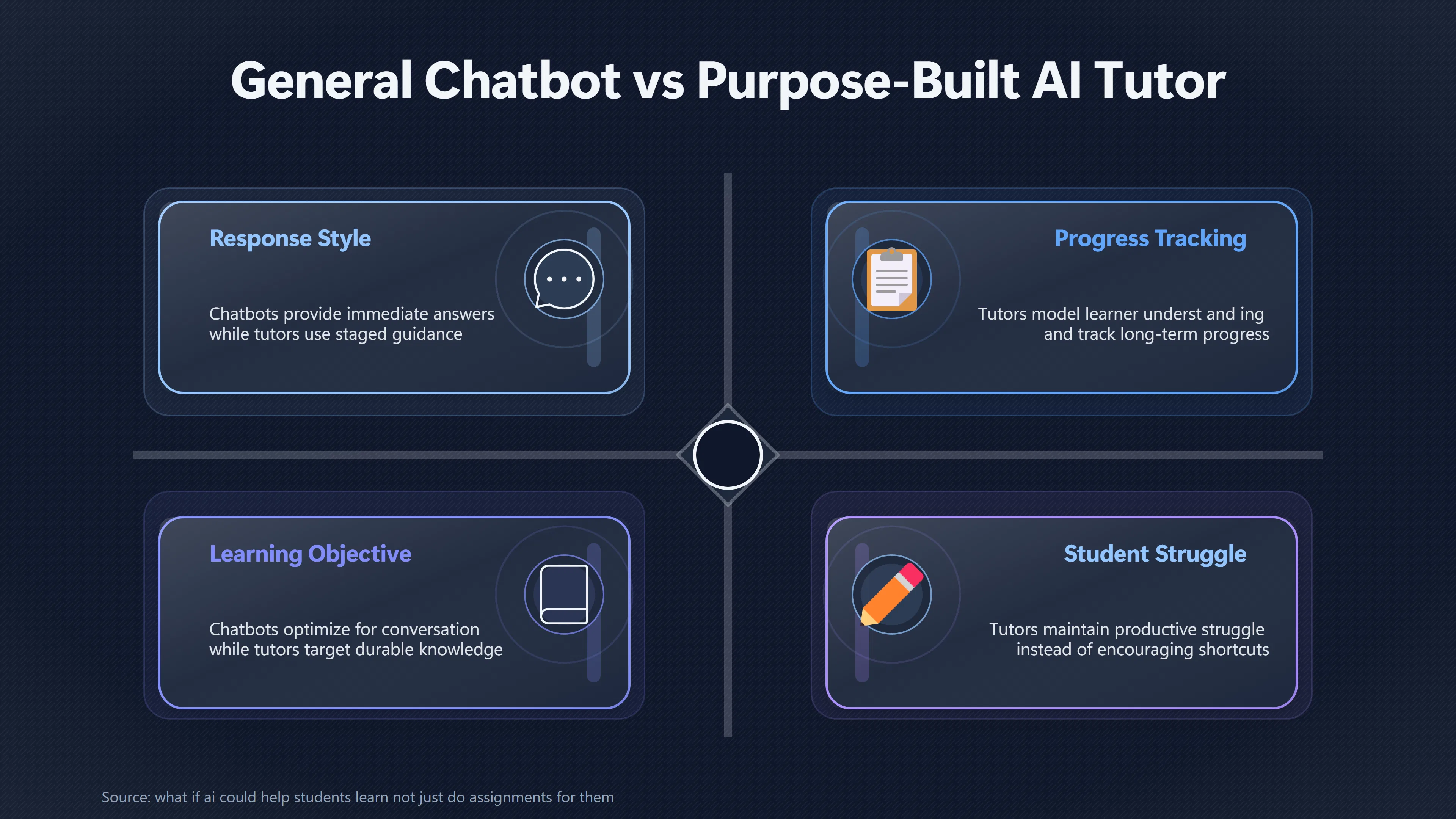
General-purpose chatbots are built to be broadly helpful across thousands of topics. They excel at explaining ideas, brainstorming, summarising documents and answering follow-up questions. Those capabilities make them valuable study companions, but they were not primarily designed around how people acquire durable knowledge.
A purpose-built AI tutor adds another layer: instructional design. Rather than treating each prompt independently, it attempts to model the learner’s current understanding and guide progress towards specific learning goals.
In practice, the difference looks like this:
General chatbotPurpose-built AI tutorResponds to almost any questionFollows a planned curriculum or learning objectiveOften gives complete answers immediatelyUses hints, questions and staged guidanceHas little memory of long-term learning progressTracks misconceptions and prior performanceOptimises for helpful conversationOptimises for learning outcomesCan unintentionally encourage shortcut-takingTries to maintain productive struggle and active recall
These differences may appear subtle, but decades of educational research suggest they are fundamental. Learning improves when students retrieve information themselves, receive immediate feedback, and work within tasks that are challenging without becoming overwhelming. Modern AI tutors increasingly attempt to embed these principles directly into their behaviour.
What the Harvard physics study showed
The clearest recent evidence comes from a randomised controlled trial conducted in an undergraduate physics course at Harvard and published in Scientific Reports in 2025. Students were randomly assigned either to a custom-built AI tutor or to a well-designed active-learning classroom session, which is itself regarded as one of the most effective evidence-based teaching approaches in higher education.[nature.com]nature.comOpen source on nature.com.
The headline finding attracted attention because students using the AI tutor achieved substantially larger learning gains while spending less time on the material. They also reported higher engagement and motivation.[nature.com]nature.comOpen source on nature.com.
The most important lesson, however, is often overlooked.
The researchers did not simply hand students an unrestricted chatbot.
Instead, they carefully engineered the tutor around established educational practice. Among other features, it:
- used course-specific material rather than relying solely on general model knowledge;
- incorporated worked solutions prepared by instructors;
- broke complex problems into manageable steps;
- prompted students to reason through questions instead of immediately revealing answers;
- deliberately avoided solving problems too quickly for learners.[nature.com]nature.comOpen source on nature.com.
This means the experiment should not be interpreted as evidence that any large language model is naturally an outstanding teacher. Rather, it demonstrates what becomes possible when a powerful language model is constrained by sound pedagogy.
That distinction is particularly relevant to discussions of AI abundance. Scaling educational access depends not simply on larger models, but on replicating effective teaching practices at very low cost.
Why instructional design changes outcomes
Teaching is more than explaining facts.
Effective tutors constantly make decisions about when to explain, when to ask questions and when to let learners struggle.
Educational psychology has identified several practices that repeatedly improve learning, many of which can be incorporated into AI tutors:
- Scaffolding: providing enough support for the learner to succeed before gradually removing assistance.
- Retrieval practice: encouraging learners to recall information rather than simply rereading it.
- Immediate feedback: correcting mistakes while the learner still remembers their reasoning.
- Adaptive difficulty: adjusting challenges as competence changes.
- Misconception diagnosis: identifying the underlying reason an answer is wrong instead of merely marking it incorrect.
A general chatbot may perform some of these behaviours occasionally, but it has no inherent incentive to do so consistently. In fact, because conversational systems are often optimised to satisfy user requests, they may reveal complete solutions precisely when withholding them would produce deeper learning.
The Harvard tutor’s design explicitly resisted this tendency by encouraging students to think through problems before receiving direct answers.[nature.com]nature.comOpen source on nature.com.
The wider evidence is encouraging—but more cautious
The Harvard experiment is an important proof of concept, but it represents one carefully designed study in one university physics course.
A broader systematic review published in npj Science of Learning examined 28 studies involving more than 4,500 pupils in primary and secondary education. The review concluded that intelligent tutoring systems generally improve learning outcomes, but it also found important qualifications. Effects varied considerably across subjects, study designs and implementations, and advantages became smaller when AI tutors were compared with other well-designed educational software rather than ordinary classroom instruction.[nature.com]nature.comMay 14, 2025…
This broader literature suggests two important conclusions.
First, educational gains appear to come from good instructional design rather than AI alone.
Second, replacing poor instruction is easier than outperforming already excellent teaching.
That is a healthier interpretation than claims that AI has “solved education”. Evidence currently supports optimism about carefully engineered tutoring systems while leaving open important questions about long-term learning, different age groups and wider deployment.
Choosing trustworthy educational AI
For learners, parents and educators, the practical question is not whether a system uses a large language model but whether it behaves like a genuine tutor.
Useful signs include:
- asking questions before providing solutions;
- adapting explanations after mistakes;
- encouraging reflection rather than copying answers;
- staying within an explicit curriculum;
- citing reliable educational material;
- making uncertainty clear instead of inventing confident responses;
- providing teachers or learners with progress information.
Warning signs include:
- immediately generating completed homework;
- confidently presenting unsupported claims;
- changing explanations unpredictably;
- rewarding prompt engineering instead of understanding;
- encouraging dependence instead of increasing independence.
A good tutor should gradually make itself less necessary as the learner develops confidence and expertise.

Why this distinction matters for lifelong cognitive empowerment
If advanced AI eventually provides personalised tutoring throughout life, the greatest transformation may not come from making information easier to access. Search engines and chatbots already do that.
The larger opportunity is making learning itself more effective.
Purpose-built tutors could support school pupils, university students, workers retraining for new industries, older adults learning unfamiliar technologies and anyone pursuing knowledge outside formal education. Because they can adapt continuously to an individual learner, they offer the possibility of bringing forms of personalised instruction that were once scarce and expensive within reach of far more people.
Whether that vision contributes meaningfully to long-term human flourishing will depend on more than increasingly capable language models. It will depend on whether educational systems embed proven teaching methods, maintain human oversight, protect learners from error and bias, and ensure that effective AI tutoring becomes broadly accessible rather than remaining available only to a privileged minority.
Amazon book picks
Further Reading
Books and field guides related to Can A General Chatbot Really Replace A Designed AI Tutor?. Use these as the next step if you want deeper reading beyond the article.
Make It Stick: The Science of Successful Learning
To most of us, learning something "the hard way" implies wasted time and effort. Good teaching, we believe, should be creatively tailored...
How People Learn II: Learners, Contexts, and Cultures
There are many reasons to be curious about the way people learn, and the past several decades have seen an explosion of research that has...
The Cambridge Handbook of the Learning Sciences
Learning sciences is an interdisciplinary field that studies teaching and learning. The sciences of learning include cognitive science, e...
Why Don't Students Like School?
Research-based insights and practical advice about effective learning strategies In this new edition of the highly regarded Why Don't Stu...
eBay marketplace picks
Marketplace Samples
Live-tested eBay searches with available results related to this page.
Selected fromrobotics kit oneBay.co.uk.
Endnotes
1.
Source: nature.com
Link:https://www.nature.com/articles/s41598-025-97652-6
2.
Source: nature.com
Link:https://www.nature.com/articles/s41539-025-00320-7
Source snippet
May 14, 2025...
Published: May 14, 2025
3.
Source: news.harvard.edu
Title: what if ai could help students learn not just do assignments for them
Link:https://news.harvard.edu/gazette/story/2025/10/what-if-ai-could-help-students-learn-not-just-do-assignments-for-them/
Source snippet
Harvard GazetteOctober 21, 2025 — WHAT IF AI COULD HELP STUDENTS LEARN, NOT JUST DO ASSIGNMENTS FOR THEM? Professors find promise in ‘t...
Published: October 21, 2025
4.
Source: news.harvard.edu
Title: professor tailored ai tutor to physics course engagement doubled
Link:https://news.harvard.edu/gazette/story/2024/09/professor-tailored-ai-tutor-to-physics-course-engagement-doubled/
Source snippet
Engagement doubled. — Harvard GazetteSeptember 5, 2024 — Image: Physics professors Gregory Michael Kestin and Kelly Miller. Study authors...
Published: September 5, 2024
Additional References
5.
Source: pubmed.ncbi.nlm.nih.gov
Link:https://pubmed.ncbi.nlm.nih.gov/40368938/
Source snippet
2025 May 14;10(1):29. doi: 10.1038/s41539-025-00320-7. A SYSTEMATIC REVIEW OF AI-DRIVEN INTELLIGENT TUTORING SYSTEMS (ITS) IN K-12 EDUCAT...
6.
Source: sciencedirect.com
Link:https://www.sciencedirect.com/science/article/pii/S1560429226000739
Source snippet
December 1, 2025 — INTERNATIONAL JOURNAL OF ARTIFICIAL INTELLIGENCE IN EDUCATION Volume 35, Issue 5, December 2025, Pages 27...
Published: December 1, 2025
7.
Source: aieducationalresearch.com
Link:https://aieducationalresearch.com/index.php/pub/article/view/27
Source snippet
November 29, 2025 — I TUTOR: A SYSTEMATIC REVIEW OF ARTIFICIALLY INTELLIGENT TUTORS FOR THE CLASSROOM ARTICLE SIDEBAR pdf...
Published: November 29, 2025
8.
Source: pubmed.ncbi.nlm.nih.gov
Link:https://pubmed.ncbi.nlm.nih.gov/40537565/
Source snippet
2025 Jun 3;15(1):17458. doi: 10.1038/s41598-025-97652-6. AI TUTORING OUTPERFORMS IN-CLASS ACTIVE LEARNING: AN RCT INTRODUCING A NOVEL RES...
9.
Source: etcjournal.com
Title: A systematic review published in May
Link:https://etcjournal.com/2025/11/10/review-of-kestin-et-al-s-june-2025-harvard-study-on-ai-tutoring/
Source snippet
Review of Kestin et al.’s June 2025 Harvard Study on AI Tutoring | Educational Technology and Change JournalNovember 10, 2025 — Regarding...
Published: November 10, 2025
10.
Source: youtube.com
Title: AI Tool Demo for Teachers: Building an Effective Tutor with Magic School AI
Link:https://www.youtube.com/watch?v=j-fApoXvTU4
Source snippet
ChatGPT's Study Mode: The AI Tutor That Changes Everything...
11.
Source: pmc.ncbi.nlm.nih.gov
Link:https://pmc.ncbi.nlm.nih.gov/articles/PMC12078640/
Source snippet
2025 May 14;10:29. doi: 10.1038/s41539-025-00320-7 A SYSTEMATIC REVIEW OF AI-DRIVEN INTELLIGENT TUTORING SYSTEMS (ITS) IN K-12 EDUCATION...
12.
Source: eric.ed.gov
Link:https://eric.ed.gov/?id=EJ1471111
Source snippet
EJ1471111 - A Systematic Review of AI-Driven Intelligent Tutoring Systems (ITS) in K-12 Education, npj Science of Learning, 2025-DecERIC...
13.
Source: youtube.com
Title: Chat GPT’s Study Mode: The AI Tutor That Changes Everything
Link:https://www.youtube.com/watch?v=e5t5tDdWcDY
Source snippet
How Khan Academy's “Khanmigo” Uses OpenAI's GPT to Teach Millions...
14.
Source: link.springer.com
Link:https://link.springer.com/article/10.1007/s40593-025-00526-1
Source snippet
the Telescope: A Systematic Review of Intelligent Tutoring Systems and Their Applications in Psychomotor Skill Learning | International J...