Within Research Take off
Why Faster AI Experiments May Hit Limits
Automated experimentation could multiply research attempts, but computing resources, hardware and verification may limit how quickly progress compounds.
On this page
- How automated experiments create feedback loops
- The role of compute and infrastructure
- Why verification remains a bottleneck
Page outline Jump by section
Introduction
Automated AI experiments could become one of the most important engines behind faster scientific and technological progress. The idea is simple: instead of researchers manually designing every test, writing every piece of code and analysing every result, AI systems could propose experiments, run them through computing systems, learn from the outcomes and repeat the cycle thousands of times. This could strengthen the feedback loops that drive future AI research and broader scientific discovery. However, faster experimentation does not automatically mean unlimited acceleration. The speed of progress may be constrained by the physical world: access to advanced computing hardware, electricity, data-centre capacity, experiment costs and the ability to verify whether AI-generated discoveries are actually correct.[AAAI Open Access]ojs.aaai.orgOpen AccessResource Democratization: Is Compute the Binding Constraint on AI Research? | Proceedings of the AAAI Conference on Artificial Intelligen…
For an AI-enabled human bloom, these limits matter because intelligence alone is not enough. A civilisation may have powerful AI researchers, but turning ideas into medicines, materials, energy systems or safer technologies requires a pipeline of experiments that can be executed and trusted. Automated experimentation could expand that pipeline, but infrastructure bottlenecks may determine whether progress compounds gradually or reaches much faster speeds.
How automated experiments create feedback loops
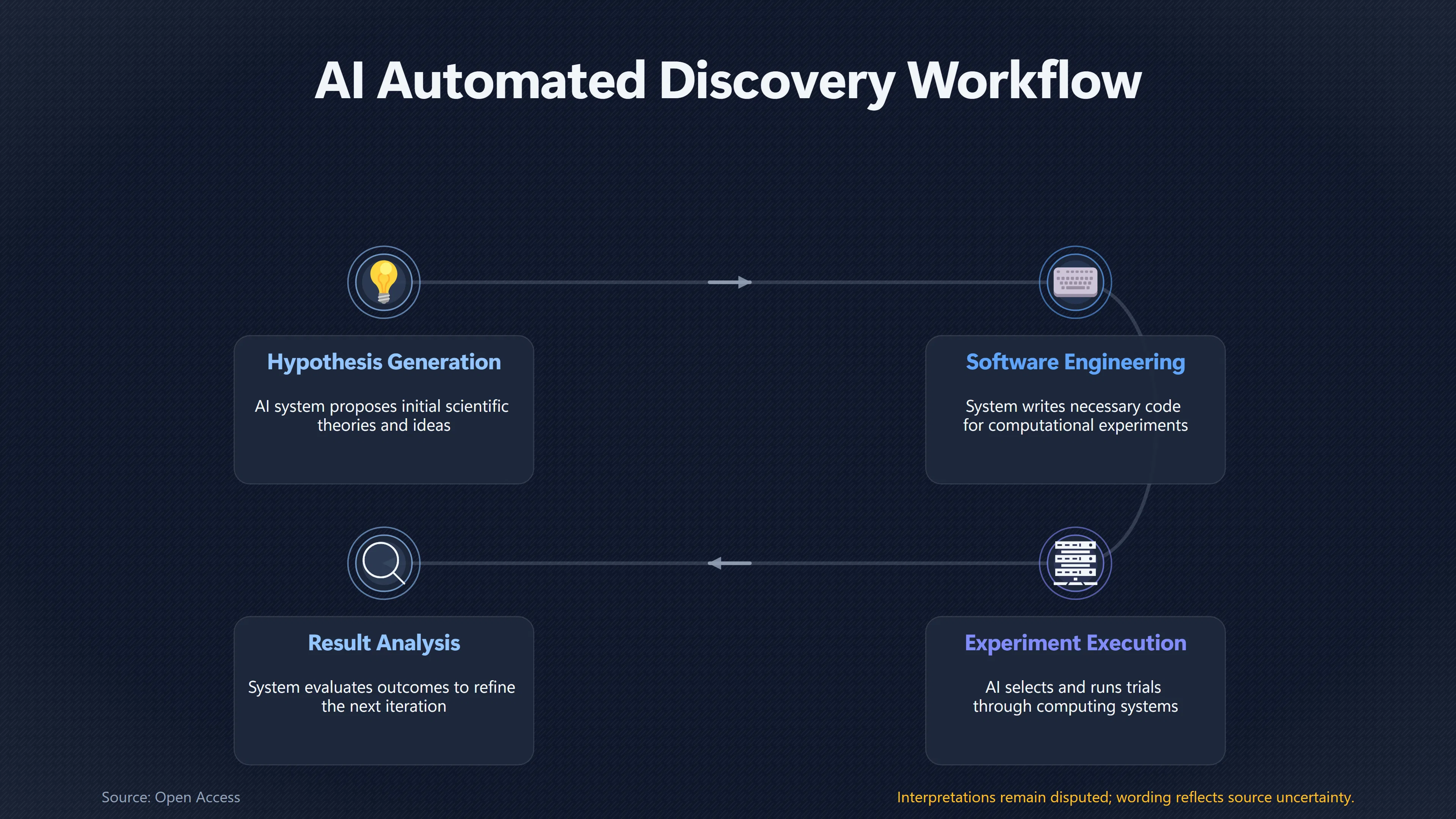
AI research automation becomes more powerful when AI systems move beyond answering questions and begin participating in the experimental process itself. A future research workflow could involve an AI system generating a hypothesis, writing the necessary software, selecting experiments, analysing results and proposing the next iteration. Instead of a human researcher conducting a small number of carefully chosen trials, an AI system could explore a much larger search space.
Early systems are beginning to demonstrate pieces of this approach. Google Research’s Empirical Research Assistance system, for example, was designed to help scientists create and improve software for computational experiments. In reported evaluations, it explored possible solutions using AI-guided search and produced strong results on several scientific computing tasks. The significance is not that it replaces scientists, but that it attacks a common bottleneck: the time required to build the tools needed to test ideas.[nature.com]nature.comAn AI system to help scientists write expert-level empirical software | NatureMay 19, 2026…
Other research systems are exploring more complete automated discovery loops. A multi-agent system described in Nature demonstrated a workflow where specialised AI agents could search literature, generate hypotheses, propose experiments, analyse results and refine ideas in experimental biology. Such systems point towards a future where AI could increase the number of scientific cycles completed in a given period, potentially accelerating fields where progress depends on repeated trial and error.[nature.com]nature.comA multi-agent system for automating scientific discovery | NatureMay 19, 2026…
The optimistic case for AI research acceleration depends on these feedback loops becoming reliable. If AI can help discover better algorithms, better experiments and better tools for research, then each generation of AI may contribute to producing the next generation. This is one pathway through which an intelligence explosion could become possible: not because AI suddenly becomes infinitely capable, but because the process of improvement itself becomes faster.
Yet the size of this effect depends on whether automated experiments can escape their own bottlenecks. Generating more ideas is relatively easy compared with producing trustworthy knowledge. A system that proposes millions of possible improvements may still make little progress if each useful idea requires expensive computation, physical testing or expert review.
The role of compute and infrastructure
The most immediate physical constraint is computing power. AI experiments require specialised hardware, particularly advanced processors and large-scale data-centre infrastructure. As automated systems run more experiments, they increase demand for the same resources already needed to train and operate frontier AI models.
Access to compute is already uneven across the research community. Studies of AI researchers have highlighted concerns that limited access to computing resources can create a divide between organisations with large infrastructure budgets and researchers without them. This matters for the long-term AI bloom question because scientific acceleration that depends only on a small number of wealthy organisations may concentrate benefits rather than broadly expand human capability.[AAAI Open Access]ojs.aaai.orgOpen AccessResource Democratization: Is Compute the Binding Constraint on AI Research? | Proceedings of the AAAI Conference on Artificial Intelligen…
Energy is another constraint. Modern AI systems rely on data centres filled with servers, networking equipment and cooling systems. The International Energy Agency has estimated that global data-centre electricity consumption could rise substantially over the coming years, with AI-focused computing becoming a major driver of this growth. It also notes that expansion is increasingly affected by practical limits such as grid connections, energy supply chains, advanced chips and infrastructure planning.[IEA]iea.orgData centre electricity use surged in 2025, even with tightening bottlenecks driving a scramble for solutions - News - IEAApril 16, 2026…
These bottlenecks are important because automated experimentation changes the demand profile of AI research. A human research team may run a limited number of experiments because people are the scarce resource. An AI-driven research system could reverse that situation: computing capacity, electricity and hardware availability may become the limiting factors.
This does not necessarily mean progress will stop. Historically, technology has often responded to resource constraints through efficiency improvements. More efficient algorithms, specialised hardware, better cooling, improved chip designs and cheaper access models could allow more experimentation from the same physical resources. The question is whether efficiency gains will keep pace with the demand created by increasingly autonomous research systems.

Why verification remains a bottleneck
The biggest challenge for automated experiments may not be generating discoveries, but knowing which discoveries deserve trust.
Scientific progress depends on verification: experiments must be repeatable, measurements must be reliable and results must survive scrutiny. AI systems can generate hypotheses at a scale far beyond human researchers, but this creates a new problem. If AI produces thousands of possible findings, humans and existing scientific processes may struggle to test them all. Research on AI-driven scientific discovery has highlighted verification as a central limitation: increasing the number of hypotheses is only useful if reliable methods exist to evaluate them.[PubMed]pubmed.ncbi.nlm.nih.govThe need for verification in artificial intelligence-driven scientific discovery - PubMedApril 9, 2026…
This issue appears differently across fields. In computer science, an AI system may be able to test code automatically, making verification relatively fast. In chemistry or biology, however, important discoveries may require physical experiments, laboratory equipment or clinical testing. An AI might suggest a promising drug candidate quickly, but proving that it is safe and effective remains a much slower process.
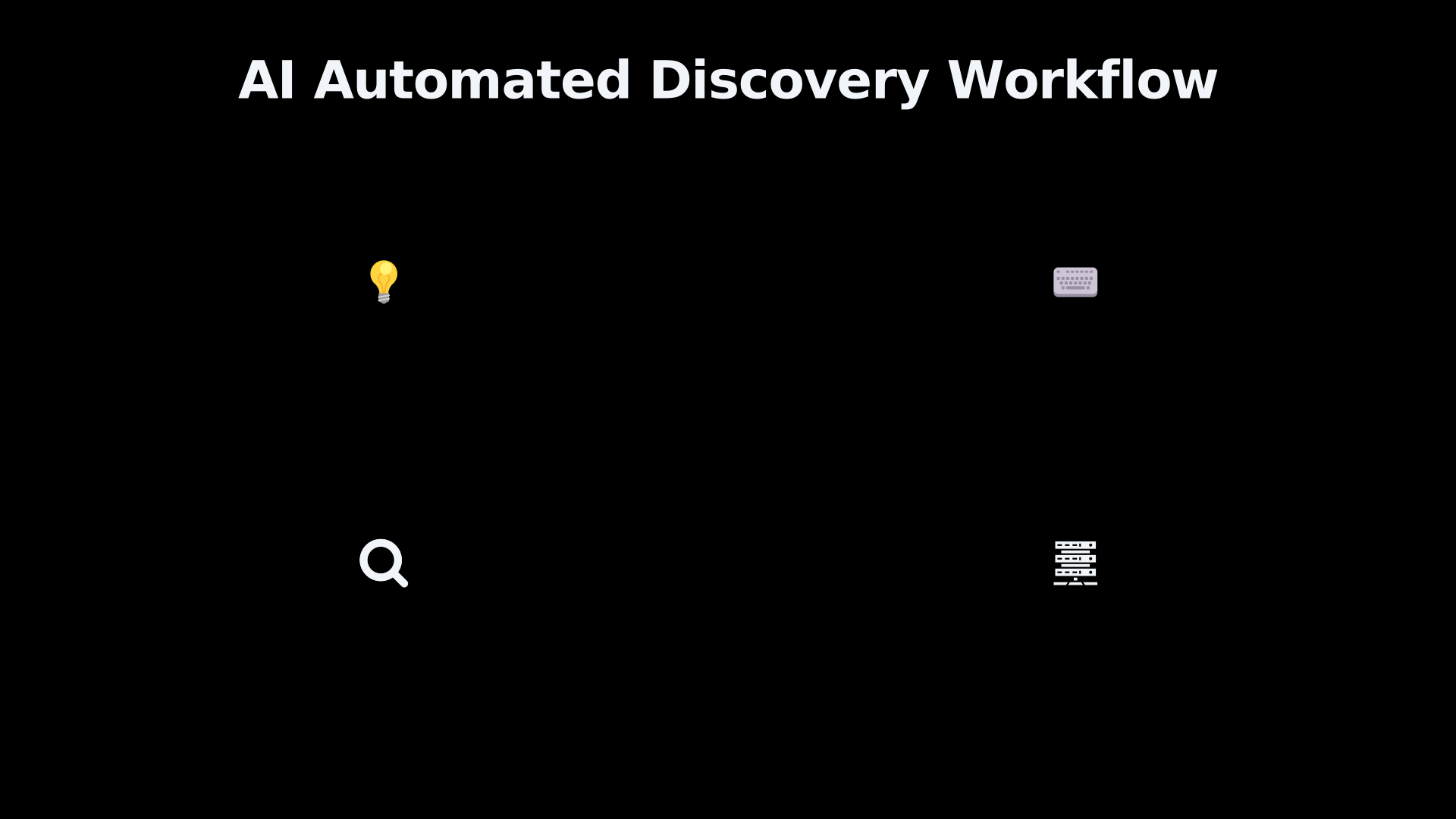
Self-driving laboratories attempt to address this gap by connecting AI systems directly to robotic experiment platforms. These systems can automate parts of the physical research cycle, but they still face constraints: experiments can be expensive, equipment can fail, and selecting the right experiment remains difficult. Research into autonomous laboratories has identified the cost and efficiency of experimental validation as continuing bottlenecks even when AI handles planning and analysis.[arXiv]arxiv.orgCompressing the Validation Bottleneck: An Agentic Self-Driving Lab for Scientific DiscoveryJuly 5, 2026…
The result is that verification may become the key dividing line between faster experimentation and genuine scientific acceleration. A future where AI generates endless ideas but cannot reliably distinguish breakthroughs from errors would produce more activity without necessarily producing more knowledge.
What infrastructure limits mean for the AI bloom vision
Automated AI experiments illustrate a broader lesson about technological abundance: intelligence must be connected to the physical world. Advanced AI could potentially help humanity discover new medicines, cleaner energy technologies, better materials and more efficient systems, but each advance requires a foundation of chips, electricity, laboratories, manufacturing capacity and trusted evaluation.
The most optimistic scenario is not one where AI research runs without limits. It is one where humanity builds an expanding ecosystem in which AI systems increase the productivity of scientists, engineers and institutions while infrastructure improves alongside capability growth. In that scenario, automated experiments become a multiplier for human creativity rather than a replacement for scientific judgement.
The main risks are therefore not only whether AI becomes capable enough, but whether societies can build enough open, sustainable and widely accessible infrastructure to support it. Compute concentration, energy constraints and verification failures could slow the path towards abundance or limit who benefits from it. Conversely, solving these bottlenecks could turn AI research automation into a powerful mechanism for accelerating the discoveries on which a larger human future depends.
Amazon book picks
Further Reading
Books and field guides related to Why Faster AI Experiments May Hit Limits. Use these as the next step if you want deeper reading beyond the article.
Life 3.0: Being Human in the Age of Artificial Intelligence
'This is the most important conversation of our time, and Tegmark's thought-provoking book will help you join it' Stephen Hawking THE INT...
The Coming Wave: Technology, Power, and the Twenty-first Cent...
"We are approaching a critical threshold in the history of our species. Everything is about to change. Soon you will live surrounded by A...
How Innovation Works
"Originally published as How Innovation works: serendipity, energy and saving of time in Great Britain in 2020 by 4th Estate, an imprint...
The Industries of the Future
The New York Times bestseller, from leading innovation expert Alec Ross, a “fascinating vision” (Forbes) of what’s next for the world and...
eBay marketplace picks
Marketplace Samples
Live-tested eBay searches with available results related to this page.
Selected fromAI robot figure oneBay.co.uk.



Endnotes
1.
Source: ojs.aaai.org
Title: Open Access
Link:https://ojs.aaai.org/index.php/AAAI/article/view/29959
Source snippet
Resource Democratization: Is Compute the Binding Constraint on AI Research? | Proceedings of the AAAI Conference on Artificial Intelligen...
2.
Source: iea.org
Title: Energy and AI – Analysis
Link:https://www.iea.org/reports/energy-and-ai/
Source snippet
Energy and AI – Analysis - IEA...
3.
Source: nature.com
Title: An AI system to help scientists write expert-level empirical software | Nature
Link:https://www.nature.com/articles/s41586-026-10658-6
Source snippet
May 19, 2026...
Published: May 19, 2026
4.
Source: nature.com
Title: A multi-agent system for automating scientific discovery | Nature
Link:https://www.nature.com/articles/s41586-026-10652-y
Source snippet
May 19, 2026...
Published: May 19, 2026
5.
Source: iea.org
Link:https://www.iea.org/news/data-centre-electricity-use-surged-in-2025-even-with-tightening-bottlenecks-driving-a-scramble-for-solutions?__cf_chl_f_tk=mPlSI9KgDo0inioCRhuh6kU7U80qA.4CGq1WWVhvZcU-1783084545-1.0.1.1-072zjVfFsXXPnHR.edts3ccVzFC5OHDol3NSdHt3s8Y
Source snippet
Data centre electricity use surged in 2025, even with tightening bottlenecks driving a scramble for solutions - News - IEAApril 16, 2026...
Published: April 16, 2026
6.
Source: arxiv.org
Title: arXiv The Need for Verification in AI-Driven Scientific Discovery
Link:https://arxiv.org/abs/2509.01398
7.
Source: arxiv.org
Link:https://arxiv.org/abs/2607.04508
Source snippet
Compressing the Validation Bottleneck: An Agentic Self-Driving Lab for Scientific DiscoveryJuly 5, 2026...
Published: July 5, 2026
8.
Source: nature.com
Link:https://www.nature.com/articles/s44387-026-00111-4
9.
Source: nature.com
Link:https://www.nature.com/articles/s42004-026-01993-w
10.
Source: nature.com
Link:https://www.nature.com/articles/s41467-025-59231-1
11.
Source: iea.org
Link:https://www.iea.org/news/ai-is-set-to-drive-surging-electricity-demand-from-data-centres-while-offering-the-potential-to-transform-how-the-energy-sector-works?_bhlid=a143b03d78b92f4b696509562ec3fafd5e06d86a
12.
Source: iea.org
Title: Energy demand from AI – Energy and AI – Analysis
Link:https://www.iea.org/reports/energy-and-ai/energy-demand-from-ai
13.
Source: iea.org
Link:https://www.iea.org/reports/key-questions-on-energy-and-ai/executive-summary?_bhlid=10646f272364cf3af59c0fa8f3886b1cfe01e627
14.
Source: iea.org
Title: Energy demand from AI – Energy and AI – Analysis
Link:https://www.iea.org/reports/energy-and-ai/energy-demand-from-ai?__cf_chl_f_tk=LREaBt4A86rtRBpxIKwUQNkKYp3tZg2NS1Z_Zft3ZtM-1782901234-1.0.1.1-TR9.DSjZ0WqjOqCxoLGJyklO0XaW3QF1MMaf4I6v6FA
15.
Source: pubmed.ncbi.nlm.nih.gov
Link:https://pubmed.ncbi.nlm.nih.gov/41952583/
Source snippet
The need for verification in artificial intelligence-driven scientific discovery - PubMedApril 9, 2026...
Published: April 9, 2026
16.
Source: pmc.ncbi.nlm.nih.gov
Link:https://pmc.ncbi.nlm.nih.gov/articles/PMC13293872/
17.
Source: pmc.ncbi.nlm.nih.gov
Link:https://pmc.ncbi.nlm.nih.gov/articles/PMC11804648/
18.
Source: pmc.ncbi.nlm.nih.gov
Link:https://pmc.ncbi.nlm.nih.gov/articles/9454899/
19.
Source: aisi.gov.uk
Link:https://www.aisi.gov.uk/blog/more-compute-more-capability-why-ai-agent-evals-need-to-account-for-test-time-compute
Additional References
20.
Source: youtube.com
Link:https://www.youtube.com/watch?v=Gy7e1vYHDQI
Source snippet
AI Replacing Engineers? The GPU Bottleneck Explained...
21.
Source: youtube.com
Title: AI-Driven Scientific Discovery – Yuanqi Du
Link:https://www.youtube.com/watch?v=vXN1YFcSqNM
Source snippet
The Intersection of AI & Scientific Discovery with Microsoft Research AI for Science Partner...
22.
Source: ornl.gov
Link:https://www.ornl.gov/autonomousscience
23.
Source: mlanthology.org
Link:https://mlanthology.org/iclrw/2025/gridach2025iclrw-agentic/
24.
Source: alphaxiv.org
Link:https://www.alphaxiv.org/abs/2601.17920v1
25.
Source: research.google
Link:https://research.google/pubs/an-ai-system-to-help-scientists-write-expert-level-empirical-software/
26.
Source: alphaxiv.org
Link:https://www.alphaxiv.org/overview/2605.23204
27.
Source: biorxiv.org
Link:https://www.biorxiv.org/content/10.64898/2026.01.05.697809v1.full
28.
Source: research.google
Link:https://research.google/teams/cloud-ai-research/
29.
Source: papers.cool
Link:https://papers.cool/arxiv/2607.04508